
Cape Town rewards a certain kind of traveller: the one who has stopped trying to see everything and has started choosing well. The city is not a uniformly walkable place, and the official guidance describes accessibility as attraction-specific rather than citywide. That is not a drawback for visitors in their fifties and sixties. It simply means the day is built around six or seven experiences, each with its own effort level, its own seating, and its own weather rules. The cableway, the Waterfront, Kirstenbosch, the peninsula, the penguins at Boulders and a long Winelands lunch form a sensible spine. What follows is how each one actually works on the ground.
Cape Town Tourism groups Table Mountain, the V&A Waterfront, Kirstenbosch, Groot Constantia, Robben Island and Cape Point as its "Big 6", and advises allowing several days and checking weather-related operations before travelling. That advice is worth taking literally. The wind known as the Cape Doctor blows frequently, and it decides more of your week than any booking does.
When should over-50s visit Cape Town to avoid the worst crowds?
March to May and September to November give the best balance for older travellers: milder temperatures, thinner crowds and easier booking. December to February is the busiest period, with mostly dry weather but higher prices and packed attractions. June to August is coolest and wettest, but the quietest, and well suited to museums, restaurants and wine tasting.
Cape Town Tourism describes a Mediterranean climate: warm, generally dry summers and cooler, wetter winters. It names January as one of the city's busiest months, when flights and accommodation cost more and popular attractions fill. Its 2024 destination overview reported 73% accommodation occupancy, with February the peak month on its published chart.
The airport's own travel information notes that the peak season of November to February commands higher rates and requires earlier booking, and that during December to January and at Easter visitors should add an extra 30 to 60 minutes for longer queues. For a traveller who would rather not stand in a line for two hours, that single sentence is the most useful line in the planning file.
Wind matters as much as season. The south-easterly Cape Doctor blows frequently, and the cableway closes in strong wind or poor weather. Build one flexible day into any itinerary and keep the mountain for whichever morning looks clear.
How hard is Table Mountain if you take the cableway?
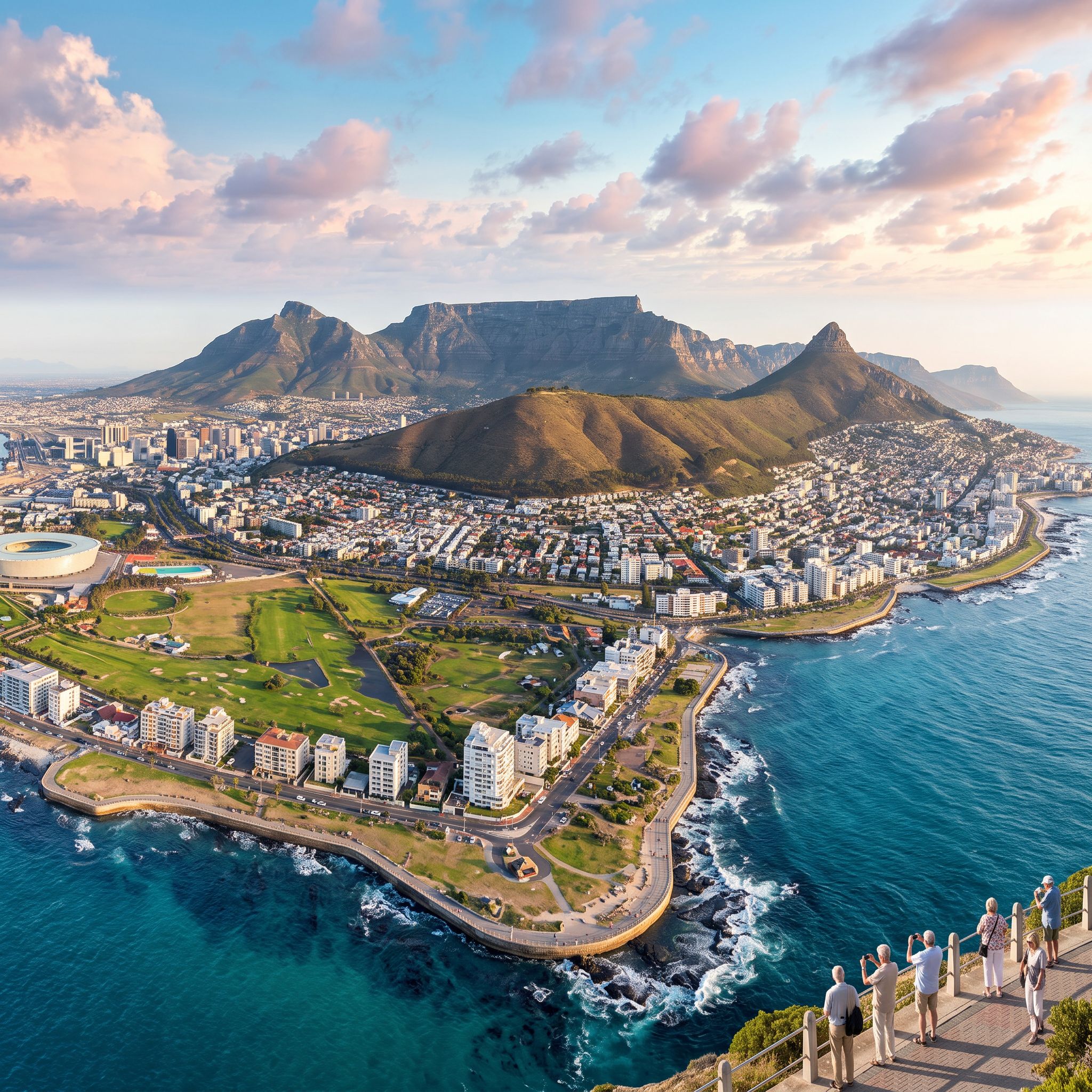
The cableway removes the climb entirely. The rotating floor gives everyone a 360-degree view on the way up and down, so there is no scramble for a window. The ride takes a few minutes. At the summit there are easy short walks of 15 to 30 minutes, plus clean toilets, a cafe and a gift shop.
The cable car reaches a summit at 1,085 metres with views over the city, the Atlantic and the Cape Peninsula, according to Cape Town Airport's travel information, which advises allowing two to three hours round trip including the queue and booking online to skip the ticket line. The same page suggests using the cable car for Table Mountain if you are unsure about fitness levels.
Guest feedback gathered on Google is consistent on two points. Staff are described as friendly and helpful, including guiding visitors through the stations and assisting older people and those with mobility issues. And the ride itself is called smooth and quick. As of November 2026 the cableway holds a Google rating of 4.6 out of 5 from 1,184 reviews.
"Well organised, would recommend coming for 7:30am to get ahead of the business and be on one of the first cars up. They have staff to help with people arriving early to ensure no one buts ahead of the line. The toliets were well kept up, and quite clean." (Google, November 2026)
Two practical cautions belong here. Queues can be very long at busy times, with waits of several hours reported, and the cable car holds around 50 to 65 passengers and can feel crowded, which is worth knowing for anyone uneasy in enclosed spaces. Booking online in advance and arriving early in the morning are repeatedly recommended in reviews to reduce queue time.
 AI-edited
Do overseas visitors get senior discounts in Cape Town?
Mostly not. The documented concessions are for South African pensioners and citizens with valid South African identification. Cape Town Tourism publishes a cableway senior fare of R230 against an adult fare of R340, and a R130 return is reported for South African citizens aged 60 or over. No international over-65 fare is documented.
This is the single most misunderstood item in Cape Town planning, so it is worth stating plainly. The Cape Wheel reports a R95 pensioner fare for South African pensioners with valid South African identification. The Iziko South African Museum and the Two Oceans Aquarium both report reduced South African pensioner prices, though the amounts are not stated.
Rates are indicative and vary by season and booking channel, and the cableway advises checking current fares and eligibility directly with the operator because prices change. The cableway also has an annual winter maintenance closure of about two weeks at the end of July; Cape Town Tourism reports a scheduled closure from 27 July to 9 August 2026. Confirm the window before you fix dates.
Is the V&A Waterfront a good low-effort day?
Yes, for shopping, eating and a gentle wander. The Waterfront is Cape Town's most-visited destination, with more than 450 shops, 80 restaurants, the Two Oceans Aquarium, the Zeitz MOCAA museum, harbour cruises and the Robben Island ferry departure point. Exact walking distances, gradients and lift locations across the whole complex are not documented.
Cape Town Airport's travel information puts the Waterfront 25 minutes from the airport; the measured road route from Cape Town International Airport to the V&A Waterfront is 22 km, about 15 minutes with clear roads and no stops. It is the easiest half-day in the city to arrange around a slow morning.
The Cape Wheel sits here, offering elevated views over the waterfront and city. Booking arrangements and cancellation terms for the wheel are not documented, and neither is the nearest pharmacy or medical facility for the waterfront as a whole. Ask your hotel before you set out.
For anyone combining the Waterfront with the city's history, the ferry to Robben Island leaves from here, and our guide to Cape Town's history at the Castle, District Six and Robben Island covers what that visit involves. Robben Island drew 266,188 visits in Cape Town Tourism's 2025 figures, and a Fodor's traveller who went in August warned that it was chilly, especially on the ferry.
What is a visit to Kirstenbosch like on the legs?
Kirstenbosch is a leisurely scenic garden rather than a hike, and it is identified among Cape Town's major attractions with access for people with disabilities and visitors with limited mobility. A complete gradient map, route distances and a classification of paths by difficulty are not published.
The garden sits on the eastern slopes of Table Mountain, 30 minutes from the airport according to Cape Town Airport's travel information, which calls it one of the world's great botanical gardens. Cape Town Tourism recorded 700,085 visits to Kirstenbosch in its 2025 figures.
Specific information about steps, slopes, seating intervals and distances on foot is not documented. That is not a warning and not a reassurance; it is simply a gap. The garden's own staff are the people to ask, and a short enquiry before you go will tell you more than any general guide. A Fodor's itinerary discussion recommended Kirstenbosch for a short walk and views over the city, without specifying how long that walk takes.
No Kirstenbosch senior or over-65 tariff is documented, no regular closing day is recorded, and booking procedures and cancellation terms are not published in the material available. Confirm all three directly with the garden.
How do the Cape Peninsula and Boulders penguins fit into a day?
They are usually combined. Fodor's contributors consistently paired Cape Point or the Cape of Good Hope with Simon's Town and Boulders Beach, and one report added Chapman's Peak and a fish-and-chip lunch at Fish Hoek. The penguin colony at Boulders, in Simon's Town, is 45 minutes from the airport by road.
Cape Town Tourism's 2025 attraction figures record 1,110,340 visits to Cape Point and 1,048,732 to Chapman's Peak Drive, so this is not a quiet corner of the region. The full route, the funicular, the lighthouse and the timing are covered in our dedicated peninsula-drive guide, which is the place to plan the day properly.
Two things are worth knowing before you book any version of it. First, a Fodor's contributor who took a small-group van tour of up to about 10 people described an optional short bicycle ride, making it possible to join without cycling. Second, the same report found the time allotted at the Cape Point sign and beach excessive after the funicular and lighthouse visit, which suggests asking about the schedule before committing.
Wildlife etiquette is not optional. During one Cape Peninsula trip, a Fodor's traveller saw a baboon snatch a bag of chips from a woman just outside a restaurant. Keep food out of sight and bags closed.
What does a Winelands lunch involve for a slower traveller?
The Winelands are a full day rather than an afternoon. Stellenbosch, Franschhoek and Paarl lie 35 to 75 minutes from the airport by road, and Fodor's contributors repeatedly grouped them into a full-day excursion rather than combining them with city attractions. Groot Constantia, closer in, recorded 382,788 visits in Cape Town Tourism's 2025 figures.
For a traveller who wants the wine without the driving, the forum evidence is unusually clear. Fodor's contributors recommended a guide for day trips when time was limited, especially for Cape Point, the city and the Winelands. One account said renting a car worked well after previous visits, but that a guide had been easier on earlier trips because someone else handled driving on the opposite side of the road while the visitors looked at the scenery.
That is the whole argument in one sentence. A driver turns a tense left-hand-drive afternoon into a lunch with a view. Cape Town Airport's travel information notes that Stellenbosch, Franschhoek and Paarl offer wine estate lodges and country hotels, a popular choice for visitors combining city and wine country stays.
How do you plan around wind and crowds?
Check conditions the morning you go, book the cableway online, arrive early, and keep one day unplanned. The cableway closes in strong wind or poor weather, and reviews repeatedly recommend the cableway app and an early start. A Fodor's traveller reported wind closing the cable car entirely, and another had Signal Hill substituted for the summit.
The Cape Doctor is the reason. Cape Town Airport's travel information notes that this south-easterly wind blows frequently, and a Fodor's trip report from October 2014 describes a cold, windy Table Mountain after a sunny start, so a warm layer is essential even on a bright day. Another contributor called the summit fabulous but advised appropriate clothing for cold winds and preparation for short hikes around the top to reach different viewpoints.
On crowds, the pattern is seasonal rather than mysterious. January is one of the busiest months according to Cape Town Tourism, and the airport advises adding 30 to 60 minutes during December to January and at Easter. Outside those windows, the city is manageable. Within them, early mornings buy you the mountain.
Getting around is its own decision. Cape Town Tourism describes MyCiTi as the primary city bus service, operating on dedicated lanes and serving central Cape Town and areas including Hout Bay, Century City and Melkbosstrand, with boarding bridges for level access from platforms or pavements. The City of Cape Town's Urban Mobility department describes MyCiTi as the city's only universally accessible public-transport service. Rail may be less reliable, and the City advises visitors not to take a train late at night.
What should over-50s be careful of in Cape Town?
The ordinary precautions of a major city, plus two local ones: transport at night and the mountain's weather. Cape Town Tourism advises keeping valuables secure, avoiding large amounts of cash and keeping emergency numbers available. The City advises sharing itineraries with friends or family and travelling with someone else rather than alone where possible.
Use authorised airport taxis and designated e-hailing arrangements rather than accepting unsolicited transport offers, per Cape Town Tourism. The airport's own guidance states that the main tourist areas, including the V&A Waterfront, Camps Bay, Clifton, Constantia, Stellenbosch, Franschhoek, Sea Point, Green Point, De Waterkant and the Bo-Kaap, are well-policed and very safe during the day and evening. It does not extend that description to every neighbourhood or every mode of transport.
Keep the numbers to hand. Mobile emergencies are 112, landline emergencies 107, police 10111, ambulance 10177, and the City of Cape Town emergency centre is 021 480 7700. Table Mountain National Park emergencies are 086 110 6417 and sea and mountain rescue 021 937 0300. The available airport information lists 10177 for ambulance or medical emergencies and 112 from a mobile phone.
Nearest hospitals and pharmacies are not documented for the individual attractions. Ask your hotel for the nearest 24-hour emergency department and check whether your travel insurance requires a particular facility. Cape Town Tourism's 24-hour Band-Aid service, on 021 487 6552, helps with lost documents, victim support, emergency accommodation and itinerary changes.
What else should you settle before you fly?
Entry rules, airport assistance and transfers. A valid passport is required, with validity requirements varying by nationality, and an online traveller declaration is required before entering or leaving South Africa according to Irish and Canadian government advice. Visas are not issued at South African ports of entry.
U.S. guidance states that two consecutive blank visa pages are required, and visa-free stays of up to 90 days apply to some nationalities including U.S. citizens and Canadians, but every traveller must verify the rule for their own passport. A yellow-fever certificate may be required depending on recent travel history; check with a travel clinic.
Cape Town International Airport has ramps with gentle slopes, passenger lifts serving all levels, moving walkways and wheelchair-friendly access to shops and restaurants. Passengers needing assistance should request it at least 48 hours ahead on 021 935 3737. A Visitor Information Centre sits on the ground floor of the central terminal.
Transfers are straightforward. The drive from the CBD, V&A Waterfront or Camps Bay to the airport takes 20 to 30 minutes by Uber or taxi and costs R150 to R350, while the MyCiTi A01 bus costs around R80. Our guide to getting to Cape Town, the long-haul flight and airport transfers takes that side of the trip further. For the nights themselves, see where to stay in Cape Town when comfort comes first.
How should a first visit be shaped?
Three or four experiences, spaced out, with the mountain flexible and the Winelands guided. Cape Town Tourism recommends allowing several days and checking weather-related operations before travelling, and the guest feedback on the cableway makes the same point from the other direction: early, booked and weather-checked beats ambitious.
A workable shape looks like this. One morning for the cableway, early and pre-booked. One slow day at the Waterfront with a harbour cruise or the aquarium. One garden morning at Kirstenbosch. One full day for the peninsula or the Winelands, with a driver. That leaves room for a spa afternoon, and our guide to the best spa hotels in and around Cape Town covers the options.
What the city asks in return is patience with its weather and a willingness to ask questions the guidebooks do not answer. Kirstenbosch does not publish a gradient map. The Waterfront does not publish lift locations. The cableway does not publish a closure calendar beyond its maintenance window. None of that is a reason to stay home. It is a reason to telephone ahead, to keep a spare morning, and to accept that a windy Tuesday on Signal Hill with a view of the mountain may be the better day.


