
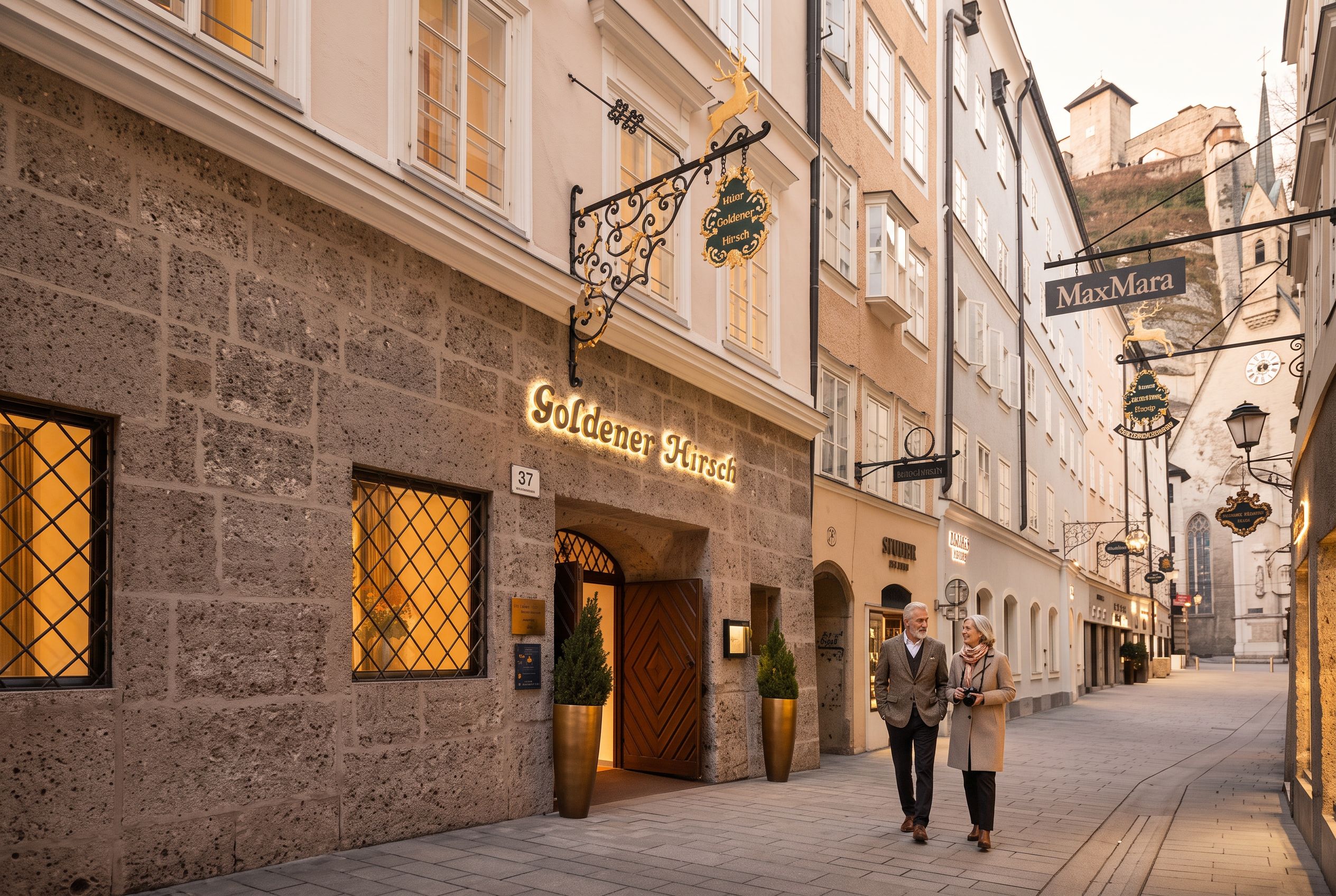
On Getreidegasse 37, where the wrought-iron guild signs hang heavy over cobblestones, the Goldener Hirsch has been receiving guests for over 600 years. This is Salzburg's most atmospheric old-town address, a warren of creaking corridors, painted ceilings, and antique furniture that whispers of festivals past. For travellers aged 50 to 70 who prize character over uniformity, it is a seductive prospect. But a historic building in a pedestrian-only zone brings its own realities, and the room you book matters more here than at almost any other hotel in the city.
This dossier is built from guest reviews, the operator's own records of the 2019 restoration, and Salzburg's official accessibility listings. It is a curated guide, not a sponsored review, so you can trust the caveats as much as the praise. If you are weighing this against the Hotel Sacher Salzburg, our dedicated dossier on that property covers its own strengths and quirks separately.
 AI-edited
Where exactly is the Goldener Hirsch, and can I walk everywhere?
The hotel sits on Getreidegasse, Salzburg's main pedestrian shopping street, with Mozart's birthplace about 200 metres away. Its second entrance opens onto Herbert-von-Karajan-Platz, directly opposite the Festival Hall, which matters in festival weeks. The funicular's valley station is 700 metres off, the DomQuartier under 500, and the fortress itself about a kilometre.
This is the hotel's greatest asset, and guests consistently report that it transforms the sightseeing experience. You can return to your room for a midday rest, drop off purchases, or change for dinner without ever hailing a taxi. For a four-day itinerary built around the old town, the convenience is hard to overstate — see our four-day Salzburg itinerary for the over-50s to see how the hotel slots into a practical plan.
There is a trade-off. Getreidegasse is busy from mid-morning until late evening, and the pedestrian crowds can be dense in summer. The hotel is in two buildings facing each other across the street, so street-facing rooms in the main house have a lively outlook, while annex rooms tend to be quieter. A guest writing on Google in February 2026 called a street-facing junior suite "reasonably quiet" even with windows over the street, but light sleepers should still ask for a room away from Getreidegasse when they book.
How accessible is a 600-year-old building, really?
The hotel has lifts, and reception can be reached from Herbert-von-Karajan-Platz as well as from the Getreidegasse door. Salzburg's tourism board records the bar and the guest WCs as barrier-free through the hotel entrance, the WCs reached by lift. Room-by-room variation is significant, though, and some rooms sit behind a half-step or a short flight.
Salzburg's official tourism listing puts it precisely. For the bar: "Entrance area: barrierfree via hotel entrance, mobile ramp to the bar" and "Restrooms (WC): barrierfree, lift". For Herzl, the hotel's restaurant: "Entrance area: barrierfree via hotel entrance, flat access or step no higher than 3 cm". Marriott, which operates the property under its Luxury Collection brand, does not publish a step-by-step accessible route for individual guest rooms, so that part has to be settled with the hotel directly.
However, the caveats are real. Half-steps turn up where you do not expect them: one Google reviewer noted in April 2026 that "there are half steps and there was one right outside my room. It can be dangerous if you are not careful." Another, writing in October 2025, called the layout "quirky, but that's the charm of staying in a centuries old building" — charming to read, worth knowing before you arrive with a suitcase.
The practical guidance is simple: if mobility is a concern, call the hotel directly, ask for a specific room rather than a room category, confirm which lift serves that floor, and say whether you need a shower you can walk into. Do not rely on a standard booking. Salzburg's tourism board publishes an accessibility record for the hotel's restaurant that is a useful second opinion on what is level and what is not.
What are the rooms actually like — and which should I book?
The house has sixty-four guest rooms and six suites across two buildings, individually designed and furnished with restored antiques, so size, layout and light vary enormously. Some rooms have walk-in showers with heated floors; others have soaking tubs or a half-step at the door. The room you get is largely a matter of what you request and what is available.
Guests writing on Google in October 2025 single out the bathrooms: "Built in speakers and Heated floors in bathroom. Noise proof doors/walls." The €30 million restoration reopened in July 2019 after almost a year of work; it renewed all seventy rooms and suites, enlarged reception and added a second lift, while preserving the historic character. But it did not standardise the rooms, and that is by design.
Guest feedback highlights the variation rather than delivering a verdict. A review left on Google in February 2026 describes a junior suite in the building across the street as large and turned down every evening, with windows over the street. One thing to weigh before you accept a room over the road: reception, breakfast and the bar are all in the main house, so every trip down means crossing Getreidegasse — no traffic to dodge, but cobbles under the feet each time. Booking.com guests score comfort 9.9 out of 10 across 284 reviews. The spread here is between very good rooms and outstanding ones — but it is a spread, and it is worth choosing inside it.
For travellers aged 50 to 70, the key questions to ask before booking are: Is there a half-step at the room entrance? Is the bathroom on the same level as the bed? Is the bed a standard height or low to the ground? Is there a walk-in shower or a tub you must step over? The answers vary by room, and the front desk staff are generally helpful in matching you to the right one if you ask.
"There are two buildings (across from each other) and our room was in the second building, which gave us an incredible view! Every detail feels luxurious, from the bronze key rings to the welcome fruit and chocolate." — a guest wrote on Google in October 2025
Is the dining worth the hype?
Breakfast is a genuine strength: Booking.com guests rate the house 9.5 out of 10 overall and name breakfast among the reasons. The fine-dining Restaurant Goldener Hirsch has since closed. The hotel's kitchen is now Herzl, next door and reached through the hotel entrance, carrying one Gault Millau toque and 12 of 20 points for 2026 and open every day.
Breakfast for hotel guests is served in the Rosa Salon — the reception room next to the fireplace lounge created in the restoration — or brought to your room on request; one guest wrote on Google in May 2025 that breakfast delivered each morning was what let the day start quietly. Guests praise the staff for accommodating early departures and special requests, which matters if you have a train to catch or an early concert ticket.
Dinner now means Herzl, which Salzburg's tourism board describes as a restaurant "in the style of a 15th-century Salzburg country inn": Wiener schnitzel, roast, trout from Lake Fuschl, Salzburger Nockerl. It opens every day, from 11.30 in the morning until 9.30 at night, with the kitchen running from noon; there is a garden terrace for warm evenings, and during the Festival it opens later around performances at the Festival Hall. The bar, reached through the hotel entrance with a mobile ramp, is the quieter spot for a nightcap.
One note for the budget-conscious: everything in the house is priced at the luxury end, dinner included, and breakfast is not automatically part of every rate — check which one you are booking. For lighter meals, the surrounding Getreidegasse has options within a two-minute walk, and our packing guide for Salzburg includes practical advice on dressing for the cobbled streets between meals.
Who should stay here — and who should look elsewhere?
This hotel suits travellers who value location, atmosphere, and personalised service above all else, and who are comfortable with historic-building quirks. It does not suit anyone who needs a fully step-free environment, a predictable modern layout, or guaranteed silence at night.
The scores say plainly who this house suits. As of August 2026 it holds 4.7 out of 5 on Google from 590 reviews and 9.5 out of 10 on Booking.com from 284, with staff scored 9.8 and location a flat 10. Guests return to the same point again and again — names remembered, taxis arranged, luggage handled without being asked.
The same reviews also show where the planning goes. Half-steps turn up in corridors and at room doors, and rooms on the Getreidegasse side face a street that is busy from mid-morning until late. None of this is a deal-breaker, but together it describes a property that rewards a phone call before booking rather than a request at check-in.
If you prefer a more predictable experience, the Sheraton Grand Salzburg offers a modern full-service hotel near Mirabell Palace with fewer historic constraints, and the H+ Hotel Salzburg near the central station is the practical choice for rail travellers. For the Goldener Hirsch, the golden rule is: call ahead, ask specific questions, and book the right room.
How do I get there with luggage, and where do I park?
Getreidegasse has been a pedestrian zone since 1983, so no car reaches the hotel door — only residents, taxis and deliveries have restricted access. Salzburg's summer driving restriction, in force 1 July to 31 August 2026, does not lock you out: hotel guests may drive into the zone with a valid booking confirmation. The hotel handles valet parking and luggage.
The practical reality is that you arrive by taxi or private car at a drop-off point near the hotel and the staff take it from there. Guests report the process as smooth — one wrote on Google that the car had been pre-positioned and was ready before they had to ask. Valet parking costs extra; published rates differ widely between channels, so confirm the current figure with the hotel when you book rather than budgeting from a number you read somewhere.
If you arrive by train at Salzburg Hauptbahnhof, the driving route to the drop-off point is about 3.5 kilometres and takes roughly ten minutes. In a straight line the station is much closer, around 1.5 kilometres, though the walking route is necessarily longer than that and ends on cobbles. Without luggage it is a pleasant way to arrive; with a suitcase the taxi is money well spent. For a full breakdown of arrival options, including the airport transfer, see our Salzburg itinerary guide, which covers transport logistics in detail.
One more thing worth knowing if you are driving in July or August: the city's summer regulation keeps through-traffic out of the inner city from 1 July to 31 August 2026, with exemptions for residents, deliveries, taxis, holders of a disabled parking permit and hotel guests who can show a booking confirmation. Keep yours on your phone. Day visitors without one are directed to three park-and-ride sites on the edge of the city.
What does it cost, and is it worth the premium?
This is a €€€ house, at the top of the Salzburg market rather than below it. Rates move sharply with the calendar rather than with the room category: the Festival weeks in July and August, the Easter Festival and Advent are the expensive windows, and a Tuesday in November is another matter entirely. You are paying a premium for the address and the heritage.
One number is worth more than a rate table here: Booking.com guests give the house 9.0 out of 10 for value for money. That is unusually high for a five-star address inside a UNESCO old town, and it says that the people who pay these rates largely feel they got what they paid for. Quote the same room for a Tuesday in November and a Saturday during the Festival and the two prices will not look related, so book the expensive windows early and read the cancellation terms rather than the headline rate.
For the price you get the address, the service, and an atmosphere no modern build can imitate. What you do not get is a predictable room. The value proposition depends almost entirely on whether you land in the right one — which is why the phone call matters more here than the rate does.
The city's own figures make the case for booking early. In January and February 2026 Salzburg counted 215,827 arrivals and 364,759 overnight stays, 6.8% and 7.2% above the same weeks of 2025; July 2026 alone brought 213,051 arrivals and 387,746 overnight stays, up 3.8% on July 2025. Winter is no dead season here — the Christmas markets fill the old town — so book well ahead, and earlier still for the Festival weeks in July and August.
The bottom line for travellers 50–70
The Goldener Hirsch is the right choice if you want to wake up on Getreidegasse, step out to Mozart's birthplace, and feel the history of Salzburg around you. It is the wrong choice if you need guaranteed step-free access, predictable room layouts, or absolute silence. Book the right room, and it is unforgettable. Book blind, and you take a gamble.
The hotel's strengths are consistent across every review source: the location is unbeatable, the staff are genuinely warm and attentive, and the breakfast is excellent. The weaknesses are equally consistent: room quality varies, some rooms have stairs or awkward layouts, and the old-town setting brings noise and crowds.
For a short stay of two to three nights focused on old-town sightseeing, this is arguably the best base in Salzburg. For a longer stay where you want a quiet retreat to return to each evening, a modern hotel outside the pedestrian zone might serve you better.
"The staff was exceptionally lovely, they treated us to some small gifts to celebrate our special occasion, remembered our names throughout the duration of our stay, were so kind with recommendations of things to explore throughout the city." — a review left on Google in November 2025
If you are still weighing options, the Hotel Sacher offers a more uniform luxury experience across the river, and our cultural calendar can help you time your visit around the festival season. Whichever you choose, Salzburg rewards the traveller who plans the practical details and leaves room for the magic.


