
Salzburg rewards the traveller who refuses to rush. The city's baroque core is compact enough to cross on foot in twenty minutes, yet dense enough to reward a week of wandering. For those of us who have learned that a holiday is not a checklist, four days here—anchored by one central base—offers the perfect rhythm: mornings for the grand sights, long lunches in courtyard cafés, and afternoons that belong entirely to you.
This itinerary is built on a simple principle: two to three major sights per day, with a proper rest built in. You will see the fortress, the cathedral, the gardens, and hear a concert. You will also have time to sit by the river with a coffee and watch the city go about its day. That, frankly, is the Salzburg most visitors miss.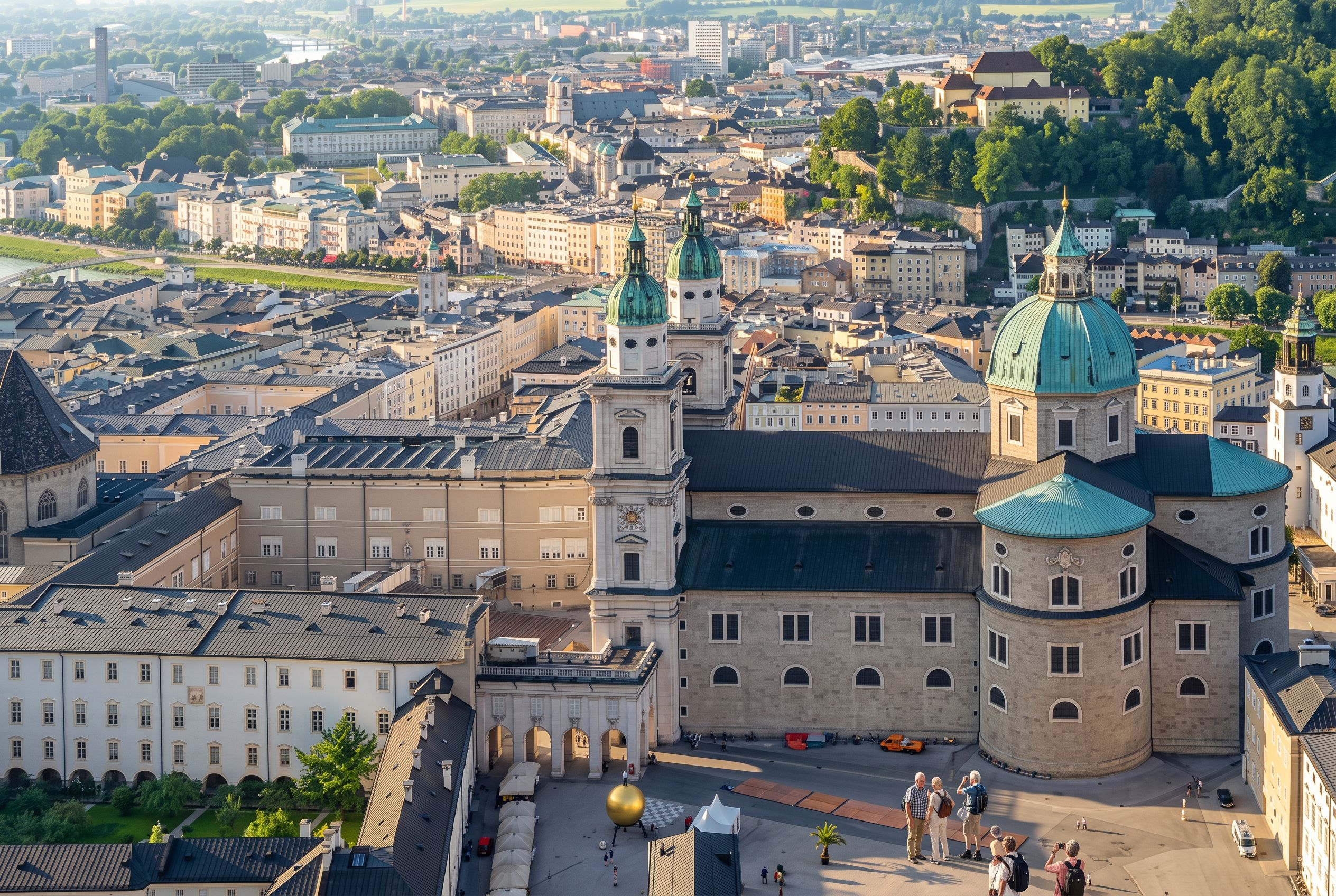 AI-edited
Why Salzburg suits travellers over 50 so well?
Salzburg's historic centre is unusually flat and compact, with most key sights within a short, level walking radius. The main challenge is not distance but cobblestones, so the smart traveller groups sights logically and uses the funicular for the fortress. This makes it one of Europe's most manageable cities for a relaxed multi-day stay.
The statistics support the instinct. Salzburg's Old Town is a UNESCO World Heritage site of baroque architecture, and its attractions cluster tightly around Residenzplatz and Getreidegasse. Unlike Vienna or Munich, where sights spread across districts, Salzburg lets you see the cathedral, Mozart's Birthplace, and the Residenz in a single morning stroll. The Salzach river promenade offers a flat, open walking route with benches and cafés—a natural place to rest between museum visits. For the over-50s traveller, the city's scale is its greatest asset. You will not need a taxi to reach most sights, though taxis are available when energy flags. Staying central and keeping meals regular pays off here, because the walking adds up quickly even in a small city. If you are staying overnight anywhere in the province, the Guest Mobility Ticket lets you break a long day with a bus ride at no extra cost.Day One: The Old Town at a Gentle Pace
Start your first day with Mirabell Gardens, then cross the river into the Old Town for Getreidegasse and Mozart's Birthplace. This is a gentle introduction that builds confidence in the city's walkability, ending with a relaxed dinner near the river.
Begin at Mirabell Palace and Gardens, a flat, level space with manicured flowerbeds and benches that invite a slow start. The gardens are the city's soft landing—a place to adjust to the rhythm of Salzburg without the pressure of museum tickets. From here, cross the Staatsbrücke bridge into the Old Town. Getreidegasse is the city's most famous shopping street, its wrought-iron guild signs hanging above the pavement like a baroque gallery. Number 9 is Mozart's Birthplace, a focused indoor museum that rewards a 45-minute visit without demanding more. The rooms are compact, the displays clear, and the connection to the composer's early life is tangible. For lunch, follow the lane to Alter Markt, where Café Tomaselli has been pouring coffee since 1700 and is, by its own account and the tourist board's, the oldest coffee house in Austria. The specialities the board lists for the house run from Einspänner and Melange to strudel and a slice of Salzburger Nockerl torte, the cake version of the city's signature dessert. It opens Monday to Friday from 7 a.m. to 7 p.m., and from 8 a.m. at weekends and on holidays, so a slow lunch is never a race. In the afternoon, let the river promenade carry you upstream towards the Mozartsteg, with the fortress rising above the rooftops. The Mozarteum lies the other way—north of the Staatsbrücke, on the Mirabell bank—so save it for the walk back."Serene! It was a peaceful experience visiting the Mirabell Gardens. You can spend hours sitting at a bench and enjoying the nature" — a guest wrote on Google in May 2026
Day Two: The Fortress and the Baroque Core
Take the FestungsBahn funicular up to Hohensalzburg Fortress in the morning, then descend into the cathedral quarter for the Residenz and DomQuartier. This is your most intensive day, so plan a proper lunch and an afternoon rest.
The funicular is the sensible choice here. The walk up is steep enough to be punishing on knees and lungs, while the FestungsBahn covers its 198.5 metres in 54 seconds and runs every ten minutes. One date to check before you commit to it: the line closes for maintenance from 9 to 13 November 2026 and again from 11 January to 14 March 2027, and only the footpath is open then. At the top, the panoramic views over the city and the Salzach valley justify the trip alone. The fortress interior—including the state rooms and the museum—is worth a substantial visit, but pace yourself: two hours is plenty. Descend into Kapitelplatz, where the cathedral's great dome dominates the square. Salzburg Cathedral is baroque architecture at its most confident, and the bronze font at which Mozart was baptised still stands inside. Entry to the nave is free, but on Sundays and church holidays it opens only at 1 p.m., and there is no visiting during services or the music at noon. Next door, the Residenz was the prince-archbishops' palace, and the DomQuartier ticket leads you through its state rooms and on to the north oratory, the cathedral museum, the organ loft above the nave and the terrace over the arcades. Two things to plan around: the DomQuartier is closed on Tuesdays except in July and August, and it asks visitors to allow at least ninety minutes for the circuit. The Residenzgalerie inside it stays closed until autumn 2027. This is your one day with four stops, so honour the afternoon rest. Return to your hotel for a proper sit-down, then emerge for a late stroll through the lantern-lit Old Town. Consider booking a concert for this evening—the city's musical calendar is rich, and our cultural calendar can help you choose.Day Three: Gardens, River, and a Rest Afternoon
This is your recovery day. Spend the morning in Mirabell Gardens and, on the right weekday, the palace's Marble Hall, walk the river promenade, and give yourself permission to do very little in the afternoon. A concert in the evening provides the day's cultural anchor.
Mirabell Palace deserves more than a quick photo stop. Leopold Mozart and his children Wolfgang and Nannerl made music in the Marble Hall, and visitors may see it on Monday, Wednesday and Thursday from roughly 8 a.m. to 4 p.m., but on Tuesday and Friday only from 1 p.m. to 4 p.m.—and not at all when a wedding or a special event has the room. Every other room in the palace houses the city administration and is closed to visitors, so if your third day falls on a Tuesday or a Friday, give the morning to the gardens and keep the hall for after lunch. Those gardens are the city's finest, with the Pegasus Fountain and the Hedge Theatre offering quiet corners for reflection; they open at 6 a.m. and stay open until dusk, with some sections closed in winter. For visitors with a hearing impairment there is an induction loop in the Marble Hall and in the Pegasus Room. From Mirabell, follow the river upstream—that is, southwards, with the Old Town on the far bank. This is the city's "soft landing" route: flat, open, and lined with benches. Carry on past the Staatsbrücke and you reach the Mozartsteg footbridge, where you cross back to the Old Town and find a café for a long lunch. The afternoon is yours: return to the hotel, read in the garden, or simply nap. In the evening, attend a concert. The city offers everything from chamber music in the fortress to orchestral performances in the Festspielhaus. For a considered introduction, the Mozart Dinner Concert at St. Peter Stiftskulinarium—one of Europe's oldest restaurants—combines music and food in a single evening. Recent guests note that the acoustics are excellent and the pacing relaxed, with no need to rush between courses."Great service and beautiful atmosphere. Definitely recommend if you love classical music. Every piece was performed perfect." — one Google reviewer wrote about the Mozart Dinner Concert in August 2025
Day Four: Lakes or Hills—An Optional Half-Day
If your energy allows, take a gentle half-day trip to the Salzkammergut lakes or the surrounding hills. Organised coach tours are the easiest option, as they handle the driving and the logistics. If you prefer to stay in the city, the Mönchsberg walk offers an easy way to get above the rooftops.
The Salzkammergut region, with its glacial lakes and alpine villages, is Salzburg's natural hinterland. Hallstatt, the most famous village, draws crowds accordingly; Salzburg Panorama Tours puts the drive at around an hour and a half each way and schedules its half-day tour at five and a half hours, leaving daily at 8.15 a.m. with two and a half hours in the village. For a gentler option, consider the Wolfgangsee, closer to the city and less overwhelmed. The organised bus tours listed by the city tourist board handle the mountain roads, which is preferable to self-driving in alpine terrain. If you prefer to stay in the city, the Mönchsberg walk is the insider's choice. This elevated path runs along the cliff that separates the Old Town from the modern city, and the MönchsbergAufzug spares you the climb: it rises 60 metres in thirty seconds from Anton-Neumayr-Platz and sets you down at the entrance to the Museum der Moderne. The official Mönchsberg route, by contrast, starts at the tourist information office on Mozartplatz with the ascent to Nonnberg Monastery and runs 4.8 kilometres over roughly ninety minutes of walking. Up top the ground is not uniformly level: the city notes that the upper viewing platform, and the path from it back into the museum, can be reached only by steps, while the lower terrace has been step-free since a stairlift was fitted from the lift's mountain station, operated independently with a Euro-Key. Taken at your own pace, it is a fitting end to a considered visit. For those who want to plan around the weather, our seasonal guide can help you choose the best dates. One local change is worth knowing about: between 1 July and 31 August 2026 the city operates a summer traffic scheme in the inner city. It is not a closure. The city says so plainly—this is a regulation of certain journeys by passenger car, vehicle class M1, and trips for work, deliveries, hotel guests and holders of a disabled parking badge remain possible. For those two months a flat park-and-ride rate of €7.50 per car per day includes public transport for up to five people. If you arrive by train and stay central, none of it affects you.Practical Notes for the Over-50s Traveller
The essentials are simple: stay central, use the funicular for the fortress, take the Salzburg Card, and build in a rest afternoon. The Guest Mobility Ticket, introduced on 1 May 2025, gives hotel guests free public transport across the Salzburg region—a genuine benefit.
The practical details matter more as the day goes on. Cobblestones are the main terrain challenge, so pack shoes with good grip and cushioning—our packing guide covers this in detail. Salzburg runs trolleybuses rather than trams, and the city tourist board is careful with the wording: "The vast majority of vehicles used for public transportation feature low-entry doors", each with a ramp that folds out as needed. Salzburg AG counts 108 barrier-free low-floor articulated trolleybuses with a kneeling function and a fold-out ramp at the second door. Fares apply to the Salzburg core zone: a single ride costs €3.00 bought on board or €2.50 each in the five-ride advance block, and a 24-hour ticket €5.20 in advance or €6.40 on board. The senior fares (€2.30 and €4.10) are not an age concession—they require a valid ÖBB VORTEILSCARD Senior. For hotels, recent guest reviews consistently praise central properties with lift access and quiet rooms. The IMLAUER Hotel Pitter Salzburg, near Mirabell Gardens, earns a Google rating of 4.6/5 from nearly 5,000 reviews as of August 2026, with guests highlighting the friendly staff and the rooftop Sky Bar. The H+ Hotel Salzburg, adjacent to the main station, scores 4.3/5 on Google and is praised for its breakfast buffet and the mobility card included with stays. The Guest Mobility Ticket is not a point of difference between houses: since 1 May 2025 every overnight guest in the province of Salzburg receives one at check-in, funded by a mobility fee of €0.50 per person per night for guests aged 15 and over, which rises to €1.10 on 1 May 2027.| Option | Cost | Notes |
|---|---|---|
| Single trolleybus ride, core zone | €3.00 on board · €2.50 in the five-ride block | €2.30 with an ÖBB VORTEILSCARD Senior |
| 24-hour ticket, core zone | €5.20 in advance · €6.40 on board | €4.10 with an ÖBB VORTEILSCARD Senior |
| Salzburg Card 72h | €44 (Nov–Mar) · €49 (Apr–Oct) | One free entry per sight, funicular, transport except the S-Bahn |
| Guest Mobility Ticket | €0.50 per person, per night | Free provincial transport for overnight guests, since 1 May 2025 |
| Taxi | Metered fare, compulsory in the core zone | Airport to centre about €12; €3.50 extra if ordered by phone or app |
How accessible is Salzburg for travellers with limited mobility?
Salzburg is one of the more accessible historic cities in Europe, with level paths through the Old Town, lifts at the fortress and Mönchsberg, and accessible public transport. The main challenges are cobblestones and some restaurant steps, so plan for those and you will be fine.
The city publishes dedicated barrier-free travel information, and the ÖBB lists Salzburg Hauptbahnhof with an escalator, a lift and an accessible WC, recording that there are no significant obstacles in the access area or on the platforms. The FestungsBahn is the barrier-free route up to the fortress, but the operator is candid about what waits at the top: many steps and inclines, and an interior that is not barrier-free, with only the panorama terrace and the bastion at the mountain station fully accessible. The museums differ from one another. Mozart's Birthplace states outright that it is not barrier-free, and the DomQuartier's two lifts may be used only when a member of staff accompanies you, which you arrange at the porter's lodge on entering from Residenzplatz. Recent guest reviews note that some restaurants have steps at the entrance, so it is worth calling ahead if this matters to you. Taxis are the easiest fallback when energy flags.When is the best time for a four-day visit?
May through September offers the most comfortable walking weather, with September providing the best balance of warmth and lighter crowds: 20.0°C by day on average against 25.0°C in August, and 120 millimetres of rain against August's 161. July and August are the warmest and the busiest months, and August is the wettest month of the year. For a relaxed pace, late May or September are ideal.
The summer festival season—17 July to 30 August in 2026—brings crowds and higher prices, though the cultural programme is unmatched. If you want to attend a concert, our cultural calendar can help you plan around the festival. The Salzburg Museum's main house, the Neue Residenz, has been under complete renovation since November 2023 and its new courtyard is not due to open to the public before 2027, so factor that into your indoor options.

