
Salzburg is one of the few cities where the calendar itself is a work of art. From the solemn notes of Mozart Week in January to the brass choirs of Advent, this compact Baroque city pulses with music in every season. For culture-minded travellers aged 50 to 70, the challenge is not finding something to attend—it is choosing which performances merit your time, your budget, and your feet. This guide walks you through the year’s major musical events, with honest notes on crowds, costs, and accessibility, so you can time your visit around the sounds you love most.
 AI-edited
What makes the Salzburg Festival the world’s most anticipated summer event?
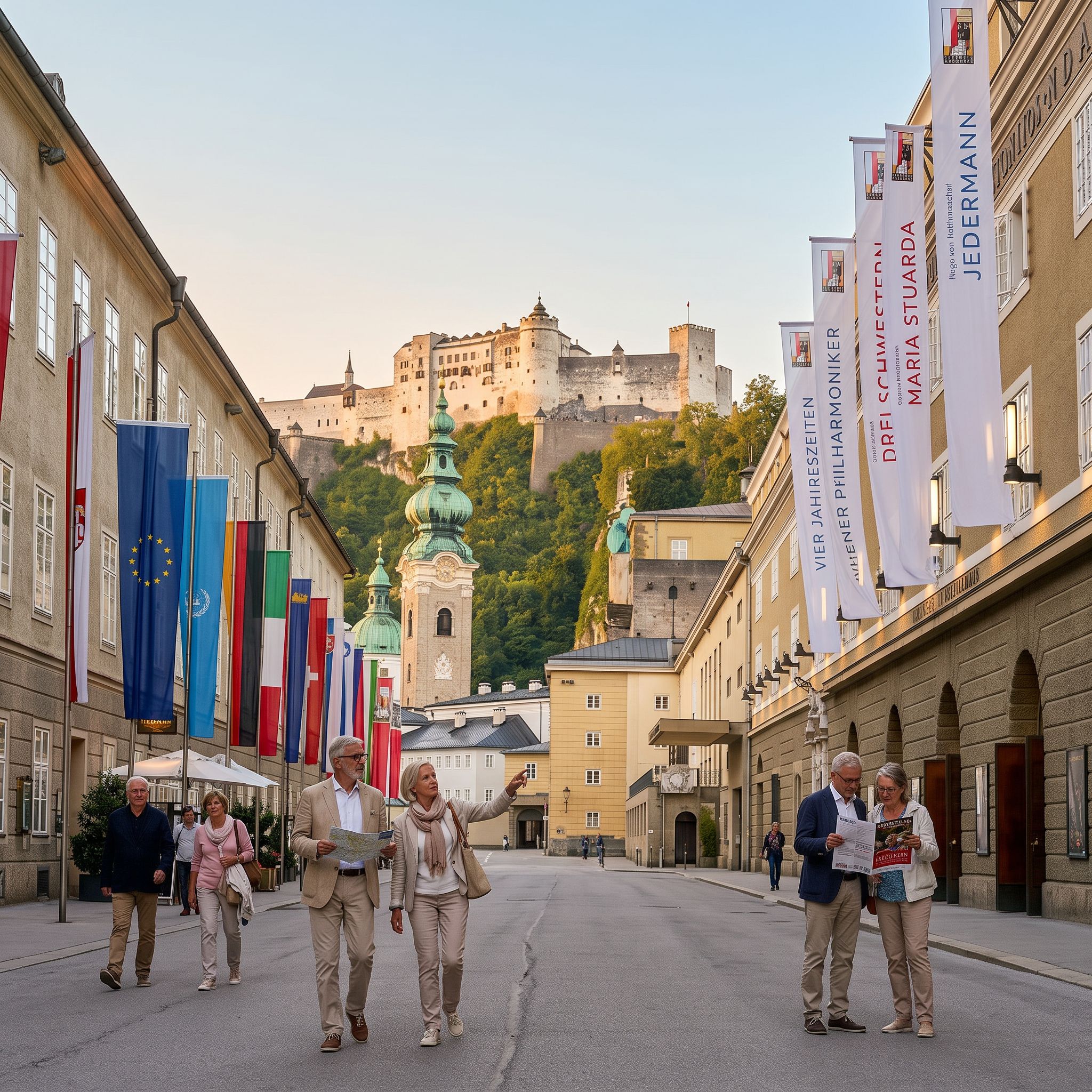
The Salzburg Festival is the city’s flagship cultural event, running from 17 July to 30 August 2026, and it transforms the entire historic centre into a stage for opera, theatre, and orchestral concerts of the highest calibre. Founded in 1920, this is the festival that defines Salzburg’s identity. The atmosphere is electric, the dress code is elegant, and the demand for tickets is ferocious. If you attend only one event in Salzburg, this is the one—but it requires planning.
The festival spreads across multiple venues, each with its own character. The Grosses Festspielhaus seats 2,179 and offers the grandest productions, while the Haus für Mozart provides a more intimate setting for chamber works. The Felsenreitschule, cut into the Mönchsberg with its tiers of arcades, is not open-air: a retractable roof closes over the auditorium within six minutes against rain and cool summer evenings. Recent guests consistently report excellent acoustics and sightlines across all three venues, though some note that the balcony seating in the Grosses Festspielhaus can feel narrow, and the halls can grow warm on hot July evenings.
As of August 2026, the Grosses Festspielhaus holds a Google rating of 4.7/5 from more than 1,800 reviews, with long-time attendees praising the consistent quality. A Google reviewer wrote of the Grosses Festspielhaus in February 2026: “A legendary and immense hall with perfect acoustics. Carved into the mountain, it has hosted the greatest orchestras and artists on the planet.” The festival also runs public guided tours of the festival halls — around 50 minutes, €7 for adults as of 2026 and included once with a valid Salzburg Card — but they climb several flights of stairs and are expressly not barrier-free; specialised tours can be arranged for guests who need them.
How do I book Salzburg Festival tickets without the stress?
For the 2026 summer festival, orders opened with the programme on 4 December 2025 and were collected until the deadline of 20 January 2026; direct online sales began on 27 March 2026, and the ticket office at Wiener-Philharmoniker-Gasse 3 is open daily from 10:00 to 18:00. The festival advises that high-demand productions sell out quickly, so early booking is essential. Subscriptions can also be arranged online or at the ticket office, and e-tickets are delivered free by email link.
The festival recommends placing your order as soon as the programme appears, with alternative seat choices ready. The moment you order makes no difference: all orders received by the deadline are treated equally, allocation starts the day after, and the festival undertakes to notify applicants by the end of March at the latest, so patience is part of the process. Be aware that tickets are personalised—bring photo ID, as it may be checked at the door. Avoid informal resale channels; unofficial tickets may not be valid.
One practical bonus is easy to miss: between 17 July and 30 August 2026 your festival ticket doubles as a travel pass on every SVV bus and rail line in the province of Salzburg, valid from six hours before the performance begins until the end of service. For those who prefer a lower-pressure option, recitals and chamber concerts generally have better availability than the headline opera productions. The festival’s opening festivities have also included free public events, which offer a taste of the atmosphere without the ticket price. If you are flexible about repertoire, you can often find returned tickets at the box office closer to performance dates.
| Event | Sales Open | Channel |
|---|---|---|
| Summer subscriptions | Autumn 2025 | Online or ticket office |
| Summer order phase (2026) | 4 Dec 2025 – 20 Jan 2026 | Online, phone, post, or in person |
| Summer direct sales (2026) | From 27 March 2026 | Online or ticket office |
| Whitsun individual tickets (2026) | 19 January 2026 | Online, phone, or in person |
| Easter Festival 2027 | 1 October 2026 | Web shop |
| Returned tickets | Ongoing | Ticket office counter |
What is Mozart Week and is it worth a winter visit?
Mozart Week, held each January at the Mozarteum Foundation — the 2027 edition runs from 21 to 31 January — is a concentrated celebration of the composer’s chamber and orchestral works, drawing connoisseurs who prefer a quieter, more scholarly atmosphere than the summer festival. The Mozarteum’s Great Hall, which seats around 800, and the intimate Wiener Saal, which takes up to 200 for chamber concerts, are praised for their beautiful interiors and superb acoustics; the Great Hall is wheelchair accessible, with two wheelchair spaces and a lift. This is Salzburg’s winter cultural highlight, and it attracts a sophisticated, older audience.
The Mozarteum complex sits conveniently next to Mirabell Gardens, making it an easy walk from the Old Town or a short bus ride. The main building has a recently built foyer with buffet catering and a cloakroom—essential during cold months. Guests consistently note that the wooden seating can become uncomfortable after about an hour, and the halls can grow warm during performances, so dress in layers.
One of the city’s best-kept secrets belongs to a second institution with a confusingly similar name: the Universität Mozarteum at Mirabellplatz 1, whose public events calendar lists a steady stream of student concerts marked “Eintritt frei” — free admission. They offer an authentic, budget-friendly way to hear young musicians. As of August 2026, the foundation’s own concert venue at Schwarzstrasse 28, listed on Google as Stiftung Mozarteum – Grosser Saal, holds a rating of 4.8/5 from 392 reviews, with visitors praising both the programming and the hall itself. For sold-out shows, returned tickets sometimes appear at the nearby ticket office on the day of performance.
Winter visits to Salzburg require sturdy footwear—cobblestones and occasional ice demand attention. Warm layers, boots with a good grip and, for anyone less steady on their feet, a walking pole are worth packing — the concert halls are the easy part, the walk between them is not.
Are the Fortress and Mirabell concerts accessible for older travellers?
Yes, with planning: the Hohensalzburg Fortress is reached by the FestungsBahn funicular, which removes the uphill walk, while the Mirabell Palace concerts take place centrally in the Marble Hall on the first floor, where a passenger lift serves guests with reduced mobility before and after each performance. Both venues offer year-round programming, making them excellent options outside the festival season.
The Fortress concerts are performed in the Golden Hall, the Arms Hall or — between 20 November and 30 December — the Castle Hall, with programmes running from Mozart to Strauss, Schubert and Haydn in rooms that hold up to 150 people. The concert ticket includes fortress admission and the return ride on the FestungsBahn, and concert guests may go up from one hour before the performance; the ascent takes about two minutes and the funicular runs every ten minutes, staying in service until roughly twenty minutes after the concert. One caveat belongs here rather than in the small print: the operator states that the Golden Hall is only conditionally suitable for visitors with reduced mobility because of the historic structure, so say so when booking. The fortress also runs a guided tour designed for older visitors, paced to suit and optionally skipping the Princes’ Chambers, which are reached by about 120 steps. It is a group offer held in German, lasting 50 to 60 minutes and bookable at least 14 days ahead, at €18.60 per person on foot or €21.70 with the funicular, as of August 2026.
Mirabell Palace, with its famous Marble Hall, hosts the Schlosskonzerte on most evenings of the year. The hall is on the first floor, not at garden level: a passenger lift for guests with reduced mobility runs from 19:00 to 20:00 and for thirty minutes after the concert, entered through the first room on the right of the park-side palace entrance. The accessible toilets are on the ground floor and open only with a Euro-Key, which the evening box office or the buffet will hand you if you do not have one. The surrounding Mirabell Gardens offer a gentle pre-concert stroll. A review left on Google in February 2026 describes a Mozart concert in the palace: “There is a weight to the history of the building that’s hard to describe; knowing it has been standing for centuries adds so much to the atmosphere … The Mozart concert was nothing short of genius.” These concerts are generally less expensive than festival performances: in 2026 the Schlosskonzerte cost €46 in category I and €42 in category II, while the Fortress concerts cost €47 and €43 with the funicular included, ten per cent less for Salzburg Card holders. They rarely sell out far in advance.
What happens in Salzburg during Advent and the Christkindlmarkt?
Advent in Salzburg transforms the Old Town into a candlelit wonderland, with the Christkindlmarkt on Cathedral Square and Residenzplatz offering handcrafted gifts, mulled wine, and a programme of brass concerts and choral performances; the market opens on the second-to-last Thursday in November and runs to 1 January, which for the 2026 season means 19 November to 1 January 2027. This is Salzburg’s second great cultural season, and it draws visitors who prefer crisp winter air to summer heat.
The market itself is compact and atmospheric, with stalls clustered around the cathedral; entry is free and the organisers describe the market as barrier-free. Its young tower brass players perform on Cathedral Square on Wednesdays from 18:00 to 18:30, in the 2026 season on 25 November and on 2, 9, 16 and 23 December. For music lovers, the further highlight is the sacred repertoire that fills the cathedral and the Franziskanerkirche. These performances are generally easier to book than summer festival events, and the Tourist Info at Mozartplatz 5 sells selected concert tickets alongside the Salzburg Card; from 22 November through December it is open daily from 9:00 to 18:00, and on 24 December until 14:00.
One budget-friendly option: attend a sung Mass. The cathedral parish lists a Hochamt at 10:00 every Sunday, and the Franciscans hold theirs at 9:00, followed by sung vespers at 18:30. These services are free and offer a genuine experience of Salzburg’s sacred music tradition. The tourist information office keeps a list of free student concerts in churches throughout the year, so it is worth asking about when you arrive.
Winter crowds are significant but more manageable than July and August. The market is busiest on weekends and in the late afternoon, so visit in the morning for a calmer experience. The cold is a real consideration—the Mirabell Gardens are open and exposed, which makes them hard going for less mobile visitors in winter, so plan indoor alternatives.
What concerts are available outside the major festival seasons?
Salzburg maintains a year-round classical music calendar through venues such as the Mozarteum, the Camerata Salzburg orchestra, and the Salzburg Cultural Association, meaning you can hear excellent performances in any month. The shoulder seasons of May, June, September and October are less crowded than the summer peak while still offering mild weather and a full cultural programme. One date belongs on the plan, though: the festival also holds a Whitsun edition, which in 2026 ran from 22 to 25 May, with individual tickets on sale from 19 January.
The Salzburg Cultural Association (Kulturvereinigung) publishes an annual programme of concerts, largely in the Grosses Festspielhaus. The symphony orchestra of the city and province is the Mozarteumorchester Salzburg, in existence since 1841; the Camerata Salzburg is an independent Salzburg chamber orchestra, in its 75th season in 2026/27, and performs regularly at the Mozarteum and elsewhere. The city’s official events calendar lists these programmes alongside theatre, exhibitions, and special events.
For travellers who want to combine music with sightseeing, the shoulder seasons are ideal. The Old Town is walkable without the festival crush, and you can explore the DomQuartier—which offers a guided tour specifically designed for the older generation—or take the UNESCO city walk at a gentle pace. The Hohensalzburg Fortress and its funicular are less crowded, and the Mirabell Gardens are at their finest in spring.
One practical note: the festival district is undergoing significant construction through the late 2020s, with the new Festival Centre rising on Herbert-von-Karajan-Platz. The Grosses Festspielhaus will close from autumn 2027 for renovation, with alternative venues planned for the 2028/29 season; the Easter Festival has already moved its opera performances to the Felsenreitschule because of the works. The ticket office has moved to Wiener-Philharmoniker-Gasse 3 until the new centre is complete. Check the official Salzburg Festival ticketing information for current access details.
How busy and how costly is each season, really?
The summer festival is the most crowded and expensive period, with peak hotel rates and restaurant prices; Mozart Week is moderately busy; Advent is crowded but shorter; and the shoulder seasons offer the best balance of availability, price, and comfort. Understanding these trade-offs helps you match your visit to your priorities.
Salzburg’s tourism statistics show the city reached 1,836,515 arrivals and 3,288,513 overnight stays in 2025, up 4 and 4.8 per cent on 2024, with strong demand in both summer and winter. The historic centre around the festival venues is the most crowded zone during July and August, with Getreidegasse, Cathedral Square, and the festival district particularly busy. If you prefer a calmer experience, the shoulder months are your friends.
| Season | Crowd Level | Cost Indicator | Booking Window |
|---|---|---|---|
| Summer Festival (Jul–Aug) | Very high | €€€€ | 6+ months ahead |
| Mozart Week (Jan) | Moderate | €€€ | 2–3 months ahead |
| Advent (Nov–Dec) | High | €€€ | 2–3 months ahead |
| Shoulder (May–Jun, Sep–Oct) | Moderate | €€ | 1–2 months ahead |
For accommodation, the Hotel Sacher Salzburg offers a central, elegant base that we have reviewed in depth. If you are planning around the festival, book rooms as early as you book tickets—ideally in January for the summer season. For dining, our guide to Salzburg’s finest restaurants and historic cafés will help you plan meals that match your concert schedule.
How accessible is Salzburg for travellers with mobility concerns?
The vast majority of Salzburg’s public transport vehicles have low-entry doors and fold-out wheelchair ramps, the ÖBB place Salzburg Hauptbahnhof in their top accessibility category for independent use, and many concert venues offer barrier-free entrances, though the Old Town’s cobblestones and some heritage buildings present challenges. With planning, most cultural venues are reachable without excessive strain.
The city’s trolleybuses have at least one wheelchair space, and drivers can lower the vehicle and deploy a ramp; the Salzburgmobil timetable app marks low-entry vehicles with a wheelchair symbol. From the main station, bus 1 to Ferdinand-Hanusch-Platz or buses 3, 5 and 6 to Rathaus reach the Old Town in seven to eleven minutes, and the S-Bahn covers the stretch to Salzburg Mülln-Altstadt in about two minutes. The DomQuartier is barrier-free within the limits of monument protection, with one condition worth knowing before you set out: for insurance reasons both of its lifts may be used only when a member of staff accompanies you.
At the fortress, the funicular solves the climb but not the building: the operator states that the Golden Hall suits reduced mobility only conditionally. The Grosses Festspielhaus is entered barrier-free through the foyer at Hofstallgasse 1, where a lift on the right leads up to auditorium level and four wheelchair spaces; the Haus für Mozart and the Felsenreitschule are reached barrier-free through the Faistauer Foyer by two ramps. For those who prefer guided experiences, the DomQuartier offers a tour designed for the older generation, and Salzburg tourism’s UNESCO city walk provides a gentle overview of the Old Town.
Induction loops for hearing aids are installed in the Haus für Mozart, the Felsenreitschule and the Landestheater, though not in the Grosses Festspielhaus. Recent guests have noted that some venues lack air conditioning, making summer performances warm and humid, and that seating in certain balconies can be narrow. If you have specific accessibility needs, contact the venue directly before booking—staff are generally helpful and can advise on the best seats and routes.
What should I wear to Salzburg concerts?
There is no strict dress code, but the festival atmosphere is formal: men are comfortable in a suit or elegant jacket with chinos, while women find a long evening dress or smart cocktail attire appropriate. For non-festival concerts, smart casual is generally acceptable, though you will never feel overdressed in Salzburg.
Traveller forums are divided on how far to take this: some recommend at least slacks and a dress shirt for men, while others say a polished look is plenty and there is no need for a ball gown. For Advent concerts, warm layers are essential—churches can be cold, and you will be walking between venues.
Comfortable shoes are non-negotiable. The Old Town’s cobblestones are charming but demanding, and you will likely walk more than you expect. Two to three days is enough for the city sights if you focus on the Altstadt, which is compact enough to cover on foot.
For practical health and safety information during your stay, including pharmacy locations and medical services, see our guide to health, pharmacies, and peace of mind in Salzburg.
When should I visit Salzburg for the best cultural experience?
For the full festival experience, visit in July or August; for a quieter but still rich cultural programme, choose May, June, September, or October; for winter magic, come in Advent. Your choice depends on whether you prioritise the world-class festival atmosphere or a more relaxed pace.
The summer festival is the pinnacle of Salzburg’s musical year, but it comes with peak prices and crowds. If you are flexible, the shoulder seasons offer excellent performances at the Mozarteum and Mirabell Palace without the festival crush. Our guide to when to visit Salzburg for fine weather and fewer crowds provides detailed month-by-month advice.
For those who love the festival but want to avoid the worst of the crowds, consider the final week of the festival in late August, when some visitors have already departed. Alternatively, the Easter Festival offers a shorter, more focused programme: the 2027 edition runs from 20 to 29 March, and general ticket sales for non-patrons opened on 1 October 2026.
“We came to Salzburg specifically for the Adventsingen. It was a wonderful experience! The Festspielhaus is super easy to get to and the organisation was top notch.” — a guest wrote on Google in November 2025
Whichever season you choose, Salzburg rewards the prepared traveller. Book early, dress well, wear comfortable shoes, and let the music guide your days. For more on the city’s cultural offerings, consult the official Salzburg Festival website for the latest programme and ticketing details.


