
Rome is a loud city in a specific, unforgettable way. Scooters thread through alleys long after midnight, the Pantheon piazza echoes off stone facades, and trams rattle past bedroom windows. For travellers aged 50 to 70 who wake at the first horn, the choice of hotel matters more than the view. The good news is that a documented set of Rome properties sits on quiet side streets, behind courtyard walls, or on the greener edges of the centre, where guests report sleeping well despite the city outside.
This guide covers only those properties. It looks at courtyard hotels in Trastevere, garden settings on the Aventine, residential Parioli, and a handful of central addresses where soundproofed windows and rear-facing rooms do the work. It also covers the one warning that recurs across every source: quietness in Rome depends on which room you are given, not just which hotel you book.
 AI-edited
Where is the best area to stay in Rome for a quiet stay?
Traveller-facing sources point most consistently to three areas just outside the busiest core: Trastevere, the Aventine Hill and Parioli. A curated quiet-hotels guide notes that all three sit just outside the centre and highlights properties with courtyards to buffer street noise. Ludovisi is also mentioned positively for quiet rooms.
The same guide, published at quiethotels.com, names courtyard hotels as its central recommendation for keeping city noise away, and lists Hotel Santa Maria in Trastevere on the bank of the Tiber, Hotel Villa San Pio on the quiet, green Aventine Hill, and Hotel Lord Byron in the Parioli district near the Borghese Gardens. Each of these settings trades a few minutes of walking for a calmer night.
Tripadvisor's Rome quiet-hotels page, read in 2025, recommends Prati, Aventino and Monti for a balance of tranquillity and access to attractions. It describes the Aventine as charming, with gardens and easy taxi access, and Monti as easy to walk and well served by public transport. One caution appears in the same review discussion: Trastevere's nightlife can be noisy unless you stay away from the busiest streets. Our district-by-district guide, Choosing Your Neighbourhood in Rome, covers the trade-offs in more detail.
Which Rome hotels have courtyards that block the noise?
A courtyard is the single most repeated noise solution. Hotel Santa Maria in Trastevere is singled out in traveller-based quiet-hotel lists for a courtyard that keeps guests away from city noise, and Hotel de Russie has a garden courtyard with lemon trees, light, airy rooms, a spa and a pool.
The courtyard principle is simple. In a city of stone facades and narrow streets, sound bounces. A room that opens onto an internal garden hears bells and birds instead of Vespas. Hotel de Russie, according to thehotelguru.com, serves breakfast alfresco in its garden courtyard when the weather allows, and sits close to Piazza del Popolo, ten minutes from the Spanish Steps.
Hotel Santa Maria's Trastevere position on the bank of the Tiber places it in a district repeatedly presented as quieter than the busiest central streets, with courtyard hotels recommended for reduced street noise. Trastevere also has a documented pharmacy, Farmacia Trastevere on Viale di Trastevere 80, which is useful planning information for anyone managing prescriptions. More on medical logistics appears in our guide to how accessible Rome is for older travellers.
What about the Aventine Hill and Parioli?
Both districts trade proximity for calm. Hotel Villa San Pio sits on the quiet, green Aventine Hill, where the setting itself reduces noise. Hotel Lord Byron stands in the classy Parioli district near the Borghese Gardens. Both appear in the same curated quiet-hotels guide as courtyard properties.
The Aventine is described in traveller sources as a quiet, green area with easy taxi access, which suits travellers who prefer not to rely on buses. Hotel San Anselmo, also on the Aventine, is described as having the feeling of a country villa while remaining a comfortable stroll from ancient Rome, and a Fodors forum post recommended it as quiet and close to the Circus Maximus and Palatine Hill. The same property is described in one accessibility source as fully accessible and as having a room for handicapped guests; that is the source's wording, and other access details are not documented.
Parioli is described as a more residential, calmer district near the Borghese Gardens. The trade-off is distance from the Pantheon and Colosseum, which is why taxi access matters here. For what a comfortable trip in this style costs, see what a comfortable Rome trip costs.
Can you stay in central Rome and still sleep well?
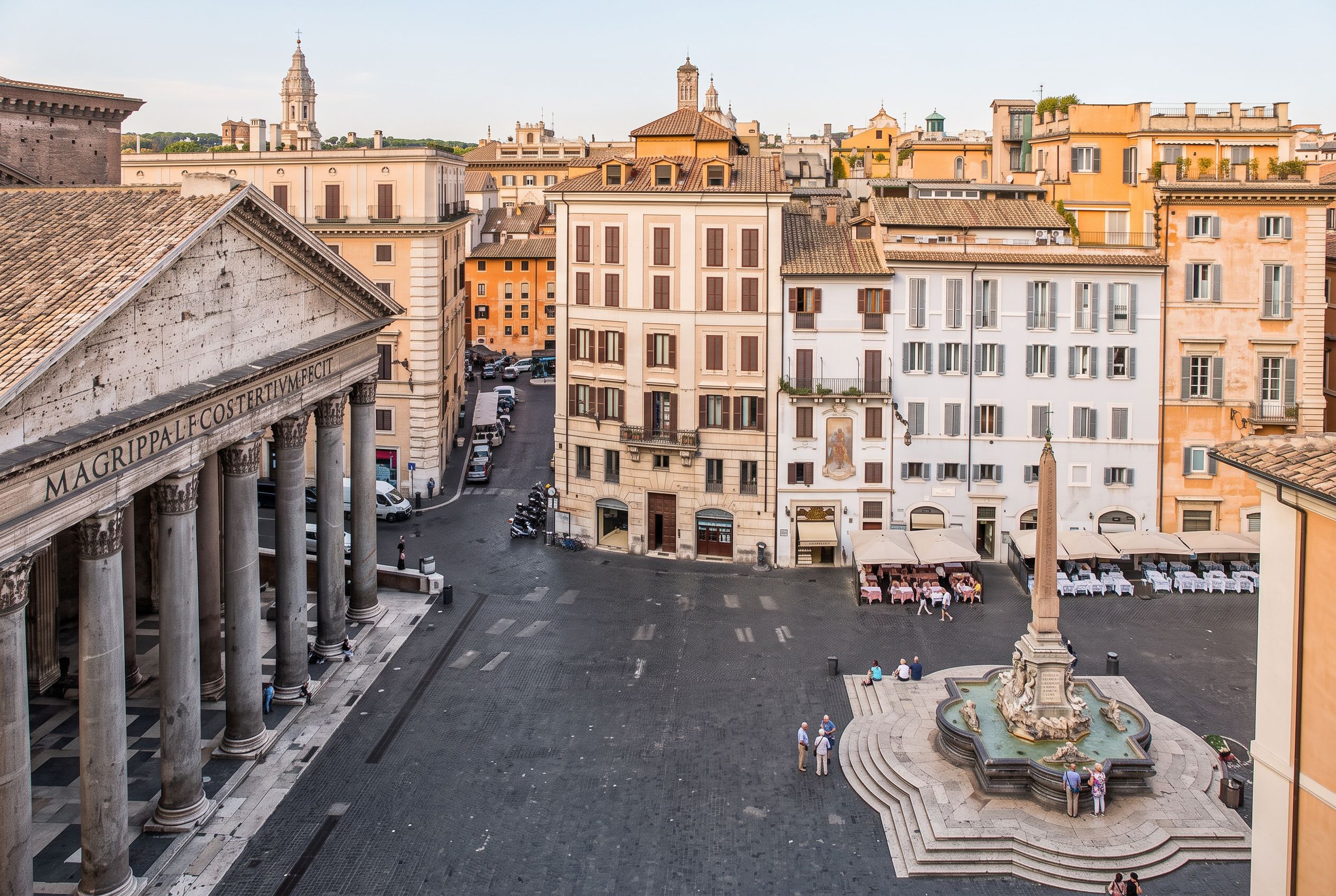
Yes, with the right room. Albergo del Senato sits directly beside the Pantheon, and guests report quiet rooms despite the busy piazza below because the windows are soundproofed. Tripadvisor's quiet-hotels listings also describe Hotel Artemide as quiet, with quiet rooms, and Donna Camilla Savelli as surprisingly tranquil at night.
The pattern across central Rome is consistent: the hotel can be in the middle of everything, and the room can still be calm, provided it is buffered from the street. A Fodor's poster noted that the Pantheon piazza has late-night foot traffic and echo off the stone facades, and that a higher-floor room solved the problem, with air conditioning making sleep easier when windows stayed shut.
Albergo del Senato carries a Google rating of 4.8 out of 5 from 1,529 reviews, as of September 2026. Guest feedback gathered across those reviews notes that rooms facing the Pantheon can be noisier than side-facing rooms, and that air conditioning is controlled by the front desk rather than in-room thermostats, requiring a call to adjust it. Both are planning details worth knowing before you book.
"Lovely hotel with spectacular customer service! Room was a comfortable size and well-kept. Breakfast was included and had a wide variety of offerings, including great fresh coffee and both sweet and savory items." (Google, June 2026)
Which room should a light sleeper ask for?
Ask for an interior-courtyard, rear-facing or higher-floor room, and request it at booking rather than on arrival. Tripadvisor's Rome quiet-hotels guidance recommends double-paned windows, higher floors and interior-courtyard-facing rooms to reduce noise for light sleepers. Street-facing rooms are the recurring caution.
Guest feedback across Rome hotels repeats the same three complaints: street noise from traffic and scooters, hallway noise through doors, and thin walls between rooms. The same feedback repeatedly links quiet rooms with restful sleep, and singles out blackout curtains, double windows and heavy shutters as the features that help most.
Reviews also mention hearing cleaners in the morning and hallway activity clearly through doors, even where the room itself was quiet. None of this is a verdict on any single property; it is the pattern that makes room choice the decisive factor in Rome.
What should travellers with mobility needs check?
Accessibility details vary by property and are not uniformly documented across Rome. Hotel Monte Cenci is described as wheelchair accessible with a lift, Starhotels Metropole Roma has roll-in showers, three elevators and ground-floor accessible rooms, and Spring House Hotel Rome Vatican has two accessible room types on the ground floor.
Hotel Monte Cenci, at Via Beatrice Cenci 10 in the Regola district, has 30 rooms according to its own site. An accessibility directory lists it as wheelchair accessible with a lift, and describes accessible room features including a bathroom emergency pull cord, a low-height counter and sink, and hardwood flooring. Walk-in showers and step-free access at all entrances are not documented for this property; confirm with the hotel when booking.
Starhotels Metropole Roma is described in an accessibility review as offering peace and quiet in the bustle of Rome, with roll-in showers, three elevators throughout the hotel and wheelchair accessible rooms on the ground floor. Spring House Hotel Rome Vatican, a Tapestry Collection by Hilton property, is described as steps from the entrance to the Vatican Museums, with two wheelchair accessible room types, both on the ground floor. The same review notes the shower was missing grab bars, and that accessible rooms are priced in line with standard guest rooms.
| Property | Documented access feature | Not documented |
|---|---|---|
| Hotel Monte Cenci | Wheelchair accessible, lift, bathroom emergency pull cord, low-height counter/sink, hardwood flooring | Walk-in showers, step-free entrances |
| Starhotels Metropole Roma | Roll-in showers, 3 elevators, ground-floor accessible rooms | Nearby pharmacy or medical help |
| Spring House Hotel Rome Vatican | Two accessible room types, both ground floor | Lift availability, full step-free route |
| Hotel San Anselmo | Described as fully accessible, with a room for handicapped guests | Detailed access measurements |
For Sourire Hotel, accessibility, lifts, step-free access and walk-in showers are not documented. The property does not publish these details; ask when booking. More on step-free routes and medical logistics is covered in our Rome accessibility guide.
What do quiet Rome hotels cost?
Rates are indicative and vary by season and booking channel. One accessibility review states that standard room rates at Spring House Hotel Rome Vatican can start at €100 per night during quieter periods and rise in peak season. A curated guide notes one Rome property with rooms starting at well under €100, described as very reasonably priced.
No per-category price table is given here because the same room category costs differently by booking channel and cancellation terms, and a matrix would invent a precision the market does not have. Treat any figure as a starting point and confirm at the time of booking.
Summer is the busiest time in Rome for visitors, and according to Turismoroma, Rome received over 38 million tourist arrivals during the summer, a record that exceeded expectations. Peak-season pricing follows that demand. The end of autumn and the beginning of winter are when you can expect the most rainfall, which is worth weighing against lower seasonal rates.
When is Rome quietest for light sleepers?
The shoulder months offer the best combination of milder temperatures and lower visitor load. Summer is the peak congestion period and the season to avoid if noise matters most. The end of autumn and the beginning of winter bring the most rainfall.
Rome's climate is classic Mediterranean, with hot, dry summers and wetter autumns. July and August are the hottest period, and November is the wettest month in the available figures. Spring through early autumn is the busiest comfort-weather window, which means the streets outside a hotel are at their loudest then too.
Transport works can also affect noise and routes. Rome suspended all trams from 16 September 2024 to 3 November, then restored service only from 2 December, while the city carried out works at Porta Maggiore to fit new 33-metre trams. The Metro A line between Termini and Battistini was closed for maintenance from 10 to 25 August 2024, with extra buses substituting service. Station closures at Spagna and Ottaviano were noted for renovation works linked to Jubilee preparations. Check current alerts before travelling.
How should a light sleeper book?
Book directly where possible, request the quiet room in writing at the time of booking, and confirm the room's aspect before arrival. Forum consensus across Rome travel threads is that the quietest rooms are at the back, in courtyards or higher up, and that front rooms pick up Vespas, pedestrians and piazza echo.
Hotel Monte Cenci shows direct booking contact details, including phone and reservation email, on its own site. Spring House Hotel Rome Vatican can be booked via the hotel website, according to the accessibility review. For the other properties in this guide, booking channels and cancellation terms are not documented; confirm both with the property directly.
Travellers weighing this decision consistently report the same conclusion: choose a hotel one notch away from the busiest square or road, even if it adds a few minutes of walking, because the calmer room is worth more than the view. If sleep is the priority, do not book a landmark-facing room for the view alone.
What else should older travellers plan for?
Rome's emergency number is 112, pharmacies operate on a rotating on-duty system, and 24-hour care is available through hospitals and certain tourist medical points. For central Rome, documented hospitals include Policlinico Umberto I at Viale del Policlinico 155 and San Camillo-Forlanini at Circonvallazione Gianicolense 87.
For Vatican-adjacent areas, Ospedale Santo Spirito is identified as the closest hospital in one guide. Pharmacies in central Rome include Farmacia Trastevere on Viale di Trastevere 80, Farmacia Piram on Via Nazionale 228, and Farmacia Senato Criserà Guglielmo on Corso del Rinascimento 50. The nearest pharmacy to any specific hotel depends on its exact address, so check on arrival.
Rome has two airports. The main one is Leonardo da Vinci at Fiumicino, about 35 minutes from the centre by train. Ciampino is used primarily by low-cost carriers and is closer to the centre but less well connected by public transport, and there is a capped taxi price into central Rome from Ciampino. The city is also easy to reach by train into Roma Termini or Roma Tiburtina.
For the ancient sites themselves, our guide to making the Colosseum, Forum and Palatine manageable covers pacing and access. Senior fares, reduced tariffs and special passes for these specific hotels are not documented; ask the property directly.
Which quiet Rome hotel suits which traveller?
Match the property to your priority. Courtyard hotels in Trastevere and on the Aventine suit those who want calm above all. Central addresses with soundproofed windows suit those who want to walk everywhere. Ground-floor accessible rooms at Starhotels Metropole and Spring House suit travellers with mobility needs.
For the deepest quiet, the courtyard properties lead: Hotel Santa Maria in Trastevere, Hotel Villa San Pio and Hotel San Anselmo on the Aventine, and Hotel Lord Byron in Parioli. For central convenience with documented quiet rooms, Albergo del Senato beside the Pantheon and Hotel Artemide are the recurring names in traveller feedback.
For mobility, Starhotels Metropole Roma documents roll-in showers, three elevators and ground-floor accessible rooms, and Spring House Hotel Rome Vatican documents two accessible room types on the ground floor. Hotel Monte Cenci documents a lift and wheelchair access. Where a detail is not documented, the property does not publish it; ask when booking.
The single most useful habit for a light sleeper in Rome is to treat the room, not the hotel, as the decision. Choose the district for calm, choose the property for access, and then choose the room for sleep.


