
The Colosseum, Roman Forum and Palatine Hill sit shoulder to shoulder in the same archaeological park, and they are usually sold as one visit. For travellers in their fifties and sixties, that packaging is the first thing to understand, because the three sites ask very different things of a body. The Colosseum has been fitted out with lifts and a barrier-free route. The Forum and Palatine have not, and cannot be, because their ground is two thousand years old. The skill in a good day here is not stamina. It is sequencing.
The Parco archeologico del Colosseo runs all three, and its own accessibility pages are unusually candid about the limits of what has been done. Lifts, ramps, loan wheelchairs and accessible toilets exist. So do steep, uneven, shifting surfaces. Planning around both is what this guide is for.
What does one ticket actually cover?
The standard ticket gives one entry to the Colosseum and one entry to the Roman Forum and Palatine Hill, and it is valid for 24 hours. A fuller ticket runs for two consecutive days and adds the arena floor, the underground level and the SUPER sites. Timed booking applies to the Colosseum.
The two parts of the visit do not have to happen on the same day, and they do not have to happen in a fixed order. The Forum and Palatine entry can be used at any point inside the ticket's validity window, before or after the Colosseum slot. That single rule is the most useful thing an older traveller can know about this park, because it turns one long day into two shorter ones if that suits better.
There is also a Forum Pass SUPER, which covers the Forum and Palatine without the Colosseum. It suits anyone who has seen the amphitheatre before, or who decides on the day that the flatter half of the park is enough.
How accessible is the Colosseum?
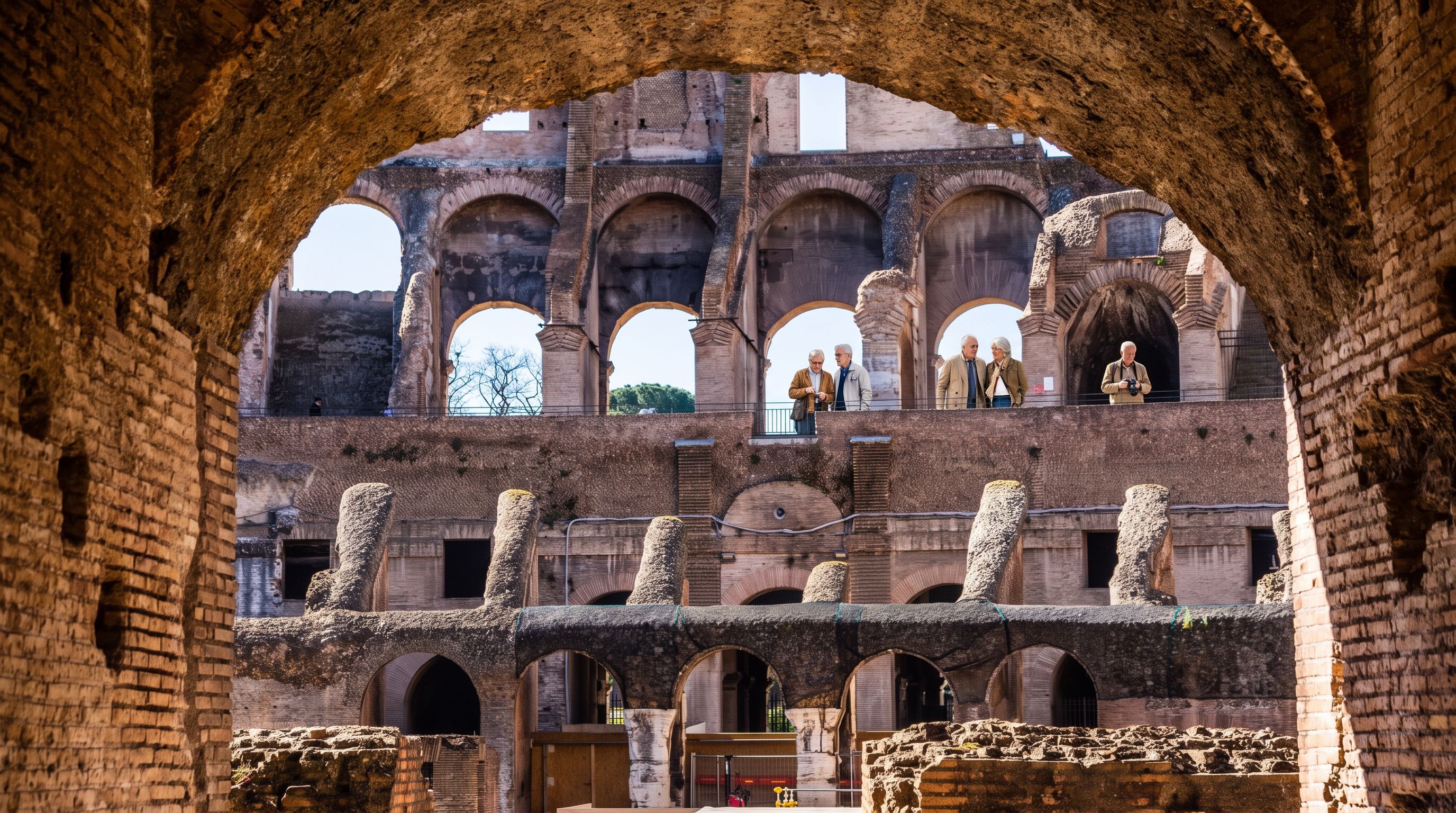
The Colosseum is the most manageable of the three. Visitors can normally reach the outdoor area and ground floor without difficulty, take a barrier-free route to the first tier, use a lift to the upper levels and a platform lift to the underground areas. Not every part of the building is accessible.
The park's own accessibility page sets out the detail. Inside the Colosseum there is a lift for people with reduced mobility connecting the first and second tiers, and a second lift giving access to some of the underground sections. A walkway covers most of the first level, and the route served by the lifts covers the second level in full. Three wheelchairs are kept on the first floor at the reception and security office, available on request and subject to availability.
The building's ancient structure imposes real limits, and the park says so plainly. Visitors with disabilities may enter with a support person. Accessible toilets sit on the first floor a short distance from the entrance turnstiles, alongside fourteen toilets in total, a baby changing table and one toilet designed specifically for visitors with reduced mobility.
 AI-edited
Two practical notes on resting. There are eight benches on the second level, placed along the visitor route through the Colosseum Museum and temporary exhibition areas. The park also names the Belvedere and the Triumphalis and Libitinaria gates as good places to sit down. Drinking fountains stand between the first and second tiers, and bottled water vending machines are in the bookstores on both levels.
What about the Forum and Palatine?
Both are only partially accessible. The park states this directly: the Roman Forum and Palatine Hill are accessible to wheelchair users but only in part, because the terrain still has uneven surfaces, changes in level and steep or irregular paths. This is the physically demanding half of the visit.
The Forum is the more workable of the two. Its documented route takes in the House of the Vestal Virgins, the Temple of Romulus, the Lacus Iuturnae, the Temple of Antoninus and Faustina and the Curia square. Lifts serve the Salara Vecchia entrance for the paths inside the Forum and Palatine, and the Curia Iulia from Via dei Fori Imperiali. A platform lift stands at the Arch of Titus. A lift at Via dei Cerchi is currently under restoration.
The park expects the length of fully accessible paths to grow from 1.5km at present to 2.0km once current work is complete. Five wheelchairs are available at the main entrances to the Forum and Palatine, on request and subject to availability.
The Palatine is the least forgiving of the three. One operator page describes the climb to the top as not recommended for wheelchair users and people with mobility disabilities. There is a golf cart shuttle for the Palatine Hill from the Via di S. Gregorio entrance, which carries wheelchair users with an escort, and a separate golf cart approved for visitors with mobility difficulties who bring their own wheelchairs, available on request.
Which parts should I prioritise?
Colosseum first, because its route is designed to be barrier-free. Then the easier sections of the Forum on the marked accessible path, if energy allows. The Palatine only if mobility and stamina permit, since it is the least forgiving of the three.
That order reflects what the park itself publishes about its terrain. It is not the only order that works. Some visitors prefer to take the Forum and Palatine while fresh and treat the Colosseum as the gentler finish, and there is a logic to that too, since the amphitheatre's lifts and level ground floor make it the easier site to end on.
The park acknowledges that even with lifts and ramps, parts of the Forum and Palatine still have steep, uneven and changing ground, and that a visit may be physically demanding in places. The practical advice that recurs across traveller accounts is more rest time and, where needed, skipping sections rather than completing the circuit.
For anyone with a cane, crutches or limited stamina, the sensible shape of the day is the Colosseum in full, a selective pass through the Forum, and a decision about the Palatine made on the spot rather than in advance.
Guided visit or independent?
Independent visiting is clearly possible on the published accessible routes. The park's official materials document the routes and support services but do not state that a guided visit is required.
What the park does publish is a set of self-guided aids. There is a tactile trail of eleven tactile panels across the park: three in the Roman Forum, three on the Palatine Hill, four inside the Palatine Museum and one at the Colosseum. A tactile book, "Accarezzare la storia di Roma", is available. Audio guides are listed among the visitor services at the Colosseum area, along with an info point, a bookshop and a refreshment point.
One service has lapsed. The distribution of audio guides in Italian Sign Language and Italian Simplified Sign Language inside the Colosseum has been suspended since 1 June 2020. The park publishes that date, and it is worth knowing before you plan around it.
For a visitor who wants interpretation without a group pace, the audio guide plus the marked accessible route covers the ground. For anyone who prefers a fixed itinerary with someone else managing the logistics, the park's own pages do not document a programme, so the choice sits with the traveller.
When should I go, and how long does it take?
Opening hours shift with the season. Up to 30 September 2026 the Colosseum opens daily from 8:30am to 7:15pm and the Forum and Palatine from 9:00am to 7:15pm, with last admission at 6:15pm. From 1 to 24 October the Colosseum runs 8:30am to 5:30pm, with last admission at 4:30pm.
Those hours come from the official ticket page and they carry their own conditions, so check them against your travel dates rather than assuming. The same page states the sites are open every day across the cited periods. The documentation gathered here does not show a separate weekly closing day for the complex.
Allow roughly three hours for the three sites together. That figure appears repeatedly in traveller accounts, including one from a visitor using a wheelchair, and another account puts the three at three hours or more. A reasonable range is two hours for a focused visit to half a day for a slow one.
| Period | Colosseum | Forum and Palatine | Last admission |
|---|---|---|---|
| Up to 30 September 2026 | 8:30am to 7:15pm | 9:00am to 7:15pm | 6:15pm |
| 1 to 24 October 2026 | 8:30am to 5:30pm | From 9:00am | 4:30pm |
The park does announce occasional early closures for events. On 14 July 2025 the Forum and Palatine closed at 2:00pm with last admission at 1:00pm, while the Colosseum stayed open later. On 28 October 2025 the Colosseum closed entirely for the International Meeting of Dialogue and Prayer for Peace, and the Forum and Palatine ran only until 1:00pm with restricted entrances. Check the park's announcements close to your date.
The park does note that the Colosseum has multiple accessible entrances, which can spread the pressure at the busiest points.
Where can I sit down, find shade and get water?
The park publishes a detailed rest and water network. There are about 70 benches across the park, most of them near drinking fountains, and 10 drinking fountains in addition to the water available in the 8 public toilets. The official pages do not publish a shade map for these specific areas.
Benches cluster at the Vicus Argentarii and Tabularium, the south-east corner of the Basilica Giulia, the Horti Farnesiani, and the Palatino and Domus Augustana with the southern path. Vending machines for drinks and snacks sit along the Via Nova, in the Horti Farnesiani and in the Domus Augustana. The eight public toilets are mainly at the entrances and exits and are designed to be accessible to people with reduced mobility.
On the medical side, the park has eleven AED defibrillators available for cardioprotection, donated with the support of the Giorgio Castelli Onlus Foundation. The park's pages do not document a pharmacy, an onsite medical room or an emergency medical protocol for these three sites.
Heat planning matters here more than at most city sites, because so much of the Forum and Palatine is open ground. The park does not publish a shade map, so the benches and fountains listed above are the practical anchors.
What does it cost, and who gets a reduction?
The official ticket page states a reduced fare of €2 for EU citizens from age 18 until the day of their 25th birthday. Another official information page says the Colosseum is free for EU citizens under 18 and over 65.
That distinction is worth holding on to. One official page states free entry for EU citizens over 65; the park's own pages state discounted admission for EU citizens aged 18 to 25. The two do not cover the same ground, and no Rome-specific senior fare for the Colosseum, Forum and Palatine complex is documented in the material gathered here. Ask at the ticket office rather than assuming.
What is documented clearly is free entry for disabled visitors plus one companion on presentation of disability documentation, with a timed booking still required where the entry system is timed. Rome's municipal museum system also grants free admission to visitors with disabilities and a family member or carer, and applies concessionary fares across many sites, including a 50% reduction for non-residents in the last two hours on Wednesdays.
One point of confusion should be flagged. Sources differ on how disabled-visitor tickets are obtained: one says they are booked through the official Colosseum website with the disabled category and a free companion ticket booked together, another says free disability tickets are not available online and must be collected at the ticket office on the day. Confirm the current method when you book. The park's pages do not state cancellation terms.
Getting there and moving between the sites
The Colosseum, Forum and Palatine are adjacent, and the three main park entrances at Largo della Salara Vecchia, Arco di Tito and Via di S. Gregorio are accessible to wheelchair users, as are the three northern-side entrances to the amphitheatre and the Stern spur entrance.
The Forum and Palatine share one combined site with two entrances, at Largo della Salara Vecchia 5/6 and Via di San Gregorio 30. That means you can plan entry around stamina and route rather than walking the whole complex as a single loop.
Public transport to the area has been improving. Webuild reported in May 2024 that the Colosseo-Fori Imperiali station was about 90% complete, with activation tests expected by October. AP reported in December 2025 that Rome opened the new Colosseo subway station beneath the Colosseum. Corriere della Sera reported in September 2026 on works to make the Colosseo-Fori Imperiali archaeological station fully accessible, adding a new elevator landing serving the intermediate museum level, with early station closures on 7 to 11 September and 18 to 20 September while the line remained open to Porta Metronia.
For a wider look at how the ancient core sits within the city, see our guide to choosing your neighbourhood in Rome, and for arrival logistics, getting to Rome by airport, train and transfer.
Practical planning notes for older visitors
Book the Colosseum slot in advance, plan the Forum and Palatine as a second, shorter outing, and decide about the Palatine on the day. The park publishes its accessible routes, lifts and wheelchair loans in detail; it does not publish a rest-and-shade map, guided-tour programme or cancellation terms.
A few things follow from that. Wheelchair loans exist at both the Colosseum first floor and the Forum and Palatine entrances, but they are subject to availability, so they cannot be the plan. The park's own accessibility page is the most reliable single document for the current state of lifts and routes, including the Salara Vecchia lift and the Via dei Cerchi lift under restoration, and it is worth reading before you travel: Parco archeologico del Colosseo accessibility page.
For the wider ancient core beyond these three sites, including the imperial fora and the Capitoline area, the park's accessible path already reaches the House of the Vestal Virgins, the Temple of Romulus and the Curia square, and the planned extension to 2.0km of fully accessible paths will add to that. The museums and the city's broader highlights sit outside this guide; our Rome highlights chosen for the over-50s covers those separately.
If a slower day is wanted between two heavy ones, a spa day in Rome is a reasonable counterweight to a morning on ancient paving.
Finally, a note on where to stay. Hotels immediately beside the Forum and Colosseum put the park on your doorstep, which removes a commute at the end of a tiring morning. Guests reviewing Hotel Forum Roma repeatedly describe it as a stone's throw from the Colosseum and the Forum, and praise the roof terrace and its views over the Roman Forum. Some reviews also report street-facing rooms as noisy and noise from the rooftop bar late into the evening. Ask for a room away from the bar and away from the street when booking.
For a fuller picture of the Forum and Palatine ticket arrangements, including how the combined entry works in practice, see this Roman Forum and Palatine Hill guide.


