
Rome rewards the traveller who plans around energy rather than against it. The city's historic centre is paved in sampietrini, the small basalt blocks set in sand that give the old streets their character, and those stones are uneven underfoot. Yet the Colosseum, the Vatican Museums, St Peter's and the Pantheon all have documented step-free or assisted routes, and ATAC, the city's transport operator, states that almost every metro station is accessible to passengers with reduced mobility. The honest reading is that Rome is doable for travellers aged 50 to 70 with a stick, a walker or a wheelchair, but not easy, and the difference between a comfortable visit and an exhausting one comes down to three choices: where you base yourself, how you move, and how much you walk.
This guide covers the city-wide picture only. Hotel-by-hotel access has its own dedicated article, and if you are still deciding where to sleep, a district-by-district guide to choosing your neighbourhood in Rome sets out which areas are flatter and which are hardest on the legs.
Is Rome wheelchair accessible?
Partly. Rome is a mixed destination: several major sights and most metro stations are documented as accessible, but the historic centre's cobblestones make many routes difficult for manual wheelchairs and uncomfortable for power chairs. Travellers who cannot handle uneven surfaces for long stretches should plan around taxis and shorter days.
Turismo Roma, the city's official tourism authority, publishes what it calls "detailed and verified accessibility information" so that people with disabilities or special needs, seniors and families with children can choose the city's art and culture spaces independently. That information is a genuine planning tool, and it is worth reading before you book anything. It is also, by its nature, site-by-site: it tells you what each museum or monument offers, not what the pavement between them is like.
The pavement is the problem. Rome-focused accessibility guides consistently describe the older districts, Trastevere and Monti among them, as difficult on uneven paving, and traveller guides warn that cobblestones in historic districts make walking harder, especially for manual wheelchair users and people with limited stamina. A Rome resident posting in a mobility thread made the comparison plainly: if a stroller is difficult to push, the city is especially hard for a wheelchair.
Which major sights have step-free or assisted access?
The Colosseum, the Vatican Museums, St Peter's Basilica and the Pantheon all have documented accessible routes. The Roman Forum is only partially accessible and Palatine Hill is not fully accessible. Access at each site varies, so confirm the route on the day rather than assuming it.
At the Colosseum, the accessible route covers Tier 1 and Tier 2 via ramps and an internal elevator. The underground and the attic are not recommended for people with reduced mobility. Wheelchairs are available for loan at the welcome desk, subject to availability. One source states that disabled visitors and one companion enter free of charge, but that the free ticket must be collected in person at the on-site ticket office on the day of the visit, because the system does not offer advance online booking for that category. Guest reviews describe a great deal of walking and standing, limited shade, and a no-backtracking policy inside, so see everything on each level before moving on. As of September 2026 the Colosseum holds a Google rating of 4.8 from 506,684 reviews.
At the Vatican Museums, sources say most areas are accessible, with elevators at the major staircase points and a dedicated wheelchair route through the main galleries, including the Sistine Chapel. Wheelchair loan is free of charge subject to availability, and advance contact by email is possible. Note one practical catch: wheelchairs borrowed there must be returned before entering St Peter's Basilica. Sources differ on the Sistine Chapel itself. One Rome accessibility guide says the museums' own guided tours are not open to wheelchair users except for the Vatican Gardens without barriers, and that the Sistine Chapel passage should not be assumed available unless confirmed on the day. WheelchairTravel.org reports that access is possible via a stair lift with a weight limit of 230 kg. Confirm with the museums before you rely on either reading.
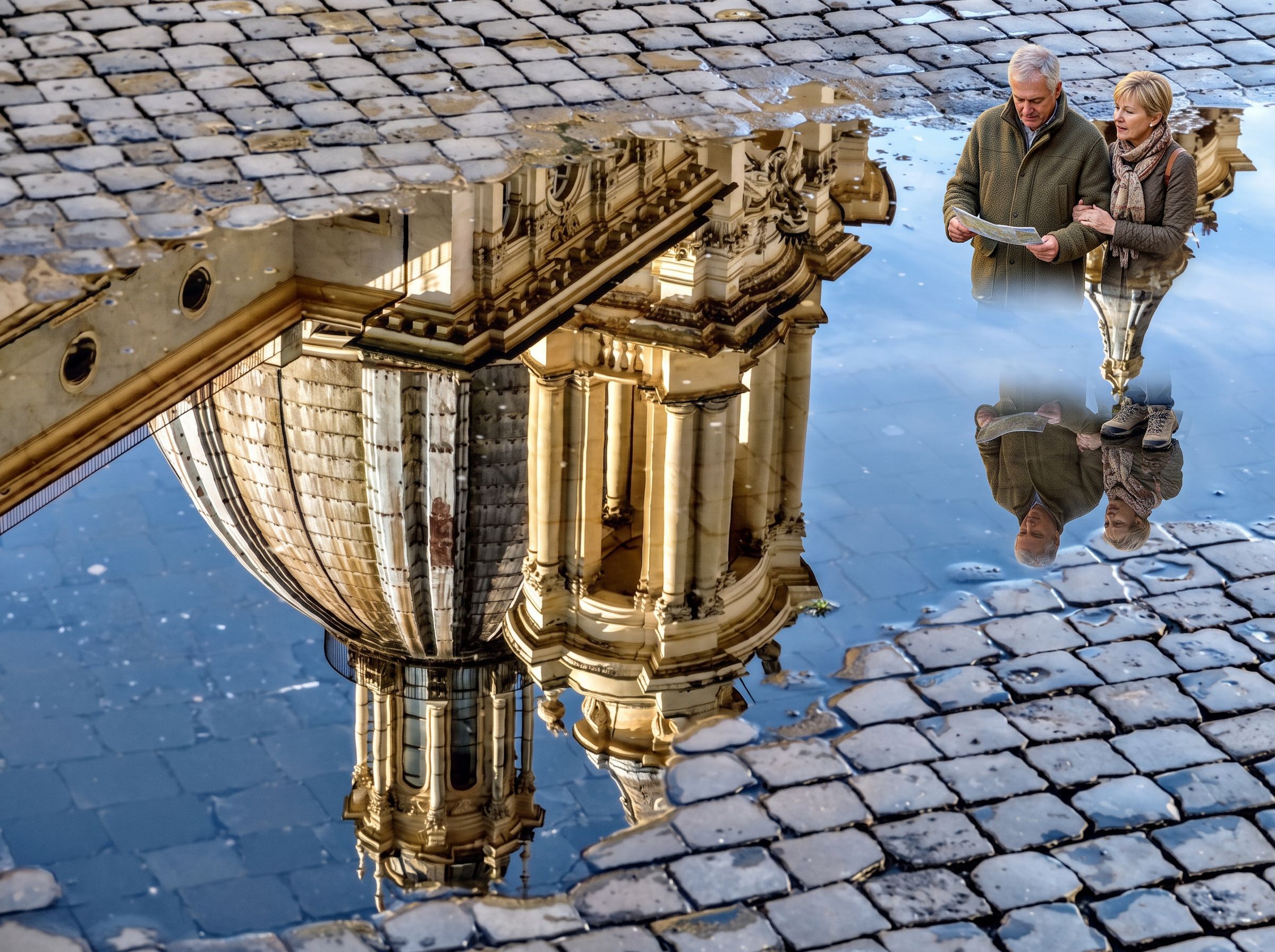 AI-edited
At St Peter's Basilica and St Peter's Square, the main piazza and the basilica interior are described as wheelchair accessible, with a dedicated accessible entrance and smoother approach paths. No specific booking requirement was documented for the basilica itself, and no separate bookable assistance service was stated for it. The Pantheon has a level entrance from the piazza and a level interior under the oculus, but the cobbles immediately outside are described as some of the roughest in the city. That is the pattern in miniature: the building is fine, the approach is not.
The Roman Forum and Palatine Hill are the weak point. The Forum is only partially accessible and Palatine Hill is not fully accessible for visitors with mobility impairments. Wheelchairs are said to be available at the main entrances to both, subject to availability. If ancient Rome is the reason for your trip, a guide to making the Colosseum, Forum and Palatine manageable walks through the practical sequencing.
Which metro stations have lifts?
ATAC states that all metro stations are accessible to passengers with reduced mobility except four on Line A: Spagna, Barberini, Repubblica and Vittorio Emanuele, which have no lifts or stair lifts to the platforms. Line C is fully accessible and Line B/B1 partly so.
That is the operator's own wording, and it is the single most useful transport fact in this article. The four exceptions sit in exactly the areas many visitors want: Spagna serves the Spanish Steps, Barberini the Trevi area, Repubblica the Termini edge, and Vittorio Emanuele the San Giovanni corridor. If your hotel is near one of them, plan on buses or taxis instead.
One caveat matters for independence. Access-verified notes that some accessible stations rely on staff-operated stair lifts, which can add waiting time and reduce the sense of travelling on your own terms. ATAC provides a stair-lift reservation service and a wheelchair loan system for metro lines A and B. The practical advice from that source is to treat the bus network as the safer default for wheelchair users and to check live service status before setting out.
| Line | Accessibility status | Stations to avoid if you need a lift |
|---|---|---|
| Line A | Accessible except four stations | Spagna, Barberini, Repubblica, Vittorio Emanuele |
| Line B / B1 | Partly accessible | Not documented in the sources gathered |
| Line C | Fully accessible | None documented |
Service patterns shift with the city's ongoing upgrade programme. Turismo Roma reported in August 2024 that works on Metro A included new lifts at San Giovanni for passengers with reduced mobility, alongside track replacement on the Ottaviano to Battistini section. Press coverage noted that Metro A closed early at 21:00 from Sunday to Thursday during that period, with shuttle buses afterwards, while Friday and Saturday nights ran later. Tram services were also affected by depot works at Porta Maggiore. Check the current position before you travel, because these arrangements change.
How bad are the cobblestones, really?
They are the biggest everyday obstacle. Sources describe the historic centre's sampietrini as uneven and difficult for manual wheelchairs and uncomfortable for power chairs, with Trastevere, Campo de' Fiori, Piazza Navona and much of the centro storico named as the hardest areas.
Better routes exist. Several sources point to Via del Corso, Via Nazionale, the Lungotevere embankment roads, and parts of Prati and EUR as flatter and smoother than the old centre. If you use a cane or a rollator, those are the streets to build a day around. If you use a wheelchair, they are the difference between an outing and an ordeal.
Guest feedback collected across Rome accessibility discussions repeats the same themes: cobblestones outside hotels, steps at entrances, and small lifts. One Rick Steves forum post said inaccessible restrooms forced dinner-plan changes twice on a single trip, which is the kind of detail worth taking seriously when you book restaurants. Reviews also warn that accessibility claims can hide stair detours, curb cuts and long waits, so the specific walking surface and entry path matter more than the label.
Rome is not wheelchair accessible" appears in a Rome wheelchair forum post, cited here as an example of how sharply some travellers experience the paving, not as a verdict on the city.
The more balanced reading is that Rome is manageable if mobility is limited but not severely compromised, provided the itinerary is short, central and taxi-heavy. For wheelchair users or anyone who cannot handle uneven walking surfaces, it remains hard work rather than easy access.
Where do taxis beat walking?
Almost everywhere in the historic centre, and especially between the Vatican, the Colosseum and the Pantheon. Travellers repeatedly advise taking taxis and sitting down often. Official white taxis are the safest airport option, and wheelchair-accessible taxis exist but should be booked in advance.
The distances in central Rome look short on a map and feel long on sampietrini. A route that reads as fifteen minutes on paper can take twice that with a stick or a walker, and the energy cost is what matters, not the distance. Multiple traveller posts say buses are crowded or inconvenient enough that taxis or ride apps are a better default for comfort and energy conservation. One mobility thread advised simply: take taxis, and sit down a lot.
For airport transfers, the official Rome airports operator states that it provides barrier-free access to parking lots, terminals, restrooms, boarding areas and baggage claim. PRM assistance at Fiumicino and Ciampino is free and should be booked at least 48 hours in advance through the airline or the airport's assistance channels. Accessible restrooms, lowered check-in desks, adapted security lanes, lifts and ramps are available at the airports. For longer transfers, especially between rail stations, the Vatican area and the historic centre, a direct taxi or a prebooked accessible taxi is the sensible choice.
Are there accessible restrooms and medical help nearby?
Pharmacies run a rotating out-of-hours duty system, so a closed shop posts the nearest open one on its door.
At Fiumicino, a Rome guide to the city's main airport records a pharmacy on the second floor of Terminal 3, plus another non-prescription outlet in Boarding Area E. First aid at Fiumicino is available around the clock. That detail is not documented and should be checked locally.
The practical habit is the one Romans use: if the pharmacy you find is closed, read the notice on the door, which names the nearest one on duty. Carry any prescription medication in its original packaging with a copy of the prescription, and keep a written list of your medicines in Italian if you can. No Rome-specific emergency number was documented for this article, so confirm the current number locally on arrival.
When should you go?
Spring and autumn are the most comfortable windows, especially late April to early June and September to October. July and August can reach 32 to 38 degrees Celsius, which makes outdoor sightseeing physically taxing for older visitors. November to early December is described as very quiet.
Rome Spirit gives month ranges: April to early June sits around 16 to 22 degrees Celsius; September runs about 20 to 26 degrees and October about 14 to 20 degrees; November to early December about 10 to 16 degrees; July and August about 32 to 38 degrees. Access-verified likewise says Rome is most workable from April to mid-May and from late September to October, with July and August particularly difficult because of heat above 35 degrees and heavy queueing.
Reduced crowds do not mean empty sites. Traveller discussions note that the Colosseum and the Vatican Museums can still be busy in low season, so book timed tickets in advance whatever month you choose. In hot months, put outdoor archaeology in the morning and museums, churches or shaded cafés in the middle of the day. Guest reviews of the Vatican Museums repeatedly mention that much of the museum has little air conditioning, that a visit takes several hours to a full day, and that the route is a one-way system, which makes it difficult to turn back or linger.
What should you know before you book?
Book timed tickets for the Colosseum and the Vatican Museums, request airport assistance at least 48 hours ahead, and check live lift status before each metro journey. Italy grants free entry to visitors with disabilities and one companion at state-managed museums and sites, but documentation is required and rules vary by site.
One source states that state-managed museums, archaeological sites and cultural institutions in Italy grant free entry to visitors with disabilities and one accompanying companion, regardless of nationality, on production of certification. This is a nationwide policy rather than a Rome-only rule, and the exact route and eligibility can vary from site to site. Separately, EU citizens aged 65 and over can enter state museums free on the first Sunday of each month, again a nationwide rule rather than a Rome offer. Routine senior discounts are not universal in Rome, and many sites charge the standard adult price.
The collected ATAC material does not document a general over-65 fare for visitors, and one Rome transport guide states that the operator's reduced-fare season pass is resident-only, tied to specific disability categories and not available to visitors. Companion travel can be free for people recognised under Italian rules as entitled to accompanied travel. Ask at the ticket office rather than assuming a senior rate exists.
For rail arrivals, RFI's Sala Blu assistance covers major stations including Termini, Tiburtina, Ostiense and Fiumicino Aeroporto, with advance notice required. The city's disability information service is Roma Per Tutti, a City of Rome service providing accessibility information for major tourist places. If you want to build in a rest day, what to expect from a spa day in Rome is a gentler way to spend an afternoon than another archaeological site. And if budget is on your mind, what a comfortable Rome trip costs sets out the numbers.
What do travellers wish they had known?
That the walking is the hard part, not the sights. Reviews and forum posts repeat the same advice: comfortable shoes, water, early starts, advance booking, and far more sitting down than you would plan for. The sights themselves are often easier than the streets leading to them.
Guest reviews of the Colosseum note that the site involves a lot of walking and standing, that much of the visit is in direct sunlight with limited shade, and that early morning or later in the day is easier. Reviews of the Vatican Museums make the same points about distance, crowds and footwear.
"Amazing experience. We booked 9am tickets and spent 5 hours going through each area. It was very heavily packed with people and you felt a little 'pushed' through the rooms by the sheer volume of crowds." — a guest wrote on Google in August 2026
That is the texture of a Rome visit at its most demanding, and it is worth planning around. A short, central, taxi-heavy itinerary with one anchor sight per day is the shape that works. Two sights and a long lunch is a good day. Three sights and a walk between each is how trips get cut short.
Rome is a UNESCO World Heritage city, and its historic centre within the city walls is the protected area. That protection is precisely why the paving has not been replaced with something smoother. The city you came to see is the city that is hard to walk on, and the two facts cannot be separated. Plan for the second and you will still enjoy the first.


