
Rome rewards the traveller who plans around comfort rather than around a checklist of sights. The city's historic centre puts the Pantheon, Piazza Navona and the Corso within a short walk of one another, and a base inside that ring cuts the daily distance on foot. Rome's own mobility guidance suggests a realistic day of four to six kilometres with taxi transfers between zones, so the choice of hotel matters more here than in a flatter, more spread-out city. This guide looks at five properties where lift access, quiet rooms and service for older guests are documented, and notes where the record is silent.
What follows is a curated selection rather than a ranking. Each property is judged on what its own listing, its accessibility documentation and its guest feedback actually say about sleep quality, arrival without stairs, lift access and proximity to the sights. Where a detail is not published, the article says so and tells you what to ask before booking. Rates are indicative and vary by season and booking channel.
Which Rome hotels best suit travellers who want comfort first?
Two properties stand out in the documentation. Relais Piazza Del Popolo has a lift to its third-floor apartments and a large walk-in shower noted in reviews. 47 Boutique Hotel documents a stair-free path to the entrance, an elevator, and wheelchair-accessible public areas. Hotel Lirico and Hotel Navona both involve steps, and Boutique Hotel Trevi documents a lift and disabled-guest facilities but little else.
The distinction matters because Rome's older buildings rarely announce their access arrangements. A lift may exist and still leave a flight of stairs between the street and reception. The five properties below are the ones where comfort and mobility details are actually documented, rather than assumed.
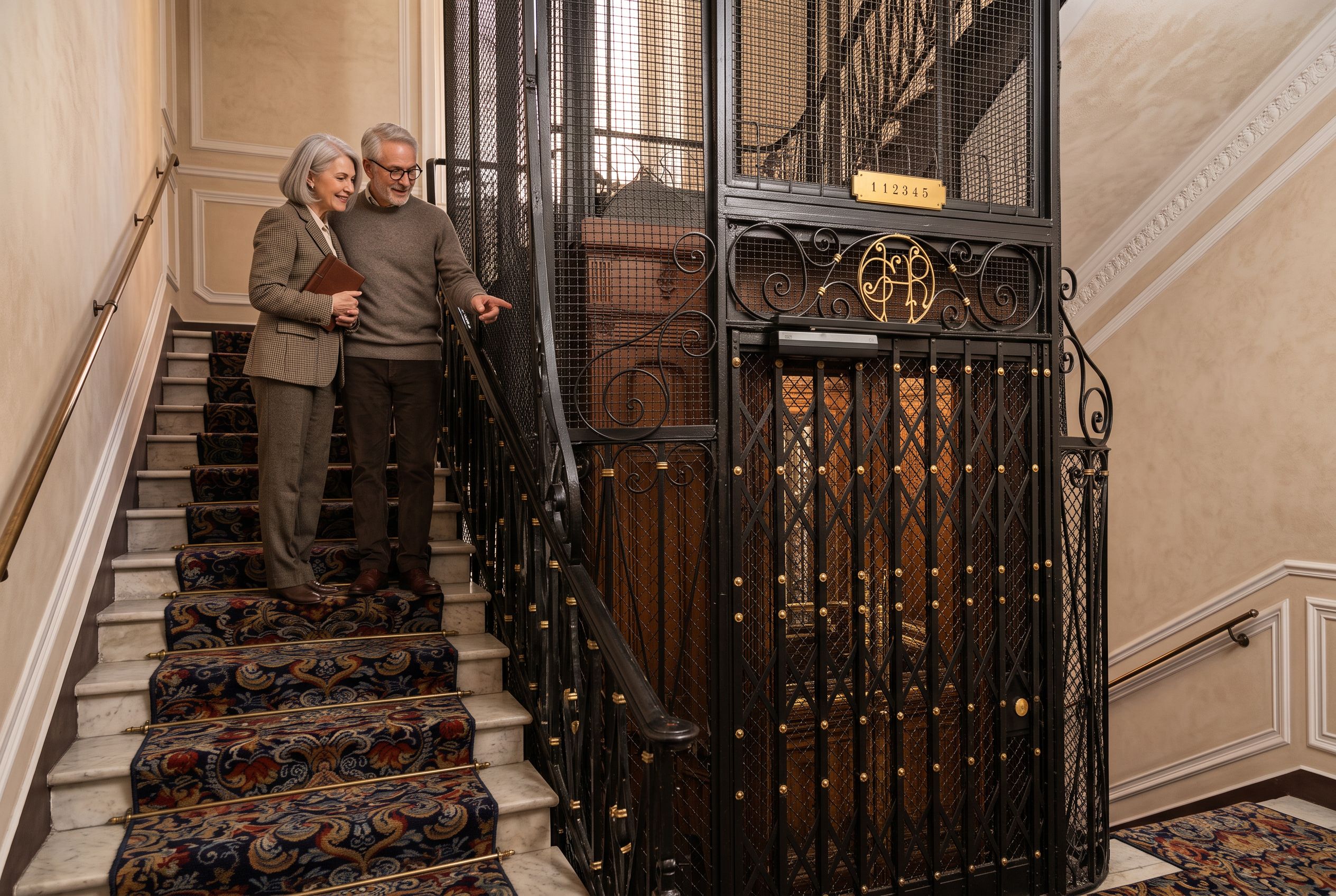 AI-edited
- Relais Piazza Del Popolo (Piazzale Flaminio, Flaminio): third-floor apartments reached by lift or stairs; a large walk-in shower noted in reviews; described as modern, immaculate and very comfortable.
- 47 Boutique Hotel (Via Luigi Petroselli): stair-free path to the entrance, elevator, wheelchair-accessible route to the elevator, and accessible registration desk, lounge and restaurant; a bathroom emergency pull cord is documented.
- Boutique Hotel Trevi (Via Delle Muratte): a lift and disabled-guest facilities are documented; step-free entry and individual room layouts are not.
- Hotel Lirico (Via del Viminale): a lift runs from reception to the rooms, but reviews describe a lot of steps to reach reception; one room had a large walk-in shower.
- Hotel Navona (Via dei Sediari): a walk-in shower is listed, but reviews describe about three steps to the elevator and state the property is not wheelchair accessible.
How do I avoid stairs when booking a Rome hotel?
Ask three questions before you book: how many steps between the street and reception, whether the lift reaches your room floor directly, and whether the bathroom has a walk-in shower. Rome's historic buildings often have narrow stairs and no elevator, and the most consistent regret in traveller discussions is not verifying access details closely enough beforehand.
An elevator in the building does not guarantee a step-free journey. One forum post about Hotel Parlamento noted that guests had to walk up two short flights of stairs to the first-floor landing, which is exactly the arrangement that catches people out. The same pattern appears in the documented properties here: Hotel Lirico has a lift, but only from reception upward, and reviews describe many steps before you reach it.
Hotel Navona's listing shows a walk-in shower, yet reviews describe roughly three steps to the elevator, a non-wheelchair-accessible layout, and an elevator that is not commercial-grade and needs repeated button presses. That is planning information, not a verdict: the hotel may suit a guest who manages a few steps comfortably, and it will not suit one who does not.
Which Rome hotels are quiet enough for a good night's sleep?
Quiet is the hardest thing to verify from a listing, and the material documents noise levels for only some properties. Guest feedback consistently praises sleep quality at Hotel Napoleon, Hotel Camelia, Hotel Pantheon, The Shire Hotel and Hilton Garden Inn Rome Colosseum. For the five curated properties in this guide, noise levels are largely undocumented.
That gap is worth stating plainly. Relais Piazza Del Popolo is described as modern, immaculate and very comfortable, but the material does not document its noise levels. The same is true of 47 Boutique Hotel, Boutique Hotel Trevi and Hotel Navona. Hotel Lirico has one review describing a basic double room as small but with great facilities; ambiance beyond that is not documented.
Where the wider Rome review set does give guidance, the pattern is consistent. Rear rooms tend to be quieter than street-facing ones, and blackout curtains make a measurable difference in summer. Guests at Hotel Napoleon reported no outside noise whatsoever in rear rooms and described the blackout curtains as very effective. At Hotel Camelia, guests reported comfortable beds, quiet rooms and soundproofing.
"The staff truly made this stay exceptional. Every single person we encountered was warm, welcoming, and incredibly helpful. They went above and beyond to make sure we were comfortable, which made the experience feel personal and effortless." (Google, March 2026)
For the curated five, the practical move is to request a room away from the street or the lift shaft when booking, and to ask whether the windows are double-glazed. Neither detail is documented for these properties, so it needs confirmation rather than assumption.
How close are these hotels to Rome's main sights?
Location convenience is documented for the addresses but not for transit, restaurants or pharmacies near each property. Relais Piazza Del Popolo sits at Piazzale Flaminio in the Flaminio area. Hotel Navona is on Via dei Sediari in the historic centre. Hotel Lirico is on Via del Viminale. Boutique Hotel Trevi is on Via Delle Muratte. 47 Boutique Hotel is on Via Luigi Petroselli.
Rome's own guidance is blunt about why this matters: staying within fifteen minutes' walking distance, or one taxi ride, of your daily main attraction reduces the transit demands of the whole day. A base in the Pantheon and Navona zone keeps several major sights within a short walk and puts taxis within easy reach.
What the material does not document is the specific proximity of public transport, restaurants or pharmacies to each of these five addresses. That is a gap worth filling yourself before booking, particularly the pharmacy question, since Rome's pharmacies are marked by a green cross and many are open around the clock.
What should I expect from breakfast and half-board?
Breakfast quality is documented for the wider Rome review set rather than for the five curated properties. Guests praise breakfast at Hotel Napoleon, Tritone Hotel and Hotel Pantheon. Half-board arrangements are not documented for any of the five properties in this guide, so board basis needs to be confirmed directly with each hotel.
Where breakfast is well reviewed, the pattern is variety and pace. Hotel Napoleon and Tritone Hotel drew descriptions of breakfast as excellent or delicious, with a wide variety of options. Hotel Pantheon's buffet was noted for fruit, breads, cheeses, meats, eggs and pancakes, and its staff for remembering drink preferences at breakfast.
Two practical notes from the wider set. At Hotel Camelia, eating is not permitted in the rooms and there is no restaurant on site, so breakfast is a fixed part of the day rather than a room-service option. At Hotel Prati, one review found breakfast basic and lacking savoury options. Neither applies to the curated five, but both illustrate why board basis is worth checking rather than assuming.
What about service and help with the practical logistics?
Service quality is where the wider Rome review set is strongest. Reception staff at Hotel Napoleon are described as arranging taxis, airport transfers, Vatican tickets and printing boarding passes. Hotel Camelia's front desk is repeatedly praised as multilingual and helpful with maps, restaurant recommendations and directions.
For a traveller in their fifties or sixties, that kind of front-desk support removes a surprising amount of daily friction. Airport transfers, timed museum entries and restaurant bookings are the three things most likely to go wrong on a short city break, and a reception team that handles them changes the shape of the trip.
Hotel Pantheon's staff were noted for knowing guests and providing excellent service; Hotel Flavia Rooms for helpful and polite front-desk staff. For the five curated properties, service is not documented, so it is worth reading recent reviews for the specific hotel you shortlist.
Rome's wider accessibility picture is worth knowing too. The city's transport authority, ATAC, describes its metro as accessible to passengers with reduced mobility, with exceptions on Line A at Spagna, Barberini, Repubblica and Vittorio Emanuele, which do not have lifts or stair lifts. ATAC states that 100% of its bus fleet is equipped with boarding platforms and a wheelchair area. Roma Capitale says it works on the progressive removal of barriers in public transport and on accessibility and mobility for pedestrians and cyclists.
When is the best time to visit for comfort?
April to early June and September to November are the most comfortable windows. April to early June brings 16–22°C with manageable crowds; September runs 20–26°C, cooling to 14–20°C in October. July and August are the least comfortable months for walking-heavy sightseeing, with heat of 32–38°C.
November to early December offers 10–16°C, very quiet streets and shorter days, which suits a gentler pace. The trade-off is rain: October and November are the wettest months in Rome's climate record, with October averaging 113.3 mm and November 115.4 mm.
| Period | Typical temperature | What it means for walking |
|---|---|---|
| April–early June | 16–22°C | Manageable crowds; spring gardens at their best |
| September | 20–26°C | Warm but workable; crowds easing |
| October | 14–20°C | Cooler, but the wettest month at 113.3 mm |
| November–early December | 10–16°C | Very quiet; shorter days, gentle pace |
| July–August | 32–38°C | Avoid if walking is the plan |
Rome's tourism board reported a record-breaking summer, with arrivals rising by more than 18% compared with the previous year and summer arrivals estimated above 38 million. That is a strong argument for the shoulder months if comfort rather than atmosphere is the priority.
What should I know about safety and health?
Rome's consumer protection body, ECC-Net Italia, advises extra caution in crowded areas including St Peter's Square, the Trevi Fountain and the Colosseum, and warns that transit hubs such as Termini, Tiburtina and Ottaviano are often crowded. It recommends keeping bags in front of you on buses, trams and the subway, especially at peak hours.
Pharmacies in Rome are marked by a green cross and many are open 24 hours, with an official portal for finding the closest one and its opening hours. Major hospitals with emergency departments include Policlinico Umberto I on Viale del Policlinico, Ospedale San Camillo-Forlanini on Circonvallazione Gianicolense, and Azienda Ospedaliera San Giovanni-Addolorata on Via dell'Amba Aradam.
The material does not include a Rome-specific emergency-number listing, so carry the standard European emergency number and confirm it with your hotel on arrival. None of the five curated properties documents health provisions, safety notes or booking terms in the material reviewed, so those are questions for the hotel directly.
What about museum access and senior fares?
Several major sites document step-free or lift-assisted access. The Pantheon has a level entrance from Piazza della Rotonda. The Musei Capitolini has elevators and stairlifts to reach the visitable floors. The Vatican Museums have elevator access at all major staircase points and a designated route through the main galleries that avoids steps entirely.
The Vatican Museums also offer free entry for disabled visitors and one carer, which is official Vatican policy, with documentation required. Wheelchairs are available free at the cloakroom, and there is a dedicated entrance for people with reduced mobility on Viale Vaticano. The Museums are open Monday to Saturday 9:00 am to 6:00 pm with last entry at 4:00 pm, and closed on Sundays except the last Sunday of each month, when entry is free in the morning. That free Sunday is noted as crowded, so it is worth avoiding if a calm visit matters.
Senior fares are patchier than most travellers expect. EU citizens aged 65 and over receive free entry to state museums on the first Sunday of each month, while non-EU seniors do not have a universal senior discount in Rome. At the Museo di Roma in Palazzo Braschi, over-65s from the EU pay €11 rather than €13, and a stair lift and lift provide access to different floors, with a wheelchair available on request.
The ETRU National Etruscan Museum lists a reduced price of €2 for eligible visitors on its prepare-your-visit page, and most architectural barriers have been removed, with access to some rooms via alternative routes, elevators and stair lifts. It is open Tuesday to Sunday 8:30 am to 7:30 pm, closed Mondays, 25 December and 1 January. Full price is €13, and the museum's GOLDEN category for visitors over 65 is priced at €36. Villa Poniatowski is scheduled to reopen in autumn 2026 while NRRP works are completed.
For a broader look at planning a Rome trip around these considerations, see Rome for travellers over 50, which covers the wider city picture. If a spa or wellness element matters to your stay, Rome's spa hotels and wellness retreats has its own dedicated guide.
How do I choose between these five hotels?
Match the property to your mobility rather than to its star rating or its address. Relais Piazza Del Popolo suits a guest who wants a lift and a walk-in shower. 47 Boutique Hotel suits a guest who needs step-free arrival and accessible common areas. Hotel Lirico suits a guest who manages stairs. Hotel Navona is the least mobility-friendly of the documented options.
Boutique Hotel Trevi sits in the middle: a lift and disabled-guest facilities are documented, but step-free entry, walk-in showers and individual room layouts are not. That makes it a property to question closely rather than to rule in or out.
Two other points are worth carrying into any booking. First, none of the five properties documents senior or over-65 rates, reduced tariffs, closing days or operator-run programmes, so any discount conversation happens at the hotel. Second, the wider Rome review set shows that small lifts, tight bathrooms and stairs at check-in are recurring features of the city's hotel stock, which is why the questions in this guide are worth asking in writing.
For travellers considering a longer Italian trip after Rome, the magazine's guides to the Amalfi Coast with grandchildren and Amalfi Coast walking for over-50s cover a very different kind of terrain.


