
Rome is workable for travellers in their fifties, sixties and seventies, but the city rewards planning more than most European capitals. The obstacles are not dramatic: they are uneven stone surfaces, long walking distances between major sights, crowds at the Colosseum and the Vatican, and summer heat that arrives early and stays late. The compensation is a historic centre compact enough that a well-chosen base puts several of the city's great sights within a walk of each other, and a public transport network that, with a few documented exceptions, can carry a reader with reduced mobility to within a short distance of most of them.
This guide covers orientation, where to stay, realistic pacing, the mobility realities of ancient sites and metro stations, and when to travel. Individual hotel reviews and single full itineraries are handled in their own dedicated guides.
How is Rome laid out, and which districts matter?
Rome's historic centre is a compact cluster of districts on the east bank of the Tiber, with the Vatican on the west bank. Most first-time visitors over 50 will spend their time in Monti, the Pantheon and Piazza Navona area, Trastevere, and around the Vatican, with Termini as the transport hub.
Monti sits above the Colosseum and the Roman Forum, and is repeatedly valued in traveller discussions as a practical base for older visitors because it gives easy access to multiple sites without requiring a long daily transfer. It is also the district closest to the archaeological core.
The Pantheon and Piazza Navona area is the historic centre proper: dense, largely flat between sights, and often used in age-aware itineraries as a gentler afternoon or evening zone. Trastevere, across the river, is treated in the same itineraries as a food-and-walking area rather than a monument district. The Tiber riverside and the Castel Sant'Angelo stretch are used as lower-intensity walking territory, useful after a heavier morning.
The Vatican, on the west bank, is its own half-day or full day. Travellers planning for parents in their sixties have set aside four to five hours for the Sistine Chapel and St Peter's Basilica combined, which is a useful calibration for anyone who assumes the Vatican is a two-hour stop.
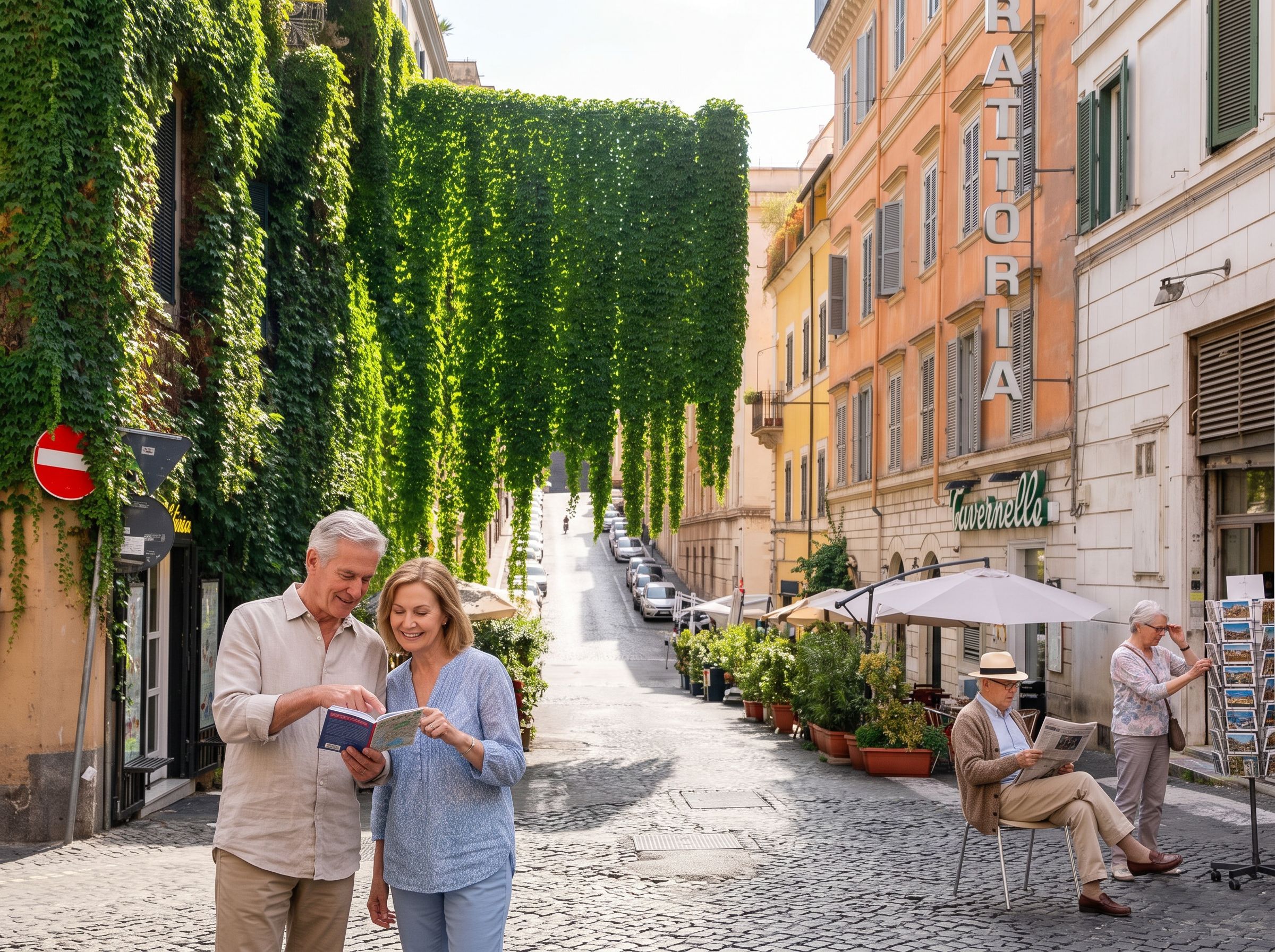 AI-edited
Where should travellers over 50 base themselves in Rome?
Stay central. Travellers in their sixties and seventies consistently emphasise a centrally located hotel so they can plan a walk for the day, return mid-afternoon to rest, and go out again in the evening. Monti is the most frequently recommended base for older visitors, with the Pantheon and Navona area a close second.
The reasoning is practical rather than romantic. A central base turns a big city into a series of short, manageable outings. A hotel near Termini or in Monti puts the metro, the main rail station and the archaeological core within reach, and it makes the mid-day return to the room feasible rather than a project.
Guest feedback across Rome hotels points to the same priorities for mature travellers: quiet rooms, working lifts, spacious rooms, and breakfast settings that are not reached by stairs or squeezed into a corridor. Reviews of several central Rome properties praise soundproofing and describe rooms as very quiet even on busy streets, while other reviews report street noise, corridor noise, thin walls and breakfast rooms that are cramped or reached by stairs. Both patterns appear in the same city.
A room with a balcony and a view is recommended in traveller discussions as part of the trip design rather than an extra, on the grounds that a pleasant place to sit in the afternoon changes the shape of the day. For readers who want to compare specific properties, our dedicated hotel guides cover individual reviews.
What pace is realistic in Rome for a traveller over 50?
One area per day. Itineraries built for visitors in their sixties typically keep Day 2 around the Colosseum and the nearby area, Day 3 in Vatican City, and Day 4 around Piazza Navona, with long blocks allowed for each. Even a short Rome day is physically substantial.
The same itineraries allow two to three hours for the Colosseum alone, and four to five hours for the Sistine Chapel and St Peter's Basilica combined. Those figures are worth holding onto when planning, because they are the realistic durations for visitors who are not rushing.
A traveller in their late sixties with knee problems reported that a successful Rome trip was entirely feasible but required thoughtful planning and flexibility. The same report described an all-day golf cart tour as the best recovery move after underestimating walking capacity, and said it allowed the group to see far more than they could have managed on their own. Golf cart tours are a recurring recommendation in traveller discussions about Rome for older visitors and for visitors with limited mobility.
How walkable is Rome, really?
Rome's centre has extensive cobblestones. Even where a site is reachable, the immediate surroundings can be tiring on foot and are better tackled in short segments.
That last point matters. There is no official citywide terrain rating for Rome, and no documented average daily step count. What is documented is site-specific: the surfaces around the major monuments, the distances between them, and the access arrangements inside them. Planning should be built on those, not on a general impression of the city.
The practical consequence is that a Rome day is best broken into segments rather than treated as a continuous walk. A morning at one site, a sit-down lunch, an afternoon at a second site within a short distance, and an evening in a district where the walking is gentle. The gentle seaside strolls and best views on the Amalfi Coast follow a similar logic for readers who prefer their walking flat and short.
What are the mobility realities at the Colosseum and the Forum?
The Colosseum's main entrance is described as wheelchair accessible with no stairs, and a lift connects the ground floor to the first and second levels. The underground and attic levels are not accessible to wheelchair users because of stairs and narrow passages. The Roman Forum and Palatine area is included in the same timed-entry system.
The Colosseum opens at 8:30 a.m., with the Roman Forum and Palatine area opening at 9:00 a.m. In summer 2026 it closes at 7:15 p.m., with last admission at 6:15 p.m. The site closes on 1 January, 1 May and 25 December in the published 2026/2027 schedule.
Tickets are timed and name-specific, and official reservations are released 30 days in advance. The official site publishes a helpdesk email and phone number for booking support, and assistance responses are said to take 48 to 72 hours by email. Free admission is offered on the first Sunday of the month, plus 25 April, 2 June and 4 November, and the official page states that free-admission slots are not reserved in advance.
Reduced and free categories are documented, including free entry for disabled visitors and one companion, and reduced pricing for some younger EU citizens. No senior-specific fare is documented on the official Colosseum pages.
Specific step and terrain detail for the Roman Forum and Palatine area is not documented. Ask at the ticket desk or check the official page before committing to a long Forum walk.
How accessible are the Vatican Museums?
The Vatican Museums state that ramps and elevators are available along the main gallery circuit, with an accessible entrance opposite the Pinecone Courtyard and free wheelchairs available with ID and a deposit. Most guided tour routes can be adapted for wheelchair users.
Disabled visitors and their companions receive free tickets at the Special Permits or Welcome Desk, and those free tickets cannot be booked online. Free entry is documented for visitors with a certified invalidity of at least 67 per cent, and where the visitor is not self-sufficient, free entry extends to a companion as well.
Standard admission is €20 without online booking, with a reduced rate of €10 without online booking. The museums are open Monday to Saturday, with free entry on the last Sunday of the month, subject to the museum's opening and closure calendar.
The Vatican Museums do not document a general senior discount by age. Concessions are documented for children under seven, EU youth age bands, and disability-based admission. Readers who want the full picture on access and assistance should consult the Vatican Museums accessibility information before booking.
Which metro stations and transport options work for reduced mobility?
ATAC states that all metro stations are accessible to passengers with reduced mobility except Spagna, Barberini, Repubblica and Vittorio Emanuele on Line A. The Termini to Centocelle line is not accessible. Metro Line C is fully accessible, while Lines A and B are only partially accessible and need advance checking of lift status.
Buses are among the more practical options for step-free movement in Rome, and Line C is the most reliable metro line for mobility access. Four independent accessibility sources agree that Rome's metro is uneven for step-free travel, with Line C best and older Line A sections less reliable. ATAC's official transport page is the key source for current metro accessibility, and the operator also publishes accessibility information for bus and rail network users.
For arrivals, the Sala Blu assistance service at Roma Termini supports passengers with reduced mobility, and advance booking is recommended. At Rome Fiumicino Airport, ADR provides assistance for passengers with reduced mobility, including accessible desks and priority procedures for security and passport control. First aid at Fiumicino is open 24 hours a day, and pharmacies are available in Terminal 1 and Terminal 3, with additional non-prescription pharmacies in the boarding areas. Airport-access guidance for Rome states that PRM assistance should be requested at least 48 hours before the flight, for both Fiumicino and Ciampino.
One traveller discussion about a 74-year-old visitor gave blunt advice: do not rely on buses, the subway is the best option. That sits awkwardly beside the accessibility guidance, and the reconciliation is that Line C and the accessible Line A stations work well, while the rest requires checking. Readers who want the operator's own current position should start with Rome's official public transport information.
What transport disruption should travellers plan around?
Rome's Metro A has been running with last trains at 21:00 from Sunday to Thursday, with extra buses covering the route afterwards. Friday and Saturday service runs later, until 01:30. The early Sunday-to-Thursday cutoff means taxis, buses or itinerary changes may be needed after dinner.
Several stations have been through extended works. Spagna at the Spanish Steps was closed for an extended refurbishment in 2024 and was scheduled to reopen in early October after work on accessibility and restyling. Ottaviano, the Metro A stop serving the Vatican area, was closed for renovation and later reopened after a 50-day shutdown, with reports noting that work continued afterwards. Furio Camillo on Metro A was closed from 19 August to 7 November 2024 for escalator replacement and other renewal work. Vittorio Emanuele was closed from 8 April to 30 June 2024 for extraordinary maintenance, with nearby Manzoni or Termini suggested as alternatives.
In August 2024, Rome closed half of Metro A between Termini and Battistini for track works, with replacement buses operating during the shutdown. Rome also temporarily replaced much of its tram network with buses from mid-September to early December 2024 while redeveloping the Porta Maggiore tram depot, with a return to normal tram operation targeted for early December. Piazza Venezia was largely inaccessible to vehicles because of excavation for a new Metro C station a short distance from the Colosseum, and lifts were under construction at San Giovanni to improve access and interchange between Metro A and Metro C.
Because works continue, check the operator's current notices in the week before travel rather than relying on any published summary.
When should travellers over 50 go to Rome?
April to June and September to October are the most comfortable months for sightseeing. July and August are the hottest, driest and busiest, and are the least comfortable for older visitors. Autumn brings good weather with fewer crowds, and winter has the lowest crowds but more closures.
Rome has a hot-summer Mediterranean climate. Average highs rise from about 12 to 13°C in January to about 30 to 31°C in July and August. Rainfall peaks in autumn, especially October and November. The World Weather Information Service gives the driest period as July at 19.2 mm and the wettest month as November at 115.4 mm.
Crowd pressure follows the same curve. Rome's tourism office reported record-breaking summer tourism in 2025, stating that the city received over 38 million tourist arrivals during the summer and that over 70 million arrivals were expected for the full season. That is the context for anyone considering a July or August visit.
| Period | Conditions | Planning note |
|---|---|---|
| April to June | Mild, comfortable for sightseeing | Strong window for travellers over 50 |
| July to August | Hottest and driest; average highs 30 to 31°C | Peak crowds and prices; hardest months |
| September to October | Excellent weather, fewer crowds | Second strong window |
| October to November | Rainfall peaks; November wettest at 115.4 mm | Pack for rain |
| Winter | Lowest crowds, more closures | Check individual sites before travelling |
The Colosseum's earliest documented opening is 8:30 a.m., which is the earliest figure.
What tickets, passes and concessions apply?
EU citizens aged 65 and over are listed among reduced-fare categories for Rome city museums and archaeological sites. The city also offers free admission for visitors with disabilities plus one companion. The Roma Pass gives access to more than 100 attractions and is valid for 72 or 48 hours.
The city museum network lists free admission to everyone on the first Sunday of each month, free admission for visitors with disabilities and a family member or carer, and a reduced rate of 50 per cent for non-resident visitors in the last two hours of each museum's opening on every Wednesday. Non-resident visitors aged between 6 and 25 also fall into a reduced category. Groups of at least 20 people have their own provision. The Sistema Musei di Roma Capitale can be reached on 060608 every day from 9:00 to 19:00.
The Museo Nazionale Romano is open Tuesday to Sunday, closed Mondays, with last admission at 18:00. Full price is €15, with a concession at €2, and a ticket for the Aula Ottagona only at €5. A combined ticket allows entry to each venue within one week of the first visit, and an annual card provides unlimited access to the four museum sites for one year from the day of purchase. Admission is free to all state-run cultural venues on the first Sunday of the month. The Crypta Balbi site is temporarily closed to the public, and at the Baths of Diocletian site the Natatio, Hall VIII and the Museum of Protohistory are closed until further notice.
The Pantheon is open daily from 9:00 to 19:00, with the ticket office closing at 6:00 p.m. and last individual entry at 6:30 p.m. Full price is €7 and the reduced category shown is EU citizens aged 18 to 25, not seniors. Admission is free on the first Sunday of the month. Visitors with disabilities or reduced mobility may enter via the external ramp on the Via della Minerva side.
The Roma Pass, valid 72 or 48 hours, gives access to more than 100 tourist attractions including museums, monuments, archaeological areas and experiences. The published page does not document a senior-specific Roma Pass price.
What should travellers know about pharmacies, hospitals and safety?
The emergency number in Italy is 112. A city pharmacy-finder portal is the practical way to locate the closest one.
Several central 24-hour pharmacies are named in Rome medical guidance, including Farmacia Piram on Via Nazionale, Farmacia Trastevere on Viale di Trastevere, Farmacia Igea San Gallicano on Via di San Gallicano, and Farmacia Senato Criserà Guglielmo on Corso del Rinascimento. Major hospitals with emergency departments include Policlinico Umberto I on Viale del Policlinico 155, Ospedale San Camillo-Forlanini on Circonvallazione Gianicolense 87, and Azienda Ospedaliera San Giovanni-Addolorata on Via dell'Amba Aradam 8. Ospedale Pediatrico Bambino Gesù at Piazza di Sant'Onofrio 4 operates 24 hours a day.
ECC-Net Italia's Rome health and safety guidance advises checking facilities in advance, especially elevators, ramps and modified public transport during busy periods and Jubilee-related crowds. The same guidance notes that the municipality's operations centre can be contacted for non-medical assistance within the municipal area.
On the street, traveller discussions advise carrying enough cash for a cab ride because some drivers may refuse credit cards, avoiding purchases from street vendors, and buying tickets from official websites or guided tours rather than accepting street offers of skip-the-line entry. Guided tours are recommended as a way to avoid the longest queues at the Colosseum and the Vatican, which is a mobility benefit as much as a time saving.
No place-specific safety warning is documented for the Colosseum or the Vatican Museums beyond controlled access and timed entry. No nearest pharmacy or medical-help point is documented for either site.
What about tours for seniors and limited mobility?
Golf cart tours recur in traveller discussions about Rome for older visitors and for visitors with limited mobility. Guided tours are also recommended for avoiding the longest queues at the Colosseum and the Vatican.
The clearest account comes from a traveller in their late sixties with knee problems, who described an all-day golf cart tour as the best recovery move after underestimating walking capacity, and said it allowed the group to see far more than they could have managed independently. That is a single report, not a recommendation of a particular company.
For the Vatican Museums, the accessibility page states free entry with the possibility of guided tours upon reservation, and notes that most guided tour routes can be adapted for wheelchair users. For the Colosseum, the official site publishes a helpdesk email and phone number for booking support, with assistance responses said to take 48 to 72 hours by email.
Readers who want a deeper look at touring with family members across generations might enjoy our guide to Tuscany with grandchildren, which follows a similar planning logic at a slower pace.
What else should travellers over 50 know before booking?
Book timed entries early, confirm lift status before travelling, and build the day around one area rather than several. Rome is manageable for travellers in their fifties to seventies, but it rewards planning rather than spontaneity.
Timed ticketing governs the Colosseum and the Roman Forum and Palatine area, with official reservations released 30 days in advance. Vatican Museums free tickets for disabled visitors cannot be booked online and must be collected at the Welcome Desk or Special Permits desk. City museum free days on the first Sunday of the month apply across the network, and the Museo Nazionale Romano's first-Sunday free admission applies to all state-run cultural venues.
Several site-specific details are not documented. The Roman Forum and Palatine area has no published step or terrain detail. Neither the Colosseum nor the Vatican Museums publishes a nearest pharmacy or medical-help point. Rome as a whole has no documented citywide walking grade or senior terrain rating. Where a detail is not published, ask the operator directly rather than assuming.
For readers extending a trip south, the Path of the Gods and other Amalfi Coast trails for active over-50s covers a very different kind of walking, and the Amalfi Coast family guide covers multi-generational travel from the same region.


