
The Amalfi Coast rewards families who choose their base carefully. Amalfi town has the flattest main waterfront area of the coast's better-known settlements, while Positano is steep and stair-heavy and Ravello is reached by road and is much less walkable for limited mobility. For grandparents travelling with grandchildren, that single fact shapes everything: where to sleep, how to move, and how much to attempt in a day.
The coast is a cliff-set landscape of vertical villages and stairways, and that is part of its cultural form as much as its scenery. It is also the main travel consideration for older visitors. The good news is that the easiest sightseeing here is often done from the water rather than by road, and the towns with the gentlest walking are also the ones with the best beaches for children.
Is the Amalfi Coast suitable for children?
Yes, with the right base and realistic distances. The official Amalfi Coast FAQ identifies Maiori and Minori as the best beaches for children, and notes there are no play parks, so beaches and piazzas are the main casual play spaces. Amalfi town offers the flattest waterfront and level central square on the coast.
The official visitor information states that the tourist season runs from early April, or Easter, until the end of October, and that spring or early autumn are the best times because there are fewer tourists. One accommodation-focused source suggests May or September specifically as preferable periods for comfort and lower strain. Both windows suit grandchildren of school age and grandparents who would rather not queue in August heat.
What the coast does not offer, according to the official FAQ, is playgrounds. Beaches and piazzas do the work instead. That is worth knowing before you promise a park.
Where should grandparents base themselves?
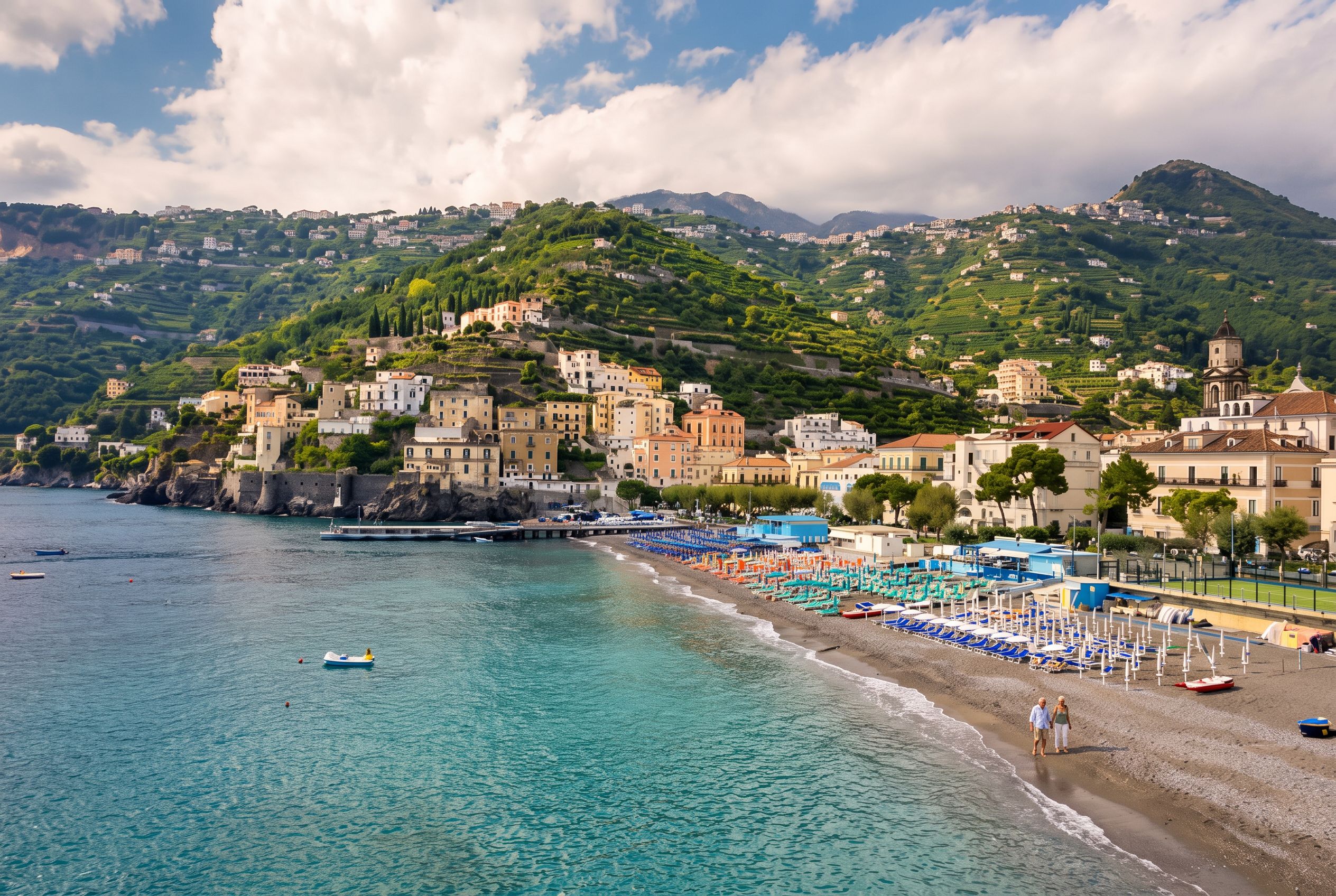
Amalfi town is the best-supported base in the material gathered for multigenerational travel. Its main seafront and Piazza Duomo are described as mostly flat, with the cathedral square at water level. The town becomes steeper behind the square, and the cathedral itself has stairs to enter.
That flat core matters more than it sounds. It means a grandparent can walk a toddler in a pushchair along the waterfront, or sit on a bench within sight of older children, without negotiating a staircase. It also means the walk back to a hotel is short and predictable.
Positano, by contrast, is repeatedly described as steep and staircase-dominated, with main routes functioning like staircases and limited practicality for independent wheelchair users in some accounts. Several sources advise visiting it by ferry or boat rather than basing there. Ravello's central area is described as relatively flat once reached, but reaching it means a road transfer.
 AI-edited
For a fuller comparison of the towns and their terrain, our guide to choosing the best base on the Amalfi Coast covers the same ground in more detail.
How do you get around without exhausting everyone?
Ferries and private transfers are the most consistently recommended ways to reduce strain on this coast. Public buses are documented as not accessible for wheelchair users or people with significant mobility limitations: narrow aisles, no wheelchair spaces, summer overcrowding and a step up to board. Driving is repeatedly discouraged.
Alicost, one of the ferry operators on the route, states that all its vessels accommodate passengers with reduced mobility and that it provides boarding and disembarking assistance on its fast ferries. The company asks passengers to notify it when booking on +39 089 871483 and to arrive at the dock at least one hour in advance. Its fleet runs five monohulls and two high-speed craft across the Gulf of Naples, the Gulf of Salerno and along the Amalfi Coast, with free Wi-Fi on board. One carry-on bag of up to 45 × 35 × 20 cm is included in the Travelmar ticket price, and Travelmar's service runs all year round across Salerno, Vietri sul Mare, Cetara, Maiori, Minori, Atrani, Amalfi, Praiano and Positano.
One forum contributor on getting around without a car bought day passes to avoid repeatedly buying individual tickets. A published guide gives the COSTIERASITA 24-hour pass at €10, or €12 including Positano's local buses, and a separate guide puts the local bus ride at €2 to €5 depending on distance and ticket. No senior or over-65 fare is documented for the Amalfi Coast transport operators reviewed.
What do you do with grandchildren of different ages?
Match the activity to the youngest child's stamina, not the eldest's. Gentle boat rides and beach time work across ages. Lemon groves suit school-age children who can manage a short climb. Teenagers can take on more walking, but the coast's terrain limits how much anyone covers in a day.
For younger children, the clearest documented option is a short boat outing. Capone Servizi Marittimi in Maiori publishes a half-day Amalfi Coast tour of about four hours, with a maximum of 12 passengers and advanced booking required. The route takes in sea views of the Marmorata Waterfall, Amalfi, the Natural Arch, Conca dei Marini, the Furore Fiord, Praiano and Positano, with a free stop of about one hour in Positano. A separate Maiori listing on GetYourGuide describes a four-hour small-group tour departing from the Port of Maiori, limited to six participants, with snacks, drinks and swim stops.
Amalfi Boat Tour publishes routes departing from every seaside town, including Maiori, covering Maiori, Minori, Ravello seen from the sea, Atrani, Amalfi, Conca dei Marini, Furore, Praiano and Positano. The company says a typical tour carries a maximum of 10 people and includes snorkelling sets, towels and a limoncello tasting. A small-group operator runs a half-day boat and snorkelling tour from Amalfi to Positano and back with a maximum of 10 to 12 participants.
For a wider look at moving around on the water, see seeing the Amalfi Coast mostly by boat, with little walking.
Which beach works best for a family day?
Maiori has the coast's longest beach and a wide seafront, and the official visitor information names Maiori and Minori as the best beaches for children. For beach time with mobility support, Marina Spiaggia in Amalfi is the clearest documented option, with an inclusive beach project running June to October.
The inclusive beach at Marina Spiaggia in Amalfi is documented with a walkway, floating chairs, a Job chair, six loungers, six umbrellas and free assistance from qualified operators. Access is available from June to October, with free assistance provided by the L'Alveare Social Cooperative. The cooperative organises access; no cancellation terms are documented.
Maiori sits 5.4 km from Amalfi by road, about 10 minutes with clear roads and no stops. That is a short hop for a beach day, and the seafront is wide enough that a grandparent can sit while children paddle within sight.
| Location | Terrain | Documented access notes |
|---|---|---|
| Amalfi town centre | Mostly flat waterfront and Piazza Duomo; cathedral has stairs; terrain climbs behind the square | Best-supported base for limited mobility |
| Marina Spiaggia, Amalfi | Walkway, floating chairs, Job chair, six loungers, six umbrellas | Free assistance by qualified operators, June to October |
| Maiori | Coast's longest beach and a wide seafront | Named by the official FAQ as best for children |
| Minori | Quiet sandy bay between Maiori and Amalfi | Named by the official FAQ as best for children |
| Positano | Very steep; main routes function like staircases | Best seen as a day visit or boat view |
What about gelato, pizza and a lemon grove?
Amalfi's flat centre is where the casual eating happens, and the lemon groves sit in the upper valley above town. The Amalfi Lemon Experience publishes a classic lemon tour at 10:15am lasting about 1.5 hours, at €30 per guest, with children aged 2 to 10 at €15 and under-2s free.
The Amalfi Lemon Experience is an organic, family-run lemon farm in Amalfi, run by Salvatore Aceto and his family. According to Visit Amalfi, excursions, educational tours, tastings, cooking classes and the sale of typical products are among the experiences the family offers daily, and a visit to the Museum of Farming Civilization Arts and Crafts adds value to the journey into the realm of the lemon. The farm states there is no parking on site and that the tour starts at Via Delle Cartiere 59 in Amalfi.
A separate listing describes the visit as sitting in the upper valley of Amalfi past the Paper Museum, with walking access uphill from the centre or a local mobility bus option. Pre-booking online is recommended. The Amalfi Historical Garden lemon farm publishes a 1 hour 30 minute tour with tasting, meeting on Salita per Pontone in Amalfi, including organic lemonade, limoncello and lemon cake.
One published warning matters here: the garden visit begins with a short climb up stone steps. That is the clearest documented caution for grandparents planning with younger children. The Amalfi Lemon Experience itself lists comfortable shoes with non-slip soles among its requirements.
For the eating side, the town's level centre is where pizza and gelato are easiest to reach with children in tow. The official FAQ notes there are no play parks, so the piazza does double duty as the after-lunch runaround.
How much walking is really involved?
The Amalfi Coast is not broadly easy for limited-mobility travel. Even short distances can involve stairs, waiting and mode changes, especially with luggage, children or older grandparents. Amalfi town is the strongest documented mobility-friendly zone; Ravello's main piazza and Villa Rufolo are moderate; Positano is hard.
Villa Rufolo in Ravello sits near the main plaza and bus stop, with mostly level gardens and only a few steps. One source says the approach is the challenge rather than the gardens themselves, and that visitors should check with the ticket office before proceeding. The villa's official notice effective 1 March 2026 states it opens daily from 09:00 to 18:00, with last admission at 17:30, and hours extend during festival season. Free guided tours are guaranteed from May 2026, including an English-language tour at 11:00.
The published tariff is €8 standard, €6 for visitors over 65 and children aged 5 to 12, and €7 for groups of 15 or more. That is one of the few documented over-65 reductions on the coast.
In Amalfi town, public elevators connect Piazza Municipio with the Luna Rossa parking area, and the Santa Maria elevators are documented as operating from 7:30am to midnight. A municipal page states the Santa Maria elevator ride costs €1.00 and is free for legally authorised disabled badge holders and Amalfi residents over 65. Another Amalfi page gives the public elevators to the monumental cemetery in Piazza Municipio, with descent always free and a single ride priced at €3.00.
If you want a gentler walking day, our piece on gentle seaside strolls and the best views on the Amalfi Coast maps the flatter options. Anything involving serious climbing belongs in walking the Path of the Gods and other Amalfi Coast trails, which has its own dedicated guide.
When should you go, and what should you book?
Spring or early autumn are the best times according to the official Amalfi Coast FAQ, which gives the season as early April, or Easter, to the end of October. May and September are suggested by one accommodation-focused source for comfort and lower strain. The inclusive beach at Marina Spiaggia runs June to October.
Book boat tours in advance. Capone Servizi Marittimi requires advanced booking for its half-day tour, and the Amalfi Lemon Experience recommends pre-booking online. Alicost asks passengers needing assistance to notify the company when booking and to arrive at the dock at least one hour ahead.
Road restrictions affect family travel by vehicle. A 2026 report said Salerno province banned tourist buses, mini-vans and other heavy vehicles from the road linking Ravello and Scala, citing safety issues, and another provincial restriction affected the SR 366 linking Agerola to Amalfi via Furore and Conca dei Marini. Seasonal alternate-plate controls apply between Vietri sul Mare and Positano, generally from 10:00am to 6:00pm, with odd-numbered plates barred on odd dates and even-numbered plates on even dates. A separate 2026 practical guide gives the SS163 restrictions as running from 1 June to 31 July on weekends and public holidays, from 1 August to 30 September every day, and in October on weekends and public holidays, all between 10:00am and 6:00pm. Exemptions include tourists with confirmed bookings for arrival and departure days, drivers with disability badges, taxis and private hire vehicles.
The tourist information point in Amalfi is documented as open daily from 10:00am to 7:00pm from 1 April to 2 November, with reduced winter hours from 3 November to 31 March, according to Visit Amalfi's getting-around page.
What should grandparents know about health and safety?
Emergency numbers for the Amalfi area are documented as 118 for medical emergencies and 112 for general emergencies. The Guardia Medica in Amalfi can be reached at 089.871272. No coast-wide entry ticket or universal permit applies to the Amalfi Coast itself.
One Amalfi-specific source also documents local service numbers including 113, 115, 116, 117 and 1530 for various services. The material does not document a nearest pharmacy or medical point for Amalfi town centre specifically, so ask at your accommodation on arrival.
On accommodation, reviews across several Amalfi properties point to the same practical theme: ask about stairs and noise before booking. One review of Hotel Croce di Amalfi described 77 steps to reach the hotel and warned the property is difficult if mobility is an issue. Hotel Doria was noted in one review as having a handicap-accessible room and bathroom, presented as an exception rather than a standard. Several properties drew comments about thin walls, church bells, street noise or hard beds. Ask for a room away from the street or stairwell, and confirm step counts and lift access in writing when booking.
On heat, the season runs to the end of October, and the coast's vertical layout means shade and breeze vary sharply between the waterfront and the lanes behind it. Plan the uphill or exposed parts of any day for the morning.
Coast-wide cultural programming has been active, but it is spread across multiple towns rather than centred in one place, as the Amalfi Coast UNESCO World Heritage press release sets out: the project debuted on 6 June 2025 with an inaugural event in Positano and continued with 13 further events, one per municipality.
What does a realistic family day look like?
A workable pattern is a morning boat or beach, lunch on Amalfi's flat waterfront, an afternoon rest, and one short outing. The coast rewards fewer, better-chosen activities rather than a full itinerary, because transport between towns eats the day.
Distances are short but slow. Amalfi to Maiori is 5.4 km by road, about 10 minutes with clear roads and no stops. Amalfi to Positano is 19 km, about 35 minutes with clear roads. Maiori to Positano is 24 km, about 45 minutes with clear roads. Salerno Costa d'Amalfi Airport to Amalfi is 46 km, about 65 minutes with clear roads. Those times assume free-flowing traffic, no stops and no town crossings in rush hour.
Salerno Costa d'Amalfi Airport reopened for commercial service in July 2024 after renovation, with press reports in 2024 saying flights restarted on 11 July 2024 and further terminal work planned into 2026 and 2027. The airport had been closed for commercial use since 2016.
For days beyond the coast itself, our guide to day trips worth making from the Amalfi Coast covers Capri, Pompeii and Ischia, which have their own dedicated guide.
The practical summary
Amalfi town works as the base because its waterfront and central square are the flattest documented ground on this coast. Maiori and Minori are the beaches the official visitor information names for children, and Maiori is a 5.4 km hop from Amalfi. Marina Spiaggia in Amalfi is the clearest documented option for beach time with mobility support, running June to October with free assistance from qualified operators.
Boat tours, a lemon grove visit and Villa Rufolo in Ravello fill the days that remain. Each has a documented price, season or condition, and each can be booked ahead. Rates for accommodation are indicative and vary by season and booking channel, so confirm directly with the property.
The one thing to accept is that this coast is built on slopes. Plan around the steps rather than pretending they are not there, keep the walking distances short, and the grandchildren will remember the boat, the beach and the lemonade rather than the staircases.


