
The Zillertal stretches like a long, green corridor through the Tyrolean Alps, and each village along its spine has a distinct character. For travellers aged 50 to 70, the choice of where to stay can make the difference between a trip that flows effortlessly and one that requires daily compromises. This guide compares five key bases—Mayrhofen, Zell am Ziller, Fügen, Finkenberg, and Hintertux—across the factors that matter most: atmosphere, transport links, walkability, cable-car access, and evening pace.
 AI-edited
Which village offers the best atmosphere for seniors?
Zell am Ziller feels like a real working town with a relaxed pulse, while Mayrhofen is busier and more resort-oriented. Fügen offers a spa-focused calm, Finkenberg is a quiet satellite of Mayrhofen, and Hintertux is a high-altitude outpost for glacier enthusiasts.
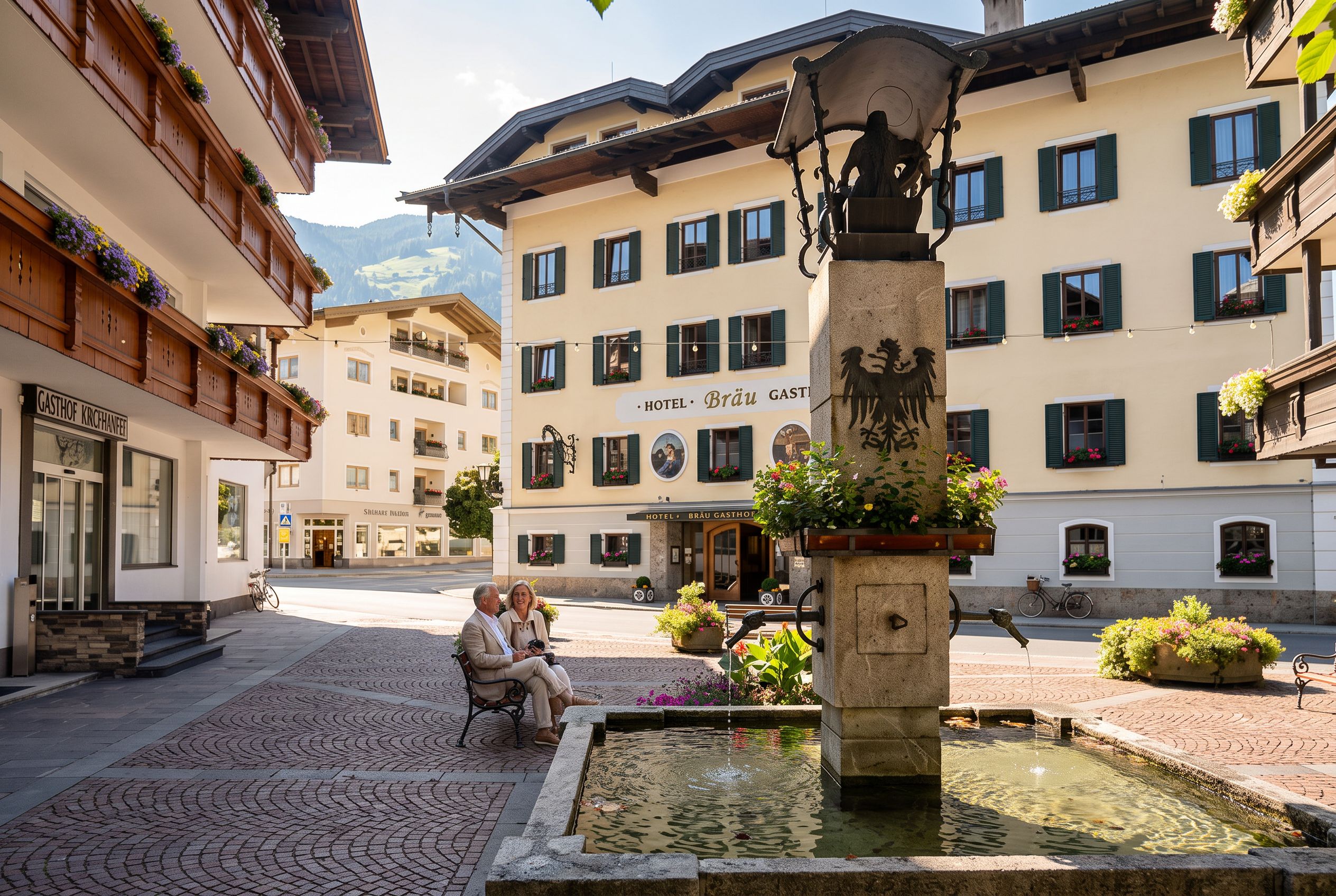
Zell am Ziller is often described as the valley's historical and cultural heart. Its late-Baroque parish church — locally called the "Zillertal Dom", completed in 1779 — and the farmers' markets of the Zell-Gerlos area give it an authentic, lived-in feel that many visitors over 50 appreciate. The village centre is compact, with a handful of good restaurants and a few shops, but it never feels overwhelmed by tourism. The impression regular visitors describe is of a working village that happens to have tourism in it, rather than the reverse.
Mayrhofen, by contrast, is the valley's largest resort and its commercial hub. It has more restaurants, shops, and evening options than any other base, but it also draws larger crowds, especially during school holidays. Guest reviews note that the main street can feel busy, and some hotels near the centre report noise from evening entertainment until 10 pm. For those who prefer a quieter evening, a room in a side street or a hotel with good soundproofing makes a difference.
Fügen sits lower in the valley and has a spa-oriented atmosphere, thanks to the Zillertal Thermal Baths and several wellness-focused hotels. It is calmer than Mayrhofen but still has good services. Finkenberg, just a few kilometres from Mayrhofen, is a quieter alternative with direct access to the Penken ski area. Hintertux, at the valley's southern end, is the smallest and most remote, appealing primarily to those who want year-round glacier skiing or high-altitude hiking.
How do transport links compare between villages?
Mayrhofen and Zell am Ziller sit on the main Zillertalbahn rail line, making them the most convenient bases for car-free travel. Fügen is also on the line, while Finkenberg and Hintertux require a bus connection from Mayrhofen.
The Zillertalbahn runs from Jenbach in the Inn Valley up to Mayrhofen, with stops at Fügen, Zell am Ziller, and several smaller villages. The journey from Jenbach to Mayrhofen takes about 50 minutes, and the operator runs a half-hourly service on the 32-kilometre line. Accessibility is more specific than a blanket promise: the Verkehrsverbund Tirol lists for each individual connection whether it is a low-floor train and whether a wheelchair space and a wheelchair-accessible toilet are on board, and a wheelchair space can be reserved in advance on +43 5 17 17 5. Our guide on Getting to the Zillertal covers the full journey from Innsbruck Airport.
Finkenberg is served by a regular bus from Mayrhofen's train station, taking about 10 minutes. Hintertux is farther: bus line 4104 takes 40 minutes from Mayrhofen station to the glacier cable car. The Zillertal Arena operates free ski buses during winter cable-car hours, connecting Zell am Ziller, Gerlos, and surrounding villages directly to the slopes; free travel applies with a valid ski pass and winter sports equipment. Mayrhofen has its own free ski buses to the Ahornbahn and Penkenbahn, and the local tourist board describes those buses as barrier-free. In both cases the buses run only during lift operating times, not for late-evening trips.
| Village | Rail connection | Bus to Mayrhofen | Free ski bus |
|---|---|---|---|
| Mayrhofen | Terminus of Zillertalbahn | N/A | Yes (to Ahornbahn and Penkenbahn) |
| Zell am Ziller | Yes, 11 min to Mayrhofen | N/A | Yes (to Arena) |
| Fügen | Yes, 35 min to Mayrhofen | N/A | No |
| Finkenberg | No | 10 min | No |
| Hintertux | No | 40 min (line 4104) | No |
Which village is most walkable and step-free?
Zell am Ziller and Fügen have the flattest, most compact centres with paved paths, making them the most walkable for seniors. Mayrhofen is walkable but hillier, while Finkenberg and Hintertux have steeper terrain and fewer level pavements.
Zell am Ziller's main street is largely flat, with shops, cafes, and the train station within easy walking distance of most hotels. The village's compact layout means you rarely need a bus for errands. Fügen is similarly flat and well-paved, with the Spieljochbahn cable car station just a short walk from the centre. The operator describes the Spieljochbahn as a barrier-free gondola, and the Austrian cable-car association's accessibility data sheet of November 2024 lists both sections as wheelchair-navigable, with accessible parking and accessible toilets at the valley station — practical details for those with limited mobility.
Mayrhofen is more spread out. The train station, main shopping street, and the Penkenbahn and Ahornbahn cable cars are within a 15-minute walk of many hotels, but the village has gentle slopes and some uneven pavements. Guest reviews mention that older pavements in the side streets can be uneven, so sturdy footwear is advisable. For a detailed assessment of mobility across the valley, see our dedicated guide: How Accessible Is the Zillertal for Older Travellers?
Finkenberg and Hintertux are both hillier. Finkenberg's centre is small but on a slope, and Hintertux sits at 1,500 metres with steeper paths and fewer level walking routes. These villages are better suited to those who are comfortable with inclines or plan to use lifts for most outings.
Which village has the best cable-car access?
Mayrhofen has the most direct lift access with two major cable cars in the village itself. Zell am Ziller is the gateway to the Zillertal Arena, while Fügen, Finkenberg, and Hintertux each serve one specific ski area.
Mayrhofen is home to the Penkenbahn and the Ahornbahn, both within walking distance of the village centre. The Mayrhofen-Hippach tourist board states that all four of the resort's feeder lifts — Ahornbahn, Penkenbahn, Horbergbahn and Möslbahn — offer barrier-free boarding, and singles out the Penkenbahn as the most accessible of them; the Austrian cable-car association's data sheet lists accessible toilets at the Ahornbahn valley and summit stations too. From Mayrhofen, you can access three distinct ski areas: Penken, Ahorn, and, via bus, the Hintertux Glacier.
Zell am Ziller is the main access point for the Zillertal Arena, the valley's largest ski area. The Rosenalmbahn cable car is a short walk or bus ride from the village centre. The Kapauns 8-seat chairlift, which improves the connection between Zell am Ziller and Gerlos, has been running since the 2022/23 winter season; the regional paper Bezirksblätter Schwaz put the total investment including piste work at €14.5 million. It replaced a two-seater from 1993 and now carries passengers all the way up to the Übergangsjoch.
Fügen has the Spieljochbahn, whose two sections the November 2024 data sheet lists as wheelchair-navigable. Finkenberg has the Finkenberger Almbahnen, which link into the Penken area and whose valley-station car park is described as entirely barrier-free. Hintertux has the glacier cable car, open 365 days a year between 1,500 and 3,250 metres, and the ascent from the valley station to the panorama terrace at the top is listed as wheelchair-accessible. For summer visitors, the Hintertux Glacier offers skiing even in July, but it is the farthest base from the valley's other attractions.
How does evening liveliness compare between villages?
Mayrhofen has the most evening options, including restaurants, bars, and occasional live music. Zell am Ziller and Fügen are quieter, with a few good restaurants but limited nightlife. Finkenberg and Hintertux are very calm after dark.
Mayrhofen's evening scene is the valley's most varied. You will find everything from traditional Tyrolean restaurants to Italian pizzerias and a handful of bars. However, some hotels near the centre report noise from evening entertainment until 10 pm, as noted in recent guest reviews. For a quieter stay within Mayrhofen, choose a hotel set back from the main street or one with good soundproofing. The Neuhaus Zillertal Resort on Am Marktplatz is central and rated 4.3 out of 5 from 1,434 Google reviews as of August 2026; guest impressions of noise vary, so it is worth asking for a room away from the square.
Zell am Ziller offers a more relaxed evening. There are several good restaurants — the Restaurant Bräu on Dorfplatz and the SpitzBua on Gerlosstrasse among them — but the village does not have a party scene. Fügen is similarly calm, with a few restaurants and the Therme Zillertal open daily from 10 am to 10 pm. Finkenberg and Hintertux have very limited evening options; most visitors eat at their hotel or drive to Mayrhofen.
"We had great time with Zelloon. The room and service is impeccable. The spa area is amazing and also quiet. Breakfast is delicious. Close to the ski lift as well." — a Google review of the Zelloon Boutique Hotel in Zell am Ziller, January 2025
Which village suits winter versus summer visits?
For winter, Mayrhofen and Zell am Ziller are the best all-round bases for ski access and services. For summer, Fügen and Zell am Ziller offer the most relaxed walking and wellness options, while Mayrhofen is better for those who want varied hiking and lift-accessed trails.
In winter, Mayrhofen's three ski areas give it the edge for variety. The Penken area is popular for intermediate skiing, while Ahorn is gentler and better for beginners. Zell am Ziller's Arena is vast and well-connected by free ski buses. Fügen's Spieljoch is a smaller, family-friendly area. Finkenberg and Hintertux are quieter but offer direct access to specific slopes.
In summer, the Zillertal transforms into a hiking paradise. Mayrhofen has the most marked trails and lift-accessed routes, including the Ahornbahn, which runs daily until 31 October 2026 at fifteen-minute intervals. Zell am Ziller offers gentler valley walks and access to the Arena's summer activities, including the Arena Coaster at the Rosenalmbahn valley station, where riders set their own speed; Google reviewers note that queues build through the afternoon, so an early ride is easier. Fügen is ideal for those who want to combine walking with spa visits at the thermal baths. Finkenberg and Hintertux offer high-altitude hiking but with fewer services.
Which village is best for seniors with mobility concerns?
Zell am Ziller and Fügen are the most senior-friendly bases due to their flat terrain, step-free cable cars, and good public transport. Mayrhofen is also practical if you choose a hotel with confirmed elevator access and step-free entry.
For travellers who want to minimise walking on uneven ground, Zell am Ziller's compact, flat centre is ideal. The Rosenalmbahn valley station sits across the Ziller in Rohrberg and is reached by the village and ski buses; the operators' accessibility data sheet names it the barrier-free entry point to the Zillertal Arena, with accessible parking, accessible toilets and level gondola boarding from the 2025/26 winter (a ramp before that). Fügen offers similar advantages, with the Spieljochbahn providing step-free boarding and accessible toilets.
Mayrhofen requires more careful hotel selection. The village has slopes, and some older hotels lack elevators. The tourist board's accommodation search can be filtered for accessible properties: open "All filters" and tick "Behindertengerecht" under features. When booking, confirm that your hotel has elevator access, step-free entry, and an accessible bathroom. The Neuhaus Zillertal Resort is an example of a centrally located, well-equipped house: the tourist board lists a large wellness area, a well-stocked wine cellar and free parking, but neither it nor the hotel's own site documents a lift or step-free entry.
The Hotel Zum Senner Suites in Schlitters (a small village near Fügen) is described on booking portals as having a lift, upper floors reachable by lift and one wheelchair-accessible unit; the hotel's own website documents none of these. Schlitters is quieter than the main bases and has its own Zillertalbahn station — six minutes from Fügen-Hart and 41 minutes from Mayrhofen — which makes it practical for guests who prefer calm surroundings.
How do costs compare between villages?
Zell am Ziller generally offers better value than Mayrhofen, with more affordable accommodation and dining. Fügen is mid-range, while Finkenberg and Hintertux can be pricier due to their smaller size and specialised appeal.
According to Fodor's travel guide, Zell am Ziller has "a dozen hotels or bed-and-breakfast pensions at surprisingly reasonable cost," making it the valley's best-value base. Mayrhofen, as the largest resort, tends to be more expensive, especially during peak winter and summer seasons. Fügen falls in between, with a mix of mid-range hotels and spa resorts.
Finkenberg and Hintertux have fewer accommodation options, which can drive up prices, particularly for hotels with direct lift access. However, they offer a quieter, more exclusive experience that some travellers are willing to pay for.
| Village | Hotel price (per night, double) | Dinner for two (mid-range) |
|---|---|---|
| Mayrhofen | €€€ | €60-80 |
| Zell am Ziller | €€ | €45-65 |
| Fügen | €€ | €50-70 |
| Finkenberg | €€€ | €55-75 |
| Hintertux | €€€ | €60-85 |
What about the smaller villages like Gerlos or Kaltenbach?
Gerlos and Kaltenbach are covered in their own dedicated guides, but in brief: Gerlos offers a high-altitude atmosphere with direct Arena access, while Kaltenbach is a modern ski resort with efficient lift connections.
Gerlos sits near the Salzburg border and is part of the Zillertal Arena system, with free ski buses connecting it to Zell am Ziller. It is a good choice for skiers who want a quieter base with direct slope access. Kaltenbach is a modern resort with the Hochzillertal lift system, which reaches almost 2,400 metres; unlike the Mayrhofen, Zell, Fügen and Hintertux lifts it publishes no accessibility data sheet, so step-free boarding is not documented there. Both villages are worth considering if your priorities align with their specific strengths, but for most seniors, Zell am Ziller or Mayrhofen offer a better balance of services and accessibility.
For those interested in the valley's cultural side, our guide on Alpine Traditions and Village Life in the Zillertal explores the history and customs that make each village unique.
"The location was perfect for the station to go to Zell am Ziller and Hoch Zillertal. It was easy to pick up the bus to take us to the gondola or to the Glacier." — a guest reviewing the Neuhaus Zillertal Resort in Mayrhofen on Google in May 2023
Which village should you choose?
Choose Mayrhofen if you want the widest choice of restaurants, lifts, and services right on your doorstep, and you are comfortable with a busier atmosphere. Choose Zell am Ziller if you prefer a quieter, more traditional base with good value and solid transport links. Choose Fügen for a spa-focused stay, Finkenberg for calm near Mayrhofen, and Hintertux for glacier access.
For most travellers aged 50 to 70, the decision comes down to a simple trade-off: convenience versus calm. Mayrhofen offers the most convenience but can feel busy, especially during peak season. Zell am Ziller offers calm and value while still being well-connected. Fügen is a strong middle ground for those who want spa facilities and flat walking.
Whichever village you choose, the Zillertal's excellent public transport network means you are never far from the valley's attractions. Plan your base according to your priorities, and you will have a trip that feels tailored to your pace.


