
Located in the heart of Tyrol, the Zillertal is a long, glacier-fed valley that Tyrol’s tourist board measures at over 47 kilometres, from Jenbach up to the year-round glacier ski area. For travellers aged 50 to 70 who tire easily or use a stick, walker, or wheelchair, the question is not whether the valley is accessible, but where its accessible pockets lie. The honest answer: the Zillertal is generally strong for limited mobility, especially on the valley floor and at major cable cars, but it is not universally step-free. The best experience comes from planning around the region’s barrier-free lifts, the Zillertalbahn railway, and level promenades, while avoiding steep alpine terrain and uneven village paths.
 AI-edited
How easy is the valley floor for walking and wheeling?
The valley floor is the easiest terrain in the Zillertal for older travellers. The main towns—Zell am Ziller, Mayrhofen, and Fügen—offer mostly flat or gently graded pavements, riverside paths, and level access to key attractions. However, some older village sidewalks remain uneven, so a rollator or wheelchair user should stick to the main routes and promenades.
The standout valley-floor route is the Zillerpromenade, the riverside path along the Ziller. The Zillertal Arena describes it as an easy, comfortable walk and says it suits families with prams; no official body certifies it as wheelchair-accessible, so treat it as gentle rather than guaranteed step-free. From the Ziller bridge in Zell am Ziller you can follow either bank 4 kilometres to Hippach and 8 kilometres in all to Mayrhofen, with a bridge roughly every 1.5 kilometres to cross over and shorten the return. The signposted circuit is 3.5 kilometres with only 10 metres of ascent.
In Mayrhofen, the town centre is compact and mostly level, with pedestrian-friendly streets and benches for rest, though some side streets have older cobblestones. The tourism board lists barrier-free access at the Europahaus, the parish church, the Erlebnissennerei dairy and the Naturparkhaus in Ginzling. The Zillertal ActivCard gives free travel on numerous bus services in the valley, which helps reduce walking between sights. For a deeper look at village life and traditions, see our guide to Alpine Traditions and Village Life in the Zillertal.
Which cable cars and gondolas are truly step-free?
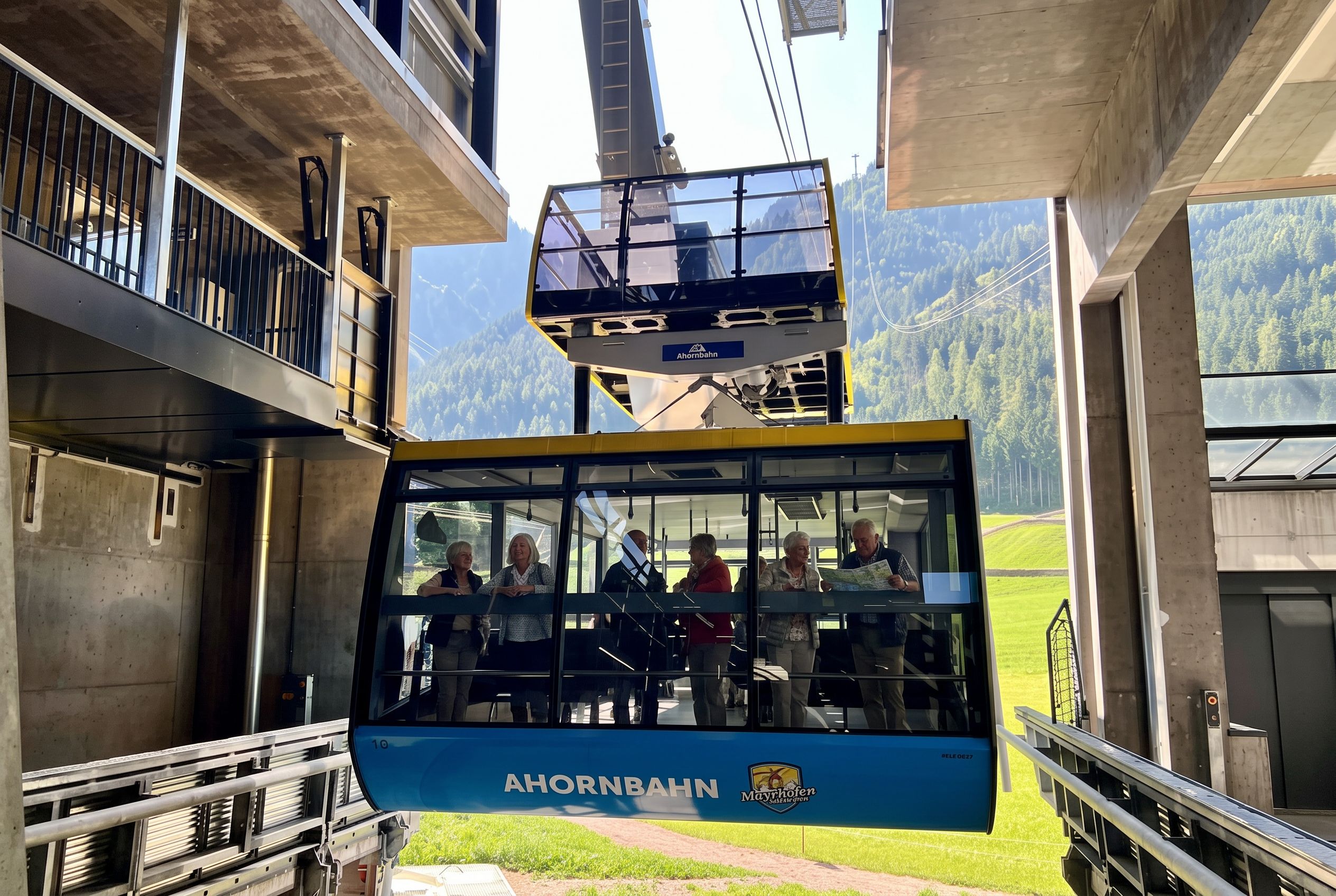
Several major lifts in the Zillertal offer step-free, ground-level boarding for wheelchair users and those with limited mobility. The Ahornbahn in Mayrhofen and the recently modernised Rosenalmbahn in Zell am Ziller have the best-documented boarding, while the Spieljochbahn in Fügen is the one lift whose top station is documented as navigable throughout. However, not every mountain lift is barrier-free, and some top stations still have stairs at viewing platforms.
The Ahornbahn in Mayrhofen is a standout. In 2026 it runs from 13 June to 27 September starting at 7:30 AM with the BergSteigerGondel, then from 8:30 AM until 31 October, departing every 15 minutes with a ride time of 6.5 minutes. The cabins hold up to 160 people, and the operator states that its feeder lifts are barrier-free thanks to passenger lifts at the stations. The Google rating is 4.7/5 from 4,336 reviews as of August 2026. One caveat: no wheelchair-navigable path on the Ahorn plateau is documented, so the plateau circuit is pram-friendly rather than certified for wheelchairs. For the birds of prey stage, a free AdlerExpress shuttle runs in summer for wheelchair users and guests with reduced mobility.
The Rosenalmbahn in Zell am Ziller was modernised for the 2025/26 winter season. The Austrian cable car association’s accessibility sheet records level walk-in boarding at the valley station from that season, where a ramp had been used before. The Google rating is 4.7/5 from 284 reviews as of August 2026. At the top, the Fichtenweg circuit is a compacted forest track, but the same sheet notes steeper sections and says a companion is needed, so plan the ride for the view rather than for an independent walk.
The Spieljochbahn in Fügen is the valley’s best-documented accessible summit: barrier-free toilets at all three stations, two barrier-free restaurants at the top, and — per the Austrian cable car association’s fact sheet — every attraction directly at the top station and every gravel forest track navigable by wheelchair. The Hintertux Glacier reaches higher: Austria’s highest passenger lift carries wheelchair users to the panorama terrace at 3,250 metres, though its barrier-free restaurants and toilets sit lower, at the Sommerbergalm (2,100 m) and the Tuxer Fernerhaus (2,660 m). The Nature’s Ice Palace is not step-free: its operator describes about 200 metres over snow to the entrance, roughly 100 of them downhill and uphill again afterwards, and warns of short iron ladders inside.
Is the Zillertalbahn railway accessible?
Partly. The Zillertalbahn runs half-hourly on the 32-kilometre line from Jenbach to Mayrhofen, which makes it an excellent way to move between towns without a car. But low-floor boarding is not guaranteed on every service: the Tyrol transport authority asks passengers to check the timetable information for a low-floor train and to book a wheelchair space by phone in advance. The documented lifting platform belongs to the steam train, not to the regular service.
The valley’s official accessible facilities PDF records the lifting platform and the dedicated compartment under the steam train, not the line service: a carriage with a lift and a compartment for mobility-impaired passengers is carried on the train, and the crew helps with boarding. The steam train runs on select dates only.
The railway connects to the main line at Jenbach, which has step-free access to platforms. For a full breakdown of how to reach the valley, see our guide on Getting to the Zillertal: Airports, Trains and Transfers.
| Feature | Details |
|---|---|
| Low-floor boarding | Not guaranteed — check the timetable information per service |
| Lifting platform | Documented for the steam train, not the regular service |
| Dedicated compartment | On the steam train, for passengers with reduced mobility |
| Steam railway access | Barrier-free with trained staff |
| Frequency | Half-hourly, daily, Jenbach to Mayrhofen (32 km) |
Are there accessible lakeside paths and promenades?
Yes, the Zillertal offers several level riverside and lakeside paths suitable for slower walkers. The most notable are the Zillerpromenade and the shore track at the Schlegeis Stausee reservoir. Both are gentle, but neither is certified barrier-free: the Zillerpromenade is officially described as pram-friendly, and the shore track is a broad gravel and access road rather than a paved path.
The Zillerpromenade, as mentioned, is the valley’s gentlest long path. It runs 8 kilometres along the Ziller between the two towns, is easy to join from either end, and is popular with cyclists as well. No official source gives a surface or a width, so a wheelchair user should treat those as unverified rather than assured.
The Schlegeis Stausee reservoir offers a different kind of low-exertion visit. The shore track along the water is broad and almost level, but it is gravel and access road rather than a paved promenade, and VERBUND as operator states plainly that the tour inside the dam wall is not possible barrier-free. The iconic Olpererhütte bridge requires a steep, rocky hike and is not suitable for limited mobility. There is a barrier-free WC at the Fischerhütte (1,782 m) by the reservoir.
In Fügen, the Therme Zillertal thermal spa, which has dropped its older name Erlebnistherme, documents barrier-free entrances and comfortable pool entries. It does not state that it has a pool hoist or adapted changing rooms, so ask before booking if you need either. For a detailed look at spa options, see our Zillertal Wellness Guide: Thermal Baths & Accessible Spas for Seniors.
“Everything is so nice here — clean and user friendly. The pools are well maintained and the view is breathtaking.” — a guest wrote about the Erlebnistherme Zillertal on Google in June 2023
Are viewing platforms barrier-free?
Some viewing platforms in the Zillertal are barrier-free, but not all. The best documented are the Hintertux Glacier panorama terrace at 3,250 metres, reached by Austria’s highest passenger lift, and the top station area of the Spieljochbahn in Fügen. However, many smaller platforms on mountain trails require navigating stairs or uneven ground. Always check the specific platform’s access before planning your visit.
The Ahornbahn top station has a wide viewing terrace with panoramic views of the Zillertal Alps, and a barrier-free toilet. The plateau circuit beyond it is pram-friendly by the operator’s own description, but no wheelchair-navigable path on the Ahorn is documented, so do not assume the walk to the Ahornsee lake is step-free.
The Almtribüne at the Gerlossteinbahn is often suggested as a simpler alternative, but the operator describes the Almpromenade leading to it as an hour-long walk, and neither the Zillertal directory nor the cable car association’s sheet lists it as barrier-free. The lift itself runs from 4 June to 18 October 2026, 8:30 to 12:15 and 13:00 to 17:00, with a midday break that is easy to be caught out by.
What about public toilets and rest facilities?
Accessible public toilets are available at major cable car stations and at the Therme Zillertal, but not at the railway stations, where nothing is documented either way. However, they are less common in smaller villages and along riverside paths. Plan your route around known accessible facilities, especially if you have limited mobility.
The Ahornbahn and Rosenalmbahn have wheelchair-accessible toilets at both their valley and top stations, and the Spieljochbahn at all three of its stations. Six summer huts are listed with a barrier-free WC, among them the Fischerhütte by the Schlegeis reservoir. The railway stations themselves are not documented either way, and there are no facilities along the Zillerpromenade, so plan around the lift stations.
If you are using a walker or wheelchair, it is wise to carry a portable toilet key or use the facilities at your hotel before heading out. There is no accessible-toilet map, despite what some guides suggest. What does exist is worth downloading: the Zillertal tourism board’s “Accessible Facilities” PDF, and the “Barrier-Free Mountain World” fact sheet the Austrian cable car industry publishes per lift company, naming accessible toilets, restaurants and wheelchair-navigable paths station by station.
What are the honest warnings about steep alpine terrain?
The Zillertal is a mountain valley, and terrain quickly becomes steep once you leave the valley floor. Many hiking trails, mountain huts, and scenic viewpoints are not accessible for those with limited mobility. The most common pitfalls are uneven village paths and stairs at mountain platforms. The costliest is assuming that every scenic spot is step-free.
“Accessible” at altitude means different things, and the official documents say so themselves: the Rosenalmbahn summit circuit is recorded as a compacted forest track that nevertheless has steeper sections and needs a companion. A lift may be barrier-free to board while the walk beyond it is not. The Olpererhütte bridge is iconic but requires a steep, rocky hike, and the Nature’s Ice Palace is reached only across snow.
Seasonality also matters. In 2026 the Rosenalmbahn runs from 23 May to 11 October, the Spieljochbahn from 23 May to 26 October and the Ahornbahn from 13 June to 31 October; the Hintertux Glacier is the only one open year-round, 8:15 AM to 4:30 PM with the last ascent at 3:00 PM. Shoulder-season closures can cut off the simplest access. Always verify lift operating dates directly with the operator before planning your day.
For a comprehensive list of comfortable hotels with verified accessibility features, see our guide on Where to Stay in the Zillertal When Comfort Comes First.
| Lift | Summer Season | Daily Hours |
|---|---|---|
| Ahornbahn, Mayrhofen | 13 June – 31 October | 7:30 AM – 5:00 PM to 27 Sept, then 8:30 AM – 5:00 PM |
| Rosenalmbahn, Zell am Ziller | 23 May – 11 October | 9:00 AM – 5:00 PM (to 5:45 PM in July and August) |
| Spieljochbahn, Fügen | 23 May – 26 October | 9:00 AM – 4:30 PM (to 5:00 PM 11 July – 30 Aug) |
How accessible is public transport in the valley?
The Zillertal’s public transport is workable for older travellers, but not uniformly barrier-free. The Zillertalbahn runs half-hourly and a wheelchair space has to be booked by phone. Buses around Mayrhofen-Hippach have a fold-out ramp and kneeling suspension, but the Tyrol transport authority cannot confirm low-floor vehicles valley-wide and asks passengers to contact the operating company in advance. Evening services can be limited.
The Zillertal ActivCard is valid from 23 May to 26 October 2026 for 3, 6, 9 or 12 consecutive days. It gives free travel on numerous bus services in the valley and, more usefully for a slow day, one return trip per day on any of the ten summer cable cars; at the Hintertux Glacier it is valid only as far as the Sommerbergalm at 2,100 metres. Buses run frequently between the main towns and the lift stations during the day.
For wheelchair users, book the wheelchair space in advance: the Tyrol transport authority takes those bookings on +43 5 17 17 5, and its timetable information shows whether a given service is a low-floor train. For the journey into the valley, ÖBB runs a mobility service for passengers with reduced mobility and their companions, with phone and email reservations. Jenbach, where the Zillertalbahn meets the main line, is rated by ÖBB as usable without assistance, with a lift and a round-the-clock accessible WC.
What practical tips should I know before visiting?
Book level-access accommodation in advance, as barrier-free hotels fill quickly. Check lift operating dates before planning your day, and always ask about the route from the top station to the viewing platform. Carry a portable toilet key and plan rest stops along your route.
The Zillertal tourism board’s official accessible holiday page lists numerous barrier-free hotels and holiday flats with level access and special equipment for people with mobility impairments; it does not itemise the fittings, so ask each property directly. In the Mayrhofen-Hippach booking mask you can filter accommodation under “Alle Filter” by the attribute “Behindertengerecht”. Booking early is essential, especially in summer when the valley is busiest.
For ticket policies, the Zillertal Arena does not offer senior citizen discounts, but visitors with a disability rating of at least 60% receive child pricing — only at the on-site ticket desks, on presentation of an official disability card, and not in combination with the ActivCard. The Mayrhofner Bergbahnen apply the same 60% threshold to selected tickets, again only at the desks. Ahornbahn parking is a reduced guest rate of €3 for the day for Ahorn or Penken visitors, validated at the desks until 5 PM or at the machines at any time, and the chip card carries a €2 deposit refunded in full on undamaged return.
Finally, be realistic about your stamina. The valley is best described as easy to moderate overall, but the most comfortable strategy is to rely on gondolas, trains, and paved valley paths rather than uphill village walking or trail-based sightseeing. With thoughtful planning, the Zillertal offers rewarding alpine experiences without demanding physical exertion.


