
Located in the heart of the Austrian Tyrol, the Zillertal valley is a long, green corridor of alpine meadows, rushing rivers, and steep mountainsides. For travellers aged 50 to 70, the journey here is as important as the destination. The good news: reaching the Zillertal is straightforward, with clear rail connections, well-signed motorway exits, and a network of local trains and buses that handle the final leg. The key is knowing which airport to fly into, which station to change at, and what to expect when you step off the train.
 AI-edited
Which airport is best for the Zillertal?
Innsbruck Airport (INN) is the closest and most convenient gateway, about 44 km by road from Jenbach at the valley entrance, with a direct road and rail connection. Munich Airport (MUC) is larger and often cheaper for flights, but the rail transfer to Mayrhofen takes between 3 hours 15 minutes and 3 hours 55 minutes. Salzburg Airport (SZG) is a third option, though less direct.
Innsbruck Airport sits just west of the city centre, and from there a scheduled bus reaches Innsbruck Hauptbahnhof (main station) in 17 minutes, running every 15 minutes. The train journey from Innsbruck to the Zillertal is the simplest of the three options: regional trains run several times an hour to Jenbach in 18 to 25 minutes, then you change to the narrow-gauge Zillertalbahn. The total time from airport to valley floor is around 1 hour 40 minutes to 2 hours, including the connection. On the timetable valid from 14 June 2026, the Zillertalbahn runs every 30 minutes through the day between Jenbach and Mayrhofen and takes about 50 minutes for the full route: the 09:39 from Jenbach reaches Mayrhofen at 10:29.
Munich Airport is a major international hub with frequent flights from the US, UK, and Asia. From the airport, you take the S-Bahn (S1 or S8) to Munich Hauptbahnhof, then board an ÖBB or DB train towards Innsbruck or Jenbach. The rail route goes via Kufstein and the Inn Valley, with a change at Jenbach. The entire journey from Munich Airport to Mayrhofen takes 3 hours 15 minutes on the fastest connection and up to 3 hours 55 minutes on slower ones, depending on how the changes fall. For a more detailed look at what to do once you arrive, see our guide to the Zillertal for travellers over 50.
Salzburg Airport is the least practical option, though not for the reason usually given: direct trains run from Salzburg Hauptbahnhof to Jenbach in about 1 hour 50 minutes, without a change. The time goes on the airport bus at one end and the Zillertalbahn at the other, which brings the total to roughly 3 hours 25 minutes. Most travellers still prefer Innsbruck or Munich.
| Airport | Distance to Jenbach | Typical travel time | Convenience for seniors |
|---|---|---|---|
| Innsbruck (INN) | 44 km | 1 hr 40 min – 2 hrs (incl. train) | Excellent – direct train, short transfer |
| Munich (MUC) | 170 km | 3 hrs 15 min – 3 hrs 55 min (rail) | Good – frequent trains, but longer |
| Salzburg (SZG) | 146 km | approx. 3 hrs 25 min (rail) | Fair – airport bus plus one change at Jenbach |
How do I get from Innsbruck to Jenbach by train?
From Innsbruck Hauptbahnhof, take any regional train (S-Bahn or REX) heading east towards Kufstein or Wörgl. The journey to Jenbach takes 18 to 25 minutes, and several trains an hour run through the day. The station is small and easy to navigate, with a clear platform for the Zillertalbahn.
Innsbruck Hbf is a modern station with lifts, escalators, and clear signage in German and English. The platforms are numbered, and the departure boards show the platform for each train to Jenbach. You can buy tickets at the ÖBB ticket machines (which accept credit cards) or at the ticket counter. Fares in Tyrol are charged by zone rather than by route: a Verkehrsverbund Tirol single ticket starts at €1.60 a zone, and travellers aged 65 and over pay from €1.10 a zone on presentation of photo ID. As of July 2026, the ÖBB Scotty app is the best tool for real-time departures and platform numbers – it is free and works offline once you download the timetable.
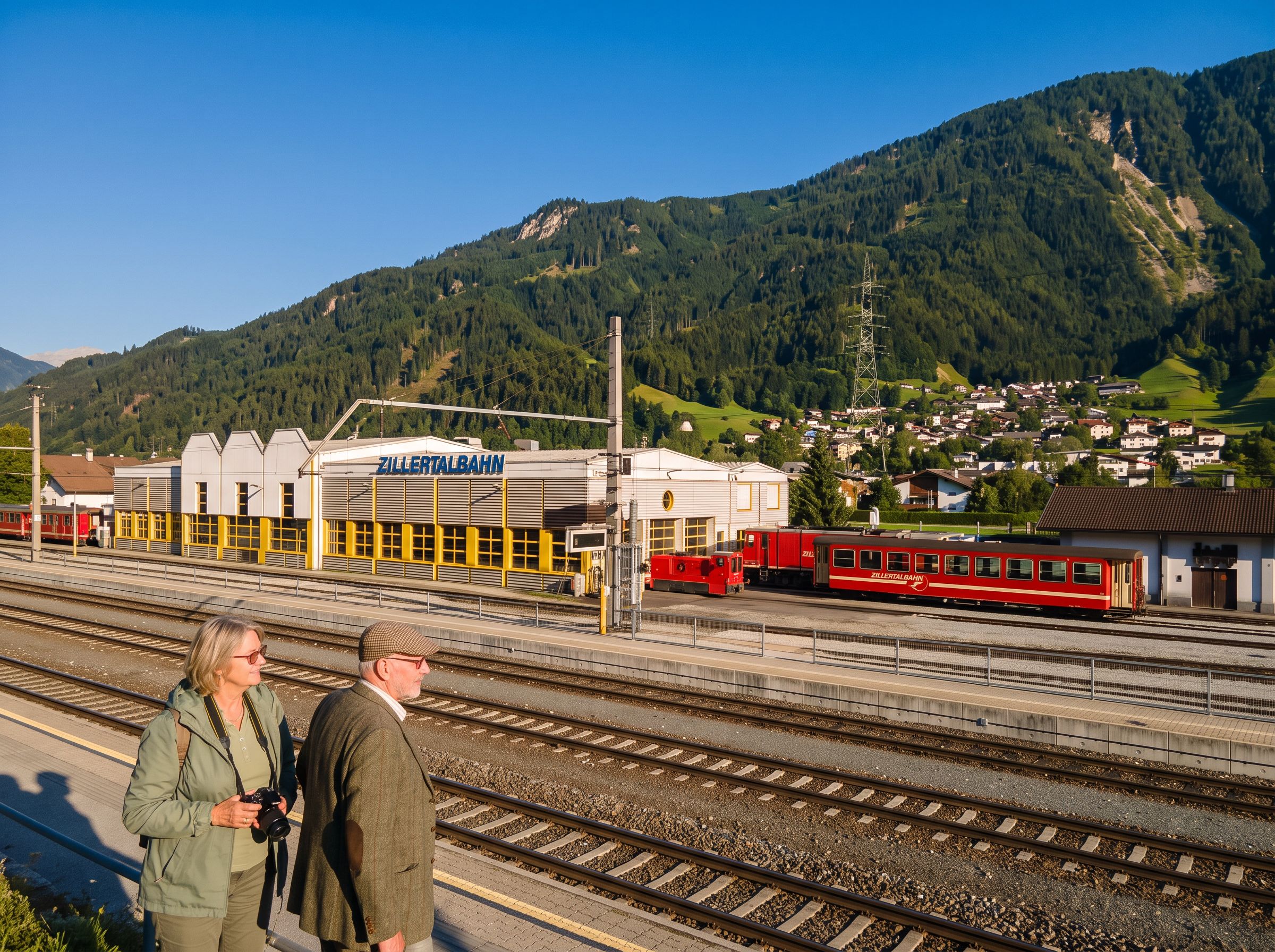
Once you arrive at Jenbach station, the Zillertalbahn platform is adjacent to the mainline platforms. Look for the narrow-gauge tracks and the distinctive red-and-cream trains. The station has a waiting room open around the clock, a staffed ticket counter, a bakery, and coffee and snack machines. ÖBB places Jenbach in its highest accessibility category, meaning the station and its platforms can be used independently without significant barriers. As of August 2026, Jenbach station holds a Google rating of 4.2 out of 5 from 226 reviews.
Is the Zillertalbahn accessible for seniors with mobility concerns?
Every Zillertalbahn train is equipped for wheelchair users, as the operator states in its own timetable. The stations are a separate question: only Jenbach is documented as barrier-free, and the Verkehrsverbund Tirol journey planner shows for each service whether it is a low-floor train with a wheelchair space and an accessible toilet.
The Zillertalbahn is a historic narrow-gauge railway that has been modernised over the years; the operator counted 19,709 modern services on the half-hourly pattern in 2025. Its timetable states plainly that all Zillertalbahn trains are equipped for wheelchair users. Platform heights differ from stop to stop, however, and no station-by-station list is published, so at the smaller halts you may need to step up into the train. Zillertal Tourism runs a dedicated accessible-holiday section for the valley, and the Mayrhofen lift company states that lifts make its base stations barrier-free.
For travellers who use a wheelchair, the Verkehrsverbund Tirol takes telephone bookings for the wheelchair space on +43 5 17 17 5, and its journey planner marks which services carry one. The journey from Jenbach to Mayrhofen is scenic, passing through villages, forests, and alongside the Ziller river. Jenbach station has toilets, including an accessible one, open around the clock. The steam train is a separate service, running Tuesday to Thursday from 2 June to 25 September 2026; the official accessible-excursions guide for the valley records that it is accessible, carrying a coach with a lift and a compartment for passengers with reduced mobility. Regional network tickets are not valid on it.
What is the best way from Munich Airport to the Zillertal?
The most reliable route is by train: take the S-Bahn from Munich Airport to Munich Hauptbahnhof (about 40 minutes), then board an ÖBB or DB train towards Innsbruck or Jenbach. Change at Jenbach for the Zillertalbahn. Total time to Mayrhofen: 3 hours 15 minutes at best, 3 hours 55 minutes on slower connections. Driving is also possible but requires an Austrian motorway vignette.
From Munich Airport, follow the signs to the S-Bahn station. Trains S1 and S8 run every 10 minutes to Munich Hbf. The journey takes about 40 minutes. At Munich Hbf, you change to the mainline trains; the departure boards show the platform. The Railjet trains towards Innsbruck are comfortable and have a dining car, and services such as RJ 85 run through to Jenbach itself. You can buy a ticket from Munich Airport to Mayrhofen as a single journey – the ÖBB website and app will show you the connections. Neither ÖBB nor DB publishes a fixed fare for this route: both price it by how far ahead you book, so compare in the app before you travel.
If you prefer to drive, the motorway route is straightforward: take the A92 from Munich Airport to the A99 ring road, then the A8 towards Salzburg, then the A93 towards Kufstein. At Kufstein, join the A12 Inntal Autobahn towards Innsbruck and take the exit signposted Zillertal – ASFINAG lists it as the Wiesing junction at kilometre 39.5. From there, follow the B169 road into the valley. The drive from Munich Airport takes about 2 hours 15 minutes without traffic. You must buy an Austrian motorway vignette before entering Austria; you can purchase one at petrol stations near the border or as a digital vignette. Since 1 December 2025 the ten-day vignette for cars up to 3.5 tonnes costs €12.80, the one-day version €9.60. Zillertal Tourism’s own arrival page sets out the same motorway route and the vignette requirement.
Zillertal Tourism describes the same approach from the north in its own words: from Munich, Salzburg or Vienna on the A1, A8 and A93 as far as Kiefersfelden, then on the A12 – vignette required – to the Zillertal exit and along the B169 into the valley.
What about Salzburg Airport?
Salzburg Airport is a viable but less convenient option. Bus line 2 runs from the terminal to Salzburg Hauptbahnhof in 23 minutes, and from there direct trains reach Jenbach in about 1 hour 50 minutes without a change. Add up to 50 minutes on the Zillertalbahn: airport to Mayrhofen takes around 3 hours 25 minutes.
Salzburg Airport is smaller than Munich and has fewer direct flights. If you do fly into Salzburg, take bus line 2 from the airport to Salzburg Hauptbahnhof; the airport gives the journey as 23 minutes. From there, a Railjet or Intercity train runs through to Jenbach without a change on most departures. The total journey time to Mayrhofen is around 3 hours 25 minutes to 3 hours 35 minutes. What makes this the least comfortable of the three is not the number of changes — there is the airport bus and the single change at Jenbach — but the length of it: you are on the move for the better part of three and a half hours after landing. If you are considering Salzburg, it is worth comparing flight prices with Innsbruck – the extra convenience of Innsbruck often justifies a slightly higher fare.
What about private transfers and luggage handling?
Private transfer companies operate from all three airports directly to your hotel in the Zillertal; Zillertal Tourism names the Four Seasons Travel airport shuttle for Innsbruck, Salzburg and Munich. As of August 2026, one Tyrolean operator quotes Innsbruck Airport to Mayrhofen from €158 for a vehicle carrying up to four people. Luggage lockers are marked on the station plan for Jenbach.
For travellers who prefer door-to-door service, private transfers are a stress-free option. Zillertal Tourism points arrivals at the Four Seasons Travel shuttle, which sells single seats at a fixed price rather than the whole vehicle. As of August 2026, a Tyrolean taxi operator quotes Innsbruck Airport to Mayrhofen at 65 to 75 minutes in normal traffic and from €158 for up to four people; the drive from Munich Airport takes about 2 hours 15 minutes. These services are particularly useful if you have heavy luggage, mobility issues, or are arriving late in the evening when public transport is less frequent.
At Jenbach station, the Verkehrsverbund Tirol station plan marks luggage lockers, so you can leave bags and explore the valley unencumbered; no operator publishes a tariff for them, and Jenbach is not among the stations ÖBB lists for its own luggage service. Some hotels also offer luggage transfer from the station – ask when booking. For a comprehensive list of comfortable hotels that cater to seniors, see our guide on where to stay in the Zillertal when comfort comes first.
How accessible are the stations along the Zillertalbahn?
Jenbach is the one station on the route with documented barrier-free access: ÖBB places it in its top accessibility category and lists a lift and an accessible toilet open around the clock. For Zell am Ziller, Mayrhofen and smaller halts such as Ramsau or Aschau im Zillertal no operator publishes station details, so check your stop in the Verkehrsverbund Tirol journey planner.
Jenbach station has a lift to the platform, a waiting room open around the clock, an accessible toilet and a staffed ticket counter, open daily from 07:05 to 11:30 and 12:00 to 17:05. The Zillertalbahn staffs counters at only three stations on the line – Jenbach, Fügen-Hart and Mayrhofen – so buy your ticket there or on board. Mayrhofen station, the terminus, has bus stops directly outside. As of August 2026 it holds a Google rating of 4.5 out of 5 from 29 reviews, and a review left on Google in January 2022 describes “a wonderful train station with so many facilities at the end of the Zillertal operation”, listing a toilet, a shop and connecting buses.
Fügen-Hart and Kaltenbach are full stations on the line, but many of the smaller stops between them are request halts – Rotholz, Schlitters, Gagering, Kapfing, Ried, Angererbach, Erlach, Regionalmuseum Zillertal and Bichl are served on demand. If you are staying in one of these villages, be prepared to step up into the train. The valley’s bus network also serves them, and the Mayrhofen buses carry a fold-out ramp or a kneeling function, with stops directly at Mayrhofen station. For more on the valley’s wellness and spa options, see our Zillertal wellness guide.
What should I pack for the journey to the Zillertal?
Pack light, layered clothing, sturdy walking shoes, a rain jacket, sun protection, and a small daypack for transport tickets and medication. In winter, add thermal layers, gloves, a warm coat, and waterproof boots. Mobility aids like trekking poles or a foldable cane are practical for uneven village sidewalks.
The Zillertal valley floor climbs gently from about 530 metres at Jenbach to roughly 630 metres at Mayrhofen, while the surrounding mountains rise above 3,000 metres – the Gefrorene Wand above Hintertux stands at 3,250 metres. Weather can change quickly, especially in spring and autumn. A lightweight fleece and a waterproof jacket are essential. For summer, pack a sun hat, sunglasses, and sunscreen – the alpine sun is strong even on cloudy days. In winter, temperatures can drop below freezing, and snow is common from December to March. Waterproof boots with good grip are a must for icy paths.
For the journey itself, bring a water bottle, light snacks, and any medication you need. The trains have limited catering, and the Zillertalbahn has no onboard toilet. A small daypack is ideal for keeping your hands free when changing platforms. If you use a walking stick, consider a foldable model that fits in your luggage. The valley has many asphalted paths, but some older village sidewalks can be uneven.
| Item | Purpose | Season |
|---|---|---|
| Layered clothing (T-shirt, fleece, jacket) | Adapt to changing alpine weather | All year |
| Sturdy walking shoes or boots | Grip on uneven paths and station platforms | All year |
| Rain jacket and compact umbrella | Sudden alpine showers | Spring–Autumn |
| Sunscreen, sunglasses, brimmed hat | Strong alpine sun | Summer |
| Thermal base layers, gloves, warm coat | Cold weather and snow | Winter |
| Water bottle and light snacks | Long waits between connections | All year |
| Mobility aids (trekking poles, foldable cane) | Uneven surfaces and longer walks | All year |
What healthcare facilities are available near the stations?
For non-urgent medical needs, the main valley towns of Mayrhofen, Zell am Ziller, Fügen, and Tux have pharmacies (Apotheke) and general practitioners. For emergencies, dial 144 for an ambulance or 112 for the European emergency number. Your hotel can help locate the nearest doctor.
Pharmacies in the Zillertal are well-stocked and staff speak English. In Mayrhofen, the Steinbock Apotheke on Hauptstraße lies about 500 metres from the station. In Zell am Ziller, the Gerlosstein Apotheke on Dorfplatz is under 400 metres from the train station, and Fügen has two, the St Pankraz-Apotheke and the Dorf-Apotheke. For minor ailments like colds or blisters, these are your best first stop. If you need a doctor, ask at your hotel reception – they can recommend a local GP and make an appointment. For serious emergencies, the nearest hospital is the Bezirkskrankenhaus Schwaz on Swarovskistraße, about 10 km from Jenbach – roughly ten minutes by road.
It is wise to carry a copy of your EHIC (European Health Insurance Card) if you are from the EU, or travel insurance details if you are from outside Europe. The Austrian healthcare system is excellent, but treatment can be expensive without insurance.
What are the pedestrian paths like near the stations?
The valley floor has many asphalted or well-maintained paths, including the Zillerpromenade along the river, which the operator describes as an easy walk that also suits families with prams. However, older village sidewalks can be uneven, and some hamlets are on steep hills. Stick to valley-floor routes for easy walking.
The Zillerpromenade runs along the Ziller river; from the Ziller bridge in Zell am Ziller you can walk either bank towards Hippach, 4 km away, and on to Mayrhofen, 8 km in all. The Zillertal Arena describes it as a comfortable, easy walk that also suits families with prams. This is a good option for a gentle stretch of the legs after your journey. In the villages themselves, the main streets are generally paved and well-maintained, but side streets and older sections may have cobblestones or uneven surfaces. If you are staying in a hamlet up the hillside, be prepared for steep gradients. The valley’s bus network serves these areas, so you can avoid walking uphill if needed.
For more on the valley’s cultural highlights and gentle walks, see our guide to alpine traditions and village life in the Zillertal.


