
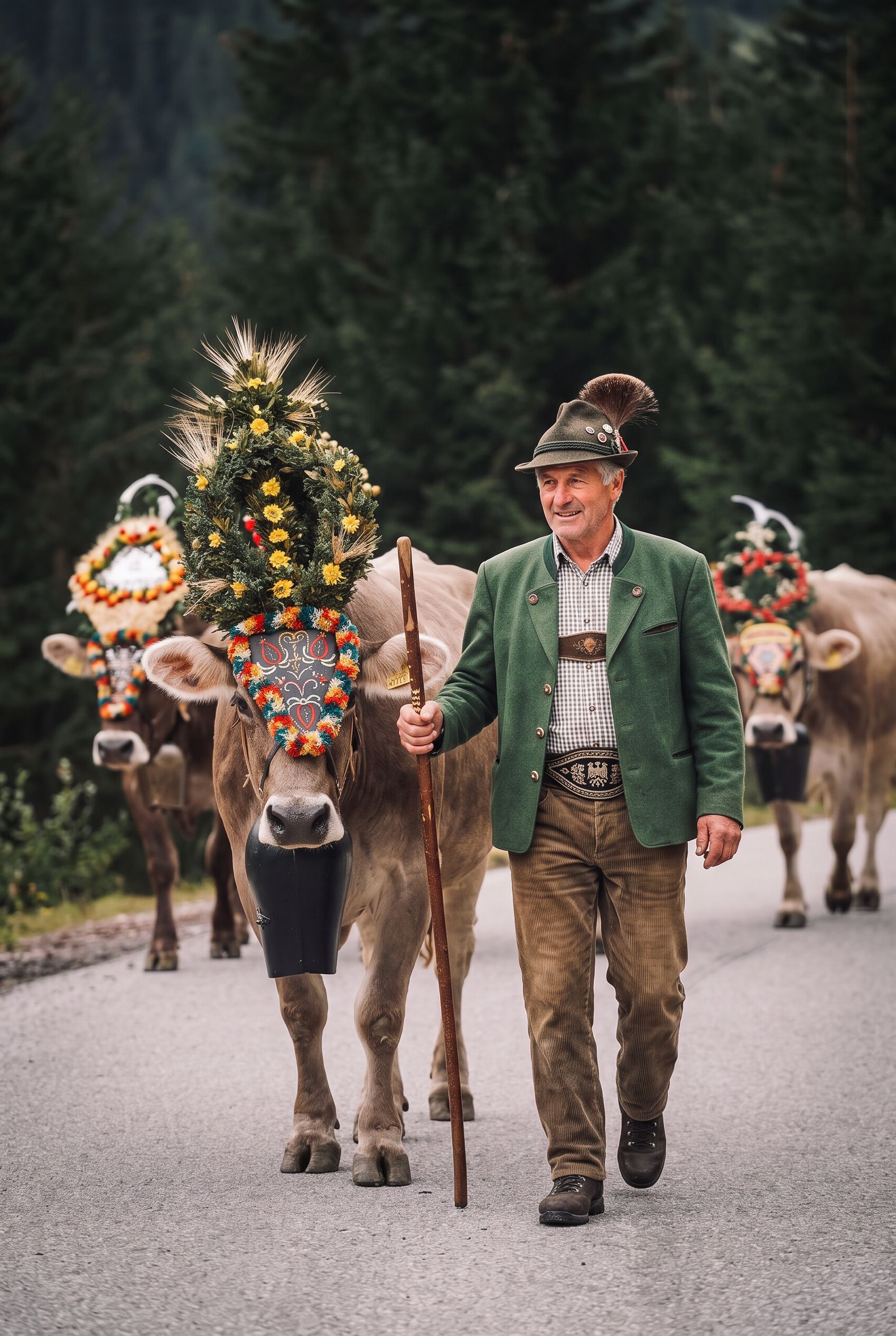
The Zillertal is one of those rare Alpine valleys where tradition is not a museum piece but a living rhythm. Village squares fill with farmers' markets and traditional music, and each autumn cattle in elaborate headdresses descend from the summer pastures. This guide is for travellers aged 50 to 70 who want to experience the valley's authentic folk culture, distilling heritage, and working mountain huts at a pace that respects both curiosity and comfort.
 AI-edited
What makes Zillertal folk culture unique?
The Zillertal's folk culture is among the most intact in the Austrian Alps, rooted in centuries-old music traditions, costume-wearing customs, and a deep connection to alpine farming that remains visible in everyday village life rather than staged performances.
Unlike many tourist regions where folklore has become a sanitised evening show, the Zillertal's traditions are woven into the calendar. The valley is famous for its brass music tradition, with local bands performing at everything from Sunday mass to the autumn cattle drives. The Blechlawine, staged by the Zillertal brass music association, fills the Waldfestplatz in Mayrhofen for four days at the end of May — 27 to 30 May in 2027, with 40 bands — and has spun off two free offshoots: brass music at five mountain huts on five Fridays between July and September, and a free village day along Mayrhofen's main street on 19 September 2026. The STEUDLTENN theatre festival plays in a converted barn at Kirchweg 22 in Uderns, three minutes on foot from the Uderns rail halt, and states that its festival site is step-free. These are not performances for visitors alone; they are community events where locals outnumber tourists.
The heritage museum in Fügen documents the part the valley played in spreading Silent Night: the Rainer family carried the carol from Fügen to Germany and England from 1824 onwards, and until 1854 it was known abroad simply as a Tyrolean or Zillertal Christmas song. This living culture is most accessible during the autumn months, when village squares host farmers' markets alongside traditional music performances.
Where can I see the Almabtrieb cattle drive?
The Almabtrieb, or cattle descent, runs from mid-September to early October across multiple Zillertal villages, with decorated cows wearing enormous bells parading through streets accompanied by folk music and village celebrations.
The 2026 calendar is already fixed for several valley towns. Gerlos holds its Almabtrieb on 26 September 2026, with the cows coming down between 09:00 and 14:00 and a supporting programme of a bandstand concert, a Zillertal farmers' market from 15:00 to 18:00, and the "Melcherball" from 20:00. Zell am Ziller also stages its drive on 26 September 2026, with the village centre given over to a supporting programme and live music from 10:00 to 17:00. Fügen-Kaltenbach offers multiple dates: 12, 19, and 26 September, plus 4 October 2026. The Kohlerhof in Fügen hosts a free-admission Almabtrieb on 12 September 2026, from 10:00.
The Zillertal Arena tourist board describes the day as more than a parade: the decorated cows are led down from the alpine pastures through the village to their home farms and welcomed into the valley with a festival. Dates vary by community, and so do the venues: in Fügen the four drives are staged at the Kohlerhof, in the village centre, at the Oberhubenhof on the Pankrazberg and at the Gasteighof in Kapfing, with two more at Stumm on 19 and 20 September and one at Hart im Zillertal on 3 October 2026.
How can I visit a schnapps distillery?
Zillertal's distilling heritage is accessible through several family-run Schnapsbrennereien that offer guided tours and tastings, with the Stiegenhaushof in Schwendau near Mayrhofen and Genuss.Brennerei.Fankhauser in Vorderlanersbach in the Tux valley the two best rated by visitors; both take bookings in advance rather than walk-ins.
Distilling herb schnapps is a Zillertal tradition dating back centuries. The Stiegenhaushof at Dorf 164a in Schwendau, a few kilometres north of Mayrhofen, is a working Schaubrennerei in a converted cow byre, where owner and master distiller Martin Fankhauser takes visitors through the production room himself and explains the fruit behind each spirit. As of August 2026 it holds a Google rating of 4.8/5 from 164 reviews and a Tripadvisor rating of 4.8/5 from 12 reviews. The house makes fruit brandies and liqueurs alongside jams and jellies, and every tour ends with a tasting in the bar, which looks straight into the sheep barn and has plenty of seating. The guided Klassik tour runs about 90 minutes; the Premium tour, with a cold-cut Brettljause, takes around two hours. The adjoining Schaubauernhof keeps chickens, donkeys, calves, goats, sheep, rabbits and pigs, opens Monday to Saturday from 10:00 to 17:00, and charges €5 for adults and €2 for children.
The Genuss.Brennerei.Fankhauser at Vorderlanersbach 56 in the Tux valley earns a perfect Google rating of 5/5 from 242 reviews as of August 2026. Owner Armin Fankhauser, a qualified Tyrolean brandy sommelier, leads the tour himself; it lasts about two hours and takes in a tasting of six fruit brandies and two liqueurs, at €20 per person, or €30 with a platter of Tyrolean Schmankerl. The distillery publishes no drop-in hours at all, so book through the enquiry form or by phone before you set out.
A third documented option is the Schaubrennerei Spitaler at Schwendberg 269 above Hippach, a family distillery working with fruit from its own garden and showing the whole path from orchard to distillate. Like the Stiegenhaushof, it is one of the fourteen entries in the region's official accessibility leaflet, and it opens on request all year rather than to fixed hours.
What museums are senior-friendly?
The Regionalmuseum Zillertal in Zell am Ziller is the valley's most comfortable cultural stop, preserving a historic farm building with valley history exhibits, but it opens only from June to early October, Monday to Friday from 10:00 to 16:00, and stays shut at weekends.
The Regionalmuseum Zillertal at Talstrasse 50b in Zell am Ziller is built around a farmhouse that was dismantled and re-erected on the museum site, with a workshop room, the "Machkammer", fitted out with old tools. Exhibits cover traditional farming life, costume history, and the valley's musical heritage. It opens from June to early October, Monday to Friday from 10:00 to 16:00, and is closed on Saturdays and Sundays; winter visits are possible by arrangement. Admission is €6 per person, and children up to 14 go free. Allow about 90 minutes for a thorough visit.
The Museum in der Widumspfiste in Fügen, run by the local heritage society, is built around the Zillertal's singing families and the way they carried Tyrolean song across Europe — at the height of the trade some 500 pedlars and singers from the valley were on the road. It opens from 9 June to 23 October 2026, Tuesday to Friday from 14:00 to 17:00, with last admission at 16:15, and the entrance fee is whatever you choose to put in the box by the door. For a different kind of exhibition, the Naturparkhaus in Ginzling covers the geology and crystal finds of the Zillertal Alps over two floors and opens daily from 15 June to 18 September 2026, 8:30 to 12:00 and 13:00 to 17:00, with guided tours in German and English.
For a more active cultural experience, the FeuerWerk HolzErlebnisWelt in Fügen takes visitors through eleven stations on the theme of wood and the biomass power plant behind it. The operator answers its own accessibility question with "yes", covering the building and the Sicht.BAR restaurant sixteen metres up, while the regional accessibility leaflet lists the site as only partly accessible — worth a phone call if step-free access decides your day. It opens Monday to Saturday from May to October and Monday to Friday from November to April, 9:00 to 16:00.
| Museum | Location | Opening Days | Senior-Friendly Features |
|---|---|---|---|
| Regionalmuseum Zillertal | Zell am Ziller | June to early Oct, Mon-Fri 10:00-16:00 | Historic farm building; €6, children under 14 free |
| Museum in der Widumspfiste | Fügen | 9 Jun-23 Oct 2026, Tue-Fri 14:00-17:00 | Silent Night and the singing families; pay what you like |
| Naturparkhaus | Ginzling | Daily 15 Jun-18 Sep 2026, 8:30-12:00 and 13:00-17:00 | Guided tours in German and English; exhibition on two floors |
| FeuerWerk HolzErlebnisWelt | Fügen | Mon-Sat May-Oct, Mon-Fri Nov-Apr, 9:00-16:00 | Step-free per operator; leaflet says partly accessible |
How can I experience working mountain huts?
Working mountain huts, or Almen, are best visited via the valley's summer gondolas and cable cars, which lift you to high pastures where farmers still produce cheese and butter during the summer grazing season.
The Zillertal's Almen are not just restaurants; they are working farms. From June to September, farmers move their cattle to high pastures and produce cheese, butter, and yogurt using traditional methods. The SchauSennerei & SchauBauernhof belongs to the ErlebnisSennerei Zillertal at Hollenzen 116 in Mayrhofen, and it is the easiest of these places to visit: open daily from 9:00 to 17:00, Sundays and public holidays included, with last admission at 16:15, audio guides in several languages, and a walk of about 45 to 60 minutes through eleven stations. It is one of the few sites named in the Zillertal tourism board's accessible-excursions leaflet. Fügen has a dairy of its own, the Schaukäserei of the Zillertaler Heumilch Sennerei at Sennereistrasse 22, where the viewing room and the cheese museum are free and need no booking; it opens Monday, Tuesday, Thursday and Friday from 8:00 to 18:00 and Wednesday and Saturday from 8:00 to 12:00, and tastings can be added only for groups of ten or more.
For a more elevated experience, take the Penkenbahn or Ahornbahn cable cars from Mayrhofen to reach high-altitude huts; the tourism board states that all four Mayrhofen feeder lifts — Ahornbahn, Penkenbahn, Horbergbahn and Möslbahn — offer step-free boarding, and rates the Penkenbahn the most accessible of them. Forum travellers recommend starting mountain activities early in the day to avoid crowds and ensure you catch the last lift down. Bring good walking shoes, a rain jacket, and a walking stick, as paths around huts can be uneven.
"Very nice alpine dairy farm that shows how the cheese and butter is made — you can view the process of making cheese or butter from the glass aisle on top of the fabric." — a guest wrote about the Zillertaler Heumilch Sennerei in Fügen on Google in May 2018
What about the Gauder Fest?
The Gauder Fest in Zell am Ziller is Austria's largest spring and traditional-costume festival, with its oldest traces reaching back to 1428 and a place in Austria's national inventory of intangible cultural heritage since 2014; it draws around 30,000 visitors with parades, music and costume culture—crowded enough to need a strategy.
The Gauder Fest takes place on the first weekend in May — 29 April to 2 May in 2027 — and is built around traditional parades, regional food, and costume culture; the Sunday procession has grown into the largest costume parade in Austria. With around 30,000 visitors descending on Zell am Ziller, it is the busiest weekend in the valley's calendar. For travellers aged 50-70 who prefer calm pacing, the best strategy is to visit early in the day, stay a little outside the main village square, or choose a non-festival weekday for museum and distillery visits. The festival's food specialities and full programme are covered in our dedicated Zillertal for Travellers Over 50: The Complete Guide.
How do I get around the valley?
The Zillertal Railway is the valley's most comfortable public transport option, running half-hourly along the 32-kilometre line from Jenbach to Mayrhofen, with a nostalgic steam train over the whole route on Tuesdays to Thursdays in summer.
The Zillertal Railway runs along the valley floor, stopping at Fügen-Hart, Zell am Ziller and Mayrhofen among a dozen other halts. Trains run every half hour, and the journey from end to end takes about 50 minutes. For a memorable experience, the steam train runs from 2 June to 24 September 2026, Tuesdays to Thursdays, leaving Jenbach at 10:44 and Mayrhofen at 13:35. The valley's bus network supplements the railway, reaching smaller villages like Gerlos and Tux.
For those who prefer driving, the Zillertalstrasse (B169) runs the length of the valley, with ample parking in village centres. However, during Almabtrieb days, village streets close to traffic, so plan to park on the outskirts and walk in.
What should I wear and bring?
Comfortable, layered clothing and sturdy walking shoes are essential, along with a small rucksack containing rain protection, water, sunscreen, and a walking stick for uneven paths around huts and farms.
Forum travellers consistently advise bringing good shoes or boots, a small rucksack, a rain jacket, water, sunscreen, a hiking hat, and a walking stick. Even if you plan only village walks, the Zillertal's cobblestone streets and farm paths can be uneven. A folding stool is useful for Almabtrieb viewing, as standing for extended periods can be tiring.
For distillery visits, no special gear is needed, but a small bag for purchasing bottles is practical. Most tasting rooms have seating, so you can sample comfortably.
When is the best time to visit?
Late September to early October is the prime period for experiencing living traditions, with Almabtrieb events, farmers' markets, and mild weather, though early September offers quieter conditions for museum and distillery visits.
The Zillertal's cultural calendar peaks in autumn. September brings warm days, golden light, and the valley's most important traditions. However, multiple villages stage their Almabtrieb on the same late-September weekend, creating crowds. For a quieter visit, choose early September or a midweek day outside the main cattle-drive weekends. The valley's wellness offerings, including thermal baths, are covered in our Zillertal Wellness Guide: Thermal Baths & Accessible Spas for Seniors.
Summer (June to August) offers the most reliable weather for high-altitude hut visits, when the Mayrhofen feeder lifts are in summer operation; the operator publishes which gondolas are running on any given day. Winter (December to March) transforms the valley into a ski destination, with traditional Krampus runs and Advent markets adding seasonal charm.
How accessible are the attractions?
The Zillertal tourism board publishes an Accessible Excursion Facilities leaflet, but it is short: fourteen sites, among them the steam train, the ErlebnisSennerei Zillertal, two show distilleries and the Naturparkhaus in Ginzling. Not one museum appears in it, so accessibility elsewhere has to be checked case by case.
The valley's village squares, baroque churches, and theme trails are among the most comfortable ways to experience the region without steep terrain. The historic steam train is documented as accessible in a different way: a carriage with a lifting platform and a compartment for passengers with reduced mobility runs with the train, and the crew helps with boarding. For specific accessibility needs, check the brochure before travel, as not all attractions have documented step-free access.
Recent guest reviews for valley accommodations consistently praise friendly service, clean and spacious rooms, and good breakfasts. The most recurring practical concern is noise—some hotels have thin walls or play background music—so request a quiet room when booking. Beds in the region tend to be firm, which may suit some travellers and challenge others.
| Attraction | Type | Accessibility Rating | Best Time |
|---|---|---|---|
| SchauSennerei, Mayrhofen | Show dairy | 8/10 (in the accessibility leaflet) | Year-round, daily 9:00-17:00 |
| Zillertal Railway | Transport | 7/10 (lifting-platform wagon on the steam train) | Year-round |
| Stiegenhaushof Distillery | Distillery | 6/10 (some uneven paths) | Year-round, Tue-Sat |
| Zell am Ziller village square | Public space | 9/10 (flat, paved) | Year-round |
The Zillertal rewards those who travel with curiosity and patience. Its traditions are not hidden; they are lived in plain sight, from the farmer driving cattle through morning mist to the distiller explaining herb infusions in a wood-panelled tasting room. For the traveller aged 50 to 70 who values authenticity over spectacle, this valley offers a rare chance to step into a culture that still moves to its own rhythm.


