
Cape Town rewards careful budgeting more than almost any long-haul city, and the published figures bear that out. Gray Line South Africa's 2026 budget guide puts mid-range travel at roughly R1,750 to R3,800 per person per day, excluding international flights, covering accommodation, meals, local transport and activities. A separate 2026 planning estimate works out at about £73 per person per day at mid-range comfort and £105 at higher comfort. The city is not uniformly cheap, and it is not uniformly dear. Knowing which is which is the whole exercise.
Two things drive the arithmetic. The first is the exchange rate, which a 2024 traveller report described as making Cape Town "incredibly affordable" for visitors holding stronger currencies. The second is season. Cape Town Tourism describes a Mediterranean climate of warm, dry summers and cooler, wetter winters, and a Cape Town budget guide reports that December to January accommodation can carry a 30 to 50 per cent premium while June to August prices often sit 30 to 40 per cent below the summer peak. Those are commercial estimates, not official tourism-board statistics, but they point the same way.
How much does a comfortable day in Cape Town cost?
Gray Line South Africa's 2026 figures put a mid-range day at R1,750 to R3,800 per person, excluding international flights. A higher-comfort planning estimate from the same year gives about £105 per person per day. Frugal travellers can work from a floor of roughly R500 to R1,350 per person per day on the same source.
The useful part is the breakdown, because it shows where the money actually goes. Gray Line's indicative daily figures for Cape Town are as follows, all per person and all excluding flights.
| Category | Budget | Mid-range |
|---|---|---|
| Accommodation | R300–R600 | R800–R1,500 |
| Food | R150–R300 | R400–R700 |
| Transport | R50–R150 | R150–R400 |
| Activities | R0–R300 | R400–R1,200 |
| Total per person | R500–R1,350 | R1,750–R3,800 |
Note what the table implies. Accommodation and activities are the two lines that swing hardest, and activities are the line a comfortable traveller controls most directly. A day built around a cableway ticket, a garden and a waterfront walk costs a fraction of a day built around private guiding.
Rates are indicative and vary by season and booking channel. Gray Line's figures are Cape Town city figures, not prices for another municipality or a similarly named destination.
What do flights add to the total?
A 2026 estimate cited averages £806 return per person from London, with fares as low as about £618 when booked advantageously. One 2026 planning figure puts a two-week trip for two people, including London flights, accommodation, meals, car hire and activities, at £3,651.
Flights are the single largest fixed cost and the one least responsive to on-the-ground choices. The same 2026 estimate gives £2,080 to £3,651 for two people over 14 days depending on accommodation, meals, transport and activities, which shows how much the ground costs can move within a fixed airfare.
Be sceptical of very low package prices. One comparison site advertised Cape Town flight-and-hotel packages from approximately £131 to £266 for two travellers for three nights, but those are search-result prices rather than dependable package budgets and should not be treated as representative of a comfortable holiday.
For the flight itself, the practical question for older travellers is comfort rather than fare class. Our guide to reaching Cape Town in good shape covers the seating and timing decisions that matter on a long southbound haul.
What do the big tickets cost?
The Table Mountain Aerial Cableway and the Cape Wheel both publish South African pensioner fares, but eligibility turns on South African identification. Cape Town Tourism lists a return cableway ticket for South African senior citizens at R110, a hike-up-and-ride-down ticket at R60, and a Cape Wheel pensioner fare of R95.
This is the most important budgeting distinction in the city, and it catches overseas visitors out. The documented concessions are for South African pensioners or citizens holding valid South African identification. No general Cape Town-wide over-65 public transport fare is documented, and no universal over-65 tariff for foreign visitors is established.
The published pensioner figures, from Cape Town Tourism's pensioner discounts page, are worth knowing even if you cannot use them, because they explain why some prices quoted in forums look different from what you will be charged.
- Table Mountain Aerial Cableway: R110 return for South African senior citizens; R60 one way for a hike up and cableway down.
- Cape Wheel: R95 pensioner fare, subject to valid South African identification.
- TEN67 Eatery: a pensioner's special at R79.
- CapeNature: 30 per cent off self-catering and camping at 25 properties, bookable only through CapeNature and unavailable during South African school holidays.
Pensioner tickets are not available online. Redemption requires visiting the ticket office at the Lower Cableway Station in person.
How much should a meal cost?
Gray Line South Africa's 2026 figures allow R150 to R300 per person per day for food on a budget and R400 to R700 at mid-range. A Fodor's family trip report described restaurant prices as "extremely reasonable" compared with the writers' home country.
That mid-range band of R400 to R700 per person per day buys three proper meals with room for a glass of wine, provided you are not eating every meal at the waterfront.
Where the money goes further is in the everyday restaurant rather than the special-occasion table. Our selection of Cape Town's finest restaurants and ocean-view tables is the place to plan the meals worth spending on, and to see which views carry a premium.
One documented value point: the cableway's own TEN67 Eatery pensioner special at R79 shows how modest the floor can be for a sit-down meal, though that price is tied to South African pensioner eligibility.
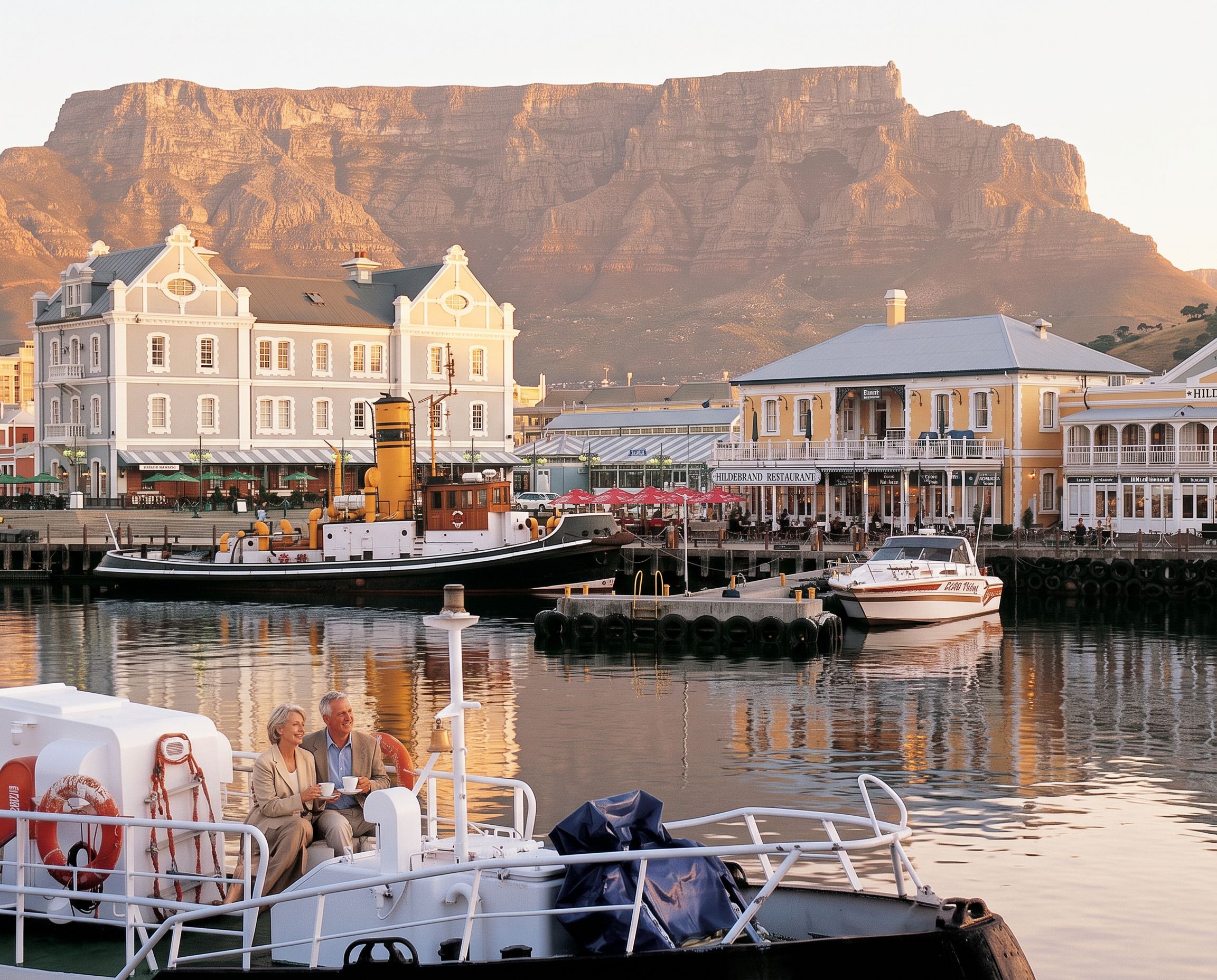 AI-edited
Where is Cape Town dear, and where is it good value?
Cape Town is dear in peak-season accommodation, in private guiding and in the headline attractions that visitors treat as compulsory. It is good value in everyday food, in ride-hailing and in winter accommodation. A 2026 budget guide describes the city as approximately 40 per cent cheaper than the United Kingdom, though that is a broad average rather than a guarantee for premium hotels or peak-season travel.
The dear side is concentrated and predictable. December to January accommodation carries the 30 to 50 per cent premium noted earlier. Private guiding is priced separately: a Fodor's discussion reported a private guide at R1,400 per day for Table Mountain and Cape Town, the Cape Peninsula and the Winelands, and the writer considered that reasonable. A Fodor's family report found the Table Mountain cable car felt expensive relative to other South African costs, even while restaurant prices felt low.
The good-value side is equally consistent. Ride-hailing is the standout. A 2026 Rick Steves forum contributor described Uber or Bolt as "readily available, affordable, and…quick to arrive", and a 2023 Cape Town Reddit report said Uber generally arrived in under five minutes and was affordable. A 2024 Reddit trip review advised using Uber because it was inexpensive. For a couple who would otherwise hire a car and navigate unfamiliar roads, that is a meaningful saving.
Peak dates matter more than citywide averages. The City of Cape Town reported on 6 March 2026 that at least 91 events were taking place across the metro, expected to attract approximately 300,000 attendees, and the 57th annual Festive Lights Switch-On was scheduled for 29 November 2026 at the Grand Parade, expected to draw more than 100,000 people. Both push up demand for rooms, dining and transfers.
What does getting around cost?
Gray Line South Africa's 2026 figures allow R50 to R150 per person per day for transport on a budget and R150 to R400 at mid-range. The MyCiTi airport bus is the documented fixed-price option: a single-trip card costs R90 from the airport or Civic Centre and covers one journey including transfers.
The airport connection deserves its own paragraph because it is the first cost decision most visitors make. MyCiTi's A01 route runs between Cape Town International Airport and Civic Centre, with buses departing every 20 minutes. Services run between 05:00 and midnight, and the journey to the city centre takes approximately 30 minutes. Tickets can be purchased at the airport station or Cape Town civic station. A monthly pass is listed at R930.
The airport station sits opposite the Central Terminal Building and is reached through the subway beneath the main road. The MyCiTi A01 bus is step-free with designated wheelchair spaces, and MyCiTi describes level boarding as making luggage easier to handle.
For comparison, the measured road distance from Cape Town International Airport to the V&A Waterfront is 22 km, about 15 minutes with clear roads. That is the free-flowing figure with no traffic and no stops, so treat it as a floor rather than a promise.
If you take a taxi, use only authorised operators available through the airport's transport kiosks and arrivals desk, per Airports Company South Africa, and decline unsolicited drivers. Cape Town Tourism identifies a designated Uber and Bolt collection point on the ground floor of Parkade 1. The airport's own transfers page sets out the options in full.
How much should I budget for two weeks?
Published 2026 estimates for two people over 14 days run from £2,080 to £3,651 depending on accommodation, meals, transport and activities. The upper figure of £3,651 includes London flights, accommodation, meals, car hire and activities. A five-night mid-range estimate for two in January comes in at about US$1,100.
Those two data points bracket the problem neatly. The £2,080 to £3,651 range is wide because the ground costs are wide, not because the flights are. The US$1,100 figure for two people over five nights at mid-range in January, from Whenderlust, includes accommodation, food, local transport, sights and tourist taxes; a more comfortable version of the same trip is about US$1,820 for two.
Cape Town Tourism recommends four to six days for the city together with the peninsula and Winelands, which means a two-week trip comfortably absorbs the region rather than the city alone. If you are weighing how long to stay, our complete guide for travellers over 50 sets out the shape of a longer visit.
the available sources do not provide a reliably sourced answer to how much money should be taken for two weeks in cash. That question requires current South African customs and safety guidance rather than a cost guide, and Cape Town Tourism's guidance is simply to secure valuables and avoid carrying large amounts of cash.
How do I keep costs down without losing comfort?
Shift your dates to winter, use ride-hailing instead of hiring a car, book accommodation away from the waterfront and check whether any attraction you plan to visit offers a concession you actually qualify for. Winter accommodation prices are reported at 30 to 40 per cent below the summer peak.
Winter in Cape Town is not a write-off. Cape Town Tourism describes June to August as cooler, wetter and occasionally stormy, with clear intervals between weather fronts, and notes that winter commonly offers lower accommodation prices. A 2025 Reddit post said winter low-season prices were more affordable. The trade is weather, not quality.
Accommodation choice matters as much as timing. A Fodor's trip report noted that Airbnbs close to attractions were "quite less expensive" than some alternatives, and a 2009 Fodor's report found the Mount Nelson's complimentary van made the waterfront effectively a 10-minute ride away despite the hotel's less central position. Position and shuttle service can substitute for a central address.
For light sleepers, the cheapest room in a lively square is a false economy. Reviews of Cape Heritage Hotel mention noise from the square, restaurants, bar and street, particularly on Friday and Saturday nights, and one account says First Thursday can be especially loud. Ask for a room away from the square. Our guide to the quietest hotels in Cape Town is built around exactly that request.
What should I know about access and health costs?
Cape Town International Airport's Central Terminal Building is fully step-free, with lifts at all level changes, dedicated check-in and security lanes for passengers with reduced mobility, and accessible toilets on every floor in both domestic and international areas. Elsewhere in the city, accessibility is attraction-specific and must be checked directly.
That airport evidence applies specifically to the airport, not automatically to all of Cape Town. A reliable city-wide statement that every route is step-free is not documented. The City's accessibility programme covers buildings, toilets, entrances, walkways, ramps, roads, bridges, signage and transport, but access remains attraction-specific. Passengers requiring assistance should notify the airport at least 48 hours before travel; the ACSA accessibility hotline is +27 21 935 3737.
Budget for access where it is documented. The Iziko South African Museum has designated disabled parking, a ramped entrance, gentle-gradient ramp walkways with handrails and access to all levels. Kirstenbosch is described as suitable for visitors with limited mobility, though exact path gradients, seating intervals and walking distances are not documented. Our guide to how accessible Cape Town is for older travellers goes through the detail attraction by attraction.
On health, no single nearest pharmacy applies to a city this size. Documented facilities include Webb & Savoy Pharmacy at 34, corner of Main and Durban Roads, Mowbray, open Monday to Saturday 08:00 to 21:00 and Sunday 09:00 to 21:00, and Rustenburg Pharmacy and Clicks Pharmacy at Fountain Square, Main Road, Rondebosch. Ask your accommodation to identify the closest pharmacy and emergency department for your exact neighbourhood. Emergency numbers: 112 from a mobile, 10177 for ambulance, 021 480 7700 for the City emergency centre, and 021 487 6552 for Cape Town Tourism's 24-hour visitor support line.
What should I pack, and what will it save?
Pack lightweight layers, a waterproof shell, comfortable shoes with secure soles, sun protection and a warm layer for exposed viewpoints. Cape Town Tourism describes a Mediterranean climate, so a single packing list covers neither a summer cableway nor a winter front. Buying these items on arrival costs more than bringing them.
The practical list that follows from the climate description is short: layers for changeable temperatures, a compact rain shell for the wetter winter months, secure-soled shoes, hat, sunglasses and sunscreen, a warm layer for the cableway and coastal viewpoints, and prescribed medication with a small first-aid supply.
Two items earn their luggage space in cash terms. Sun protection bought at a waterfront pharmacy costs more than sunscreen brought from home. A warm layer means you can stay on an exposed viewpoint rather than retreat to a cafe. Neither is a large saving individually; together they trim the small daily overruns that push a trip from mid-range to higher comfort.
The bottom line on a comfortable Cape Town budget
Build the budget in this order. Fix the airfare first, since a 2026 estimate averages £806 return per person from London with fares as low as about £618 booked advantageously. Then choose the season, because the 30 to 50 per cent summer accommodation premium and the 30 to 40 per cent winter discount move the total more than any restaurant choice. Then set the daily figure: R1,750 to R3,800 per person at mid-range on Gray Line South Africa's 2026 numbers, or about £105 per person per day at higher comfort on the 2026 planning estimate.
Leave the pensioner concessions out of your arithmetic unless you hold South African identification. They are real and they are generous, at R110 for a cableway return and R95 for the Cape Wheel, but they are not available to overseas visitors, and pensioner tickets cannot be booked online in any case.
What remains is the pleasant part. Ride-hailing is inexpensive and quick, everyday food is reasonable by northern-European standards, and the MyCiTi airport bus costs R90 for a single-trip card that covers the journey and its transfers. Cape Town is dear where visitors insist on peak dates, private guiding and a waterfront address. It is good value everywhere else.


