
Cape Town rewards the traveller who plans around terrain rather than against it. The city spreads between a flat working harbour and a mountain that rises straight from the streets, and the difference between a comfortable week and an exhausting one is usually a handful of decisions made before departure: where you sleep, how far you walk, and which days you give to the mountain and which to the vineyards. This guide sets out the shape of the place for readers in their fifties and sixties, from those who still hike to those who prefer a driver.
It covers orientation, bases, pace, the reality of a long-haul flight, sensible safety awareness and the question of when to go. Individual hotels and day-by-day itineraries are handled in separate guides, linked where they come up.
Where is Cape Town, and how is it laid out?
Cape Town is the City of Cape Town metropolitan municipality in South Africa's Western Cape province, wrapped around Table Mountain between the Atlantic and the city bowl. The historic centre sits inland of the mountain, the Atlantic Seaboard runs south along the coast, and the Winelands lie inland to the east. Cape Town International Airport sits within the municipality.
The geography matters more than the map suggests, because the mountain is not scenery at the edge of town; it is the middle of town. The City Bowl, the dense historic core, occupies the amphitheatre north of the mountain. The Atlantic Seaboard runs down the western flank through Green Point, Sea Point, Bantry Bay, Clifton and Camps Bay, then bends south toward Hout Bay. The southern suburbs, where several hospitals and pharmacies are documented, lie inland behind the mountain. The Winelands are a separate day out, reached by road.
Distances are short in kilometres and long in minutes. The road route from Cape Town International Airport to the V&A Waterfront measures 22 km, which is about 15 minutes with clear roads, free-flowing traffic and no stops. In commuter traffic that figure means very little, so treat it as a floor rather than a plan.
The City of Cape Town runs a formal universal-access programme covering buildings, public toilets, entrances, walkways, ramps, roads, bridges, signage and transport, and it works with Cape Town Tourism to publish accessible facilities and services. In central Cape Town some traffic lights carry audible signals and some pavements have tactile paving. The City does not publish a complete, attraction-by-attraction inventory of step-free routes across the whole municipality, so entrance steps, lift dimensions and accessible toilets need confirming with each hotel or site before booking.
 AI-edited
Which base suits you best?
The V&A Waterfront suits travellers who want flat ground, plentiful seating and evening walks; the City Bowl suits those who want museums and restaurants on the doorstep; the Atlantic Seaboard suits promenade walkers with a car; the Winelands suit a slower, quieter stay. Each has a different relationship to hills and to night-time.
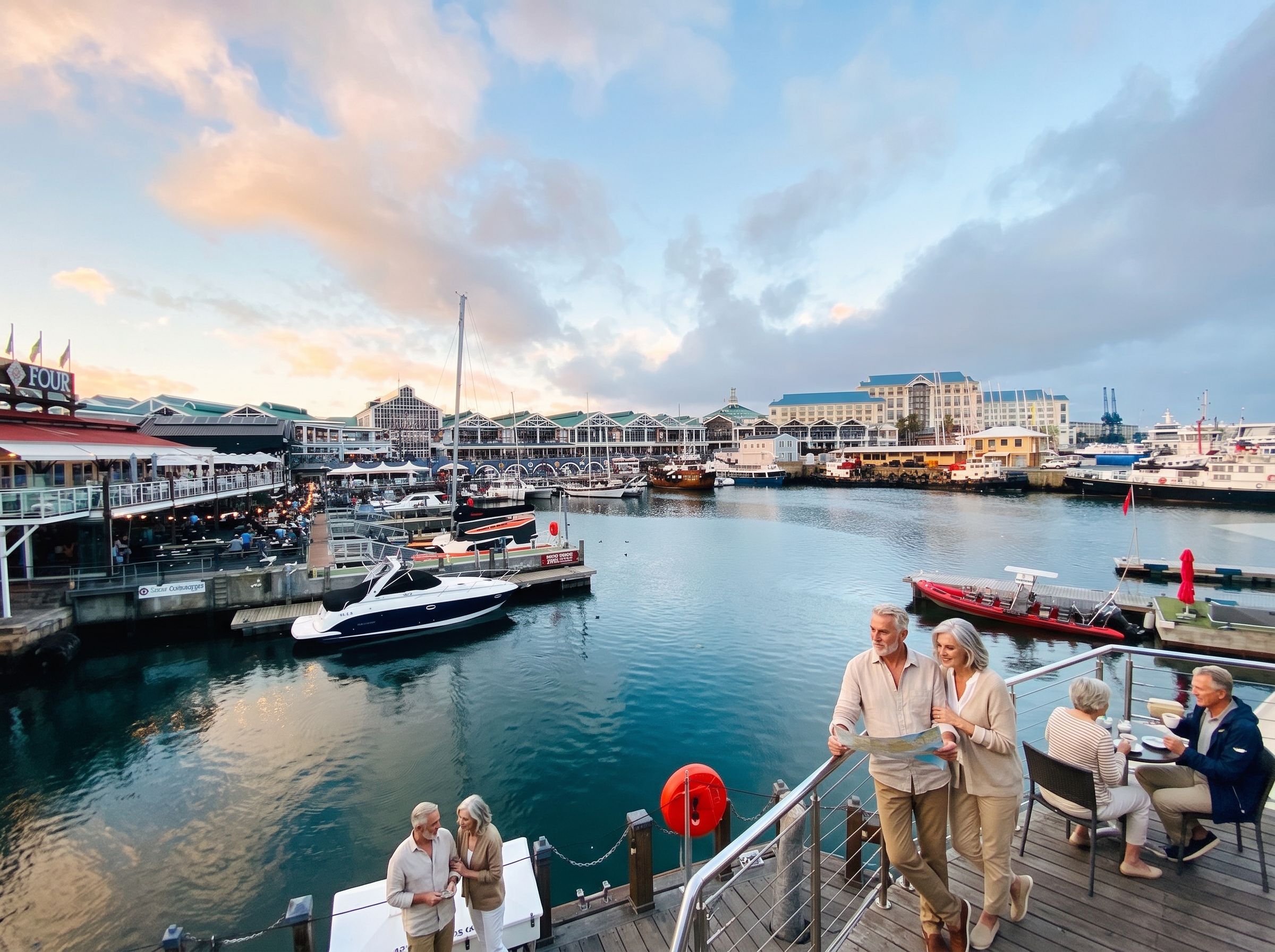
The Waterfront is the easiest base on the legs. Contributors to a disability-focused discussion on Reddit describe it as flat, with plentiful seating, and the same discussion contrasts it with hilly districts such as Bo-Kaap. Reddit contributors also identify the Waterfront as generally suitable for walking at night, within sensible limits. The City of Cape Town lists it among the city's major attractions offering access for people with disabilities and visitors with limited mobility.
The City Bowl puts you close to the Iziko South African Museum and the Company's Garden, but it is where the terrain changes fastest. A January 2026 Reddit discussion notes that ordinary streets can change character from one block to the next, and several contributors advise taking an Uber after dark, even for short journeys. Fodor's forum contributors describe walking in busy, familiar areas during daylight as manageable with ordinary city precautions, and distinguish that from night-time.
The Atlantic Seaboard is promenade country. Sea Point, Green Point, Camps Bay and Kloof Street are more commonly recommended for daytime walking, and a Fodor's trip report from October 2008 gives walking estimates of roughly one hour from the Bantry Bay area to the Waterfront and about 40 minutes onward toward Camps Bay, described as scenic but intended for a fit walker. The exact starting point, the hills and the weather all alter that journey.
The Winelands are a different proposition altogether and are covered in their own guide. For a sense of how a slower, landscape-led stay can be built around a base, our guide to beaches within easy reach of a historic city shows the same planning logic applied elsewhere.
How hilly is Cape Town, really?
Cape Town's walkability is attraction-specific rather than uniform. The City of Cape Town says universal-access tourism is meant to let senior citizens and people with disabilities move around independently, but it publishes no city-wide walkability score, no pavement-condition assessment and no general classification of the hills for older visitors.
What is documented is specific. The Iziko South African Museum has designated off-street disabled parking bays, a ramped entrance and gentle-gradient ramp walkways with handrails throughout, and Cape Town Tourism states that all levels are accessible with ample space for disabled and able-bodied visitors. The museum does not publish step counts or internal distances.
The Table Mountain Aerial Cableway has lifts, priority access at the ticket office, dedicated parking bays for visitors with disabled parking permits, wheelchairs on request and mobility scooters at the Upper Station subject to safety assessment and staff guidance. A Universal Access Walkway opened in April 2026, providing a dedicated route toward the edge of the summit plateau for wheelchair, pram and other mobility-aid users. The operator does not publish the route's total distance, gradient or number of steps.
Elsewhere, the picture is patchier and needs checking. The City's published material does not establish that every pavement, crossing or entrance in Cape Town is step-free. The U.S. travel advisory states that accessibility varies and that public transport, accommodation and information may have limited accessibility, although some attractions and restaurants have ramps or other access options.
What is a realistic pace for a week or two?
One anchored activity a day, with a rest afternoon every third day, is a realistic rhythm for most travellers in their fifties and sixties. Cape Town's attractions sit at different altitudes and on different sides of the mountain, and the wind alone can cancel a plan, so build in slack rather than filling every slot.
The mountain is the variable that decides the week. Table Mountain Aerial Cableway Company publishes live operating status, visibility, wind conditions, first and last car times and estimated queues on its website and app. Mountain wind and visibility can interrupt service even outside the planned maintenance period, so a summit visit is best held loosely and taken on the first clear, calm morning of the stay.
Group the city by geography rather than by category. The Waterfront, the Cape Wheel and the Two Oceans Aquarium sit together. The Iziko South African Museum and the Company's Garden sit together. Kirstenbosch sits on the eastern flank of the mountain, on the way to nothing else in particular, which makes it a half-day rather than a stop.
For readers who still want to walk properly, the pattern of a short, well-chosen half-day route is worth borrowing from our half-day hikes for active over-50s, which applies the same principle of one good outing rather than a full day on the feet.
Can you reach the top of Table Mountain without hiking?
Yes. The Table Mountain Aerial Cableway carries visitors to the summit plateau without a hike, and the operator provides lifts, priority ticket-office access, wheelchairs on request and mobility scooters at the Upper Station subject to safety assessment. The cable car does not run during the annual maintenance closure, when hikers must walk down.
The Cableway closes for annual maintenance from Monday 27 July to Sunday 9 August 2026. During that period all facilities and commercial operations at both the Upper and Lower Stations close to the public, including food and beverage outlets, retail stores and ablution facilities such as VIEWS by De Grendel, TEN67 Eatery, KLOUD Bar, TAP Bar and The Shop at the Top. No cable car operations take place, so hikers need to return down the mountain on foot. The Cableway is scheduled to reopen on 10 August 2026, weather permitting.
Fares are tiered by residency and age. South African citizens aged 60 and above pay R130 for a return ticket, seven days a week, online or at the ticket office, with a valid South African identity document. South African locals celebrating birthdays in July or August may still redeem their free birthday return ticket during their birthday month outside the maintenance closure dates. The operator does not publish an over-65 fare for international visitors, and Cape Town Tourism, which reports the pensioner discount, advises checking fares and eligibility directly with the operator because prices change.
Senior concessions of this kind are a South African pensioner benefit, not a universal over-65 rate. Cape Town Tourism's pensioner-discount guide says many Cape Town attractions offer discounts to South African visitors over 60, including the Cableway and the Two Oceans Aquarium, but foreign visitors should not assume a South African pensioner ticket applies to them.
How should you handle the long-haul flight?
Cape Town International Airport lies within the City of Cape Town municipality and handles the long-haul arrivals from Europe, the Gulf and beyond. The airport is fully accessible, with travelators, ramps, lifts, wheelchair access, accessible toilets and hearing loops, and it runs a landside accessibility service for passengers who need assistance.
Book assistance properly. The airport advises contacting your airline at least 48 hours before departure for wheelchair assistance between check-in, the aircraft and the terminal, and its accessibility line is +27 21 935 3737. A Visitor Information Centre sits on the ground floor of the central terminal.
On arrival, use authorised transport. The airport lists car hire, shuttles and taxis as transfer options, and it instructs arriving passengers to use authorised airport taxis rather than accepting unsolicited offers from drivers. The authorised taxi companies run a walk-in service from the transport kiosks and the domestic arrivals desk in the Central Terminal Building, with a contact number and WhatsApp on 083 682 7286. Shuttles run from the airport to Cape Town and other destinations in the Western Cape, and the MyCiTi network connects the airport with major transport routes and parts of the city. The airport's own public transport page sets out the options.
Give yourself a soft first day. A 22 km transfer from the airport to the Waterfront takes about 15 minutes with clear roads, but the flight behind it is the real distance. Travellers arriving from Europe or North America commonly lose the first afternoon to the time difference; plan nothing that requires standing.
How do you get around without a car?
MyCiTi buses, e-hailing apps and authorised taxis cover the city well enough for most visitors, and MyCiTi is designed for accessibility. The City manages the MyCiTi operating contracts and also runs Dial-a-Ride for people with special needs, and it advises accredited transport over unlicensed operators.
MyCiTi is the City's universally accessible public transport system, with tactile paving, wheelchair-compatible gates, audio induction loops at ticket kiosks and dedicated boarding areas. The municipality manages the service's operating contracts alongside Dial-a-Ride for people with special needs, as set out on the City's urban mobility pages. MyCiTi stations and buses are designed to assist wheelchair users, seniors and passengers with visual or hearing impairments.
For evenings, e-hailing is the practical answer. Several Reddit discussions advise taking an Uber after dark, even for short journeys, and Fodor's guidance advises taxis at night outside heavily populated tourist areas. The City recommends accredited transport, including recognised taxis, e-hailing services and buses.
Driving is an option some visitors take. A Fodor's trip report from October 2008 recommends renting a car for three days, describing driving as safe and getting around as easy. That is one traveller's account from 2008, not a current assessment, and it should be weighed against your own comfort with left-hand driving.
Trains are the one mode the City treats with caution: it advises visitors not to take trains late at night, to keep belongings close and, where possible, to travel with someone else.
What does sensible safety awareness look like?
Cape Town is a city where ordinary precautions go a long way. The City advises visitors to avoid deserted or dark areas, stay with others on well-lit routes, use a map, and tell someone where they are going and when they expect to return. Petty theft, particularly phone snatching, is the risk most often reported.
Fodor's Cape Town safety guidance warns about phones being snatched from people's hands and valuables being taken from cars. Reddit contributors similarly advise keeping phones and cameras concealed, especially in the CBD and at busy transport points. The City's general safety tips for visitors set out the same ground rules.
Day and night are different cities. Contributors describe daytime walking in busy, familiar areas as manageable, and several recommend Kalk Bay and Simon's Town for secure, agreeable daytime outings. After dark, the advice converges on transport rather than walking, and on avoiding quiet streets. A January 2026 Reddit thread recommends Bree Street over Long Street for an evening meal, describing it as more upscale and safer, while still advising transport from CBD hotels.
One further point recurs: a Reddit contributor advises against going near townships without a guide. Take that as a planning note rather than a verdict on any district.
Keep the numbers saved. Police and general emergency services are on 10111, ambulance on 10177, and the City's emergency centre on 021 480 7700. From a mobile phone, 112 reaches emergency services, and 107 works from a landline. Table Mountain National Park emergencies are on 086 110 6417, sea and mountain rescue on 021 937 0300, and the National Sea Rescue Institute on 087 094 9774. Cape Town Tourism's 24-hour visitor-support Band-Aid service is on 021 487 6552, with staff also available at Cape Town International Airport, Kirstenbosch and City Hall.
What health services are available?
Cape Town is a large municipality rather than a single site, so there is no single nearest pharmacy or hospital for the whole city. Several pharmacies and 24-hour hospital emergency units are documented within the municipality, and hotel reception can usually arrange transport to the nearest one.
Documented pharmacies include Webb & Savoy Pharmacy at 34, corner of Main and Durban Roads, Mowbray, open Monday to Saturday 08:00 to 21:00 and Sunday 09:00 to 21:00, as listed by the University of Cape Town's emergency health pages. Rustenburg Pharmacy and a Clicks Pharmacy both sit at Fountain Square on Main Road, Rondebosch.
Groote Schuur Hospital on Main Road, Observatory, publishes a switchboard number of 021 404 9111. Other documented 24-hour emergency units in the municipality include Life Claremont Hospital on Main Road, Claremont; Vincent Pallotti Hospital on Alexandra Road, Pinelands; Kingsbury Hospital on Wilderness Lane, Claremont; and Rondebosch Medical Centre on Klipfontein Road, Mowbray.
None of these is necessarily the nearest to your hotel. For urgent care, use the hospital nearest your actual location or ask reception to arrange transport.
When should you go?
December to February is the principal summer travel period, with the strongest demand; March to May is often comfortable for sightseeing with less pressure; June to August is winter, wetter and windier; September to November is spring, with improving outdoor weather but variable wind. No official monthly climate normals or visitor-arrival figures are published.
Treat those as broad planning descriptions rather than measurements. The airport's own travel information labels summer as November to March and winter as June to August. The Table Mountain cable car's maintenance closure falls in the winter window, from 27 July to 9 August 2026, which is worth knowing if the summit is central to your plans.
One seasonal fact deserves its own sentence: the Atlantic side has cold water, between 8 and 14 degrees Celsius, and strong currents. That is a paddling-and-watching coast rather than a swimming one for most visitors, whatever the air temperature says.
Check each operator's own site before you commit a day to it.
What do you need before you fly?
Requirements depend on your nationality. South Africa's Department of Home Affairs requires a valid passport or travel document, a visa where one applies, sufficient funds, a return or onward ticket and a yellow-fever certificate where the journey begins in or passes through a yellow-fever area.
Citizens of the UK, USA, Canada, Australia, New Zealand, Germany, France, the Netherlands and most EU nations are visa-free for stays of up to 90 days, according to the airport's travel information. The U.S., Canadian and Irish government sources give the same under-90-day rule for their nationals. A nationality-specific conclusion cannot be made without knowing your passport, so check with the South African mission applicable to you.
Passport validity requirements differ slightly between sources. South African Home Affairs states validity for no less than 30 days after the intended visit and at least one unused endorsement page, while the U.S. source states 30 days after planned departure and two consecutive empty visa pages. Follow the requirement published by the South African authority applicable to your nationality.
Travellers entering or leaving South Africa must submit an online traveller declaration before travelling; it can also be completed through the SARS mobile app or at the airport if necessary. A yellow-fever vaccination certificate is required when arriving from a designated yellow-fever-risk country, as the Department of Home Affairs visa pages set out.
Which attractions offer senior fares?
South African pensioners hold the documented concessions, not international visitors. The Cableway, the Cape Wheel, the Iziko South African Museum and the Two Oceans Aquarium all list reduced prices for South African pensioners with valid identity documents. No over-65 fare for foreign visitors is documented at any of them.
The pattern is consistent and worth understanding before you budget. Cape Town Tourism's pensioner-discount guide says many Cape Town attractions offer discounts to South African visitors over 60, and the individual listings confirm the identity-document condition. For anyone travelling on a foreign passport, the standard adult fare applies.
Two Oceans Aquarium is among the wheelchair-friendly attractions Cape Town Tourism identifies, though the aquarium's own detailed access statement is not reproduced. The Cape Wheel has two wheelchair-accessible cabins with emergency buttons and a rapid-response system for returning passengers to ground level.
Check the operator's own site before you go.
How do you choose a hotel without reading reviews for a week?
Choose by district first and by room position second. Reviews of Cape Town hotels repeatedly turn on noise and on bathroom configuration rather than on service, and both are things you can ask about at the time of booking. Detailed hotel reviews are handled in separate guides.
Noise is the recurring theme. Tripadvisor reviews of one Long Street property report nightclub and street noise continuing until roughly 2:30 to 3:30 a.m., particularly from Thursday to Sunday. Reviews of a city-centre heritage hotel describe noise from restaurants, the street and corridors in rooms facing the square, and reviewers there advise requesting a room away from the square or street. At another city hotel, some reviews describe excellent soundproofing while others report street noise and an early-morning call that disturbed sleep. The practical translation is simple: ask for a room away from the street or the bar, and ask what the hotel does about weekend noise.
Bathrooms matter as much as beds. Tripadvisor listings and reviews identify walk-in showers at several Cape Town hotels, and one review of a Southern Sun property reports a shower over a bathtub with no support for getting in and out. Ask specifically whether the room you are booking has a walk-in shower and whether the bathroom door is wide enough for your needs; the hotels do not publish these dimensions.
Breakfast is where Cape Town hotels tend to earn their praise, with buffets, cooked-to-order eggs and rooftop settings all recurring in reviews. For a fuller picture of how to weigh a hotel stay against the days around it, our family guide to Santa Fe takes the same approach to matching a base to a trip.
What else should you know before you book?
Book the Cableway around its maintenance window, keep the emergency numbers saved, confirm accessibility details directly with each site, and treat published fares as indicative. The City publishes universal-access information but not a site-by-site inventory, and operators change prices and hours without notice to third parties.
Rates quoted here are indicative and vary by season and booking channel. The Cableway's R130 South African pensioner return and the Cape Wheel's R95 South African pensioner fare both depend on a valid South African identity document presented at the time, and both are reported by Cape Town Tourism rather than published as fixed tariffs.
For specific access questions, the parties to ask are the operators themselves. The Cableway publishes live operating status and queue estimates. The City publishes universal-access information covering transport, signage and public buildings.
Finally, pace the trip around the wind. It cancels cable cars, whips up the Atlantic and empties the beaches, and it arrives without much warning. A flexible plan with one movable day is worth more in Cape Town than a tightly booked one.
How should you start planning?
Start with the season, then the base, then the one or two things you will not compromise on. Cape Town rewards a loose plan: a clear morning for the mountain, a flat day at the Waterfront, a garden morning at Kirstenbosch, and enough slack to move any of them when the wind changes.
Readers travelling with grandchildren will find the logistics of a multi-generation trip set out in our guide to Hoi An with grandchildren, which covers the same question of matching pace across ages. Cape Town itself divides neatly: the Waterfront and the aquarium for the youngest, the cable car for everyone, and the museum for a rainy afternoon.
What the city asks of an older traveller is honesty about terrain. The flat ground is genuinely flat, the accessible attractions are genuinely accessible, and the hills are genuinely steep. Plan for the version of yourself that is on the trip, not the one in the photographs from twenty years ago, and Cape Town delivers a fortnight that feels unhurried rather than reduced.


