
Chiang Mai has a reputation as one of Southeast Asia's great bargains, and for everyday spending that reputation holds up. A bowl of khao soi at a street stall, a songthaew ride across the Old City, a one-hour massage: these remain modest outlays by the standards of any Western city. Where the arithmetic changes is comfort. A quiet room, a private transfer, a table with linen and a guided day out each move the total upward, and the cool-season window from November to early February moves it again. This guide sets out what the documented figures actually say, tier by tier, so travellers aged 50-70 can plan a budget that matches the trip they intend to take.
Chiang Mai City is a UNESCO Creative City of Arts and Crafts, and the provincial authorities have submitted "Chiang Mai, Capital of Lanna" for World Heritage consideration as a cultural landscape. That status underpins the city's appeal, but it does not set its prices. What sets them is season, neighbourhood and how much comfort you buy. Rates quoted throughout are indicative and vary by season and booking channel.
How much does a comfortable day in Chiang Mai cost?
A comfortable day in Chiang Mai is documented at roughly THB 600–1,000 per person, covering a private guesthouse room, mixed local meals, city transport and one paid activity. Broader traveller datasets put the city average nearer THB 1,936 per day, or about USD 59. The gap between those two figures is the gap between simple comfort and polished comfort.
A 2026 budget breakdown describes the THB 600–1,000 daily figure as a "comfortable budget," and a separate 2026 guide reports that many visitors comfortably get by on RM150–RM250 per day, with the same components: a private room, hearty meals, local-market dining, daily transport and one paid experience. Budget Your Trip, meanwhile, reports an average of USD 59 per day for Chiang Mai, with a one-week trip averaging USD 416–420 per person.
For a premium-but-not-luxury stay, a practical planning range is about USD 60–100 a day once accommodation, meals, local transport and some sightseeing are included. Recent budget guides put a mid-range day at roughly THB 1,000–2,000.
What do frugal, mid-range and comfortable budgets look like?
Three tiers are documented. Frugal travel can run on 200 THB per day if you eat local Thai food, skip alcohol and walk most places. A comfortable lifestyle with leisure activities needs 300–500 THB per day or more. Mid-range comfort, with better dining and private transport, sits at THB 1,100–2,200 per day.
The frugal end comes from a contributor in a Chiang Mai cost discussion, who noted that 200 THB per day can work under those conditions, while 300–500 THB per day or more is better for comfort with leisure activities included. A separate first-timer thread estimated 350–400 EUR for ten days for the most basic expenses, which suggests short stays can stay moderate if comfort demands are limited.
Monthly figures from the same forums give a sense of scale: a fuller "comfortable" monthly example was given as about 25,000 THB minimum to live frugally, with some contributors saying 30,000 THB per month is enough for comfort. A modest stay was commonly put around 30,000 THB per month for a comfortable lifestyle.
What should flights and airport transfers add to the budget?
Airport-to-city transport is the clearest value point in Chiang Mai. The airport shuttle bus charges fixed fares of 40 baht on Routes A1 and A2 and 60 baht on Route A3. Private transfers cost more but operate 24 hours and include luggage assistance. Flight costs are not documented.
Chiang Mai International Airport offers public car service, public bus, shuttle bus and taxi options. Route A1 runs from the airport via Nimmanhaemin Road and Huay Kaew Road to the city moat. Route A2 runs via Mahidol Road to the Night Bazaar and Chang Klan hotels. Route A3 runs via the Second Ring Road to the 700th Anniversary Stadium.
Private transfers are advertised as operating 24 hours a day, with the driver meeting arrivals and assisting with luggage. One service says pick-up is outside Exit 11 in the arrival hall and operates Monday to Sunday, 24 hours. Bolt states it is available at CNX airport, with pickup points shown in the app. A private car transfer service describes itself as wheelchair accessible, and a separate listing says its service is stroller accessible but not strictly wheelchair accessible unless the wheelchair folds and fits in the luggage compartment.
RTC Chiang Mai City Bus services resumed in early 2024, with three routes operating to and from the airport. One transport guide notes that the Pink and Blue lines were not running through 30 September 2024.
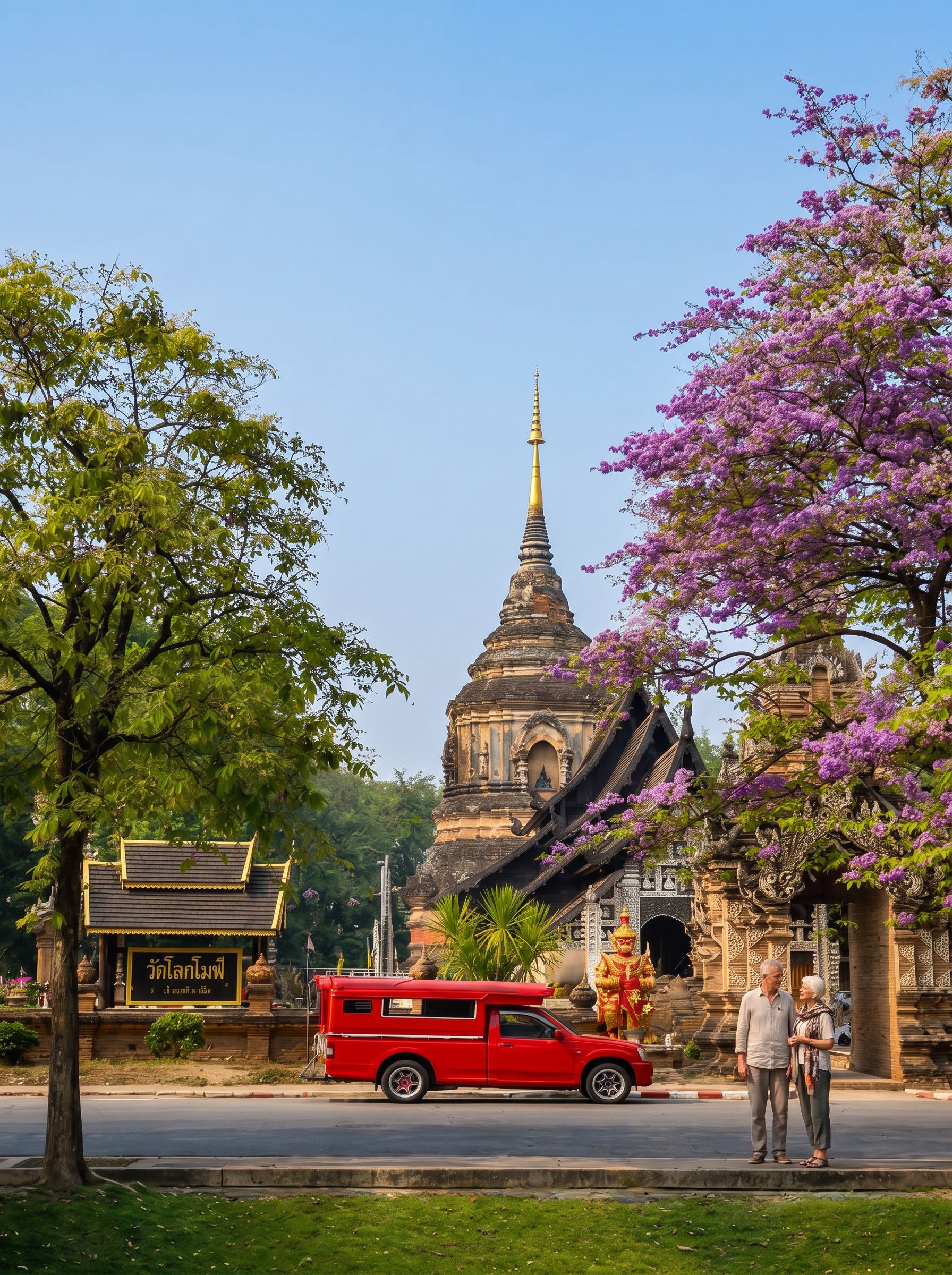 AI-edited
What do meals, coffee and massages cost?
Street and local Thai food runs 40–90 THB per meal, often around 50–60 THB, with khao soi at 50–70 THB at street stalls or mall basements. Western meals run 90–200 THB in one report and 150–400 THB in another. A one-hour massage is repeatedly quoted at 300–500 THB, while spa pricing runs 1,000–2,000 THB.
Coffee is commonly 35–60 THB outside tourist-heavy spots. One contributor noted their neighbourhood in Saraphi had 35 THB iced coffee or tea, while Nimman café prices could be noticeably higher. That neighbourhood difference is the single most repeated cost warning: staying in Nimman or around the Old City raises food and transport prices, while Saraphi was cited as much cheaper for everyday meals and coffee.
Transport within the city is similarly modest. A red songthaew was quoted at 30 THB in one thread, while another budget guide says songthaews commonly run about 30–40 THB per ride within the city and a further page says about 40 THB is typical for a local ride. Airport trips by ride-hailing were said to be around 150 THB. Grab and Bolt are recommended for taxis, and one 2026 guide describes them as the easiest default, with metered taxis scarce.
What do hotels cost by tier?
Budget Your Trip's Chiang Mai data puts a typical hotel room around USD 22 per night, with 3-star hotels around USD 21 and 5-star hotels around USD 92. Those are the only tiered accommodation figures. Forum reports put monthly rentals from 5,000 THB for basic rooms to 10,000 THB for Airbnb-style stays.
For travellers aged 50-70, the more useful question is what comfort actually buys. The best-reviewed comfort factors in guest feedback are quiet location, strong staff responsiveness, solid breakfast, lift access and walk-in showers. The biggest value risk is paying for a centrally located property that still suffers from airport, nightlife, corridor or door noise, because that damages sleep quality directly.
Guest feedback illustrates the point. Quiet rooms were repeatedly praised at The Chiang Mai Old Town, where guests described rooms as "very quiet" and "super quiet," and at Green Tiger House, called quiet despite being central. Por Daowadung was described as having a walk-in rain shower, good blackout curtains and an elevator serving three floors.
At the other end, night-time noise is the most common complaint in the record. Novotel Chiangmai Nimman Journeyhub sits under the airport flight path, with some guests saying aircraft noise ran from early morning to late night. Travelodge Nimman drew repeated complaints about nightclub noise. HOP INN Chiang Mai and Melia Chiang Mai both drew reports of corridor noise carrying into rooms. None of these properties publishes sound-insulation specifications; ask for a room away from the lift, the corridor or the road when booking.
What do tours and day trips add?
Documented excursion prices are limited. The Monks Trail to Doi Suthep was described as a 1.5–2 hour walk with 30 THB entry, and elephant parks were said to cost 1,500–2,500 THB. For day trips, budget more than the cheapest-looking headline price, because hiking add-ons and longer transfers move a trip from cheap to expensive quickly.
One attraction-level senior concession appears in the material: a single attraction reports reduced admission from age 65 and over, with adults paying 200 baht and seniors or disability visitors paying 150 baht. That is an attraction-level fact, not a Chiang Mai-wide rule. Brokenships Chiang Mai charges 200 THB for adults and 150 THB for people with disabilities and seniors aged 65 and over.
No Chiang Mai-wide senior or over-65 fare programme is documented, and no senior discounts or special passes are documented for city transport. The Chiang Mai National Museum publishes admission of 20 THB for Thai visitors and 200 THB for foreign visitors, with no senior concession shown on that page. A separate tourism listing mentions seniors being free and closure on Mondays, Tuesdays and public holidays, but that is not the museum's own page.
Doi Suthep itself requires motorised transport or a tram from the city. A cable-car proposal for the temple was formally revived in 2025, with a reported plan to cut the trip from about 30 minutes to under 10 minutes. The proposal describes a route from the foothills to the temple. As of the material reviewed, it remains a proposal.
When is Chiang Mai cheapest, and when does it climb?
The cool, dry high season is the most expensive window. One guide says hotel prices in late November through early January commonly run 30–60% higher than the June–October low season. Another says November to April is the busiest and most expensive season. The cheapest months coincide with the rainy season and the burning season.
Chiang Mai's tourism demand is strongly seasonal. Peak time runs from late October to the end of January, while the pollution season from February to April or May pushes many visitors away. December through February is the strongest international tourism window for Thailand overall, and Chiang Mai's peak season is November to early February.
Published month-by-month figures are for the city and municipality rather than the whole province. October averages 31.7°C high, 22.6°C low and 124 mm of rain over about nine days. The wettest month is August at 223 mm over about 17 days. March through May is the hottest period, with April typically the hottest month and daytime highs often above 35–38°C. Burning season usually peaks in March, when air quality can become unhealthy or sometimes hazardous; a separate safety guide says agricultural burning can affect air quality from late January to mid-April, with smoke worst in March.
For travellers weighing cost against comfort, the trade is straightforward: the best-weather window is not the cheapest one. The festival calendar and quiet seasons shift demand further, and accommodation should be booked early if a better-value base is the goal. One contributor advised reserving guesthouses in advance through major booking platforms rather than assuming walk-in bargains.
| Period | Conditions | Cost signal |
|---|---|---|
| November to early February | Coolest and driest; peak international window | Hotel prices 30–60% above low season in late Nov to early Jan |
| March to May | Hottest period; April highs above 35–38°C; burning season peaks in March | Demand falls; air quality is the main drawback |
| June to October | Low season; August wettest at 223 mm over about 17 days | Lowest documented hotel pricing |
Is Chiang Mai good value for getting around?
Yes, for short trips. Songthaews run about 30–40 THB per ride within the city, and the airport shuttle is 40–60 baht. Ride-hailing works well and is the easiest default, while metered taxis are scarce. Walking is easiest in the flat, compact Old City, but sidewalks outside it are often narrow, uneven or obstructed.
City transport commonly relies on songthaews, tuk-tuks, taxis, motorcycle taxis and ride-hailing. One 2026 guide says Grab and Bolt work well and are the easiest default, while metered taxis are scarce. For travellers who are sensitive to walking, heat or pace, the most comfortable approach appears to be using Grab or Bolt, or occasional songthaews, rather than relying on walking everywhere.
On foot, the Old City is the most walkable area and is described as flat and compact. Outside it, sidewalks are often uneven, narrow or obstructed, and road-edge walking may be necessary. No source reviewed specifically documents cobblestones in Chiang Mai's pedestrian network, and no source gives a documented count or map of rest benches in pedestrian areas. The provincial tourism office states that the Chiang Mai municipality market area has a slope for the handicapped and smooth, level paths connecting all walking routes, and the official province tourism site says the Saturday–Sunday walking market is built to "fully facilitate" disabled and elderly visitors, with a designed slope and level, smooth walking paths suitable for wheelchair users.
No source reviewed gives a Chiang Mai municipal train or bus accessibility programme with lifts, step-free boarding or bookable assistance for seniors. For exact booking and cancellation terms on transport operators in Chiang Mai, those are not documented; ask the operator directly.
What practical costs and contacts should be in the budget?
Healthcare is inexpensive at the clinic level. A Chiang Mai healthcare guide states small clinics are common and often attached to pharmacies or shopfronts, and that a clinic visit typically costs 200–500 THB including basic medication. That is a city-level statement, not an exact-place fact. Emergency numbers are free to use: 1669 for medical emergencies, 191 for police, 199 for fire and 1155 for Tourist Police.
Pharmacies documented in Chiang Mai include Klang Wetchapan Pharmacy, Roongkasem Pharmacy, RX Pharma Chemists, Salaya Pharmacy and Siam Drug and Micromart. Among these, the source gives opening hours for Roongkasem, RX Pharma Chemists, Salaya Pharmacy and Siam Drug and Micromart, but not for Klang Wetchapan Pharmacy.
- Roongkasem Pharmacy: 9:00 am–24:00 Monday–Saturday, 18:00–24:00 Sunday
- RX Pharma Chemists: 8:30 am–9:30 pm Monday–Saturday
- Salaya Pharmacy: 9:00 am–11:00 pm daily
- Siam Drug and Micromart: Central Airport Plaza on Mahidol Road, 11:00 am–9:00 pm daily
Bangkok Hospital Chiang Mai has a 24-hour Trauma and Emergency Service Center, a 24-hour call centre and a pharmacy counter open 8:00 am–8:00 pm. Its out-patient department is open 8:00 am–8:00 pm daily. Same-day and next-day appointments cannot be scheduled on the website, and emergencies are handled by phone. The hospital does not document lifts, step counts, walking distances, cancellation terms or shuttle service for visitors; ask when booking. The US Consulate medical-facilities list for Northern Thailand names private ambulance services at Bangkok Hospital Chiang Mai, Chiang Mai Ram Hospital, Lanna Hospital, McCormick Hospital and Sriphat Medical Centre.
Maharaj Nakorn Chiang Mai Hospital is documented as the main hospital in Mueang Chiang Mai District, and one source gives its pharmacy division as part of the hospital. For the exact municipality, the nearest documented hospital is Maharaj Nakorn Chiang Mai Hospital in Mueang Mai District, and the nearest documented pharmacy is CK Pharmacy in Chang Phueak or the Chiang Mai University pharmacy in Mueang District, depending on where you stay. For a fuller picture of medical planning, see health, vaccinations and peace of mind in Chiang Mai.
What should you pack, and where does the budget stretch furthest?
Pack lightweight, breathable clothing, modest dress for temples with shoulders and knees covered, sturdy walking shoes for uneven sidewalks, and flip-flops for easy on-and-off at temple entrances. Add a sun hat, sunscreen, sunglasses, insect repellent, a refillable water bottle and cash in Thai baht. A rain jacket or compact umbrella covers the wet season.
Heat and humidity are especially difficult in the hot season, and one source advises early-morning or late-afternoon sightseeing in March–May. Air quality can be unhealthy during burning season, roughly mid-February to April, so sensitive travellers may also want a mask. The calmest time for temple-hopping on foot is early morning or late afternoon because heat is strongest from March to May.
On value, the pattern is consistent. Food and local transport are cheap. Housing, tourist-area cafés and longer day trips drive costs up. Several contributors were surprised that Chiang Mai was not uniformly cheap.
Chiang Mai has been placed on UNESCO's World Heritage Tentative List as "Monuments, Sites and Cultural Landscape of Chiang Mai, Capital of Lanna," and a 2026 local report says the Thai Cabinet approved submission of "Chiang Mai, Capital of Lanna" to UNESCO as a cultural landscape World Heritage site. For those planning a longer stay, a five-day Chiang Mai itinerary for the over-50s can help anchor daily spending around a realistic number of paid activities.
What the published figures do not tell you
Several common budget questions have no documented answer for Chiang Mai. Whether three days is enough, whether 10,000 Thai baht covers four days, and how Chiang Mai compares with Bali are all unanswered. The clearest documented signal is that the cool, dry high season is the expensive one.
What the material does establish is the shape of the spending. A comfortable day is documented at THB 600–1,000 for simple private lodging, local food and easy transport. Mid-range comfort with better dining and private transport sits at THB 1,100–2,200 or more. The average across broader traveller datasets is around THB 1,936 per day, or USD 59. Hotel rooms average around USD 22 per night, with 3-star at about USD 21 and 5-star at about USD 92.
Where the city is remarkably good value: local meals at 40–90 THB, songthaew rides at 30–40 THB, the airport shuttle at 40–60 baht, and one-hour massages at 300–500 THB. Where it climbs: peak-season hotel rates 30–60% above low season from late November to early January, spa treatments at 1,000–2,000 THB, elephant parks at 1,500–2,500 THB, and any base in Nimman or the tourist core of the Old City.
No citywide average daily budget is documented for Chiang Mai itself, and no Chiang Mai-wide senior fare programme exists. The practical approach for travellers aged 50-70 is to fix the accommodation tier first, since that is the largest single line and the one most affected by season, then build the daily figure around meals, transport and one paid activity. Rates are indicative and vary by season and booking channel.


