
Salzburg is one of those rare cities that rewards you before you even arrive. The train glides past alpine foothills, the bus from the airport is a 15-minute breeze, and the moment you step onto the cobblestones of the Old Town, you understand why Mozart never wanted to leave. For travellers aged 50 to 70, the key is choosing the right arrival route — one that balances comfort, cost, and your energy for the day ahead. This guide covers exactly that: how to get here from the airport, by train from Munich, Vienna and Innsbruck, and what to expect when you step off the platform.
 AI-edited
Salzburg Airport or Munich: Which one should I choose?
Salzburg Airport (SZG) is the most convenient option for direct arrivals, with a trolleybus journey of about 15 minutes to the city centre or 23 minutes to the main station. Munich Airport (MUC) is a viable alternative when flight options or prices are better, but the total door-to-door time via train is about 2.5 hours. For most travellers over 50, Salzburg Airport wins on ease; Munich wins on choice.
Salzburg Airport is small and the walking distances are short: a covered footpath runs from the "Airport" bus stop straight to the check-in desks. Barrier-free WCs are in both the check-in hall and the departure hall, the accessible parking bays sit in the car park near the exit between stairwells C and D, and every stairwell there has a wheelchair-sized lift. If you need help getting to the aircraft, tell your airline or tour operator when you book and at the latest 48 hours before departure, so the request reaches the airport assistance team in time. First-aid staff are on duty daily from 05:30 to 23:00.
Munich Airport, by contrast, is a major international hub with far more flight options. The trade-off is the onward journey. From Munich Airport you take the S1 or S8 to Munich East or Munich Central Station, about 40 minutes, then board a direct train to Salzburg. The total journey runs about two and a half hours. Munich Central Station is large and busy, so allow extra time for the change and ask staff rather than guessing.
How do I get from Salzburg Airport to the city centre?
Two trolleybus lines serve the airport, and both run every day. Line 2 reaches Salzburg Main Station (Hbf) in about 23 minutes; line 10 runs directly into the city centre in about 15 minutes and has its own Sunday and public-holiday timetable. A taxi to the centre costs around €12, plus a €3.50 call-out charge if you order one rather than take it from the rank.
A covered footpath runs from the "Airport" stop to the check-in desks. You cannot buy a ticket from the driver: Salzburg AG ended on-board sales on every trolleybus line, lines 2 and 10 included, on 1 October 2025. At a ticket machine or in the Salzburg Verkehr app you buy the 1-hour ticket for the Salzburg core zone — €2.60 at fares valid from 1 January 2026, or €2.10 on the senior fare with an ÖBB Vorteilscard Senior — and it covers any number of changes within 60 minutes. The €2.50 single ride quoted elsewhere is the per-ticket price of a pack of five, sold only at customer centres and tobacconists. Every trolleybus is a low-floor vehicle with a kneeling function and carries a folding ramp at the second door, which the driver operates on request.
If you prefer a taxi, the rank is directly in front of the terminal. Fares are regulated: a meter is compulsory in the city core zone, and Tourismus Salzburg puts the airport-to-centre fare at around €12, depending on traffic and route. Ordering by phone or app adds a €3.50 call-out charge; taking a cab from the rank does not. The airport itself puts a shuttle or transfer to the main station at about 15 to 20 minutes and notes that the motorway detour is not necessary. The transfer operators the airport lists mostly serve the ski resorts, with shared fares from around €29 per person.
What is the best train from Munich to Salzburg?
Deutsche Bahn puts the fastest Munich-to-Salzburg train at 1 hour 29 minutes and lists up to 39 direct connections a day; in the 2026 timetable, engineering work means most direct trains take about 1 hour 45 minutes to 2 hours. The regional RE 5, run by Bayerische Regiobahn, takes about 2 hours and is far cheaper with a Bayern-Ticket — €34 for one person, €44 for two — unless you book a fast train well ahead.
The Bayern-Ticket costs €34 in second class for one person and €44 for two, and it covers unlimited regional travel in Bavaria for a day. Deutsche Bahn names Salzburg Hbf explicitly in the validity area, so the RE 5 is included. First class is €46.50 for one and €68.50 for two. The catch: regional trains only — no ICE, IC or EC — and inspectors do check.
If you prefer speed and comfort, the ÖBB Railjet and DB ICE trains are the quickest option, with spacious seats and luggage racks. Advance fares booked on the ÖBB website are the cheapest; flexible tickets bought on the day cost considerably more. If you are over 65, it is worth buying an ÖBB Vorteilscard Senior before you travel: it is sold in the ÖBB app, the ÖBB ticket shop, at ticket counters and through ÖBB sales partners, can be bought up to six months before you want it to start, and then runs for twelve months. What it saves you is set out further down.
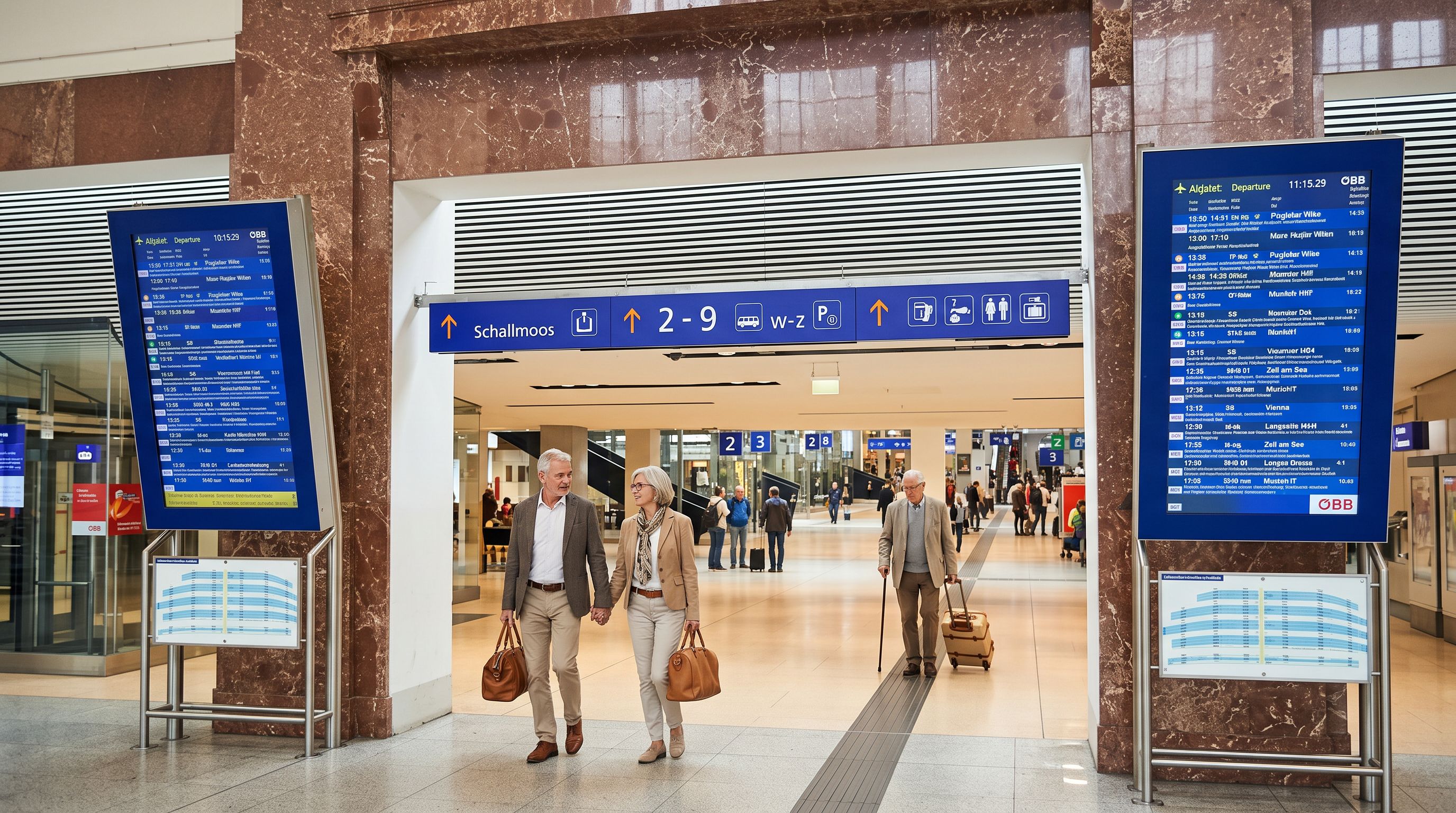
“The Salzburg train station is clean, modern, and very easy to navigate. It offers a great selection of shops and eateries which are perfect for a quick snack before a trip. The platform layout is intuitive with clear signage and helpful staff available if you get lost.” — a reviewer wrote on Google in March 2026
How do I get from Vienna to Salzburg by train?
ÖBB runs direct trains from Vienna to Salzburg twice an hour, and the fastest Railjet covers Wien Hbf to Salzburg Hbf in about 2 hours 25 minutes. If you land at Vienna Airport you need not change at all: direct trains run from the airport station straight through to Salzburg Hbf in about 2 hours 50 minutes.
The line does not run through the Salzkammergut lake district, as is sometimes claimed. ÖBB routes it along the Westbahn through St. Pölten, Linz, Wels and Attnang-Puchheim, and the mountains only appear in the last half hour before Salzburg. Each hour brings one fast Railjet calling at St. Pölten and Linz and a second direct train with more stops, so it is worth checking which of the two you have booked. Advance fares are the cheapest; flexible tickets bought on the day cost considerably more.
Vienna Airport’s railway station sits beneath the terminal, so the way from arrivals is short and level. If the timing suits, take the through train to Salzburg — it saves crossing Vienna with luggage. The City Airport Train is a different service: it runs nonstop to Wien Mitte in 16 minutes, every half hour, and does not serve Wien Hbf, so it only makes sense if you are staying in Vienna first.
What about coming from Innsbruck?
ÖBB runs a direct train from Innsbruck to Salzburg once an hour, and it takes about 2 hours 5 minutes. Between 10 July and 16 September 2026, engineering work in the Unterinntal stretches that to roughly 2 hours 15 minutes. The route crosses the Alps, and the mountain scenery makes the journey a highlight in itself.
Munich is in fact the shortest of the three main rail routes, but for travellers coming from western Austria or Switzerland the Innsbruck line is the most practical. The train terminates at Salzburg Hbf, from where trolleybus lines 1, 3, 5, 6 and 25 run into the centre. If you are continuing to the Salzkammergut or Hallstatt, you change at Salzburg Hbf for regional trains.
How accessible is Salzburg Hauptbahnhof?
ÖBB puts Salzburg Hbf in its top accessibility category: the station can be used independently, with no significant barriers on the approach or the platforms, and it has lifts and a barrier-free WC. Staffed mobility assistance exists, but it is not round the clock and has to be booked in advance. There is no pharmacy inside the concourse, though there are shops, bakeries and a supermarket.
The taxi rank is directly outside the main entrance, and the trolleybus stops for lines 1, 2, 3, 5, 6 and 25 are a short walk away. Assistance with boarding is free, but it has to be arranged beforehand: ÖBB’s Mobility Service Centre is open daily from 06:00 to 21:00 on +43 5 1717 5, and for departures from Salzburg Hbf it asks for at least three hours’ notice — one of the shortest lead times in the country, since journeys from smaller stations need twelve. Ticket counters are open daily from 05:30 to 21:15 and the information desk from 07:00, or 08:00 on Sundays.
For travellers staying in the Old Town, the walk from the station is about two kilometres on flat ground, which most people cover in 20 to 25 minutes. With heavy luggage the trolleybus or a metered taxi is the easier choice. The station also connects directly to the Salzburg S-Bahn network, which serves the suburbs and nearby towns.
What about luggage handling and transfers?
For travellers who prefer not to handle their own luggage, several services offer door-to-door transfer. ÖBB’s own luggage service collects from any address in Austria, Germany or South Tyrol and delivers to any other, from €24.90 per piece; it must be booked at least three working days ahead and only alongside a valid ÖBB ticket. Private operators such as Send My Bag work internationally.
If you are arriving by train, the lockers at Salzburg Hbf are a practical option. ÖBB has converted the station to multifunctional lockers in sizes from small to extra-large; they can be taken on the spot or reserved in advance through the operator, and the price is shown during booking. ÖBB’s standard locker tariff elsewhere runs from €2 for a small locker to €4.50 for a jumbo, for up to 24 hours. ÖBB does not list a staffed left-luggage counter at Salzburg Hbf, so plan on using the lockers.
For airport arrivals, the bus from Salzburg Airport has luggage racks, and the low-floor design makes boarding easy. If you are taking a taxi, the drivers are accustomed to helping with luggage. Pre-booked transfer services often include luggage handling as standard.
What is the easiest door-to-Old Town route?
The simplest route for most travellers is a metered taxi from Salzburg Airport or Salzburg Hbf to their hotel. The airport is about 4.5 kilometres from the Old Town, roughly ten minutes by road, and Tourismus Salzburg puts the fare at around €12. For those who prefer public transport, trolleybus 10 from the airport stops at Mozartsteg, a short walk from the main square.
The Old Town is largely pedestrianised, with narrow cobblestone streets and historic lanes. The city has also imposed a summer traffic restriction, but it is narrower than it sounds: it runs from 1 July to 31 August 2026 only, and the City of Salzburg states plainly that hotel guests may still drive into the restricted zone if they can show a valid booking confirmation from an establishment inside it. Deliveries, journeys to medical care and holders of a disabled parking permit are likewise exempt. Inside the pedestrian zone itself a taxi can still only set you down at the edge, and most Old Town hotels are a five to ten minute walk from the nearest drop-off point.
For travellers with mobility concerns, the flattest route into the Old Town is along the Salzach riverfront, which is paved and level. The main shopping street, Getreidegasse, is cobblestoned but relatively flat. For the fortress, there is a funicular from the Old Town that saves you the steep climb. For more details on walking routes and accessibility, see our complete guide to Salzburg for travellers over 50.
What should I pack for the journey?
Comfortable walking shoes with good grip are essential — Salzburg’s Old Town is famous for its cobblestones. Light layers and a rain jacket are wise, as the weather can change quickly. A supportive daypack, a refillable water bottle, and a power bank for your phone will make the day easier. If you plan to visit the fortress or Kapuzinerberg, consider a walking pole or collapsible cane.
Salzburg’s climate is cool temperate with warm summers and rain all year. On GeoSphere Austria’s 1991–2020 averages for the Salzburg Airport station, July and August are the warmest months, with mean daily highs of 25.2°C and 25.0°C; January is the coolest, at 3.6°C. August, June and July are also the three wettest months, at 161, 159 and 147 millimetres. Packing for variable weather is sensible — a light waterproof jacket and an umbrella are useful in any season.
For the journey itself, bring a book or download a podcast. The approach from Munich runs through the Bavarian foothills and the Chiemgau; the line from Vienna is flat farmland and industry for most of its length, with the mountains arriving only at the end. On the regional RE 5 there is no restaurant car, so take snacks and water with you.
What healthcare facilities are available near the arrival points?
There is no pharmacy inside Salzburg Hbf; the nearest is the Bahnhof Apotheke at Karl-Wurmb-Straße 2, beside the station. The Uniklinikum Salzburg (Landeskrankenhaus) is about two kilometres away at Müllner Hauptstraße 48, reached on trolleybus 4 or 7 or on bus 21, 24, 27 or 28. In the Old Town there are pharmacies at Getreidegasse 4 and at Alter Markt 6.
For travellers with medical needs, it is worth carrying a full supply of any prescription medication, as finding a specific pharmacy after arrival can be time-consuming. In Austria the ambulance number is 144 and the police 133; 112 reaches the general European emergency service. For advice on whether a complaint needs a doctor at all, the national health line is 1450. For public transport questions, the Salzburg Verkehr service hotline is +43 662 632900, and Salzburg AG runs a freephone transport line on 0800 220 050 within Austria.
If you need a doctor, the Salzburg Medical Association (Ärztekammer) can help you find an English-speaking practitioner. Many hotels also have a list of local doctors who speak English. For dental emergencies, the Dental Emergency Service (Zahnärztlicher Notdienst) is available on weekends and public holidays.
How do the costs compare?
Public transport is the cheapest way in from the airport at €2.60 for a 1-hour ticket, and a metered taxi to the centre costs around €12. From Munich the Bayern-Ticket at €34 for one person or €44 for two beats a fast-train fare unless you book well ahead. From Vienna and Innsbruck, advance ÖBB fares are always cheaper than buying on the day.
| Route | Mode | Time | Cost (€) |
|---|---|---|---|
| Salzburg Airport to main station | Trolleybus 2 | about 23 min | €2.60 (1-hour ticket) |
| Salzburg Airport to city centre | Trolleybus 10 | about 15 min | €2.60 (1-hour ticket) |
| Salzburg Airport to city centre | Taxi | about 10 min | around €12, plus €3.50 if ordered |
| Munich Hbf to Salzburg Hbf | Regional train (RE 5) | about 2 hours | €34 Bayern-Ticket, €44 for two |
| Munich Hbf to Salzburg Hbf | Fast train (ICE/Railjet) | 1h 29min scheduled, about 1h 45min in 2026 | cheapest booked in advance |
| Vienna Hbf to Salzburg Hbf | Railjet | about 2h 25min | cheapest booked in advance |
| Vienna Airport to Salzburg Hbf | Direct train, no change | about 2h 50min | cheapest booked in advance |
| Innsbruck Hbf to Salzburg Hbf | Railjet | about 2h 5min | cheapest booked in advance |
Are there senior discounts on transport?
Yes. Anyone over 65 with an ÖBB Vorteilscard Senior pays the senior fare on Salzburg city tickets — €2.10 instead of €2.60 for the 1-hour ticket, about a fifth less — and 50 per cent off ÖBB standard train tickets. The Salzburg Verkehr fare pages list the current concessions.
For local transport within Salzburg, holders of an ÖBB Vorteilscard Senior pay €2.10 rather than €2.60 for the 1-hour core-zone ticket, and €2.00 rather than €2.50 for a pre-purchased single ride, at the fares valid from 1 January 2026. The Salzburg Guest Mobility Ticket, introduced on 1 May 2025, goes further than most visitors realise: every overnight guest in the province is issued one at check-in, and it covers city buses, regional buses, the S-Bahn, regional trains, long-distance trains and on-demand services throughout the province for the whole stay — including the public journey in and out. It is funded by a mobility levy added to the overnight tax, not sold separately.
For train travel, the ÖBB Vorteilscard Senior costs €31 a year and gives 50 per cent off ÖBB standard single tickets on every sales channel; ÖBB does note that within most regional transport networks the local senior reduction applies instead, which can be lower. If you are planning several journeys inside Austria it pays for itself quickly. Coming from Munich the Bayern-Ticket is usually the better buy, but if you are travelling alone and want the fast train, look for ÖBB Sparschiene saver fares.
What should I know about seasonal travel?
Summer (June to August) is the busiest and wettest season, with daytime highs around 22–23°C and frequent rain. Winter (December to February) is cold and snowy, with highs around 2–4°C, but the Christmas markets are magical. Spring and autumn offer milder weather and fewer crowds, making them ideal for travellers over 50.
If you are travelling during the Christmas market season (late November to late December), book your train tickets well in advance, as trains fill up. The markets are concentrated in the Old Town, which is easily accessible from the station. For summer travel, the Salzburg Festival (July to August) brings crowds and higher prices, but the city is at its most vibrant.
Engineering work on the German side is the thing to watch. DB InfraGO will rebuild the Rosenheim–Freilassing section in one bundled five-month closure from 7 February to 9 July 2027, with replacement services still being planned, so anyone booking a Munich approach for early 2027 should check before travelling. Until 12 December 2026, a separate closure between Passau and Obertraubling also puts the Vienna–Salzburg–Munich RJX on a two-hourly pattern and adds about 15 minutes to the journey. Trolleybus 10 from the airport, by contrast, runs every day, Sundays and public holidays included.
Further reading
Once you have arrived, you will want to explore. Our guide to Mozart's Salzburg: houses, museums and music will help you plan your cultural itinerary. For accommodation, see Where to stay in Salzburg when comfort comes first and the best spa hotels for rest and wellness. And for a complete overview, our Salzburg guide for travellers over 50 covers everything from dining to day trips.


