
The Dolomites have no airport and no railway station of their own. That single fact shapes every journey to the range, and it is the reason the practical question is never "which flight?" but "which gateway, and what happens after it?" The mountains rise across three provinces, South Tyrol, Trentino and Belluno, and each has its own railhead and its own bus corridor. Travellers aged 50-70 who plan the last leg as carefully as the first will find the whole approach calm and predictable, because the region's public transport is built around the assumption that the train stops before the mountains begin.
This guide covers the airports that serve the range, the Brenner and Calalzo rail lines, the bus and transfer chains that finish the job, and the door-to-resort routes that work best without a car. The in-region lift and valley bus network is a separate subject with its own dedicated guide.
Which airport should you fly into for the Dolomites?
There is no airport inside the Dolomites. Venice Marco Polo and Treviso serve the eastern side and Cortina; Bolzano is closest to the central South Tyrolean valleys; Innsbruck suits the northern valleys; Verona is the main gateway for Trentino and the western valleys. Choose the gateway nearest your valley, not the one with the cheapest fare.
Venice Marco Polo and Treviso sit roughly 1h45 to 2h by road from Cortina, and no airport lies in the heart of the range. That means the airport decision is really a valley decision. Bolzano is the handiest airport for Val Gardena, with Innsbruck also practical. Verona works best for Trentino and the western valleys.
For travellers arriving from the UK, no source in the material reviewed documents a London-specific route. The documented answer is to fly to Venice, Verona, Innsbruck, Treviso or another gateway and connect onward by train, bus or transfer.
What is the easiest route from Venice to Cortina?
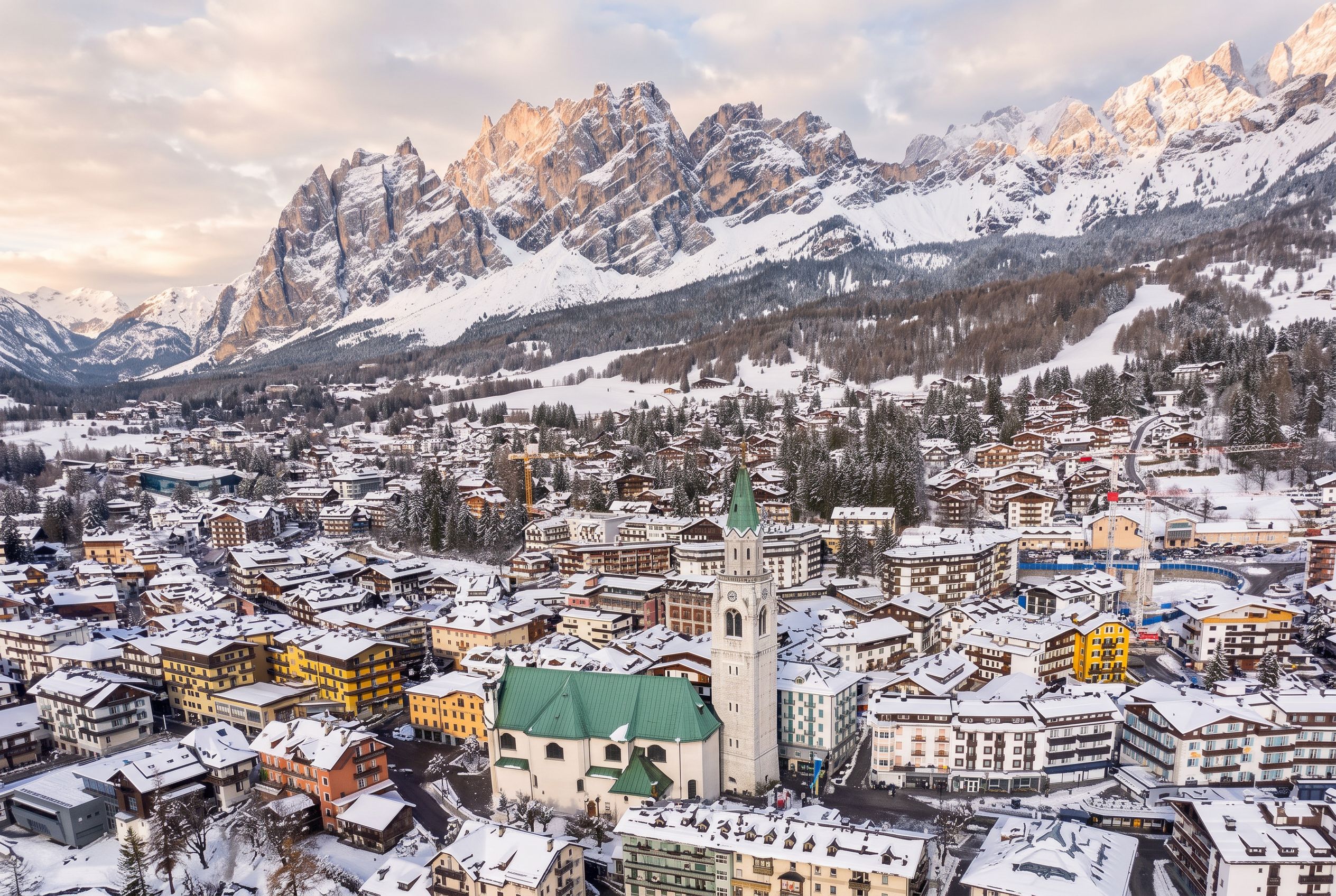
The direct coach from Venice Marco Polo to Cortina is the simplest non-car option. Venice Marco Polo Airport lists winter-season bus links to Cortina and other Dolomites destinations via ATVO, Cortina Express and FlySki Shuttle, with advance booking available. The rail alternative runs to Calalzo di Cadore, then onward by bus or shuttle.
Venice Airport's own transfer pages set out the winter bus links, and these are the routes most travellers use. ATVO runs a Venice to Cortina service, Cortina Express and FlySki Shuttle cover the same corridor, and all can be booked ahead.
The rail chain works differently. Venice Airport directs travellers to Venice Mestre by airport bus, then onward by train to Calalzo-Pieve di Cadore or Feltre. Calalzo is the closest railhead for Cortina and Auronzo, and Cortina's official information names Calalzo di Cadore and Dobbiaco as its nearby stations, both requiring an onward bus connection. There is no railway climbing into the high valleys, so the trip almost always ends with a bus leg.
An express bus from Venice Mestre to Cortina d'Ampezzo takes about 2.5 hours, and a traveller posting on the Rick Steves Travel Forum described it as probably the fastest and simplest way to reach the Dolomites. Measured on the road network, Venice Marco Polo to Cortina d'Ampezzo is 149 km, about 125 minutes with clear roads.
 AI-edited
For anyone continuing into Alta Badia, the route runs through Cortina first, then onward by bus or taxi depending on season. There are no direct buses from Alta Badia to Venice, so the return journey also routes via Cortina. One forum contributor said they would make that transfer the day before departure and spend half a day in Venice rather than risk a same-day connection.
How do you reach Val Gardena and the central valleys?
For Val Gardena and neighbouring South Tyrol valleys, guides consistently describe a rail-to-bus or rail-to-transfer chain rather than a direct airport arrival. The useful rail points are Bolzano, Bressanone, Ponte Gardena and Chiusa, with onward bus, taxi or transfer. Bus 350 connects the Bolzano, Ponte Gardena, Bressanone and Chiusa corridor with the valley.
From Venice, the usual chain is airport to Mestre, train to Bolzano, then bus, transfer or private shuttle. From Venice to Ortisei specifically, one workable route is the airport bus to Venezia Mestre, train via Verona to Bolzano, then bus onward to Ortisei.
The Bolzano bus station sits a 5 to 10 minute walk from the train station, a detail that matters if luggage or mobility is a concern. It is a short distance, but it is a real walk with bags.
For the final kilometres from a station to accommodation, South Tyrol's Seiser Alm accessibility page points to the Südtirol Transfer connection shuttle, which takes travellers directly from the station to their accommodation, shared or private, and is bookable online. Dolomites Transfers is a private transfer and taxi operator in Val Gardena and Gröden offering airport and station transfers plus tours, and its listing states it is open all year, from 1 January 2026 through 31 December 2026.
How does the Brenner railway work?
The Dolomites' rail backbone is the Brenner line, running from Munich to Verona with stops at Trento, Bolzano, Bressanone and Fortezza/Franzensfeste. The Veneto side is reached via the Calalzo line. In every case the train almost always ends with a bus leg, because no railway climbs into the high valleys.
Trenitalia and ÖBB operate the Brenner corridor. Practical rail gateways named in recorded guidance include Calalzo di Cadore for Cortina, Cadore and Auronzo; Dobbiaco and San Candido for Val Pusteria and the Tre Cime; Bressanone and Brunico for Val Gardena and Val Badia; and Bolzano and Trento for Val di Fassa and Val di Fiemme.
From Innsbruck, regular trains run to Brunico with one change at Fortezza, then bus 460 continues to Alta Badia. The Bolzano to San Candido/Innichen journey via Fortezza takes about 2.5 to 3 hours with only one transfer, and the stations involved are described as very small and manageable.
For Dobbiaco, the rail route requires changing in Verona and then again in either Bolzano or Fortezza. That is the path to expect rather than a single simple train. Measured on the road network, Fortezza to Dobbiaco railway station is 311 km, about 225 minutes with clear roads, which underlines how indirect the rail geography is in this corner of the range.
There is no direct Lake Como to Dolomites train documented. The practical pattern is to reach a rail gateway such as Verona, Bolzano, Bressanone, Brunico or Calalzo and continue by local transport.
How accessible are the stations and buses?
South Tyrol mobility guidance states that many regional trains have low-floor access, stations feature lifts, and public buses are barrier-free with ramps. ATVO's official Cortina service page says its buses are accessible to people with reduced mobility and have luggage space. Bruneck station has lifts, step-free access and accessible bus links.
These are the documented points. Beyond them, accessibility and step-free infrastructure are not documented in the material reviewed for Cortina itself, where the municipality-level transport pages describe routes rather than on-site step-free detail. Travellers who need that information should confirm it directly with the operator before booking.
The CallBus, a Kronplatz-area mobility service, can be booked for accessible journeys, with assistance requested at the time of booking.
Across the region, accessibility is uneven and needs checking property by property. Several hotel listings note stairs, limited front-desk hours, or that wheelchair accessibility may have limitations, while others advertise lifts or stair-free entrance paths. The Dolomites Transfers Venice to Val Gardena airport taxi page states that free child seats and booster seats are available on request; it does not publish wheelchair features, senior discounts or cancellation terms for that route.
What should you know about luggage?
Luggage storage at Venice airport is priced at 7 EUR per day, or 5 EUR per day at the Tronchetto office. Travellers using that service are advised to consolidate into one very large suitcase, because storing bags and changing trains multiple times was described as costly and inconvenient.
The advice that recurs across traveller accounts is to pack lighter or plan a more direct transfer. Multiple changes with heavy bags are the main friction point on the whole journey, and the Bolzano station-to-bus-station walk is the clearest example of a short but real distance with luggage.
ATVO's Cortina buses have luggage space, which makes the direct coach option easier for anyone travelling with a large case. For those who prefer to break the journey, several forum contributors recommended a night in Venice or Verona rather than attempting to reach the Dolomites immediately after landing.
When do the buses and transfers run?
There are no buses between Cortina and Alta Badia from mid-April to mid-June, and again from mid-September to 26 December, so travellers need a taxi in those periods. Cortina Express runs twice daily from mid-June to mid-September and daily from 26 December to the end of March between Cortina and Alta Badia.
These seasonal gaps are the single most important timing detail for anyone planning a shoulder-season arrival. The winter bus links from Venice to Cortina and other Dolomites destinations are described by Venice Marco Polo Airport as winter-season services, which means they do not operate year-round.
On the roads, winter tyres or chains are mandatory from 15 November to 15 April in the relevant road areas, with further obligations when it snows on Veneto passes. That matters if any part of the journey is by car or taxi.
No senior or over-65 rail or transfer fare is documented for the Dolomites as a whole, and no reduced-tariff pass specifically for seniors was documented. Travellers should ask the operator directly rather than assume a concession exists.
What are the easiest door-to-resort routes?
For Cortina d'Ampezzo, fly to Venice Marco Polo and take an ATVO or Cortina Express-style transfer via Mestre. For Val Gardena, Val Badia and central South Tyrol, fly or rail into Bolzano, Bressanone or Innsbruck, then use a regional bus, Südtirol Transfer or a private transfer. For the eastern Dolomites around Cadore and Auronzo, use Calalzo as the railhead.
These three patterns cover most arrivals. The Cortina route is the most directly documented airport-to-resort chain in the material reviewed. The central South Tyrol route depends on a rail gateway plus a final connection. The Cadore and Auronzo route uses Calalzo, then bus or transfer.
For San Vigilio Marebbe, a forum reply suggested a train to Brunico plus a private driver for the last 10 miles, or the Venice to Cortina bus plus a driver, and warned that the Cortina option would be very pricey. That is forum guidance rather than a published rate, and no official fare was found for the connection.
Hotels in the region commonly advertise airport or train-station pickup, including free train-station pickup or scheduled shuttle service. Even where pickup is offered, the shuttle is frequently surcharged, with examples including airport transfer fees and train-station pickup fees on several properties. A July 2026 Tripadvisor review of one forest-side resort in Bressanone described paid transfers to and from Brixen train station as convenient.
Once you are in the valleys, getting between villages, lifts and trailheads is a separate subject covered in our guide to the Dolomites for travellers over 50. For where to base yourself, see where to stay in the Dolomites when comfort comes first, and for the cultural backdrop of the Ladin valleys, the mountain villages and Ladin culture of the Dolomites.
What health and emergency information should you carry?
Emergency number 112 operates across Val Gardena, Alta Badia and the Sciliar and Alpe di Siusi area. In the Belluno and Alleghe section of the Dolomites, emergency care uses 118. Pharmacies are listed in Ortisei, Santa Cristina, Selva, Corvara, La Villa, Castelrotto, Siusi, Fiè and Alpe di Siusi.
In Val Gardena, the local healthcare page states there are doctors, paediatricians, dentists and pharmacies in Ortisei, Santa Cristina and Selva di Val Gardena. A doctor on call is listed in Selva Gardena from July to September and December to April. Hospital Bressanone is about 30 to 35 km away and Hospital Bolzano about 35 to 40 km.
In Alta Badia, the nearest hospital is stated as Brunico Hospital, about 38 km away, with pharmacies listed in Corvara and La Villa. In the Sciliar area, the source lists Hospital Bressanone at 30 to 35 km, Hospital Bolzano at 35 to 40 km, and the Dolomiti Sportclinic Ortisei.
On the Veneto side, the province-level Belluno guide states that the Tourist Medical Guard is available for non-residents in the main tourist resorts, with fees of €25 for an outpatient visit, €40 for a home visit and €5 for repetitive prescriptions. The same guide states that 76 affiliated pharmacies provide continuous pharmaceutical assistance 24 hours a day through a shift system.
Ask when you call.
What should you check before you book?
Confirm three things before committing: whether your chosen bus or transfer runs in your travel month, whether your hotel's reception hours cover your arrival time, and whether any accessibility detail you need is documented by the operator. Where a detail is not published, ask the operator directly.
Seasonal operation is the first check. The Cortina to Alta Badia bus gap from mid-April to mid-June and mid-September to 26 December catches many shoulder-season travellers. The winter-only Venice airport bus links are the second.
The second check is arrival timing against reception hours. Several properties note front-desk hours that end in the evening, and late check-in may require advance contact or an extra fee.
The third is accessibility. South Tyrol's regional trains and buses are documented as largely low-floor and barrier-free, and Bruneck station has lifts and step-free access. For Cortina itself, and for individual hotels, that level of detail is not documented, so it must be confirmed case by case.
Finally, note that no source in the material reviewed gives a full price benchmark for the journey. The need for transfers and the presence of seasonal closures mean costs vary by valley and season. Rates quoted anywhere are indicative and vary by season and booking channel.


