
The Dolomites are not one culture but several, layered over the same limestone. In the valleys around the Sella massif, a Rhaeto-Romance language older than Italian survives as an everyday tongue, taught in schools and used in public offices. Val Gardena and Alta Badia are its heartlands, and for travellers aged 50 to 70 they offer something rare in Alpine Europe: villages where the local identity is not staged for visitors but simply lived, in trilingual signposts, family carving workshops and church calendars that still shape the year.
This guide stays in the valleys. It covers the Ladin language and its institutions, the woodcarving tradition of Ortisei, the Ladin museums of Val Gardena and Val Badia, the Messner Mountain Museum circuit, and what is and is not documented about getting around on foot. Where a detail is not published, it says so. General Dolomites sightseeing, lifts and hiking routes sit outside this brief and have their own dedicated guide.
What exactly is Ladin, and where is it spoken?
Ladin is a Rhaeto-Romance language, not a dialect of Italian, spoken by almost 33,000 people across five Dolomite valleys around the Sella group: Val Gardena and Val Badia in South Tyrol, Val di Fassa in Trentino, and Livinallongo and Ampezzo in Belluno. Those valleys span two Italian regions and three provinces, according to Museum Ladin.
In Val Badia the numbers are striking. The San Vigilio cultural pages state that Ladin is the mother tongue of 97% of the population there, and that schools teach through a model designed to build proficiency in Italian and German while keeping Ladin a living language. In Val Gardena, the tourism board notes that Ladin became the third official language in the Ladin municipalities of South Tyrol in 1989 and is used in public offices serving the Ladin population.
The practical consequence for a visitor is visible before anyone speaks to you. Val Gardena's municipalities carry three official names, used together on signposts and in public life: Urtijëi / St. Ulrich / Ortisei, S. Crestina / St. Christina / S. Cristina, and Sëlva / Wolkenstein / Selva Gardena. Alta Badia's tourism board describes the valley as a custodian of age-old Ladin and Alpine culture, and the wider Ladin community as roughly 30,000 people across five valleys.
 AI-edited
Why do the Dolomites feel more Austrian than Italian?
Because South Tyrol operates a trilingual system in which German, Italian and Ladin coexist in schools, signage and public administration. Official tourism pages describe this German-Italian-Ladin arrangement as the everyday framework of the province, which is why travellers aged 50-70 often find the Ladin valleys read as Germanic in manner and Mediterranean in climate.
Travellers notice it immediately. Forum reports from visitors in the 50-plus bracket repeatedly describe the Dolomites and South Tyrol as feeling more Austrian or Germanic than Italian while remaining multilingual and culturally mixed. Ortisei in particular is described as a Ladin town where residents may speak Ladin at home and are comfortable in German and Italian.
Language ability varies by generation. A Rick Steves forum post about an Ortisei hotel notes that the owners spoke Ladin, the older relatives did not speak English, and their children did. That pattern is worth knowing when you book: English is common among younger staff and less reliable among older family members, so a few words of German or Italian go further than usual here.
One question readers ask has no published answer. How to say hello in Ladin is not documented in the material gathered for these valleys, so no greeting is offered here rather than an invented one.
How did woodcarving become Ortisei's defining craft?
Val Gardena's carving tradition began in the 16th century, when local carvers sold their work across Europe. Ortisei became known for carved wooden sculpture, and a woodcarving school was funded there in 1872. The trade is still active in family workshops, and the Dolomites tourism board links Val Gardena specifically to traditional woodcarving and Ladin craftsmanship.
The craft is not a museum piece. The Val Gardena tourism site describes craftsmanship as a living part of Ladin identity in the valley, and the tradition is described as at least four centuries old, centred in Ladin villages and still carried on in family workshops. Shops in Ortisei sell carved religious and secular pieces, and a Fodor's trip report describes the writer buying cowbells there that they judged better than the versions sold elsewhere.
For a slow morning, the sensible approach is to treat the pedestrian centre as a single cultural cluster rather than a list of separate stops. The old town, the church of Sant'Ulrico and the museum sit close together, with workshops in between. Sources describe the centre as pedestrianised and lined with painted houses, but they do not publish step counts or formal accessibility details for the walk itself. Anyone with limited stamina should plan the visit around the museum and the flat central streets and ask locally about the rest.
Which museums explain Ladin culture best?
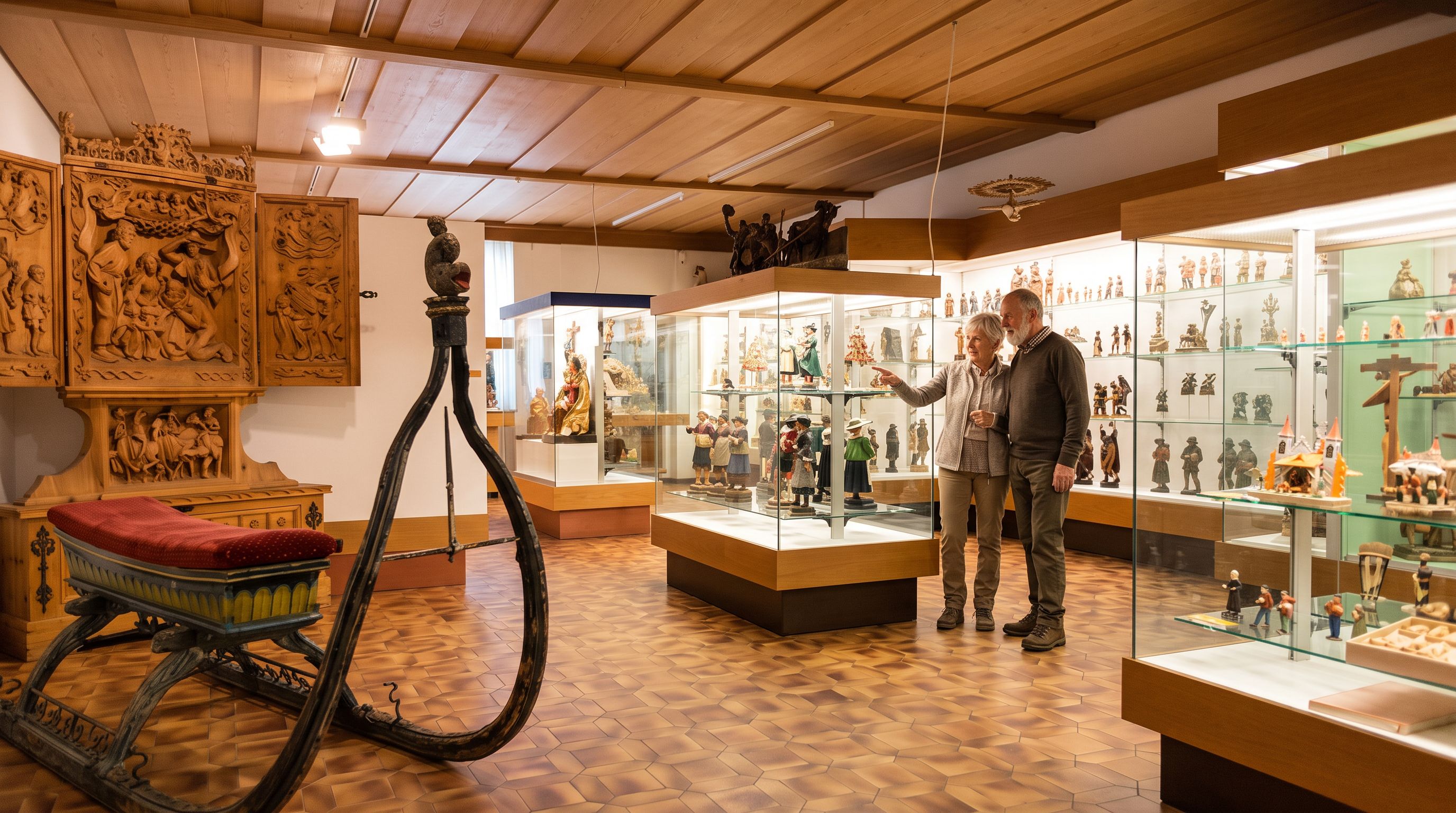
Two institutions carry the story. Museum Gherdëina in Ortisei covers Val Gardena's Ladin history, woodcarving and natural history, with adult admission €10 and seniors 65+ at €8. Museum Ladin runs two sites: Ciastel de Tor in San Martino in Badia for cultural history and language, and Ursus ladinicus in San Cassiano for geology and palaeontology.
Museum Gherdëina sits in the centre of Ortisei at Cësa di Ladins and holds sections on wood toys, woodcarvings, paintings, archaeology, the Dolomites and Luis Trenker, according to the Südtirolerland listing. Its own site publishes opening hours of Monday to Saturday, 10am to 6pm, and notes a virtual exhibition option. A toy exhibition marking 70 years of wooden toy history from the company Sevi was reported as planned from December 2025, and renovation and expansion work is planned from 2025 onward with funding partly from the provincial Ladin education and culture office and the Autonomous Region of Trentino-South Tyrol. The museum's own site still showed normal opening times in September 2026, so this is a planned work item rather than a documented closure.
Museum Ladin's two sites share a season: both are open from 1 May to 1 November, Tuesday to Sunday, 10.00 to 18.00, and closed on Mondays, according to the museum's own pages. Ciastel de Tor occupies a castle in San Martino in Badia and covers the cultural history, language, art and life of the Ladin community up to the present day. The San Cassiano site spreads across three floors and covers the cave bears that lived in the area more than 50,000 years ago. The museum also runs guided tours and craft workshops for children.
| Museum | Location | Season | Hours | Senior 65+ |
|---|---|---|---|---|
| Museum Gherdëina | Ortisei | Year-round pattern published | Mon-Sat, 10am-6pm | €8 (adult €10) |
| Museum Ladin Ciastel de Tor | San Martino in Badia | 1 May - 1 Nov | Tue-Sun, 10.00-18.00; Mon closed | Not documented |
| Museum Ladin Ursus ladinicus | San Cassiano | 1 May - 1 Nov | Tue-Sun, 10.00-18.00; Mon closed | Not documented |
Museum Gherdëina's reduced fares are published in full: €8 for groups of 10 or more, €8 for people with disabilities, €2.50 for students under 26, €1.50 for school classes, and free entry for children under 8. The museum also closes in spring from early April to early May and in autumn from the end of October to the end of November. Neither Museum Ladin site publishes a senior rate in the material reviewed, so ask at the desk.
What will I find at the Messner Mountain Museums?
The MMM is a six-site circuit devoted to mountain culture, spread across South Tyrol and the Dolomites. MMM Dolomites sits on Monte Rite at 2,181 metres between Cortina and Cadore and focuses on rock and mountain climbing. Senior fares of 65+ are published for MMM Dolomites, Corones, Firmian, Ortles and Ripa.
Because the sites are far apart, the first planning decision is which one you actually mean. Travellers on Fodor's recommend the museum in the Brunico area, housed in a 13th-century castle, and note that another Messner museum sits just outside Bolzano. MMM Ripa, in Bruneck Castle, presents mountain peoples from four continents through photographs, textiles, furniture and reconstructed interiors.
Seasons and hours differ sharply by site, and each carries its own condition. MMM Dolomites is open 1 June to 30 September, 10:00 to 17:00, with last admission at 16:30, and closed on Tuesdays. MMM Corones opens with the cable cars, 10:00 to 16:00, last admission 15:30, seven days a week, and publishes weather-related closures, including one due to strong winds on 26 March 2026. MMM Firmian opens from the third Sunday in March to the second Sunday in November, 10:00 to 18:00, closed Thursdays. MMM Ortles runs from the fourth Sunday in May to the second Sunday in October, then from the second Sunday in December to 1 May, with longer hours in July and August from 13:00 to 18:00 and last admission at 17:30.
| Museum | Season | Hours | Senior 65+ | Circular walk |
|---|---|---|---|---|
| MMM Dolomites (Monte Rite) | 1 Jun - 30 Sep | 10:00-17:00, last 16:30; closed Tue | €10 (adult €12) | Not suitable for disabled visitors |
| MMM Corones | Opens with cable cars | 10:00-16:00, last 15:30, daily | €12 (adult €14) | Suitable for disabled visitors |
| MMM Firmian (Bolzano) | 3rd Sun Mar - 2nd Sun Nov | 10:00-18:00; closed Thu | €13 (adult €15) | Not suitable; courtyard and exhibition room barrier-free |
| MMM Ortles (Solda) | 4th Sun May - 2nd Sun Oct; 2nd Sun Dec - 1 May | Jul-Aug 13:00-18:00, last 17:30 | €10 (adult €12) | Suitable for disabled visitors |
Two access notes matter for older visitors. MMM Dolomites does not permit large trekking backpacks or hiking poles, does not allow dogs, and prohibits flash photography; its circular walk is not suitable for disabled visitors. MMM Corones is not reachable by car. MMM Ortles requires no reservation for a museum visit. Several museum pages repeat that stout footwear is essential. The official pages do not document a specific mobility-assistance programme beyond the reduced admission category for people with disabilities, and booking conditions for individual sites are not documented in the material reviewed.
A MMM Tour-Ticket covers one visit each to Firmian, Juval, Ortles, Ripa, Dolomites and Corones, is valid for one year, and is priced at €55 adult, €45 concession, €125 family and €25 for children.
What traditions and church customs are still observed?
Ladin tradition remains publicly framed around the church calendar and communal ritual. Alta Badia's published cultural material describes Palm Sunday customs in which children take small brooms to church to be blessed, and a second family and village custom linked to weddings. Church-linked customs remain part of Ladin life in the valley.
Mountain churches are not documented in the material gathered for the specific places in this brief, so no church is described here as a visitor attraction, and no opening times are given. What can be said is that religious observance is not a heritage display in these valleys; it structures the year.
Ladin identity is described by Alta Badia's tourism board as marked by linguistic identity, tradition, agriculture, craftsmanship and the wooden decorations visible in local architecture. The same source notes that Ladin is spoken daily in Alta Badia and taught in lessons on Ladin language and culture. For a visitor, the honest position is that the customs are real and continuing, but the published record on attending them as an outsider is thin. Ask at the Ortisei tourist association, which publishes seasonal opening hours and special closures, including 1 November and 25 December, with reduced Saturday afternoon and Sunday openings from mid-April to mid-May and in November.
Are there market days in the Ladin valleys?
Market days are not documented in the official material gathered for Val Gardena, Alta Badia, Ortisei or the Messner Mountain Museum Dolomites. No weekly market schedule can be given here, and none should be assumed. The tourist offices are the correct place to ask.
This is a genuine gap rather than an oversight in the valleys. The official tourism pages reviewed cover museums, language, craft and seasons, and none of them publishes a market calendar for these villages. Rather than repeat a schedule from an unverified source, this guide leaves it open.
What is documented is the visitor information infrastructure. The Ortisei tourist association publishes an address in central Ortisei and seasonal opening hours, with the special closures noted above. It does not publish accessibility aids, booking terms or cancellation conditions in the material reviewed, and it does not list guided activities in the reviewed pages. If a market day matters to your trip, contact the association directly before you travel rather than planning around a date found elsewhere.
Which Ladin cultural sights are easiest underfoot?
The best-documented option is Museum Gherdëina in Ortisei, because it publishes exact senior pricing, a central location and a clear opening pattern. Museum Ladin's two sites are also fixed indoor visits with published seasons. The Messner museums vary: MMM Corones and MMM Ortles describe their circular walks as suitable for disabled visitors, while MMM Firmian and MMM Dolomites do not.
Beyond that, the record is thin and should be treated as such. Museum Gherdëina's source gives the central location and opening hours but does not document lifts, stairs, slope or walking distance. The Ortisei tourist association does not document accessibility aids. The Messner museum network's official site confirms the circuit but the material does not document exact accessibility terms, closures or booking conditions for each site.
Two practical consequences follow. First, no source in this material documents exact underfoot difficulty ratings for churches, village walks or market-day access in Val Gardena or Alta Badia, so treat any confident claim about flat routes in these villages with caution. Second, the museum visit itself is the most predictable cultural activity, because it is an established indoor site with fixed hours rather than a rough walking route.
One further pressure point is documented. Coverage in 2025 described long lines at the valley station and the Furnes intermediate station for the Seceda cable car above Ortisei, alongside a proposal to increase transport capacity and an announced environmental impact assessment before any authorisation. A 2025 regional report described Val Gardena as overwhelmed by visitors, with crowds at Seceda. No source quantifies crowding by hour or season, so the sensible approach is to build the cultural day around the museum and old town and treat the lift stations as a separate decision.
For travellers weighing where to base themselves, our guide to Dolomites hotels chosen for comfort covers the practical side of village stays, and the complete Dolomites guide for travellers over 50 handles transport, seasons and terrain across the wider range.
Where should culture-focused visitors base themselves?
Ortisei and San Martino in Badia carry the strongest documented cultural links. Guest reviews connect stays at Hotel Sassongher in Corvara in Badia and Ostaria Posta in San Martino in Badia directly to Ladin traditions, values and heritage, with learning about Ladin culture described as a bonus of the stay.
Ortisei's advantage is concentration: the museum, the church of Sant'Ulrico and the carving workshops form one walkable cultural cluster, and the village is described as a Ladin town where locals may speak Ladin at home. San Martino in Badia holds Ciastel de Tor, the castle museum covering Ladin cultural history and language. Corvara in Badia sits in Alta Badia, where the tourism board frames the valley as a custodian of Ladin and Alpine culture.
Reviews of Ortisei and San Martino in Badia hotels repeatedly praise food quality, with breakfasts described as generous and varied and half-board dinners as high standard, and staff described as friendly, attentive and helpful. Many guests say they would return, including at Hotel Angelo Engel in Ortisei and Ostaria Posta in San Martino in Badia.
Two recurring issues are worth planning around rather than dismissing. Night-time noise and poor acoustics appear repeatedly in Ortisei-area reviews, including complaints about noisy large groups and rooms that were quieter only when located farther from entertainment areas such as a club beneath a main building. Sleep quality is sometimes affected by bed comfort, with one Expedia review describing a hard single mattress and another an uncomfortable fold-out bed. Dining pacing can also vary, with reviews mentioning delayed meals and buffet or multi-course service changing by night. Ask for a room away from the bar or entertainment areas when booking, and confirm the bed configuration in writing.
Accessibility in Ortisei and wider Val Gardena properties is mixed in the reviews surfaced, with some listings praising helpful access and others noting steps. Exact walk-in shower or lift availability is not consistently documented, so ask the property directly. If a spa is part of the plan, our round-up of Alpine spa hotels in the Dolomites sets out what each one publishes.
What should you confirm before you go?
Confirm three things directly: the current status of Museum Gherdëina's planned renovation work, the opening pattern of whichever Messner museum you intend to visit, and whether any market day falls during your stay. None of these can be settled from published material alone.
Museum Gherdëina has renovation and expansion work planned from 2025 onward, with funding partly from the provincial Ladin education and culture office and the Autonomous Region of Trentino-South Tyrol. Its own site still showed normal opening times in September 2026, so the reported impact is a planned work item rather than a documented closure. Check before travelling.
Messner museum seasons cluster around late spring to early autumn, with MMM Dolomites open only June to September and MMM Firmian and MMM Ortles following longer but still seasonal calendars. Winter is the least convenient period for MMM Dolomites, and cable-car dependent sites such as MMM Corones can close for wind or follow ropeway schedules.
Emergency numbers are not documented in the material gathered for these valleys, and neither are nearest-pharmacy details for the museums named. Ask at your accommodation on arrival. Rates quoted here are indicative and vary by season and booking channel.
For families combining a Dolomites stay with a city break, our Venice guide for travelling with grandchildren covers the onward leg.


