
The Dolomites reward a particular kind of traveller: someone who wants mountain scenery at close range without necessarily climbing to it. The range became a UNESCO World Heritage Site on 26 June 2009, recognised for the beauty of its landscape and its geological importance, and it now covers about 142,000 hectares across five provinces: South Tyrol, Trentino, Belluno, Udine and Pordenone. Around 95% of the nine systems' surface is protected by national, regional or provincial parks, or by national monument or SCI/SPA status, as the official Dolomites tourism site states.
What makes the range unusually workable for readers in their fifties and sixties is the lift network. Cable cars, gondolas and chairlifts carry visitors to high viewpoints with no walking at all, and a documented accessible-trails programme runs alongside the conventional hiking routes. The practical question is not whether the Dolomites suit older travellers, but which valley, which base and which pace suit you.
Why do the Dolomites suit travellers over 50?
The Dolomites work for older travellers because the lift system and the documented accessible-trail network let you reach high scenery with limited walking. The UNESCO Dolomites Foundation coordinates 36 accessible routes across all nine Dolomite systems and 13 panoramic viewpoints reachable by fully accessible lift systems, with technical sheets in Italian, German and English.
That programme is the single most useful planning document for this audience. Each route comes with maps, GPS coordinates, environmental and geomorphological notes, and stopping points, so you can judge in advance whether a trail suits you. The routes are described as suitable for people with limited mobility, including older travellers.
Beyond the accessible network, the ordinary lift infrastructure does most of the work. A gondola replaces a two-hour climb; a chairlift puts a rifugio lunch within a short stroll. Several travellers on the Rick Steves forum have noted how much scenery is reachable with what one thread called minimal exertion, and that combining hikes with gondolas and ski lifts is standard practice rather than a compromise.
Which valleys and resorts should you consider?
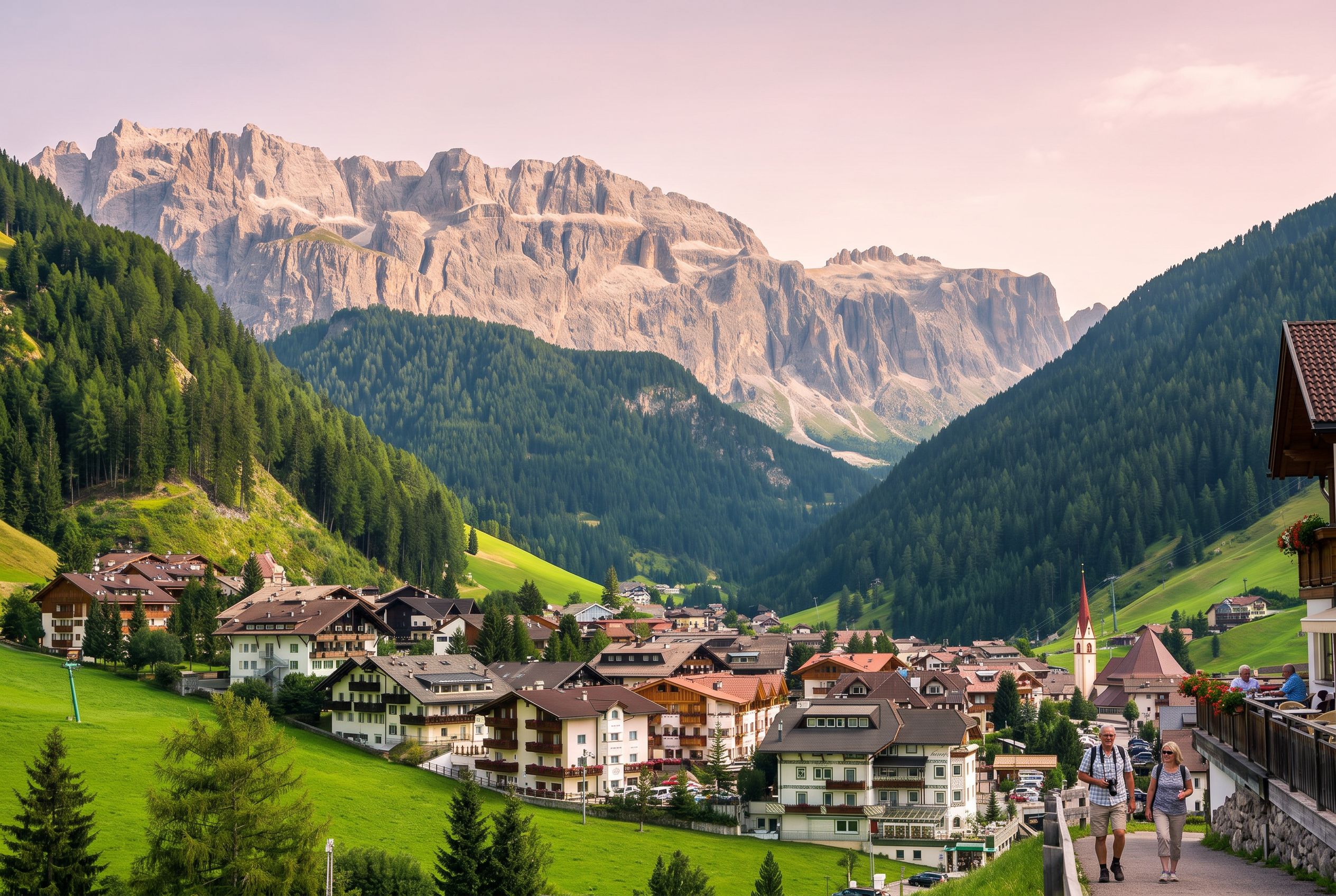
Three areas carry most of the practical documentation for older visitors: Val Gardena in South Tyrol, the Seiser Alm plateau above it, and the Ampezzo valley around Cortina d'Ampezzo in Belluno province. Val Gardena has the densest published accessibility information; Seiser Alm has the strongest barrier-free accommodation listings.
Val Gardena covers three villages, Ortisei, Santa Cristina and Selva, sitting at roughly 4,000 to 4,500 feet according to a Rick Steves forum discussion. The local tourism board documents numerous barrier-free lifts to easily accessible viewpoints, plus accommodation and restaurant listings for guests with special needs. Forum contributors repeatedly describe Ortisei as the easiest village for access, with buses linking all three villages and multiple lifts rising to higher ground.
The Seiser Alm, or Alpe di Siusi, is Europe's largest high alpine pasture and sits above the villages of Siusi allo Sciliar and Castelrotto. The regional accessibility page documents over 100 barrier-free accommodation options in the area and surrounding villages, accessible toilets at specific transport nodes, and several accessible hiking paths.
Cortina d'Ampezzo anchors the eastern Dolomites and is the gateway to the Tre Cime di Lavaredo and the Ampezzo Dolomites Natural Park.
 AI-edited
How do the valleys and resorts connect?
Public transport works well between the larger towns and valleys, and less well deep into remote trail areas. Bolzano, Trento and Belluno are the practical rail gateways. Venice and Innsbruck are the two most common airport sides. From Bolzano, the bus to Ortisei takes about an hour according to a forum report.
Within Val Gardena, buses run between Ortisei, Santa Cristina and Selva, and the local tourism board advises getting around on foot, by bicycle or by public transport rather than by car during busy periods. The Gardena Card, sold by the Val Gardena tourism organisation, gives unlimited trips on 18 cable cars in the valley, valid for either 3 or 6 consecutive days. Adult rates for the 2026 season, valid from 6 June to 11 October 2026, are €124 for 3 consecutive days and €160 for 6 consecutive days, with children under 8 at €5, bike transport at €5 and dogs travelling free.
Dolomiti Bus serves the Province of Belluno, which the operator describes as a mountainous area of 61 municipalities. The operator publishes timetables online. For the wider range, a current travel guide notes that visitors commonly combine private buses, local trains and cable cars.
How do you choose a base?
Choose one valley and stay in it. Val Gardena is the most concretely documented base for older visitors, with Ortisei named repeatedly in forums as the easiest village for access. Seiser Alm suits those who want the plateau itself on the doorstep. Trying to cover the whole range from one short stay is the most common planning mistake.
The case for a single base is practical. Forum contributors recommend starting in Ortisei rather than attempting to see too much of the region by car in a short stay, and one detailed suggestion for older adults builds a trip around Ortisei, the Alpe di Siusi cableway at Compatsch, and very easy out-and-back walking near Hotel Steger-Dellai, naming the Hans and Paula Steger Trail as a good option.
Altitude is part of the base decision. Val Gardena's villages sit at around 4,000 to 4,500 feet, and a forum discussion suggests that visitors who handle Denver well should likely be fine there. The same discussion advises those unused to altitude to take it easy on the first full day, drink plenty of water, and avoid a major hike immediately on arrival.
If you want the plateau rather than the valley, note the access rules. The road up to the Seiser Alm is closed to cars from 9:00 am to 5:00 pm during the season, according to the Seiser Alm cable car operator. Holders of an official European Disability Card may drive up to Seiser Alm and Compatsch at any time, but prior registration and an access permit via the municipal portal are required.
How fit do you need to be?
Less fit than most people assume. The accessible Dolomites network is designed for people with limited mobility, including the elderly, and the lift system removes most climbing. The terrain remains mountain terrain, and the accessible programme does not claim that all Dolomite walking is easy or flat.
The honest position is that the Dolomites offer a wide spectrum, and the skill is matching yourself to the right band. At the gentlest end sit the accessible trails and the lift-served viewpoints. Above that come valley-floor walks, plateau circuits and rifugio strolls. Beyond that lie the long alpine routes, which are their own subject and not what this guide covers.
One caution worth carrying: the accessible-trails pages do not publish step counts, lift-change counts or distance-on-foot for individual routes in their summary material. The technical sheets give detail, but if a specific figure matters to you, confirm it with the local tourism office before you commit.
What do the accessible routes and viewpoints actually offer?
The programme publishes 36 accessible trails across all nine Dolomite systems and 13 panoramic viewpoints reachable by fully accessible lift systems, coordinated by the UNESCO Dolomites Foundation. Each route carries maps, GPS coordinates, stopping points and technical sheets in Italian, German and English.
The Accessible Dolomites programme is presented through an interactive map on the tourism site, which can be used to plan by geographic area and to browse nearby activities. The route pages include environmental and geomorphological features alongside the practical detail, so you can assess suitability before travelling.
Val Gardena's own accessibility page documents numerous barrier-free lifts to easily accessible viewpoints, and lists barrier-free accommodation and restaurants. In the Seiser Alm area, the regional page offers an accommodation filter for accessible properties and lists accessible infrastructure points.
What the accessible-trails pages do not document is health provisions, safety guidance, booking or cancellation terms, or an on-page assistance booking service. The programme is built for self-planning. If you need assistance arranged in advance, that conversation happens with the individual valley tourism office, not through the route pages.
What are the mobility realities on the ground?
Lifts do the climbing, but the ground between them varies. Val Gardena documents barrier-free lifts and accessible viewpoints. Seiser Alm documents accessible toilets at specific transport nodes. Exact step-free routes, station transfers and airport transfers are documented for the broader region but not as one universal system across the whole Dolomites.
The Renon cable car, which runs from Bolzano up to Soprabolzano, is stated by the operator to be accessible for wheelchair users, and the installation of travel cabins has shortened the journey to 12 minutes to the top of the plateau. A cabin departs every 4 to 12 minutes from the Bolzano and Soprabolzano stations, and it is not possible to reserve tickets or seats.
On the Seiser Alm cable car, people in wheelchairs, people with 100% disability and blind people ride free, with accompanying persons paying the regular price, according to the operator's summer 2026 tariff page. In Val Gardena, the tourism board states that blind or visually impaired people may use public transport free of charge with appropriate ID.
The Seiser Alm accessibility page does not give step counts, gradient figures or walking-distance thresholds for its paths. The Val Gardena accessibility page does not document health provisions. Ask the valley tourism office directly for the specific detail you need.
When should you go?
September and early October are the strongest window for this audience. Summer runs mid-June to September with long days and frequent afternoon thunderstorms. Autumn brings golden larches and the enrosadira sunset glow. Spring is the quietest shoulder season, but many high routes and huts remain closed.
One over-60 planning thread explicitly targets September or early October, suggesting that period for walking, birdwatching, photography and local food and wine. The same discussion suggests a five-to-seven-day stay as a useful length for active seniors who want a mix of walking and relaxed exploration.
Summer is the season for trails, via ferratas and open huts, and the Dolomites receive less precipitation annually than most of the Alps, though summer afternoons can still bring storms. Winter runs December to April with solid snow usually from November at higher elevations.
| Month | High / Low | Daylight | Sunshine | Rainy days |
|---|---|---|---|---|
| April | 19°C / 5°C | 13:32 | 5 hrs | 7 |
| May | 23°C / 9°C | 14:56 | 6 hrs | 10 |
| June | 27°C / 13°C | 15:42 | 7 hrs | 9 |
| July | 29°C / 15°C | 15:25 | 8 hrs | 9 |
| August | 28°C / 15°C | 14:12 | 7 hrs | 9 |
| September | 25°C / 11°C | 12:37 | 6 hrs | 6 |
| October | 19°C / 6°C | 11:01 | 5 hrs | 6 |
What do lifts, passes and senior fares cost?
Senior fares exist but are not universal. The Seiser Alm cable car offers a senior rate for those born in 1960 or earlier: €18 one-way and €26 return in summer 2026. Dolomiti Superski gives a 10% reduction on some ski passes for the same age group. Rates are indicative and vary by season and booking channel.
The Gardena Card is the main lift product in Val Gardena, valid for 3 or 6 consecutive days on 18 cable cars, with 2026 summer rates of €124 and €160 respectively for adults. The tourism board does not document a senior fare for the Gardena Card, only adult and junior rates.
For disability discounts, the conditions are specific. Dolomiti Superski gives people with a recognised disability of at least 51% a 20% discount on daily, multi-day and season ski passes, sold only at sales points. In Val Gardena, adults and juniors with a disability of 51% or more receive a 20% discount on the Gardena Card, and the tourism board advises checking discount eligibility with sales points or by email.
Museums carry their own reductions. The Geological Museum of the Dolomites offers a reduced ticket of €4 for over-65s. DoloMythos Museum charges seniors aged 60 and over €12 against €14 for adults. The MMM Dolomites charges people with disabilities €10.
What about health services and mountain safety?
Emergency numbers differ by service. The single European emergency number 112 reaches mountain rescue across the Dolomites. In the Veneto Dolomites, the health emergency number is 118, with the operations centre active 24 hours a day, seven days a week, and helicopter rescue available when needed.
Val Gardena's hiking-safety page states that emergency calls must go to 112, and that the Where Are U app may be used for emergencies. In Selva di Val Gardena, the local page lists Pharmacy Dolomiti on 0471 795142, an outpatient clinic at Nivesstr. 2, and additional pharmacies in Santa Cristina and Ortisei. It does not document a hospital in Selva itself.
At province level, the Veneto health guide lists Belluno Hospital, Feltre Hospital, Agordo Hospital and Pieve di Cadore Hospital serving the Dolomites area, with emergency rooms and first-aid points open around the clock. A broader travel guide names Brunico, Bressanone, Cortina d'Ampezzo, Bolzano and San Candido as towns and ski areas with a hospital within reasonable reach.
Altitude deserves its own line. The forum advice is consistent: take the first full day gently, drink plenty of water, and do not attempt a major hike on arrival day. The accessible-trails pages do not document health provisions or safety guidance, so that planning sits with you and your doctor.
What can you do on a lower-effort day?
Museums, cable-car viewpoints and plateau strolls fill a rest day well. The museum network publishes fixed opening patterns and senior discounts. The MMM Dolomites on Monte Rite, at 2,181 metres between Cortina and Cadore, is closed, so check before planning around it.
The Messner Mountain Museum's Dolomites site sits inside a former First World War fort, and the operator states plainly that the museum remains closed. Its circular walk is described by the operator as not suitable for disabled people. The MMM Dolomites visitor page carries the current status.
Elsewhere the pattern is more reliable. The Geological Museum of the Dolomites offers winter activities and guided tours by reservation, plus thematic workshops called Geolabs, and does not document a weekly closure day. DoloMythos Museum states that it stays open every day all year round, closing only on 25 December, with guided tours on request and long daily opening hours in summer.
For pure scenery with no walking, the lift-served viewpoints do the work. The Seiser Alm cable car runs from 22 May to 2 November 2026, 8:00 am to 6:00 pm, extended to 7:00 pm from 7 June to 6 September 2026. The Renon cable car from Bolzano requires no reservation and departs every 4 to 12 minutes.
What should you know before booking?
Book lifts and popular access points ahead where reservations are required, and confirm accessibility detail directly with the property. The Tre Cime di Lavaredo toll road reopened on 25 May 2025 with reservation required. The Col Rodella cable car at Campitello di Fassa closed for renovation during summer 2025, with reopening scheduled for December 2025.
Infrastructure changes matter more in the Dolomites than in most mountain regions, because a single lift closure removes a whole viewpoint from your trip. Dolomiti Superski reported more than €100 million invested for the 2024–25 winter season, with lifts and slopes open into mid or late April 2025 in areas including Cortina d'Ampezzo and Faloria, Plan de Corones, Arabba, 3 Cime Dolomites, Val di Fiemme and Obereggen, and Valles-Jochtal. The Falzarego chairlift at Col Gallina was the last to close that season, on 4 May 2025.
Local events close roads. The Val Gardena tourism board announced road closures, parking bans and public transport suspensions for the HERO Südtirol Dolomites event from 12 to 14 June 2025, affecting Streda Nives, Streda La Sëlva, Streda Mëisules, Streda Rainel, Streda Dantercëpies and the SS243 at Gardena Pass.
On accommodation, the recurring theme in guest feedback is noise rather than access. At one Alpe di Siusi property, a Tripadvisor review reports ski lift machinery running from about 7:30 am to 7 pm with rooms close to the cable car, and notes that sleeping with windows open is a must in warm weather. Where you book near a lift station, ask for a room away from the machinery.
How many days do you need?
Five to seven days is the length suggested in an over-60 planning discussion for a mix of walking and relaxed exploration. That allows two or three lift-served days, a valley day, a museum or rest day, and slack for weather. A single valley base makes that rhythm workable.
The temptation in the Dolomites is to treat the range as one destination. It is not. Val Gardena, Alta Badia, the Ampezzo valley and the Trentino valleys each have their own lift systems, bus networks and tourism offices, and moving between them costs half a day each time.
A realistic week from Ortisei might combine the Alpe di Siusi plateau, a Gardena Card day across several lifts, a valley-floor walk, a museum, and one longer outing by bus. Readers who want a city at one end of the trip may find the rail gateway useful: Bolzano, Trento and Belluno all connect onward, and Venice is one of the two most common airport sides for reaching the range. If you are adding days in the lagoon city, our guide to Venice's flattest strolls and loveliest corners covers the gentler side of a stopover there.
What does this guide not cover?
This is an orientation guide. Individual hotel reviews and single full itineraries are separate subjects with their own dedicated articles. Where a specific property or a day-by-day route is what you need, look for the matching guide rather than stretching this one.
The same applies to the wider region. The Dolomites sit within a travel area that includes several distinct destinations, and some of them are better served by their own coverage. If your trip extends south towards the coast, our review of the Furore Grand Hotel on the Amalfi Coast sits in a different landscape entirely. Closer to the Dolomites, if you are travelling with family, Venice with grandchildren covers a very different kind of trip, and day trips from Venice covers Padua, Verona, the Brenta Canal and the Lido.
What this guide does is give you the framework: which valleys to consider, how they connect, how much walking is realistic, what the lifts and passes cost, when to go, and where the health and safety services sit. Everything else hangs off those decisions.
How do you get there?
Bolzano, Trento and Belluno are the practical rail gateways to the range. Venice and Innsbruck are the two most common airport sides. Rail-and-bus travel is manageable if you can handle luggage, stairs into carriages and station navigation; a forum post recommends taxis from station to hotel when needed.
From Bolzano, the bus to Ortisei takes about an hour according to a forum report, and one contributor describes the Val Gardena area as the most accessible by public transport in the Dolomites. Dolomiti Bus publishes timetables for the Belluno province network online.
Within the valleys, buses link the main villages and lifts. The Val Gardena tourism board advises leaving the car behind during busy periods and using public transport instead. In Val Gardena, the Gardena Card doubles as a public transport product, which simplifies both lift access and village-to-village movement.
For anyone arriving by air, the two common sides are Venice Marco Polo and Innsbruck. Both connect onward by rail to the gateway towns, and from there by bus into the valleys. Build in generous connection time, particularly if you are carrying luggage and changing at an unfamiliar station.
What is the practical summary for a first trip?
Pick one valley, base yourself in Ortisei or on the Seiser Alm, aim for September or early October, allow five to seven days, and plan around lifts rather than long walks. Confirm accessibility detail directly with the tourism office, and check lift status before you travel.
The Dolomites reward preparation more than most mountain destinations, because the difference between a comfortable week and a tiring one lies in small decisions: which village, which lift, which room, which month. The documented accessible network, the lift infrastructure and the valley-level tourism offices together give you enough published detail to make those decisions before you leave home.
The rest is weather and temperament. Take the first day gently, keep the walking within what you actually enjoy, and let the cable cars do the climbing. The scenery arrives either way.


