
Hoi An rewards the curious eater. The Ancient Town's food culture runs on fresh herbs, river seafood and dishes cooked to order over charcoal, and the town's restaurant and market culture is one of the main reasons travellers in their fifties and sixties put it on the itinerary. The practical question is not whether to eat, but how to eat well without losing two days to a stomach upset. The guidance below is deliberately calm: most visitors eat widely and stay well, and the sensible precautions are few, cheap and easy to carry.
Hoi An is generally described as a low-risk destination, with food- and water-borne illness named as a more realistic concern than crime. The town's own food businesses were inspected in 2025, and most met legal food-safety criteria, according to a May 2025 report. That is a useful baseline, not a guarantee about any single stall. What follows is planning information: what to drink, which stalls to choose, how to handle ice and raw herbs, and what to keep in your bag.
Is Hoi An tap water safe to drink?
No. Most sources covering Hoi An advise bottled, filtered or boiled water for drinking, and several extend that to brushing teeth. One Lonely Planet guide takes a more permissive view, saying Hoi An water is of reasonable quality and brushing is acceptable. Because the sources conflict, bottled or reliably filtered water is the conservative choice for older visitors.
The disagreement is worth stating plainly rather than smoothing over. Guidance for Hoi An from several travel sources says tap water is not safe to drink and should be avoided for brushing teeth as well. Lonely Planet's Hoi An guide is the outlier, describing local water as reasonable quality while still recommending bottled water for drinking. If you have a sensitive stomach, or you are travelling with anyone prone to digestive trouble, treat the stricter reading as your default.
Use bottled or filtered water for drinking, brushing teeth, making ice and taking medicines. Check that bottles are factory-sealed; avoid bottles that appear refilled, a common practice at some informal vendors. Hoi An tap water guidance sets out the same position for the town specifically.
One practical note from a Rick Steves Travel Forum trip report dated 23 March 2024: the writer's husband accidentally brushed and rinsed with Hoi An tap water once and did not become ill, but the couple said they would not deliberately risk it. The same report notes that hotels supplied limited bottled water, so buying a large bottle in town and refilling personal bottles was their routine.
What about ice in drinks?
Guidance is mixed. Filtered, factory-produced ice in established restaurants is described as generally safe, while ice from roadside stalls is treated more cautiously. Factory-produced clear cylindrical ice is regarded as lower risk. If your digestion is sensitive, avoid ice unless its source is clear.
Ice is lower-risk at established Hoi An restaurants and cafés that use commercial or filtered ice, but crushed ice from informal stalls and mobile vendors is less certain, according to guidance on tap water and ice in Vietnam. Several forum contributors specifically warned against crushed ice, and one suggested that hollow-centred machine ice is more likely to be commercially produced. That is traveller advice, not a guarantee.
Do not assume a drink is safe simply because it is cold. For lower risk, choose sealed bottled drinks, or beverages made with ice from a reputable hotel, restaurant or sealed commercial source. A cold beer or a sealed soft drink carries less uncertainty than a fruit shake blended with ice of unknown origin at a low-turnover stall.
 AI-edited
Is Hoi An street food safe to eat?
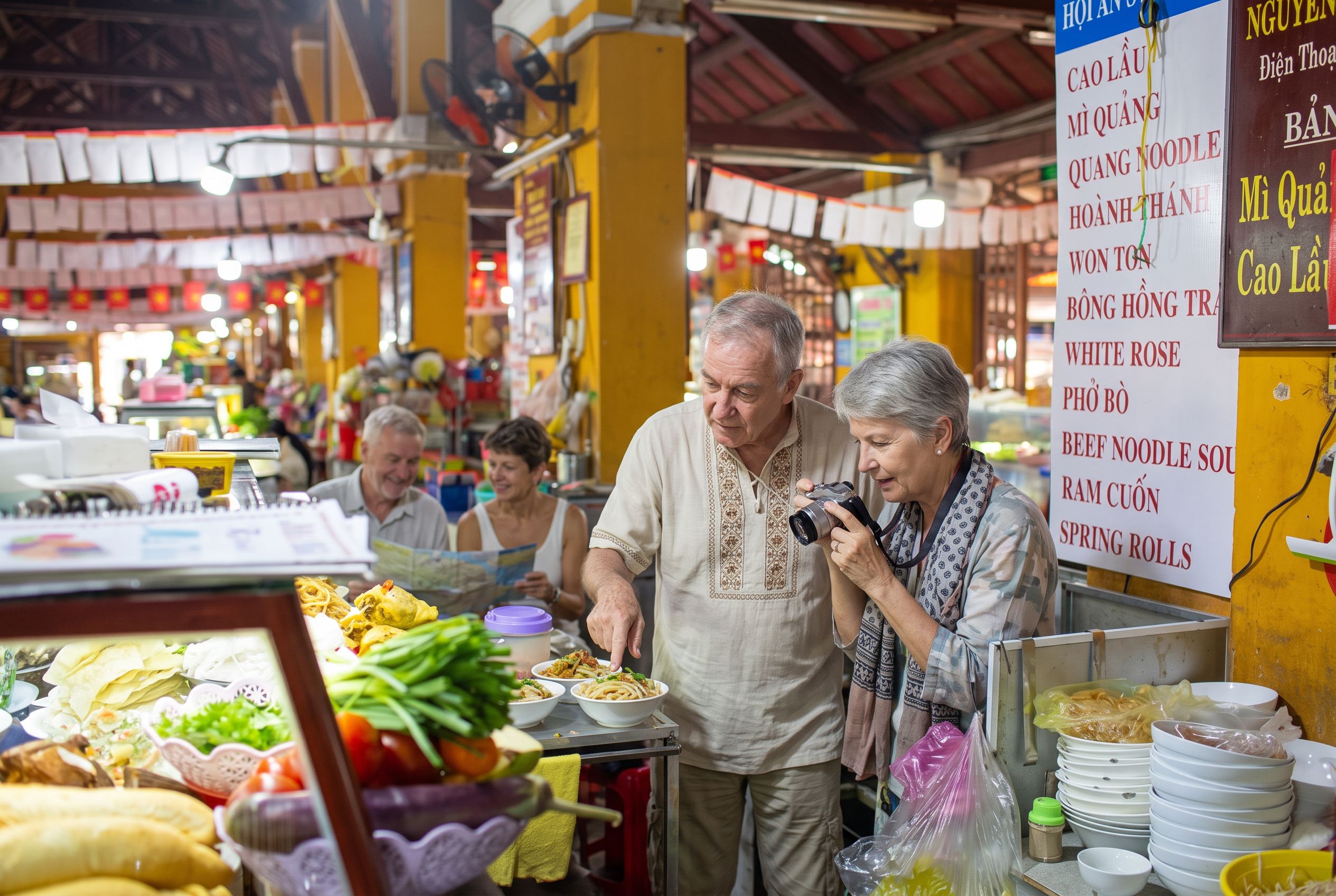
Street food in Hoi An is generally described as safe when it is cooked fresh, served hot and bought from busy, high-turnover stalls where local customers are eating. The reporting does not establish that all Hoi An street food is safe, nor that it is unsafe. Popularity is a useful signal, not a guarantee.
Recorded travel guidance consistently points to the same three markers: high turnover, food cooked in front of you, and food served hot. Vietnam Tourism's food-safety guidance says the principal risks are tap water, raw produce washed with unfiltered water, and food left out for hours, and describes busy stalls and freshly cooked food as the safer choice.
Specific dishes are named as good candidates from busy stalls: bánh xèo, cao lầu, mì Quảng, cơm gà and bánh mì. For a fuller picture of what to order and where, see our guide to eating in Hoi An for travellers 50-70.
What to avoid is equally clear. Food sitting unrefrigerated in the sun or for several hours, raw herbs or vegetables of uncertain washing, and improvised festival-night stalls with little visible hygiene are the recurring cautions. Safety and health guidance for Hoi An lists the same three.
Is bánh mì safe, and what about seafood?
Bánh mì is not inherently unsafe, but pâté, mayonnaise, meat and fresh herbs become higher-risk when held warm or prepared well in advance. Buy it busy and freshly assembled. For seafood, choose dishes cooked thoroughly and served hot, and avoid raw shellfish or cooked seafood left unrefrigerated.
Hoi An's bánh mì commonly contains pâté, pickled vegetables, herbs and a protein filling. The risk sits in the fillings that spoil, not in the bread. A bánh mì assembled in front of you at a stall with a fast queue is a different proposition from one that has been sitting assembled in a cabinet.
Hoi An's food identity includes Thu Bon River seafood. The guidance is straightforward: choose seafood cooked thoroughly and served hot, and avoid raw shellfish and cooked seafood that has been sitting unrefrigerated. Vietnam food-safety guidance identifies ice, raw herbs and uncooked seafood as specific risk points, though that guidance is broader than Hoi An itself.
One anecdotal warning deserves a mention without being inflated. A Reddit discussion dated 22 February 2025 refers to illness associated with a bánh mì shop in Hoi An, but the material does not provide enough verifiable detail to identify the shop or establish the number of cases. Treat it as an anecdote, not evidence of a town-wide problem. No source documents how many Hoi An visitors became ill or identifies particular vendors.
Can you eat salads and fruit in Hoi An?
Hoi An cuisine uses fresh local herbs extensively, and washing water is difficult to verify. Older travellers with sensitive digestion should favour cooked vegetables and accept raw herbs only at reputable, busy establishments. Peeled fruit is lower risk than unpeeled fruit, and fruit from hotel breakfast buffets is a reasonable starting point.
The Rick Steves trip report dated 23 March 2024 offers a useful distinction: the writer felt comfortable with fruit, vegetables and salads in hotels, but was more cautious with restaurant and street-stall produce unless the venue had been recommended. That is a sensible split for a two-week trip.
Unpeeled fruit, fresh juices diluted with unknown water, and unsealed ice are named as specific cautions in food-safety guidance. If you want a fruit snack while walking, choose fruit you peel yourself.
For herbs, a practical suggestion from a Reddit thread dated 7 January 2025 and updated 3 November 2025 was to add raw herbs or leaves to steaming pho so they are heated, rather than eating them uncooked. It is a small adjustment that costs nothing in flavour.
Does flooding change the food-safety picture?
Yes. During or immediately after flooding, avoid food exposed to floodwater and be especially cautious about raw produce, ice and water. Hoi An's Old Town can flood during heavy rain, especially in October and November, when water sometimes reaches knee height on some streets.
The published month-by-month table for Hoi An gives October 655 mm of rainfall and high flood risk, and November 438 mm with very high flood risk. October and November are also quieter months, partly because of the weather rather than any closure.
During October and November flooding, avoid wading through floodwater where possible. It may conceal hazards and contaminate food or footwear. For older visitors, those two months deserve particular caution because flooding can disrupt transport, walking routes, restaurant operations and sanitation. If your trip falls in that window, our guide to coping with heat and humidity in Hoi An covers the opposite season's challenges, and the two together give a full picture of the year.
What should over-50s pack for an upset stomach?
Pack oral rehydration salts and basic stomach-settlement supplies, particularly if your digestion is sensitive. Carry prescription medicines in original packaging with a written list of generic names and doses. Do not rely on finding a particular medicine locally.
What they do support is a simple kit:
- Oral rehydration salts, in hand luggage rather than checked baggage.
- Any prescription medicines you take, in original packaging, plus a written list of generic names and doses.
- A copy of your prescriptions and your travel-insurance details.
- Alcohol hand sanitiser for use before eating.
- Bottled or filtered water for drinking, and a refillable bottle to top up from a large purchased bottle.
For visitors aged 50 to 70, the practical priority is avoiding dehydration. Carry safe drinking water while walking, take oral rehydration sachets if medically appropriate, and seek help early if symptoms are severe or prolonged.
Seek medical help promptly for persistent vomiting or diarrhoea, blood in stool, high fever, confusion, fainting or signs of dehydration. Diarrhoea lasting more than 48 hours also warrants medical advice rather than self-treatment. Forum contributors mention oral rehydration, broth and pharmacy treatment, but these are anecdotal reports, not medical recommendations.
Where do you go if something goes wrong?
Hoi An has a hospital, several pharmacies and a recommended international clinic, but no major international hospital. For serious or specialist treatment, travellers may need to go to Da Nang, approximately 30 km away and about 40 minutes by car. Save the numbers below before you need them.
The Hoi An World Heritage information page lists these local facilities and telephone numbers:
| Facility | Address | Telephone |
|---|---|---|
| Hoi An Hospital | 04 Trần Hưng Đạo | (+84.510) 3862170 |
| Thái Bình Dương Hospital | 06 Phan Đình Phùng | (+84.510) 3921656 |
| Hoi An Pharmacy | 64 Nguyễn Thái Học | (+84.510) 3861258 |
| Minh Tâm Pharmacy | 4A Trần Hưng Đạo | (+84.510) 3914606 |
| Pharmacy 213 | 128 Trần Hưng Đạo | (+84.510) 3861258 |
| Pharmacy 216 | 03 Thái Phiên | (+84.510) 3863753 |
| Huy Hoàng Pharmacy | 04 Lý Thường Kiệt | (+84.510) 3916312 |
Travel-health sources also identify the Hoi An International Clinic on Lê Hồng Phong Street as a recommended clinic with English-speaking staff. The material does not provide its current telephone number, opening hours, fees, accessibility details or booking policy. Call ahead, particularly for English-language care.
Emergency numbers: ambulance 115, fire 114, and the Hoi An tourist police hotline 0235 3861 745, as listed by a 2026 safety guide.
Pharmacies are within roughly 230 m to 1.7 km of particular hotels in Hoi An, according to accommodation listings. Ask your hotel to identify the nearest open pharmacy and clinic on arrival, and confirm whether the clinic can treat foreign patients and accept insurance.
If you are choosing where to base yourself, quieter properties away from the bar streets can make a real difference to sleep quality during a recovery day. Our round-up of the quietest hotels around Hoi An covers the options.
How do you eat well in Hoi An without worrying?
Eat where the food is cooked to order and moving fast, drink from sealed or reliably filtered sources, peel your own fruit, and carry rehydration salts. Hoi An's food culture is one of the pleasures of the trip, and the precautions are small adjustments rather than restrictions.
The town's food businesses were inspected in 2025 and most met legal food-safety criteria, according to a May 2025 report. The same report said authorities were increasing surveillance of mobile cooking services, spontaneous markets and street-food businesses because those settings can carry higher risks. Hoi An had also introduced a community-monitoring model for agricultural, forestry and fishery food safety for 2024 to 2025, tracking food production and trading and helping monitor compliance locally.
What the reporting does not establish is a town-wide safe or unsafe label. No official Hoi An-wide accreditation for every street-food stall is documented. choose the busy stall, watch the food hit the heat, and keep your water sealed.
One final planning note. The Ancient Town is compact, largely flat and mostly pedestrianised at set times, with motorised transport banned on much of the Old Town from approximately 9:00 to 11:00 and 15:00 to 22:00, according to Lonely Planet. For more on terrain, pacing and getting around, see our guide to Hoi An's accessibility for older travellers.
Vaccinations and general health cover sit outside this guide; they have their own dedicated article. What belongs here is the everyday business of eating well, and in Hoi An that is a pleasure worth protecting with a few simple habits rather than a reason to hold back.


