
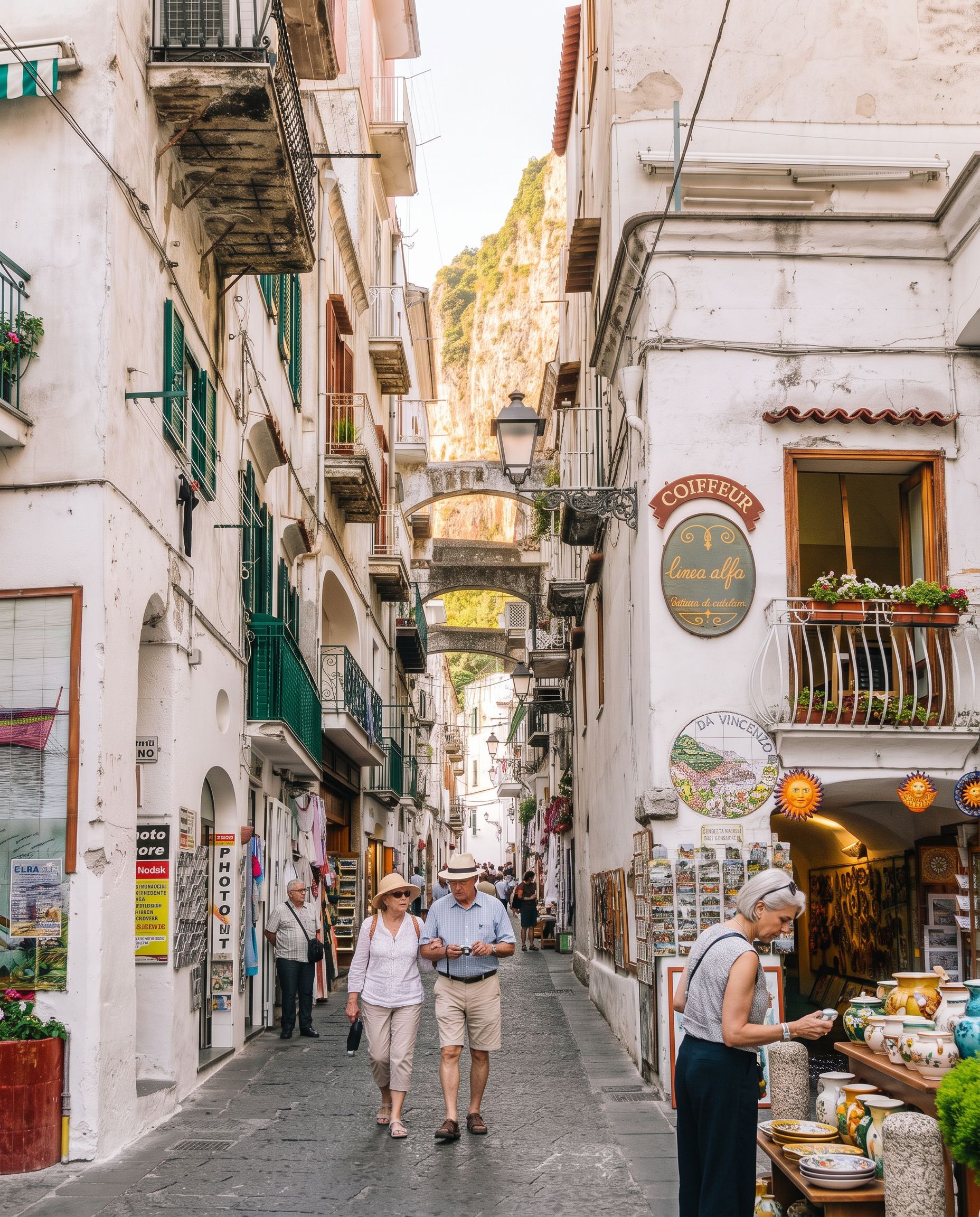
The Amalfi Coast is not a promenade destination. It is a vertical one, built into cliffs where the shortest route between two points is almost always a staircase, and where the stone underfoot has been polished smooth by centuries of traffic. For travellers aged 50-70, the difference between a comfortable week and a painful one comes down to what goes in the suitcase before leaving home. Supportive footwear, a manageable bag, sun protection and a realistic sense of daily distances matter more here than in almost any other Italian destination.
The coast's towns are documented as steep, step-heavy and surfaced with cobblestones and uneven stone, and the packing advice from multiple travel sources converges on the same short list: cushioned walking shoes with grip, a light daypack, sun protection and a rain layer. Everything else is optional. What follows is a practical guide to the items that earn their place, the terrain that dictates them, and the local details worth knowing before arrival.
 AI-edited
Why do shoes matter more than anything else on the Amalfi Coast?
Because the coast is vertical. Sources describe uneven cobblestone streets, ancient stone steps and steep inclines throughout the towns, and one packing guide notes that stair-heavy journeys from bus stops to hotels, beaches and restaurants can involve 50 to 200 steps. That figure comes from a general Amalfi Coast packing guide, not a municipal measurement, but it captures the daily reality.
Supportive walking shoes are the single most repeated recommendation. The consistent specification is cushioned shoes with real grip, good tread or straps, and no flimsy soles. One Amalfi Coast packing guide recommends broken-in walking shoes with good grip and ankle support, plus water shoes or strapped sandals for pebble beaches and a dressier but still comfortable pair for evenings.
The same guide warns against flip-flops on wet pebbles and states that stilettos are physically unsuitable for Positano's stone steps. Another packing source says simply to leave heels at home because cobblestones and stairs are everywhere, and warns that brand-new shoes can cause blisters on the coast's stone steps. Blisters here are not a minor inconvenience: one accessibility-focused page notes that they are genuinely debilitating on stepped terrain, because every route out of your accommodation involves more climbing.
How many pairs of shoes should you actually pack?
One Amalfi packing guide recommends three pairs maximum: walking shoes, beach shoes, and a dressier pair that still works on stairs. Forum travellers go further, with several recommending two pairs of walking shoes so one can dry out or be rotated if it starts to cause irritation.
The logic is straightforward. Coastal walking generates heat and moisture, and a shoe that stays damp against the foot is a shoe that rubs. Rotating between two pairs gives each one time to dry overnight, which matters more in July and August when humidity is high and rooms may not dry footwear quickly.
What to leave behind is equally clear. Heels are singled out repeatedly as unsuitable. Flimsy sandals are described as poor for walking any distance, though strapped sandals with proper soles work for beach days and short evening walks.
Should you bring a walking pole?
No official Amalfi Coast authority or operator material reviewed for this guide documents walking-pole advice for the coast towns specifically. That does not mean a pole is unhelpful; it means the recommendation is not documented in the published sources. Travellers who use one at home for knee or balance confidence should treat it as a personal decision rather than a destination-specific recommendation.
The coast is described as vertical, with uneven cobblestone streets, ancient stone steps and steep inclines. One source says stair-heavy journeys from bus stops to hotels, beaches and restaurants can involve 50 to 200 steps. Another says the coast involves more walking and climbing than people expect.
For anyone who already uses a pole on uneven ground, the case for packing a collapsible one is reasonable.
What kind of luggage works on stairs and ferries?
One source says the coast's narrow streets and steep stairs make wheeled luggage difficult, and recommends a carry-on spinner plus a travel backpack. Another Amalfi packing guide advises one medium suitcase and one carry-on day bag per person. A Rick Steves forum post warned that a large cruise suitcase would be "unforgiving" on the stairs.
The ferry network adds a second constraint. Published ferry pages state that luggage is usually permitted, with some services adding a small fee, and one route guide says there is usually an added charge of about €2 per piece on some services. At Positano, the port offers porter help for bags to hotels above the port, which is useful because the town is built on steps and steep lanes.
Porter availability elsewhere on the coast is not documented. Where no porter service is documented, the practical assumption is that you or a travelling companion will carry the bag up whatever stairs separate the drop-off point from the room. That makes a single manageable case per person the sensible target, with a day bag small enough to wear on both shoulders.
How should you pack for summer heat?
July and August are described as 30 to 35°C by midday, with high humidity and limited shade. Lightweight, breathable fabrics, a hat, sunglasses and high-SPF sunscreen are specifically recommended. Several sources advise planning walking-heavy activities before 11am and after 5pm during these months.
Summer ferry schedules confirm a strongly seasonal travel pattern from April or May through October, which supports packing for hot-weather sightseeing in the main season. The Amalfi infopoint extends its hours to 22:00 from 1 June to 30 September, which matches the coast's hot-season rhythm and late-day activity. That late opening is useful in summer heat, when midday walking is harder.
A light layer still earns its place. Several sources say evenings stay warm but an extra layer can be useful for air-conditioned restaurants or boat rides. For fall or winter, one source recommends sweaters, light jackets, closed-toe shoes, a folding umbrella and a rain jacket. For spring and summer, the same source recommends light dresses, swimsuits, sarongs, hats, sunglasses and comfortable shoes for narrow streets and stairways.
For beach days specifically, the recommendation is a beach towel, flip-flops or shoes for rocks, a waterproof bag, high-protection sunscreen and a snorkelling set. A refillable water bottle is practical given the pedestrian zones and short closures that push more time onto foot in town centres.
What is the dress code for ladies on the Amalfi Coast?
Practical sources advise flats or wedges at most, with breathable daytime wear and one dressier pair that can handle stairs. One guide explicitly says to avoid heels. The coast is not formal, and forum travellers repeatedly note that you will not need a lot of fancy clothes.
The recurring advice is function first. A Fodor's poster said they did better with dressy flats than sandals, and another warned that "you won't need a lot of fancy clothes" but should "bring good walking shoes." Several travellers said they would pack less, especially fewer clothes and fewer pairs of shoes, and more function-focused outfits.
For evenings, the dressier pair in the three-pair rotation covers restaurants and hotel terraces without sacrificing stair-worthiness. Breathable daytime wear handles the heat. The one item that appears in nearly every source, regardless of gender, is footwear that can manage stone steps and cobblestones without causing blisters.
What health and pharmacy details should you know before packing?
Amalfi has a Guardia Medica at +39 089 871272 and two pharmacies, Farmacia degli Arsenali and Farmacia del Cervo, listed by Marina Amalfi. Amalfi also has an Ospedale Civile with a 24-hour emergency ward, x-ray and dialysis by appointment, according to a safety guide. Positano has a Guardia Medica Turistica summer kiosk on Spiaggia Grande.
Emergency numbers documented include 112 for general European emergencies and police, and 118 for medical emergencies and ambulance services. Marina Amalfi also lists 115 for fire and 118 for first aid. The most consistently repeated medical and general emergency numbers are 112 and 118.
Pharmacy availability is only explicitly documented for Amalfi and nearby specific places. A coast-wide pharmacy map is not documented. Travellers with prescription medication should carry enough for the trip and keep it in hand luggage, since replacing specific medicines on the coast may require a visit to a larger centre.
For a fuller picture of medical services, pharmacy locations and what to do if you need help, see our dedicated guide to health, pharmacies and peace of mind on the Amalfi Coast.
How do you get around without wearing yourself out?
The Costiera Amalfitana bus system is documented with integrated fare products on Sitabus, including 45-minute, 90-minute, 24-hour and 3-day tickets, plus route-specific discounts on some lines. Sitabus states a free single ride, by choice, on either the Amalfi–Minori–Maiori or Amalfi–Ravello route for holders of the UNICO COSTIERA SITA 24-hour and 3-day passes, subject to limited places.
Sitabus also states a 50% discount on the Sorrento/Positano/Amalfi line for holders of the same passes, also subject to limited places. A senior fare is documented for Italo rail travel in Italy, with travellers over 60 receiving discounts of up to 60%, but this applies to Italo rail offers, not to Amalfi Coast local buses. An Amalfi Coast over-65 bus discount is not documented.
Ferries reduce walking where they run. Published schedules show many daily sailings in high season, including Amalfi–Positano and Amalfi–Salerno services. Amalfi–Positano crossings typically take around 20 to 25 minutes depending on operator and route. One transport guide says ferry service is generally absent November through March, with limited shoulder-week exceptions. Sources differ on whether summer services reach all municipalities from Vietri sul Mare to Positano; confirm specific routes with the operator before relying on them.
Road distances give a sense of scale. Salerno railway station to Amalfi is 25 km by road, about 50 minutes with clear roads. Sorrento railway station to Positano is 15 km, about 30 minutes with clear roads. Amalfi to Positano is 19 km, about 35 minutes with clear roads. These times assume free-flowing traffic with no stops, which is not the summer reality on the SS163.
| Route | Distance | Time with clear roads |
|---|---|---|
| Salerno station to Amalfi | 25 km | About 50 minutes |
| Sorrento station to Positano | 15 km | About 30 minutes |
| Amalfi to Positano | 19 km | About 35 minutes |
| Positano to Praiano | 7.2 km | About 15 minutes |
| Praiano to Furore | 14 km | About 20 minutes |
Summer driving restrictions apply on the SS163 Amalfitana from Vietri sul Mare to Positano, with alternating licence-plate restrictions running 10:00 to 18:00 on summer and shoulder-season schedules. A positano.com page says the rule applies on Saturdays, Sundays and public holidays from 1 June to 31 July, every day in August and September, and returns to weekends and public holidays in October. Guests with confirmed accommodation bookings are exempt on arrival and departure days only. For a fuller picture of when to travel and what to expect by season, see our guide to when to visit the Amalfi Coast for warm days and small crowds.
What should travellers with mobility concerns know?
Positano is the least practical base for reduced mobility. One guide says Positano alone has about 1,500 steps between the main road and the beach, and another says the village is largely not rollable for wheelchair users. Amalfi town is more manageable at waterfront level, with a flat harbour promenade, though the cathedral interior has steps.
Praiano has a useful access feature: Marina di Praia is reached by a lift and a short stair-free path, which is specifically relevant for travellers who want a beach with less climbing. Furore's fjord beach is stairs-only and explicitly described as not accessible. SITA buses are practical but not a step-free solution; one accessibility guide says the routes are not reliably accessible and should not be assumed to solve mobility issues.
Boat-based sightseeing is described as the most workable option in some accessibility guides, with boats from Sorrento or Amalfi recommended for wheelchair users, especially with accessible boarding and fixed seating. Alicost says all vessels accommodate passengers with reduced mobility and provides boarding and disembarking assistance on its fast ferries when notified during booking. Positano Jet says elderly passengers, people with disabilities and pregnant women are welcome, and that dedicated assistance must be requested at least 48 hours before departure.
Lift or bathroom access, that detail is not documented and should be confirmed directly with the accommodation when booking. Several guest reviews of Amalfi Coast properties mention stair climbing to reach rooms, including reports of 77 steps and around 100 to 110 steps at specific hotels, but these are guest accounts rather than published property specifications.
What should you leave at home?
Heels, brand-new shoes, flimsy flip-flops for walking, large suitcases and excessive clothing are the items most consistently flagged as poor choices. Forum travellers repeatedly say they would have packed less, especially fewer clothes and fewer pairs of shoes, and more function-focused outfits.
The pattern in traveller feedback is consistent: people overpack for the coast and regret the weight. A Reddit post said they would choose a smaller suitcase and a backpack or duffel approach rather than a large bag. A Fodor's poster said not to bring a lot of suitcases and to keep it light.
Several posters also said they would use ferries more and buses less to reduce stress and save their legs, especially in hot weather. That is a packing-adjacent decision: lighter luggage makes ferry travel easier, and ferry travel reduces the walking that heavy luggage makes harder.
For anyone interested in the coast's food and drink culture, our guide to lemons and limoncello on the Amalfi Coast covers what to taste and where, while our closer look at Le Sirenuse in Positano covers one of the coast's best-known hotels in detail.
What is the practical packing checklist?
Broken-in walking shoes with grip, a second pair for rotation, water shoes for pebble beaches, one dressier pair that handles stairs, lightweight breathable clothing, a hat, sunglasses, high-SPF sunscreen, a light layer for evenings, a refillable water bottle, a rain jacket for shoulder season, and one manageable suitcase with a day bag.
Medication, a copy of prescriptions and the emergency numbers 112 and 118 belong on the list as well. For Amalfi specifically, the Guardia Medica number is +39 089 871272, and the two pharmacies listed by Marina Amalfi are Farmacia degli Arsenali and Farmacia del Cervo.
Beyond the items, the planning matters. Book accommodation with the step count in mind. Ask about porter service where it exists, particularly at Positano. Check ferry schedules for the season you are travelling, since service is generally absent November through March with limited shoulder-week exceptions. And plan the day around the heat: before 11am and after 5pm for walking-heavy activities in July and August.
The coast rewards preparation. With the right shoes, a bag you can carry, and a realistic sense of the terrain, the steps become part of the experience rather than an obstacle to it.


