
Lake Como in summer is a place of shimmering water, steep staircases, and cobblestones that have been polished by centuries of footsteps. For travellers aged 50 to 70, the difference between a memorable holiday and a physically exhausting one often comes down to what you pack—and more specifically, what you put on your feet. This guide is not a generic packing list; it is a practical, place-specific strategy for navigating the lake's unique terrain, microclimate, and summer heat with comfort and confidence.
 AI-edited
What shoes should I pack for Lake Como's cobblestones and steps?
Pack exactly two pairs of shoes: one pair of supportive, grippy walking shoes (sneakers or sturdy leather sandals) and one pair of lightweight evening flats or dressier sandals. Leave high heels and flip-flops at home; the terrain is unforgiving and the locals will spot a struggling tourist from fifty metres.
The historic towns of Bellagio, Varenna, and Menaggio are built on steep hillsides. Their streets are paved with uneven cobblestones, and many of the most scenic routes involve staircases with dozens of steps. One Google reviewer wrote in August 2026, after the climb to Villa del Balbianello: "Pack good shoes if you do the hiking road, flip flops and sandals are a bit risky on the rocky path." Dressier walking shoes with a cushioned footbed and a real tread do the same job as a trainer without looking like one; what matters is the sole and the arch support, not the label.
Ferry gangways present another challenge. The gap between the dock and the boat can be significant, and the metal ramps become slippery when wet. A shoe with a deep tread pattern will give you the grip you need to board and disembark safely. If you plan to visit the lake's beaches—rocky shores rather than sand—consider packing a pair of lightweight water shoes. The stones underfoot are the reason, and a thin pair weighs almost nothing in a case.
How do I dress for Lake Como's microclimate?
Pack lightweight, breathable layers in natural fabrics like linen and cotton. A typical July day starts at around 18°C (65°F), peaks near 29°C (85°F) by mid-afternoon, and drops after sunset. A light sweater or jacket is non-negotiable for evening ferry rides and dinner on a lakeside terrace.
July is the hottest month in Como. The 1989–2020 averages published by Climates to Travel give a mean daily high of 29.4°C (85°F) against a mean low of 18.2°C (65°F), and the same record notes that the hottest days reach around 35°C (95°F), with 37°C (98.5°F) measured in Como in August 2017. The lake itself stays cool — 17 to 19°C (63 to 66°F) through the summer — and the wind chill on a fast ferry can make a short crossing feel markedly cooler than the shore. This is not a destination for a single outfit; you will change clothes multiple times in a day.
For daytime exploration, choose loose-fitting linen trousers or capri pants, a breathable cotton or linen top, and a wide-brimmed hat. Shorts are acceptable in tourist areas, but many churches require shoulders and knees to be covered, so carry a light scarf or a long-sleeved shirt in your daypack. For the evening, a simple sundress or lightweight trousers with a cotton sweater works perfectly. The dress code at upscale restaurants is "smart casual"—no need for a jacket, but leave the beachwear in your room.
What luggage is best for stepped towns?
Use a lightweight carry-on suitcase with four spinner wheels, or a wheeled backpack if you are comfortable with one. Porters are rarely available at train stations, and you may need to carry your bag up a flight of stairs or across a cobbled square. A heavy checked bag will become your enemy within the first hour.
Varenna's train station, for example, sits above the lake and is connected to the ferry dock by a steep street of roughly half a kilometre. RFI lists the station as barrier-free with a lift to platforms 1 and 2, but records no staffed assistance service there, so a taxi is the sensible option for that stretch if you have mobility concerns. The same challenge applies in Bellagio, where the car park sits above the town centre and the main street descends sharply towards the lake. If you are staying in a historic building—many of which have no lift—you will be grateful for a bag that weighs under 10 kilograms.
The ferry system itself is luggage-friendly: boats have designated luggage areas, and the crew are accustomed to helping passengers with bags. But the gangways are narrow, and a bulky suitcase will slow you down during boarding. A soft-sided duffel bag or a backpack with a hip belt distributes weight better than a hard-shell suitcase if you need to walk any distance.
How do I handle the summer heat?
Adopt the "shift" strategy: walk between 9 AM and 1 PM, rest during the peak heat from noon to 3 PM, and resume activities at 5 PM. This is the rhythm locals follow, and it makes the difference between a pleasant day and a miserable one. High-SPF sunscreen, a wide-brimmed hat, and UV-blocking sunglasses are essential, not optional.
The Alpine sun reflects off the lake surface, intensifying exposure. Sunburn can happen even on overcast days. Reapply sunscreen every two hours, and consider a sun-protective shirt for long days on the water. Mosquitoes are also prevalent in the humid lakeside vegetation, so pack an effective repellent. Repellent wipes or a DEET-free spray are the gentler option for sensitive skin.
Air conditioning is not universal in Lake Como's hotels. Many historic buildings rely on thick stone walls and shutters to stay cool, which works well until a heatwave. When booking, check whether the room has air conditioning and whether it operates on a timer or is individually controlled. Hotel Barchetta Excelsior on Piazza Cavour lists air conditioning on its room pages and holds 4.3 out of 5 on Google from 821 reviews as of August 2026; "awesome lake view with a balcony and air-conditioning," one Google reviewer noted in July 2026. If you are sensitive to heat, prioritise hotels with modern cooling and ask whether the unit is under your own control.
For a deeper look at timing your visit, see our guide When to Visit Lake Como for Warm Days and Small Crowds.
What about accessibility and medical support?
Lake Como's older villages are not wheelchair-friendly, and even Como's rebuilt lakefront promenade has steps and level changes that local reporting describes as impassable in a wheelchair. The ferry system is the most accessible way to move between towns. For medical needs the European emergency number is 112, and pharmacies are widely available.
The pedestrian paths in Bellagio and Varenna are steep and uneven, with many staircases. If you have limited mobility, Como and Menaggio are the flatter bases — but flatter is not step-free: the rebuilt Como lakefront is broken by steps and level changes, so check the stretch you actually plan to walk rather than trusting the town as a whole. The C110 runs along the western shore from Como to Colico via Argegno and Menaggio, and the C130 runs from Como to Bellagio via Nesso. Both lines were renumbered in 2025, so older guidebooks still call them C10 and C30. Timetables are on the ASF Autolinee website and in its ASF For You app.
For healthcare, the main hospital is the Ospedale Sant'Anna in Como (Via Ravona 20, San Fermo della Battaglia, switchboard 031 5851), whose porter's lodge and switchboard are staffed around the clock. Further up the lake, Menaggio has the Ospedale Erba-Renaldi, which ASST Lariana describes as a low-volume site with a 24-hour emergency department, and Gravedona the Ospedale Moriggia-Pelascini. Pharmacies are marked with a green cross and can treat minor ailments; the pharmacist will advise whether you need a doctor. For a complete guide to medical services, see our dedicated article Health, Pharmacies and Peace of Mind on Lake Como: A Practical Guide for Travellers 50–70.
"Great location as 2 minutes from the Duomo and major Squares, and the funicular." — a review left on Google in November 2025 for a hotel on Como's Piazza Cavour
What should I pack for ferry rides?
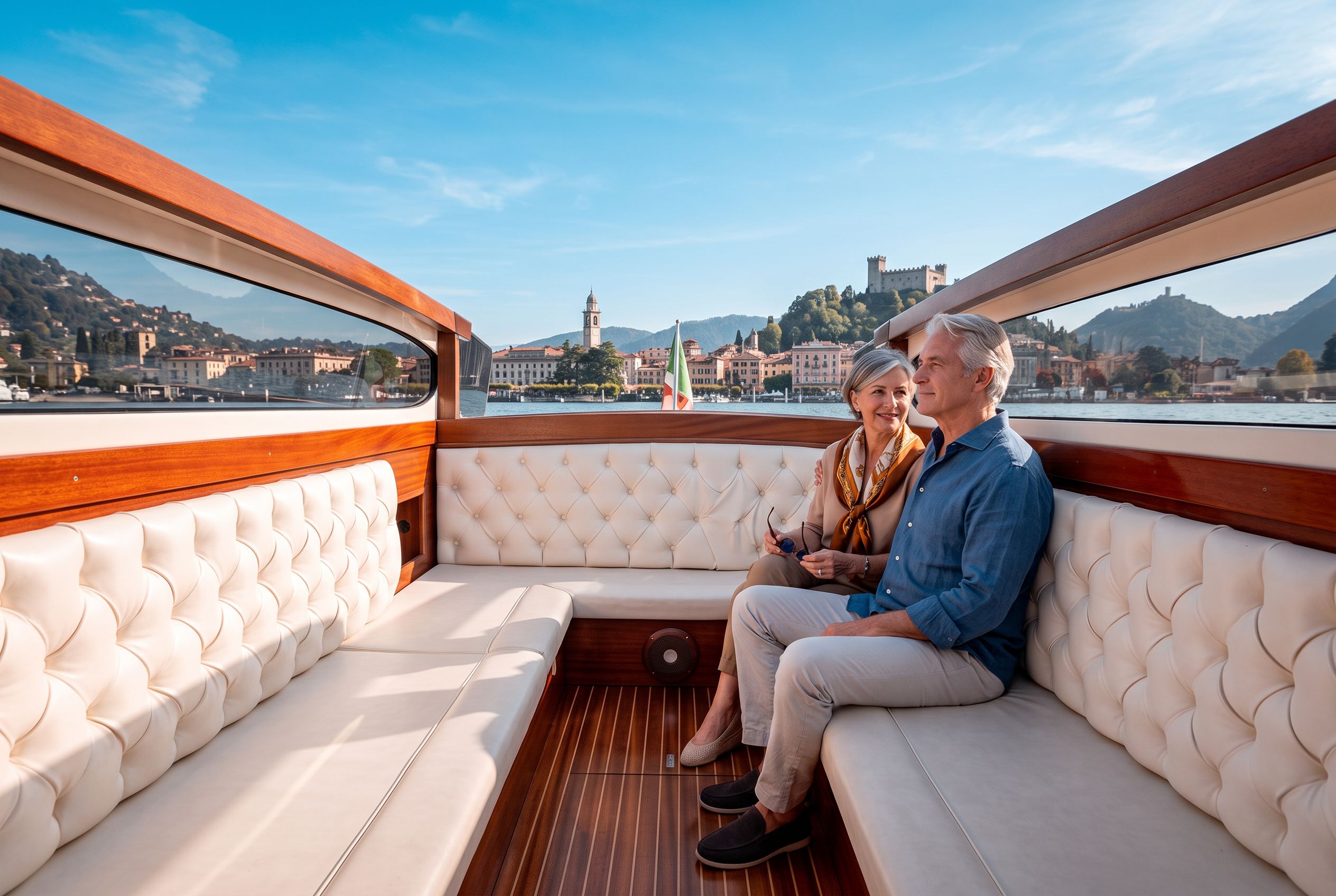
Pack a light jacket or windbreaker, sunscreen, sunglasses, and a small bag for motion sickness remedies. Ferry rides can last from 15 minutes to over two hours, and the wind chill on a fast hydrofoil is significant even on a hot day. A scarf or buff is useful for protecting your neck from both sun and wind.
The ferry network is the most scenic way to explore the lake. As of July 2026, Navigazione Laghi runs regular services connecting all major towns. The journey from Varenna to Como runs from about 55 minutes on the fast service, which carries a supplement, to close to three hours on the slow ship calling at every village — not the short drive time many assume. Plan your day around the ferry schedule, and always carry a bottle of water and a snack. The boats have small bars, but queues can be long in peak season.
If you are prone to motion sickness, take a preventative tablet before boarding. The lake can get choppy in the afternoon, especially on the wider central basin. A small cross-body bag is better than a backpack on a crowded ferry, as it keeps your valuables secure and accessible without having to remove it.
What are the new rules for 2026?
Como has no day-tripper fee. As of August 2026 the city taxes overnight stays only, and a €5 charge for day visitors has been discussed in the local press without ever being introduced. Villa del Balbianello is the real constraint: advance booking is compulsory and the daily ceiling is reported at around 1,200 visitors. Plan ahead or risk being turned away.
Overtourism has prompted real changes, though not the one most often repeated. The €5 day-tripper charge trialled on 29 selected dates in 2024 was Venice's, not Como's, and Venice ended its own trial in July 2026; Como levies only its imposta di soggiorno, which as of August 2026 the city defines as payable per person and per night. Villa del Balbianello, where the lake-retreat scenes of Star Wars: Episode II – Attack of the Clones were filmed and where Casino Royale shot in 2006, is the genuine capacity story: the FAI makes advance booking compulsory, and regional press puts the daily ceiling at around 1,200 visitors. Reaching the villa on foot from Lenno means a 1 km uphill path, partly gravel, which the FAI times at about 25 minutes, or a 2.5 km trekking route of about 45 minutes — described by the FAI as unsuitable for pushchairs or people with mobility difficulties. A taxi boat from the Lido di Lenno lands you at the villa's dock and avoids the climb.
For wine lovers, the lake's terraced vineyards offer a different perspective. See our guide Wine Tasting Around Lake Como and the Valtellina: A Relaxed Guide for Wine-Minded Travellers 50–70 for a curated itinerary.
Where can I find pharmacies and emergency care?
Pharmacies are marked with a green cross and most close for a long lunch break, but individual hours vary. Outside them a duty rota applies: under Lombardy law the pharmacy on duty serves from 8 AM to 8 PM with its doors open, and the current rota for the province of Como is published by ATS Insubria.
Carry a small health kit with remedies for motion sickness, mosquito bites, sunburn, and minor digestive issues. This will save you from hunting for a pharmacy when you are tired and hungry. Keep all prescription medications in their original packaging, and carry a copy of your prescription. EU citizens should bring their EHIC card for free or reduced-cost treatment; non-EU travellers need private insurance documentation.
One timing detail is worth knowing before you need it. The number 116117 reaches the out-of-hours doctor service, which Regione Lombardia runs Monday to Friday from 8 PM to 8 AM and around the clock on Sundays and public holidays; during weekday surgery hours a pharmacy or a local GP is the right first stop instead.
What are the best locations for senior travellers?
Stay in the central lake area—Varenna, Bellagio, or Menaggio—for the best boat access and views. Avoid the city of Como if your goal is to explore the mid-lake, as travel time is misleadingly long. Varenna is frequently recommended as a great base for touring the mid-lake.
Each town has its character. Varenna is quieter and more compact, with a lovely lakeside promenade. Bellagio is busier and more commercial, but its position at the lake's "Y" junction makes it a transport hub. Menaggio offers a good balance of amenities and access to the western shore. If you prefer a slower pace, consider Lenno or Tremezzo, where the Greenway links the shoreline villages over about 10 km; its organisers state that it cannot be done in a wheelchair, because long stretches are cobbled and broken by steps.
Villa del Balbianello holds 4.7 out of 5 on Google from 12,626 reviews as of August 2026. "Beautiful view, garden and environment," one Google reviewer wrote in August 2026. "Very popular, so buy tickets online well before your visit, especially for the weekends." The standard ticket covers the park, the terraces and the outside of the Loggia Durini on a self-guided basis; the interiors open only on a guided tour of about 50 minutes, booked separately. Arriving by taxi boat and walking the 1 km path back down to Lenno is a common compromise, but the FAI does not rate that path as suitable for visitors with mobility difficulties in either direction.
What should I leave at home?
Leave high heels, stilettos, and any shoe with a smooth sole. Leave bulky jewellery, expensive watches, and anything you would be devastated to lose. Leave a full-sized toiletries kit—buy sunscreen and insect repellent at a local pharmacy. Leave the expectation of perfect weather; pack for sun, rain, and cool evenings.
Lake Como is a place of casual elegance. The most stylish travellers are the ones who look comfortable: a linen shirt, well-fitted trousers, and good shoes. Overpacking is the most common mistake. You will not need a different outfit for every dinner, and you will not need formal wear unless you are dining at a Michelin-starred restaurant. Stick to a capsule wardrobe of mix-and-match pieces in neutral colours, and you will fit in perfectly.
For food-focused travellers, see our curated roundup Lake Como Hotels Worth Booking for the Food: A Curated Roundup for Travellers 50–70.


