
Salzburg is a city that rewards a steady pace, and for travellers aged 50 to 70, the practical question is rarely about what to see—it is about how to stay comfortable, healthy, and reassured while you see it. The good news is that this compact Austrian city is well equipped for exactly that. From barrier-free buses to a structured pharmacy system and clear emergency numbers, Salzburg offers genuine peace of mind if you know how to use it. This guide focuses solely on health reassurance: finding pharmacies and doctors, navigating the city hospital, travelling with medication, understanding the EHIC/GHIC and insurance basics, and staying comfortable in summer heat or winter cold. Trip costs and packing lists are covered in their own dedicated guides.
What makes Salzburg workable for senior travellers is the combination of a walkable historic core and a modern, accessible transport network. The city has invested heavily in low-floor buses, accessible rail stations, and clear signage. The most practical base for older travellers is the Altstadt edge and Mirabellplatz area, where walking routes are flatter and transit connections are easiest. From there, the most central pharmacies are only a few hundred metres away and the main public hospital about 1.5 kilometres — close enough that nothing you are likely to need turns into an expedition.
 AI-edited
How do I find a pharmacy when I need one?
Salzburg has a dense network of pharmacies (Apotheken) in and around the historic centre, with several open six days a week and a rotating emergency service for Sundays and nights. The key is to know which one is on duty before you need it—your hotel front desk can confirm this in seconds.
Pharmacies in Austria are highly structured, which surprises many visitors. You cannot assume a supermarket will have what you need, and not all medicines available over the counter at home are freely sold here. The good news is that Salzburg's central pharmacies are plentiful and used to serving visitors from abroad.
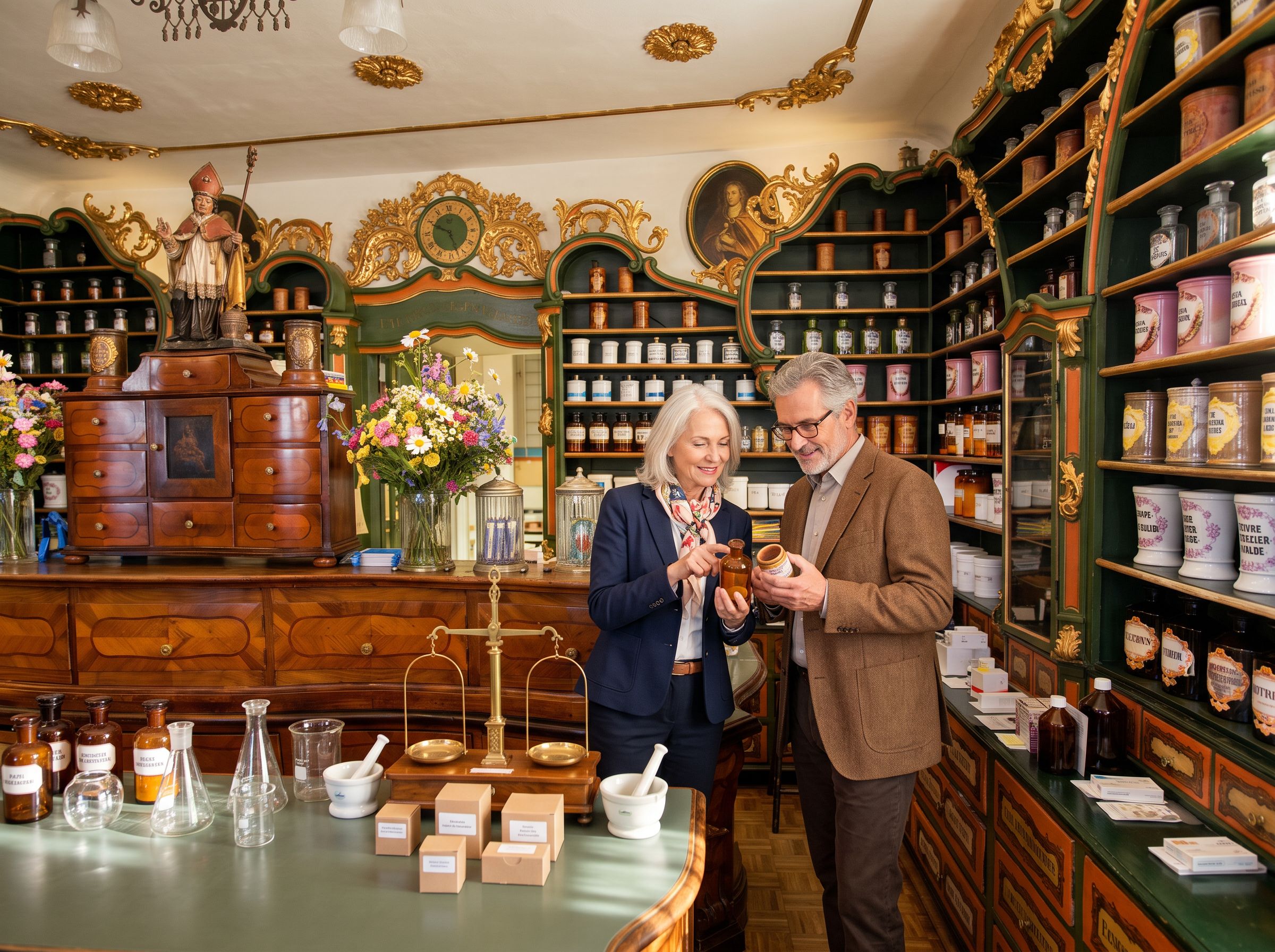
Among the most central options, the Apotheke zum Goldenen Biber on Getreidegasse 4 has stood in the same building since 1608 and has been in one family's hands since 1713. The pharmacy states that every member of its staff speaks at least one foreign language, English among them. As of August 2026 it holds a Google rating of 4.5/5 from 70 reviews. Its opening hours are Monday to Friday 9:00–18:00 and Saturday 9:00–13:00, extended to 17:00 on Saturdays in Advent.
The Alte fürst-erzbischöfliche Hofapotheke on Alter Markt 6 is, in the words of Salzburg's tourist board, the oldest apothecary still in existence in the city: established in 1591, with rococo furnishings that date back to 1777. It holds a Google rating of 4.6/5 from 50 reviews as of August 2026, and it keeps the same counter hours as the Biber—Monday to Friday 9:00–18:00, Saturday 9:00–13:00.
Other reliable central options include:
- Engel-Apotheke, Linzer Gasse 5—Mon–Fri 8:00–18:00, Sat 10:00–18:00
- Elisabeth Apotheke, Elisabethstraße 1a—near the main station
- Landesapotheke, Müllner Hauptstraße 50—open Mon–Fri 8:00–18:00, Sat 8:00–12:00
- Salvator-Apotheke, Mirabellplatz 5—listed in the pharmacy chamber's on-call directory
- Bahnhof-Apotheke, in the Forum 1 centre at the main station—Mon–Sat 8:00–18:00
Distance matters more than the count. Measured in a straight line from the Alter Markt, four of these are genuinely central: the Hofapotheke stands on the square itself, the Biber is 130 metres away on the Getreidegasse, the Engel-Apotheke about 320 metres across the river, the Salvator-Apotheke some 680 metres north at Mirabellplatz. The Elisabeth-Apotheke and the Landesapotheke are a further 1.2 to 1.4 kilometres out. Walking routes run longer wherever a bridge is involved, which matters for the Engel-Apotheke in particular. On step-free access the picture is mixed: Google's business listings flag a wheelchair-accessible entrance for the Engel-Apotheke, the Landesapotheke and the Bahnhof-Apotheke, while for the two oldest houses, in buildings of 1591 and 1608, no source states anything either way.
What happens outside normal pharmacy hours?
Austria uses a rotating on-call system for nights, Sundays, and public holidays. The nearest duty pharmacy is not always the closest one to you, and a surcharge applies—€3.80 between 8 pm and 8 am on any day, €1.30 on Sundays and public holidays between 8 am and 8 pm. Your hotel can confirm the current on-duty pharmacy.
Travellers are often surprised by how structured this system is. Unlike in some countries, you cannot simply walk into any pharmacy at 9 pm on a Sunday. Instead, one pharmacy in the city stays open for emergencies, and the roster rotates daily. The official Salzburg health portal and the 1450 line can direct you to the right address.
The surcharge is charged once per visit, not per packet, and a duty pharmacy stays open until 8 am the following morning. For basic health items and toiletries on a weekday or Saturday, the Forum 1 complex at Salzburg Hbf is a practical fallback: it houses dm, Müller, a Eurospar and the Bahnhof-Apotheke under one roof, a few steps from the platforms. On a Sunday, though, the centre and its Eurospar are closed, so the duty pharmacy is your only option that day.
"Excellent, knowledgeable service. The pharmacist's recommendations helped a lot!" — one Google reviewer on the Apotheke zum Goldenen Biber, April 2017
How do I see a doctor if I need one?
For urgent but non-emergency medical help, dial 141 for the doctor-on-call service, which covers evenings, weekends and public holidays, or 1450 for the health advice line, staffed by trained nurses around the clock. For serious emergencies, call 112 (EU emergency) or 144 (ambulance).
Salzburg does not have a dedicated tourist clinic system, but the practical backup is solid. The GP emergency centre is at Dr.-Karl-Renner-Straße 8, 5020 Salzburg. It is an out-of-hours service rather than a walk-in clinic: the Salzburg medical chamber gives its city surgery hours as Monday to Thursday 7 pm to 11 pm, Friday 5 pm to 11 pm, and at weekends additionally 8 am to 1 pm and 4 pm to 11 pm, with a telephone service from 11 pm to 7 am. Call 141 before you set off. Hospitals accept walk-in patients, but be prepared for longer waits, as cases are prioritised by urgency.
For non-urgent needs, Salzburg health directories list English-speaking physicians and travel-medicine-capable doctors. Your hotel can usually recommend a nearby practice, and many doctors are accustomed to seeing visitors. If you have a chronic condition, it is wise to carry a summary of your medical history in English, along with your regular prescriptions.
The city's major hospitals include:
- Landeskrankenhaus Salzburg, Müllner Hauptstraße 48—the main public hospital
- Unfallkrankenhaus der AUVA Salzburg, Dr.-Franz-Rehrl-Platz 5—accident and trauma
- Christian Doppler-Klinik Salzburg, Ignaz-Harrer-Straße 79
- Privatklinik Wehrle-Diakonissen, Guggenbichlerstraße 20—private hospital
What about the EHIC/GHIC and insurance basics?
The European Health Insurance Card (EHIC) or UK Global Health Insurance Card (GHIC) covers medically necessary treatment at public hospitals and doctors in Austria, but it does not cover private treatment, ambulance repatriation, or non-urgent care. Comprehensive travel insurance is still essential.
For travellers from the EU, the EHIC is your first line of reassurance. It entitles you to state-provided healthcare on the same terms as Austrian residents, which means you will pay the same fees an Austrian would. The UK GHIC works similarly for British travellers. However, neither card covers everything:
- Private hospitals and private doctors are not covered
- Prescription medication from pharmacies may require payment
- Emergency repatriation to your home country is not covered
- Pre-existing conditions may not be fully covered
Travel insurance is therefore non-negotiable. When choosing a policy, check that it covers pre-existing conditions, includes medical evacuation, and has a 24-hour emergency helpline. Keep your policy number and emergency contact saved in your phone and on a printed card in your wallet.
If you need treatment, keep all receipts and medical reports. You can claim reimbursement from your home health authority for EHIC/GHIC-covered treatment, and from your insurer for everything else. The hospital or doctor will provide the necessary documentation.
How do I travel with medication safely?
Austrian federal guidance states that medication for personal use may be brought in without a permit up to a maximum of three retail packs of the smallest size, provided you keep medicines in their original packaging. For prescription medicines you need written confirmation from your treating doctor—and if it is not in German, a certified translation.
Travellers consistently report that the single most important habit is keeping medicines in original packaging from day one. Do not repack everything into a pill organiser for the whole trip—customs officers and pharmacists need to see the original labels. Carry a copy of your prescription or a doctor's note, especially for anything controlled or less familiar.
When flying, keep essential medicines in hand luggage. Checked baggage can be lost, delayed, or subjected to temperature extremes that damage medications. Austrian health guidance specifically warns that heat can damage many medicines, which is relevant in summer months.
Practical tips from experienced travellers:
- Take only what you need for the trip plus a small buffer—excessive quantities raise questions
- Carry your doctor's written confirmation for prescription medicines—in German, or with a certified translation
- Keep medicines in hand luggage, not checked bags
- Bring a summary of your medical history and current prescriptions
- If you use injectable medication, carry it with a letter explaining its purpose
- For medicines containing addictive substances, no extra certificate is needed for stays of up to five days; from six to 30 days you need a prescription from your doctor at home
The Austrian social ministry publishes the official rules on bringing medication to Austria, including the limits that apply to medicines containing addictive substances and the paperwork the customs authorities expect.
How do I stay comfortable in summer heat?
Salzburg summers are warm rather than fierce: GeoSphere Austria's 1991–2020 normals put the average daily high at about 25°C in July and August. The key is pacing: plan sightseeing for the cooler morning hours, use the riverbank promenade for shade, and carry water with you.
The Salzach riverbank promenade is a natural cooling corridor, and the Mirabell Gardens offer shaded benches and rest spots. The Old Town's narrow streets can trap heat, so plan indoor visits—cathedrals, museums, and cafes—for the afternoon peak.
Heat can affect both you and your medication. Keep medicines out of direct sunlight and away from car interiors. If you take medication that requires cool storage, ask your hotel about fridge access—most can accommodate this.
For those concerned about sleep quality in warm weather, note that air conditioning is not standard in Salzburg's older city-centre hotels. When booking, ask specifically about air conditioning, and about fridge access if you carry medication that needs cool storage. Request a quiet room away from street noise at the same time. Our guide to the quietest hotels in Salzburg for light sleepers covers this in detail.
How do I stay comfortable in winter cold?
Salzburg winters are cold but manageable, with temperatures typically between -5°C and +5°C. Layering is essential, and the city's trolleybuses are heated, low-floor and ramp-equipped, making it easy to move between indoor attractions.
Winter is a beautiful time to visit Salzburg, with the Christmas markets drawing visitors from across Europe. The city is busy in every season: in 2025 Salzburg's accommodation providers recorded 1,836,515 arrivals and 3,288,513 overnight stays, 4.8 per cent more than in 2024, according to the city's tourism review published in April 2026. Book early for the Advent weeks.
For cold-weather comfort:
- Wear layers: thermal base, sweater, and a windproof outer layer
- Choose shoes with good grip—cobblestones become slippery when wet or icy
- Carry a small thermos for hot drinks during outdoor sightseeing
- Use the FestungsBahn funicular for the fortress rather than climbing the steep path; the panorama terrace and the bastion by the top station are fully accessible, the interior of the fortress is not
- Plan indoor breaks every 90 minutes in very cold weather
If you have respiratory conditions, cold air can be a trigger. Carry your inhaler or medication in a pocket close to your body, and consider a scarf over your mouth and nose in very cold conditions.
How accessible is Salzburg's public transport?
Salzburg's buses are predominantly low-floor with ramps that drivers can deploy, and the main rail station, Salzburg Hbf, is lift- and escalator-accessible to all platforms. Senior discounts are available from age 65 with the ÖBB-VORTEILSCARD Senior.
The city's public transport operator, Salzburg AG, runs 108 low-floor articulated trolleybuses with a kneeling function; every one of them has at least one wheelchair space by the second door, and the driver lowers the vehicle and folds out a ramp there on request. On the Salzburger Lokalbahn every platform is step-free except two, at Bergheim and Anthering; from autumn 2026 the operator expects all of them to be.
For rail travel, Salzburg Hbf is described as independently usable with no major barriers. If you need personal assistance, contact the ÖBB mobility service at least 12 hours before departure within Austria—and at least 24 hours ahead for any journey that crosses the border. On local transport the same card gives about 20% off single, one-hour, day and 24-hour tickets to travellers aged 65 and over within the Salzburg transport association.
For a full assessment of walking routes, cobblestones, and sightseeing accessibility, see our comprehensive guide to Salzburg accessibility for older travellers.
Where are the easiest walking routes?
The flattest and most comfortable walking areas are the main pedestrian routes, Mirabell Gardens, and the Salzach riverbank promenade. The Old Town's narrowest lanes involve cobblestones and some stepped entrances, so plan your route accordingly.
Salzburg is best approached as a city of selective walking. The historic centre is partly challenging for people with limited mobility because of cobblestones, narrower passages, and some stepped church entrances. However, the main pedestrian routes are well-maintained, and benches are plentiful in Mirabell Gardens and along the river.
Practical route planning:
- Use the riverbank promenade for flat, scenic walking between the Old Town and Mirabellplatz
- Take the FestungsBahn funicular for the fortress—the operator states that barrier-free access is possible only this way, and that the footpath is not barrier-free because of its steepness
- Check the approach to any footbridge before you commit—several of the Salzach crossings are reached by steps
- Plan rest stops at cafes—Salzburg's historic cafes are part of the experience
For dining recommendations that factor in comfort and accessibility, our guide to Salzburg's finest restaurants and historic cafes offers practical suggestions for discerning diners over 50.
What should I do in a real emergency?
Call 112 for EU-wide emergency, 144 for ambulance, 141 for doctor-on-call, and 1450 for health advice. Save these numbers in your phone before you arrive, and know your hotel's address to give the dispatcher.
All four are listed on the Austrian health ministry's official emergency numbers page, which is worth saving before you travel.
In a genuine emergency, the Austrian system is efficient and well-equipped. The main public hospital, Landeskrankenhaus Salzburg, is a major teaching hospital with full emergency facilities. For accidents, the AUVA trauma hospital specialises in injury care.
If you need help finding a doctor or pharmacy outside normal hours, the 1450 health line is staffed by nurses who can direct you. This is the single most useful number for non-emergency health concerns during your stay.
"I cannot say enough, good things about this facility. They were extremely professional, helpful, caring, and supportive. Both the nurse and doctor worked hard to help me." — a review left on Google in May 2026 about Salzburg's GP emergency centre
Salzburg rewards travellers who plan ahead. The city's pharmacies are excellent, its doctors are professional, and its transport is accessible. By taking a few simple precautions—carrying your medications correctly, saving the right phone numbers, and knowing where to go for help—you can explore with genuine peace of mind. The cobblestones may slow you down, but the city's health infrastructure will not.


