
Salzburg's baroque spires and cobbled lanes hide a dining scene that rewards those who know where to look. For travellers aged 50 to 70 who appreciate both a perfectly poured Melange and a dinner served with centuries of atmosphere, this compact city offers an extraordinary range of special meals. From the vaulted stone halls where Mozart once dined to the marble-topped tables of Austria's oldest coffee house, here is your considered guide to Salzburg's most memorable tables, with practical notes on booking, dress, and accessibility.
 AI-edited
What makes Salzburg's dining scene so distinctive for a special occasion?
Salzburg's dining distinction lies in its extraordinary layering of history, music, and culinary craft. The 1,200-year-old monastery cellar of St. Peter and the café where Mozart drank his almond milk stand a few minutes apart in the old town, while the region's highest-rated contemporary kitchens sit outside it and are worth the journey.
The city's food identity is inseparable from its baroque heritage. The Salzburg Festival, which runs from 17 July to 30 August in 2026, transforms the old town into a stage, and dining rooms fill with performers and audiences alike. As of 2026, Gault&Millau's Salzburg roundup places Döllerer, Ikarus, and Obauer at the very top with 19/20 points and 5 Hauben, with Kräuterreich by Vitus Winkler and SENNS.Restaurant close behind on 18.5/20. Yet for most visitors, the true Salzburg experience is found in venues that have been perfecting their craft for generations, not seasons.
What sets Salzburg apart is the continuity. Families like the Tomasellis have run their café for over 150 years. The St. Peter Stiftskulinarium has served guests since 803 AD. This is dining as cultural heritage, where the room itself is as much the reason to visit as the food on your plate. For a deeper look at the city's signature dishes and where to find them, see our companion guide to Salzburg's local specialities.
Is St. Peter Stiftskulinarium worth the hype for a special dinner?
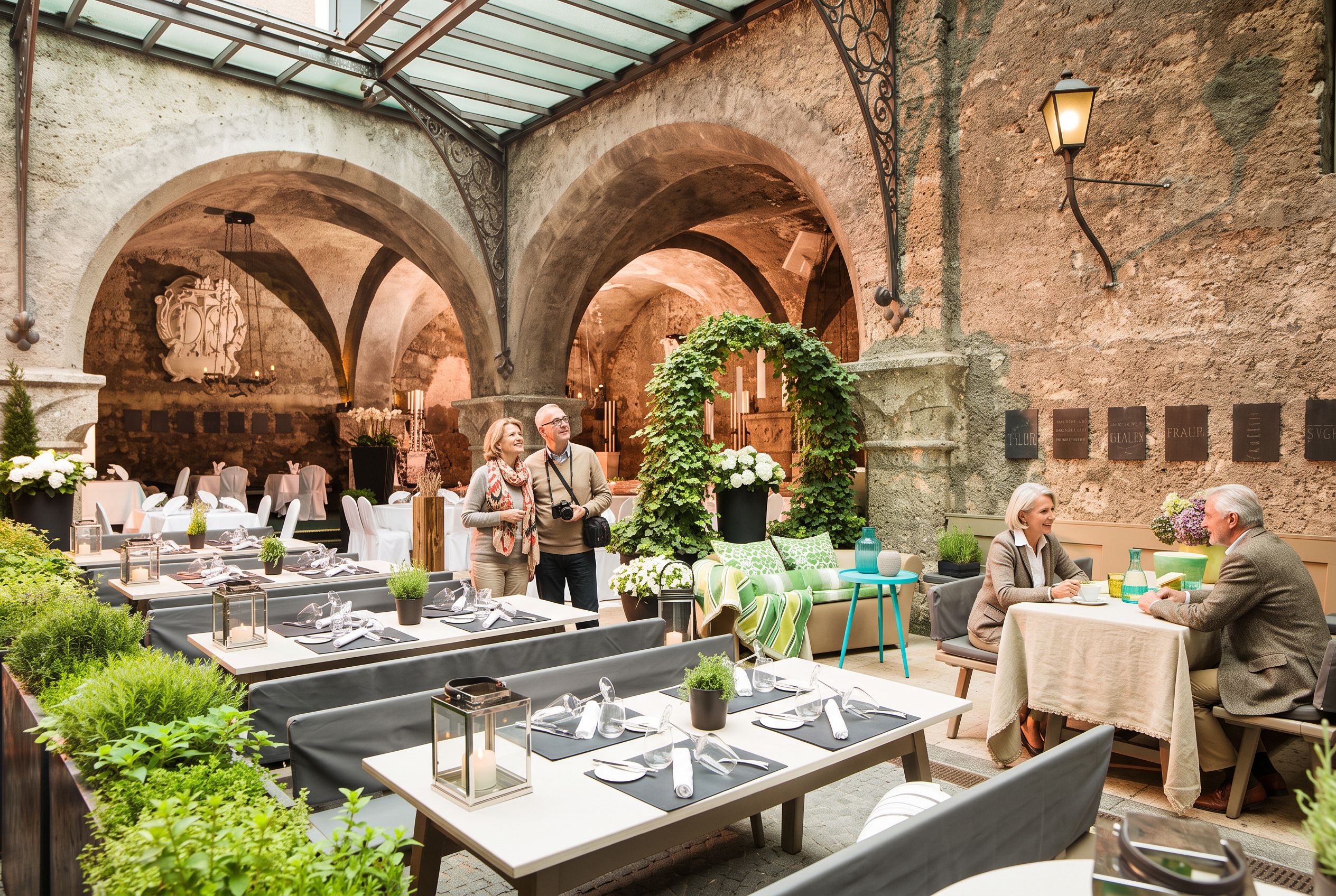
Yes, with caveats. St. Peter Stiftskulinarium offers the most atmospheric dining room in Salzburg — vaulted chambers inside the abbey walls where the Mozart family dined, as Wolfgang's sister Nannerl noted in her diary — but service can be uneven and waits long. Book ahead, go early, and treat the experience as theatre as much as dinner.
According to Salzburg's official tourism office, the Stiftskulinarium is partly barrier-free, with flat access or a step no higher than 3 cm and barrier-free restrooms. That is genuinely helpful for older travellers. The restaurant sits inside the walls of St. Peter's Archabbey in the heart of the old town, at St.-Peter-Bezirk 1/4, and it serves daily from 12.30 p.m. to 11 p.m., with hot dishes until 9.15 p.m. — later during the festival, depending on the performance.
Reviewers consistently praise the Wiener schnitzel and apple strudel for taste and presentation, and the historic setting draws descriptions like "charming and memorable ambiance." However, the same reviews note that service experiences vary "greatly" among visitors, and some guests caution about inconsistent food quality. The practical takeaway: this is a venue where you should manage expectations and savour the setting.
For a quieter alternative with equally deep roots, consider Blaue Gans at Getreidegasse 41-43, which Salzburg's tourism office lists as the oldest inn in the city, in business since 1350. It offers a more intimate, art-filled setting and a strong regional menu, though it lacks the sheer drama of the Stiftskulinarium's vaulted halls. One caveat for anyone unsteady on their feet: the same listing records several steps at the entrance.
"An absolute gem! The atmosphere here is incredibly sophisticated, where rich history meets eclectic modern furniture in perfect harmony. It manages to feel both upscale and wonderfully cozy at the same time." — a guest wrote about St. Peter Stiftskulinarium on Google in March 2026
Which fine dining restaurants in Salzburg are worth the splurge?
For a truly memorable meal, Salzburg's top tables are Ikarus at Hangar-7 by the airport, Döllerer in Golling an der Salzach, and SENNS.Restaurant at the Gusswerk north of the centre. Each offers a distinct experience: avant-garde tasting menus, classic Austrian refinement, and contemporary elegance respectively. Menus run from €150 to €285 before wine.
Ikarus sits beneath the glass-and-steel roof of Red Bull Hangar-7 at Salzburg Airport, among the airworthy historic aircraft of The Flying Bulls — a taxi ride from the old town rather than a stroll. Each month, a different international guest chef takes over the kitchen, making every visit a unique experience. Access is straightforward: the tourism office records step-free entry, or a 3 cm lip at most, plus a lift, an automatic door and barrier-free restrooms. Dinner runs from 7 p.m., the restaurant is closed on Sundays and public holidays, and on the first of each month it also closes in the afternoon. Book weeks ahead, especially during festival season.
Döllerer is not in the city at all: the restaurant stands at Markt 56 in Golling an der Salzach, south of Salzburg, and it pairs Gault&Millau's highest rating with a warm, wood-panelled room. Chef Andreas Döllerer champions regional ingredients with contemporary technique, and the menu — three courses at €150, four at €180 — is a masterclass in modern Austrian cooking. Plan it as an excursion: the ÖBB line S3 runs from Salzburg Hbf to Golling-Abtenau, and outside the festival weeks the restaurant is closed on Mondays, Tuesdays, Sundays and public holidays.
SENNS.Restaurant occupies a 19th-century bell foundry in the Gusswerk complex at Söllheimerstraße 16, on the outskirts of Salzburg rather than in the Neustadt. Chef Andreas Senn's cooking is precise and ingredient-driven, with a dining room that feels like a private club, and the menus run from €225 for four courses to €275 for six. The tourism office records the same step-free entry, with at most a 3 cm lip, along with barrier-free restrooms and two accessible parking spaces. It's an excellent choice if you prefer quiet conversation to grand spectacle.
| Restaurant | Location | Style | Price band (per person, with wine) | Booking lead time |
|---|---|---|---|---|
| Ikarus | Hangar-7, Salzburg Airport | Avant-garde tasting menus | €€€€ (menu €245-€285, wine pairing €225) | 2-4 weeks |
| Döllerer | Markt 56, Golling an der Salzach | Modern Austrian | €€€ (3 courses €150, 4 courses €180) | 1-2 weeks |
| SENNS.Restaurant | Gusswerk, northern Salzburg | Contemporary, ingredient-led | €€€€ (menus €225-€275, wine pairing €180) | 1 week |
| St. Peter Stiftskulinarium | St.-Peter-Bezirk, Altstadt | Historic, traditional Austrian | €€€ (€80-€120) | 3-5 days |
For those who prefer a less formal but still excellent meal, Zwettler's at Kaigasse 3, a few steps off Mozartplatz, earns consistent praise (4.5 out of 5 on Google from 6,827 reviews as of August 2026) for its "fantastic local wine & food" and welcoming service. A guest wrote on Google in February 2026: "The atmosphere is amazing, our waiter is really amazing and friendly … Absolutely a place to come during your stay in Salzburg." It's a wonderful middle ground between fine dining and traditional Gasthaus.
Which historic cafes in Salzburg are unmissable for coffee and cake?
Café Tomaselli on Alter Markt is the essential visit — Austria's oldest coffee house, run by the same family for over 150 years, with a terrace that catches the afternoon sun. Café Sacher offers old-world elegance and the original Sachertorte. Café Bazar, across the river, has a terrace with a picture-postcard view of the old town.
Café Tomaselli, at Alter Markt 9, is the crown jewel of Salzburg's coffeehouse culture. The house dates its founding to 1700 and is the oldest coffee house in Austria; the Tomaselli family has run it for over 150 years. Wolfgang Amadeus Mozart was a frequent visitor who, the story goes, drank his almond milk here; Hugo von Hofmannsthal, Max Reinhardt and Herbert von Karajan later kept the habit. The café is listed as wheelchair accessible, with level access or a step no higher than 3 cm, and an accessible WC.
The room is a study in Viennese-style elegance: marble tables, bentwood chairs, newspapers on wooden rods, and waiters in black aprons who have seen it all. The coffee is excellent, the cakes are traditional — the in-house bakery keeps more than twenty tortes in the case, among them its own Tomasellitorte — and the people-watching from the terrace is unmatched. The café opens Monday to Saturday from 7 a.m. to 7 p.m., and on Sundays and holidays from 8 a.m.; during festival season it stays open until 9 p.m.
Café Sacher, adjacent to the Hotel Sacher on Schwarzstraße, offers a more polished, hotel-café experience. The tourism office lists it as barrier-free with flat access, and notes special dietary options including gluten-free, lactose-free, vegan, vegetarian, and halal meals. The Sachertorte here is the original — dense, chocolatey, and best enjoyed with a pot of coffee and unhurried time.
Café Bazar, at Schwarzstraße 3, is the traditionalists' choice for its river views and literary associations. It opened in 1882, seats 100 on the terrace, and is a quieter, more local alternative to Tomaselli. The tourism office lists it as a traditional business, records it as barrier-free, and gives its hours as Monday to Saturday 7.30 a.m. to 7.30 p.m. and Sunday and public holidays 9 a.m. to 6 p.m.
What should I know about booking, dress codes, and timing?
Book everything, even for lunch. Salzburg's top venues fill up days ahead, especially during festival season. Dress is smart-casual for most venues — a jacket for men at Ikarus and Döllerer, but nowhere requires black tie. For outdoor tables, book specifically and request one; most restaurants don't have air conditioning.
Reservation strategy matters more here than the size of the city suggests. Air conditioning is rare in the older dining rooms, so in warm weather outdoor seating is at a premium: Café Tomaselli alone counts 430 outdoor seats including the garden at its kiosk, and they still fill on sunny afternoons. Book outdoor tables specifically when making your reservation, and confirm the number of stairs if mobility is a concern — historic buildings in Salzburg often have steps and basement restrooms.
For the Stiftskulinarium, expect lengthy waits for tables and meals even with a booking. This is not a restaurant for a quick dinner before a concert. Plan for a two-hour meal and embrace the slow pace. For Café Tomaselli, no reservation is needed for the café itself, but the terrace fills quickly on sunny afternoons.
If you're planning a special meal during the Salzburg Festival (17 July to 30 August in 2026), book at least three weeks ahead for fine dining, and expect festival-time hours at cafes to be extended but crowds to be intense. The old town core around Mozart-related attractions becomes congested; consider dining in the Neustadt or quieter side streets like Griesgasse or Goldgasse.
How accessible are Salzburg's historic dining venues for older travellers?
Accessibility is partial, not universal. St. Peter Stiftskulinarium, Café Tomaselli, and Café Sacher all have level access or steps no higher than 3 cm, with accessible restrooms. However, many other historic venues have steps, narrow doorways, and basement WCs. Always confirm access details when booking.
The same listings are worth reading before you book anywhere else. Restaurant Ikarus is recorded as barrier-free with a lift and an automatic door, SENNS.Restaurant with flat access, barrier-free restrooms and two accessible parking spaces, and Café Bazar simply as barrier-free. Blaue Gans, by contrast, is listed with several steps at the entrance.
However, the broader picture is more mixed. Many historic buildings have no lift, and restrooms often sit in cellars reached by narrow stairs — details the tourism listings do not always record. The practical response is simple: confirm the number of stairs when you reserve if stairs matter, and use taxis to connect dining stops rather than forcing long walks. Salzburg is very walkable but not always easy on knees and feet.
For a full assessment of the city's accessibility, see our comprehensive guide to Salzburg's accessibility for older travellers.
"This historic café sits on the corner of a spacious square in Altstadt. The interior beautifully preserves its old-world charm with traditional décor throughout, including a vintage newspaper rack near the entrance." — a review left on Google in March 2026 describes Café Tomaselli
Which tables offer the best outlook in Salzburg?
For views, the terrace at Café Bazar faces the old town and the fortress across the Salzach. Café Tomaselli's front tables overlook Alter Markt's lively square. At Ikarus, request a table near the glass wall for the aircraft collection. At the Stiftskulinarium, the Barocksaal is the grandest of its eleven rooms and the setting for the Mozart Dinner Concert.
The question of outlook is about more than scenery — it's about atmosphere. At Café Tomaselli, the front terrace tables are prime real estate for watching Salzburg's daily life unfold around the Alter Markt fountain. At Café Bazar, the river-facing terrace offers the classic postcard view of the Hohensalzburg Fortress looming above the old town.
Inside the Stiftskulinarium, eleven rooms each have their own character, from the Petrusstube and the Prälatenstube to the Haydnsaal. The Barocksaal — built in 1903 in baroque style, with stucco and frescoes — is the grandest of them and is given over to the Mozart Dinner Concert; the à-la-carte tables sit in the smaller rooms, of which the Bürgerstube is the house's most popular. Ask when booking which room you'll be seated in, and request a quiet corner if that matters to you.
For those who want a meal with a view without the fine-dining price tag, consider the terrace at the Augustiner Bräustübl, Salzburg's historic monastery brewery. It's more of an experience than a conventional restaurant — multiple food stalls, communal seating, and a maze-like layout — but the beer garden offers a relaxed, very local atmosphere. A guest wrote on Google in July 2026: "What could one imagine as more quintessentially Austrian than a monastic beer garden sheltered by horse chestnut trees? This is THE place to go for ein Maß Bier, grilled sausages, and a relaxed setting."
How much should I budget for a special meal in Salzburg?
For a memorable dinner with wine, budget €80-€120 per person at the Stiftskulinarium, whose surprise menu is priced at €149 for four courses, and €225 to €285 for the menu alone at Ikarus or SENNS. A generous café visit with coffee and cake is €20-€40, and lunch at a good Gasthaus €25-€40.
Salzburg is not a cheap city, but it offers excellent value at every level if you know where to look. The historic cafes are remarkably reasonable for their heritage — a coffee and cake at Tomaselli costs about the same as at any modern café. The fine-dining tables command serious prices, but they deliver serious cooking.
For a broader sense of what a comfortable Salzburg trip costs, including accommodation and transport, our comfortable budget guide breaks down the numbers in detail.
| Venue type | Price band | What's included |
|---|---|---|
| Historic café (Tomaselli, Bazar) | € (€20-€40) | Coffee, cake, unhurried time |
| Traditional Gasthaus (Zwettler's, Blaue Gans) | €€ (€40-€70) | Two courses, local wine |
| Historic dining room (Stiftskulinarium) | €€€ (€80-€120) | Three courses, wine, atmosphere |
| Fine dining (Ikarus, Döllerer, SENNS) | €€€€ (menus €150-€285, wine pairings €180-€225) | Tasting menu, wine pairing, service |
One note on value: the best-reviewed venues in Salzburg tend to score on ambience plus cuisine, but comfort and pacing can vary significantly. Zwettler's stands out for consistent satisfaction and warm service — a reliable choice if you want a memorable meal without the formality of fine dining. For a quieter, more local experience, consider the recommendations in Fodor's Salzburg forums, where experienced travellers share their favourite spots.
Where should I stay to be near the best restaurants?
Stay in the Altstadt or just across the river in the Neustadt for the shortest walks to Salzburg's historic tables; the top fine-dining rooms all need transport. The area around Getreidegasse is central but noisy; quieter options are found on side streets like Goldgasse or in the Neustadt near the river.
Your choice of hotel dramatically affects your dining experience. Staying in the Altstadt means you can walk to Tomaselli for breakfast, return to your room for a rest, and stroll to dinner without transport. The Neustadt, across the river, offers quieter streets and is the nearer side for SENNS.Restaurant at the Gusswerk; Ikarus sits out at the airport and needs a taxi or bus from either bank.
For light sleepers, the old town's charm comes with noise. Our guide to Salzburg's quietest hotels identifies calm-stay options that don't compromise on location. Choosing lodging that minimises uphill walking is key — the old town's hills can be deceptive.
If you're planning a festival visit, book accommodation and restaurants simultaneously. The Salzburg Festival brings a major surge in visitors, and the best tables and rooms go months in advance. For a calmer experience, consider visiting in June or September, when the weather is pleasant but the crowds have thinned.
What practical details should I not overlook?
Carry cash — some smaller venues don't take cards. Make reservations for dinner, especially on weekends and during festival season. Confirm opening hours, which vary seasonally. And remember that Salzburg's historic venues are part of its UNESCO heritage — treat them with the respect they deserve.
According to Salzburg's official tourism resources, the city's restaurant guide and coffeehouse pages are the most reliable starting points for planning. The tourism office's restaurant guide lists venues with accessibility notes, and the coffeehouse pages provide seasonal hours. Check these before you go, and again the day of your visit — hours can shift with the season.
One caveat on fares: the Salzburg transport association grants the senior price on single, hourly, day and 24-hour tickets only to travellers aged 65 and over who hold a valid ÖBB VORTEILSCARD Senior, so most visitors will simply pay the standard fare. Taxis are a sensible way to connect dining stops. If walking is a problem, don't hesitate to use them.
Finally, consider the rhythm of your day. Salzburg's cafes are at their best in the late morning and mid-afternoon, when the light is soft and the pace is unhurried. The fine-dining rooms come alive after 7 p.m. Plan your meals to match the city's natural tempo, and you'll leave with the sense of having truly dined in Salzburg, not just eaten there.


