
Ubud sits inland, in the hills above Bali's southern coast, and the heat here is a different animal from the beach resorts. Temperatures are usually given as roughly 22-31°C, but it is the moisture in the air that decides how the day feels. Humidity runs high year-round, and according to Timeanddate climate data based on 2012-2021 observations, annual humidity sits near 80%. For a visitor in their fifties, sixties or seventies, that combination changes what a sensible day looks like.
The good news is that Ubud rewards planning more than it punishes age. Cool mornings are genuinely cool. A pool and a working air-conditioner turn the middle of the day from an endurance test into a rest. The town is compact, and a private car with a driver solves most of the distances that would otherwise be walked in the sun. What follows is a practical rhythm for the day, the signs to watch for, and the details worth confirming before you book.
When should older travellers be out and about in Ubud?
Plan one substantial outing for the early morning, roughly 07:30 to 09:00, then retreat to shade, air-conditioning or a pool through the middle of the day. Senior-focused guidance recommends exactly this pattern, with active plans in the morning and late afternoon and a midday rest during the first days of a visit.
Two separate guides converge on the same window. Senior travel guidance recommends starting terraces and walks around 07:30-09:00, while another Ubud guide advises beginning before 08:00 to avoid both heat and crowds. The Campuhan Ridge Walk, a free trail along a narrow ridge between two river valleys, is specifically recommended early because it offers little shade and the midday heat is stronger. Bali.com's seasonal climate guidance notes that temperatures climb to 30-32°C by late morning in the warmest part of the year.
The afternoon is not wasted, it is simply reallocated. A Journey's Bali health guidance recommends active plans for morning and late afternoon with a midday rest. That leaves room for a spa treatment, a long lunch indoors, or a swim. Our guide to gentle yoga and a spa day in Ubud covers how those afternoons tend to work in practice.
How much water do you actually need, and what about electrolytes?
Carry at least 1.5 litres for any outing lasting more than two hours, and add electrolyte sachets when you are sweating heavily. Bali-wide health guidance advises filtered or bottled water, refilling where possible, and carrying oral rehydration salts. Tap water in Bali is not considered safe to drink.
Senior travel guidance is blunt about this: the tropical heat and humidity require drinking significantly more water than you would at home, taking breaks in air-conditioned spaces during midday, and using sun protection at all times. A refillable bottle is the practical container; a spare bottle left in the car is the practical backup.
Electrolytes are not a daily ritual but a tool. Sachets are useful after prolonged walking, heavy sweating, vomiting or diarrhoea, and the packet instructions should be followed, because they supplement water rather than replace it. Fresh coconut water is commonly used by visitors as a source of fluid and electrolytes, but it should supplement, not replace, water and any medically required drinks.
How do you recognise heat exhaustion, and when is it an emergency?
Stop walking, move into shade or air-conditioning, loosen clothing and drink fluids if you notice unusual weakness, dizziness, headache, nausea, heavy sweating or cramping. Confusion, fainting, seizures, very hot skin or an inability to drink requires urgent medical help, and sightseeing stops there.
Those two lists are the whole of the practical guidance available, and they are worth knowing before you leave the hotel rather than reading them on a phone in the sun. The first list is your cue to sit down and reassess. The second is your cue to call for help.
UbudCare Clinic 24 Hours, listed at Jl. Raya Teges No. 8, Peliatan, Ubud, states that it operates a 24-hour emergency room with doctors, an ambulance service and an on-site pharmacy for patients receiving treatment. Its published telephone number is +62 811 3977 911. A second facility, UbudCare Health Care Clinic Tebasaya at Jl. Sukma No. 37, Peliatan, is listed with telephone +62 821 8888 2273 and opening hours of 07:00-22:00, Monday to Sunday. Neither facility publishes response times, English-language provision or insurance handling; ask when you call.
Published Bali emergency numbers are 112 for general emergencies, 110 for police, 119 or 118 for ambulance, 113 for fire, 115 for search and rescue, and 129 for natural-disaster assistance. For serious concerns, senior travel guidance names BIMC Hospital in Nusa Dua as the recommended facility for international-standard care with English-speaking doctors. That is a drive south, not a walk, which is worth knowing in advance.
 AI-edited
How do you handle the sun in a town with limited shade?
Treat sun protection as daily equipment rather than a beach accessory. A broad-brimmed hat, UV-protective sunglasses and high-factor sunscreen are the baseline, one Ubud activity guide recommends SPF 50, and sunscreen needs reapplying after sweating or swimming. The tropical sun is strong even on cloudy days.
Shade is the scarce resource. Exposed trails such as Campuhan Ridge have limited shade, and central Ubud's pavements are reported as narrow, uneven and sometimes broken, with little shelter. A Reddit discussion from May 2023 warned that Ubud has few sheltered pedestrian areas, which makes walking in rain difficult while holding an umbrella.
Clothing matters as much as cream. Lightweight, breathable, quick-drying fabrics are the recommendation, and one Ubud-specific observation noted that clothes could take a full day to dry, which is the argument for packing less and washing more. Long, light sleeves do double duty against sun and mosquitoes.
Why does a pool and reliable air-conditioning matter so much?
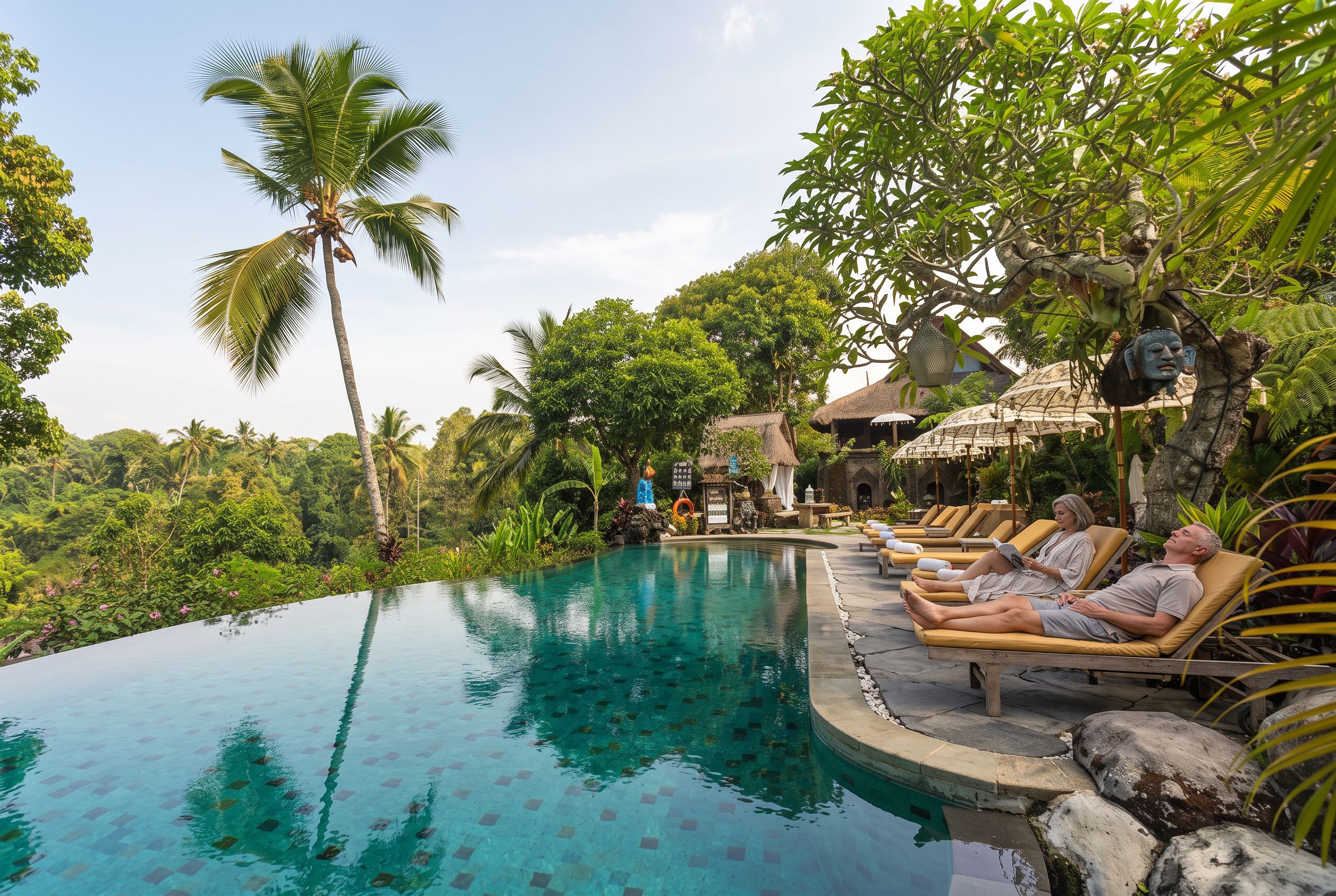
A pool and working air-conditioning are not luxuries in this climate; they are the mechanism by which the middle of the day becomes restful rather than uncomfortable. Tripadvisor's Ubud hotel listings repeatedly describe air-conditioning as valuable in the tropical heat, with some properties also offering dehumidifiers.
Guest feedback bears this out in specifics. At Alaya Resort Ubud, reviews describe air conditioning, fans and air purifiers in the rooms, and the property lists two pools, a spa, a gym and a cold plunge among its facilities. As of October 2026, Alaya Resort Ubud holds a Google rating of 4.7/5 from 4,127 reviews. A Tripadvisor review of The Ubud Village Resort & Spa describes the pool as a way to cool off during hot and humid days.
"Our room was super clean and spacious. The property was very tranquil. Location was close to restaurants, convenient stores, and the monkey sanctuary." (Google, October 2026)
Cooling is not guaranteed by a listing, though. At Ubud Inn Cottage and Spa, one Tripadvisor review reports an air-conditioner that blew air but was not cold, while other reviews of the same property describe the air-conditioning as working very well. Ask about the specific room, and ask whether a dehumidifier is available. Moisture indoors is its own problem: a September 2025 Tripadvisor review of Ani's Villas reported damp sheets and clothes and a bathroom that did not dry properly.
How should you structure the day around the heat?
Build the day in two halves with a long, cool middle. Morning for the walk or the temple, midday for air-conditioning, lunch and a swim, late afternoon for a second short outing. Build in frequent stops rather than waiting until fatigue appears, because humidity makes moderate exertion feel harder.
A Tripadvisor review of Ani's Villas from September 2025 advised that with the heat you need to go with the flow, and noted that everything takes longer because of traffic. That is useful framing. A short map distance in Ubud can take longer than expected because of traffic, uneven paving, blocked sidewalks and the need to step into the road.
For longer connections, senior travel guidance describes a private, air-conditioned car and driver as the most comfortable way to reach Ubud's temples and rice terraces, particularly because traffic is heavy and outdoor walking can be tiring. Bali Malayali's senior travel guide puts a full-day car charter with an English-speaking driver at approximately USD 35-50, and its Ubud area guide gives private drivers at USD 40-50 for a full day. Rates are indicative and vary by season and booking channel.
Where you sleep shapes the rhythm too. A property in the centre means short, hot walks back to air-conditioning; a property in the rice valleys means a car every time you leave. Our guide to choosing your base in Ubud, central town or the rice valleys works through that trade-off.
How does the wet season change the humidity?
The wet season, generally November to March, brings higher humidity and frequent rain, with January and February the wettest months at an average of 300-400mm of rainfall. Mornings may still be sunny, with heavier showers often arriving later in the day. Rain commonly comes in bursts lasting one to three hours before easing.
Bali.com's seasonal climate guidance describes the wet season as November to March, with higher humidity and frequent rain, and identifies roughly June to September as the most comfortable window, with lower humidity and the least rainfall. Timeanddate records average humidity around 81-82% in January through April, with January the wettest month in its dataset. Even in June to September, its recorded averages still show humidity around 78-79%.
The practical consequence is that the wet season compresses your outdoor window rather than closing it. One Reddit account from January 2024 described overcast skies often lasting until about 5 p.m., which kept the intense sun manageable, and said heavy showers in Ubud were often over after roughly an hour. That is one poster's December experience, not a climate guarantee.
Rain also changes the ground. The wet season is described as particularly likely to make trails slippery, and muddy or slick earth, stone and clay routes should be avoided after rain. Closed-toe walking shoes with good grip are the packing answer.
What should you pack for Ubud's heat?
Lightweight quick-drying clothing, a wide-brimmed hat, UV-protective sunglasses, high-factor sunscreen, a compact rain jacket or poncho for November to March, closed-toe shoes with good grip, oral rehydration salts, your regular medication with prescription copies, and a refillable water bottle.
- Lightweight, breathable, quick-drying clothing, plus light long sleeves for sun and mosquitoes.
- A wide-brimmed hat, UV-protective sunglasses and high-factor sunscreen.
- A compact rain jacket or poncho, particularly for November to March.
- Closed-toe walking shoes with good grip for muddy, uneven or slippery paths.
- Oral rehydration salts, regular medication, prescription copies, an allergy and medication list, and insurance details.
- A refillable bottle or bottled water, with at least 1.5 litres for outings over two hours.
- A small torch for poorly lit lanes after dark, as recommended by available senior-travel guidance.
- Insect repellent containing DEET, picaridin or IR3535.
On mosquitoes: dengue-carrying mosquitoes in Bali can be active during the day, not only at night, so repellent belongs in the day bag as well as beside the bed.
What about walking, and how uneven are the paths?
Short central journeys on foot are possible, but pavements are reported as narrow, uneven or broken, with missing slabs, open drains, high kerbs, sudden steps and scooters blocking the surface. Gradients increase beyond the centre. Ubud should not be treated as a reliably step-free destination.
The art market and Royal Palace area along the main road are described in Bali Malayali's accessibility guide as largely flat and navigable, which makes the historic core the sensible walking zone. Beyond it, rice-field and valley paths may be unpaved, uneven, muddy and slippery, with steep sections and drops beside terraces. Campuhan Ridge includes an initial ramp and flight of steps, then gentle undulations, and is not documented as fully accessible.
Rest facilities are the weak point. One source describes benches as plentiful inside the Monkey Forest but almost nonexistent in central Ubud, and no comprehensive municipal inventory of benches, accessible toilets, handrails or resting places is published. Plan your stops around cafes and air-conditioned shops rather than assuming a bench will appear.
Bali Malayali's accessibility guide advises selecting a property on the main road level with confirmed ground-floor access if you choose Ubud. Our wider piece on the finest of Ubud, chosen for the over-50s covers the sights themselves.
What should you confirm before you book?
Confirm three things in writing: that the room has working air-conditioning and, if possible, a dehumidifier; how many steps or flights separate the entrance from the room; and whether the pool is shaded at midday. None of these details is consistently published, so ask the property directly.
Guest feedback shows why. At Ubud View Bungalows, reviews explicitly warn that some rooms require three flights of stairs and advise avoiding them if stair climbing is difficult, and the same Tripadvisor material recommends checking room allocation in advance. At The Kemilau Ubud, reviews advise requesting a room away from reception, the restaurant and the street. These are property-level notes, not verdicts, but they are the kind of question worth asking at the booking stage.
Airport transfers can be arranged at some properties for an extra charge; at Alaya Resort Ubud, drivers are described in guest feedback as safe, informative and patient with luggage. The property does not publish step counts or lift details in the material reviewed here. Ask when booking.
For the food side of those indoor afternoons, our guide to what to eat in Ubud covers the local specialities. The wider question of when to come at all, month by month, has its own dedicated guide.


