
Salzburg is partly wheelchair accessible and very manageable for many seniors, but the historic Old Town is not uniformly step-free because of cobblestones, pedestrian lanes, and some slopes. The most comfortable strategy is to combine accessible squares, gardens, museums, and the fortress funicular rather than relying on continuous flat walking throughout the center. For travellers aged 50–70 who tire easily or use a stick, walker, or wheelchair, Salzburg rewards careful planning with genuinely memorable experiences.
This compact baroque city, a UNESCO World Heritage site, clusters its headline attractions within a surprisingly small area. The challenge is not distance—it is surface. Cobbles, slopes, and narrow lanes demand respect. But with the right approach, you can see nearly everything Salzburg offers without exhausting yourself. The key is knowing which routes are step-free, which lifts and funiculars do the heavy lifting, and where to rest.
 AI-edited
How Walkable Is the Old Town Really?
The Old Town is highly walkable in terms of distance, with key sights clustered close together, but the ground surface is mixed—cobblestones, occasional slopes, and narrow historic lanes can be tiring for anyone using a cane, walker, or wheelchair. The central sightseeing route is mostly flat and step-free in the major plaza-to-plaza corridor.
The pedestrianized heart of Salzburg connects the cathedral, Residenzplatz, Mozartplatz, and Mirabell areas with relatively level walking. The wider city has hills, but the plaza-to-plaza corridor through the Altstadt stays close to level. However, the charm of these streets comes with a price: uneven cobbles that can catch a cane tip or jolt a wheelchair.
For those with limited stamina, treat Salzburg as a short-hop city. Use public transport or taxis between clusters, then walk only short segments at a time. Salzburg's tourist board reckons about 20 minutes on foot from Salzburg Hbf to the centre, so many visitors with mobility concerns will prefer the trolleybus links instead. Obus lines 1, 2, 3, 5 and 6 cover the same stretch in around ten minutes and set you down at the edge of the historic core.
How Do You Reach Hohensalzburg Fortress Without the Climb?
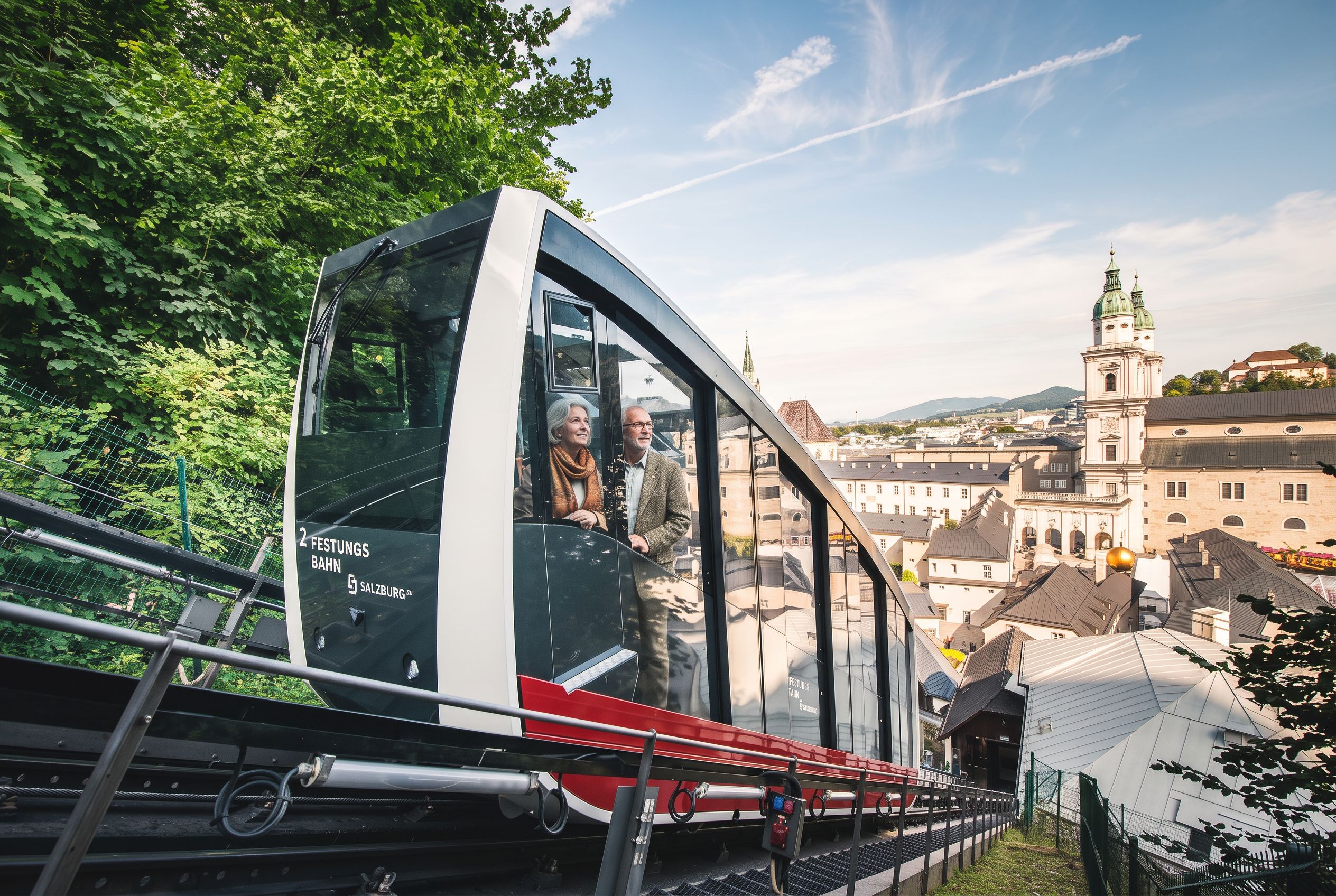
The FestungsBahn funicular is the official barrier-free way up to Hohensalzburg Fortress, and a lift in the bell tower then reaches the courtyard, the armoury exhibition, the tavern, the Kuenburg Bastion and the Marionette Museum. The footpath up is explicitly not barrier-free because of its steepness, and the fortress interiors are not barrier-free either.
The funicular runs on a ten-minute cycle, so wait times are short, and Salzburg's tourist board puts the ride at 54 seconds over a distance of 198.5 metres. The cars are standing-only with a sloped floor and all-glass sides, giving unobstructed views of Salzburg during the ascent. The funicular ticket is included with fortress entry and with the Salzburg Card, which also allows use of a fast lane to skip queues. One date to plan around: the FestungsBahn is closed for rebuilding work aimed at improving accessibility from 11 January to 14 March 2027, and during that window the fortress can be reached only on foot.
Guests consistently report the ride is smooth, quick, and clean, with staff described as friendly and helpful. As of August 2026, the FestungsBahn holds a Google rating of 4.5/5 from 2,209 reviews. The lower station is at Festungsgasse 4, in the heart of the Old Town and a short level walk from Salzburg Cathedral, making it an easy addition to any itinerary.
Once at the top, the experience is partial. The operator is direct about it: there are many steps and gradients across the site, and the interiors are not barrier-free. What the bell-tower lift opens up is the courtyard, the armoury exhibition, the tavern, the Kuenburg Bastion and the Marionette Museum, and no advance booking is needed for it. Allow about an hour for the funicular and castle visit—enough to absorb the panoramic views without rushing.
"If you don't feel like walking, this is one of the best, fastest, and most enjoyable ways to get to the castle." — a guest wrote on Google in October 2025
Is the Mönchsberg Lift Worth Using?
The Mönchsberg elevator is praised as a fast, convenient way to move between the Old Town and higher viewpoints, and the ridge walk at the top is mostly level. A practical insider tip is to use the funicular at one end and the elevator at the other, because the ridge walk is level.
The Mönchsberg lift rises 60 metres in about 30 seconds, carrying you from the historic centre up to a wooded plateau with sweeping views over Salzburg's rooftops, and it is also the barrier-free way into the Museum der Moderne at the top. Rick Steves' Europe travel blog reckons you can walk the length of the Mönchsberg in about 30 minutes, making it a gentle excursion for those who want alpine scenery without a hard climb. As of August 2026 the lift holds a Google rating of 4.3/5 from 1,099 reviews.
For a restful afternoon, consider combining the Mönchsberg with the fortress: take the funicular up one side, walk the level ridge, and descend via the elevator on the other. This creates a loop that minimizes climbing while maximizing views. The ridge path is well-maintained and mostly flat, suitable for walkers and electric mobility aids.
Which Gardens and River Paths Are Easiest on the Feet?
Mirabell Palace and Gardens are a strong choice for limited mobility, with accessible routes repeatedly highlighted for the palace grounds. The Salzach river promenade offers the least strenuous walking in the city—level, easy, and well-marked.
The Mirabell Gardens, made famous by The Sound of Music, feature wide paths and gentle gradients, and Salzburg's tourist board states plainly that both the palace and the gardens are barrier-free. A lift inside Schloss Mirabell reaches the Marble Hall. This is a place to linger, with benches placed for resting and photographing the Pegasus Fountain and the floral parterres.
For the flattest possible stroll, head to the river. The promenade along the Salzach links the Old Town with the Mirabell quarter, and the grassy embankments make an unhurried place to sit and watch the water. At the Mirabell end, the city completed a new ramp in 2026 over the historic flight of steps between the Orangery garden and the Mirabell garden, laid in Untersberg marble slabs, so that stretch is now crossed without steps.
Hellbrunn Palace, slightly outside the centre, presents a mixed picture. Hellbrunn's own site says the trick fountains and the historic park are accessible without restriction to visitors in a wheelchair, while the palace exhibition can be reached only by a staircase. A wheelchair can be borrowed free of charge at the ticket desk against an identity document, and accessible toilets are in the central passage and beside the playground in the park.
Which Museums and Cultural Sites Are Fully Accessible?
The Salzburg Museum in the Neue Residenz is closed for a full refurbishment until 2027, so the DomQuartier is now the strongest accessible cultural stop: it was adapted within the limits of monument protection and is reached by two lifts. Salzburg Cathedral is step-free everywhere except the crypt.
For a rainy day or a midday rest, these indoor options shine. One caveat first: the Salzburg Museum in the Neue Residenz is shut for a general refurbishment and expansion, and the museum expects it to stay closed until 2027, so do not build a day around it. The DomQuartier, which links the cathedral, residence, and museum spaces, was adapted within the limits of monument protection—but the result is genuinely accessible. Its two lifts may only be used in the company of a DomQuartier staff member, for insurance reasons, and a wheelchair can be borrowed at the porter's desk.
Salzburg Cathedral itself welcomes all visitors with a barrier-free entrance and spacious interiors. The city's official accessibility guide is precise about the limit: every part of the cathedral except the crypt can be reached by wheelchair. The cathedral square (Domplatz) is one of the most level and open spaces in the Old Town, making it a natural gathering point and rest stop.
One notable exception: the Mozarteum Foundation states plainly on its own site that Mozart's Birthplace is not barrier-free. The historic house retains its narrow stairs and period layout. If Mozart is a priority, the Mozart Residence on the other side of the river is barrier-free through the Theatergasse entrance; the foundation asks visitors to ring +43 662 874227 40 so staff can open it.
How Reliable Is Public Transport for Getting Around?
The vast majority of Salzburg's buses and trolleybuses are low-entry, and those carrying a fold-out wheelchair ramp are marked with a wheelchair symbol. The Guest Mobility Ticket has made public transport across the province free for overnight guests since 1 May 2025. A reduced senior fare exists, but it requires an ÖBB Vorteilscard Senior.
Since 1 May 2025, overnight guests receive the Guest Mobility Ticket at check-in, valid for the whole stay across the province of Salzburg: urban transport, regional buses, suburban railways, regional and long-distance trains, and micro-mobility services. It is funded by a mobility levy charged alongside the overnight tax, so it is included rather than free in the strict sense. Two things it does not cover: the FestungsBahn and the Mönchsberg lift both need a regular ticket of their own.
ÖBB places Salzburg Hbf in its highest accessibility category and writes that the station can be used independently, with no significant obstacles or barriers in the access areas or on the platforms; a lift and an accessible WC are listed among its facilities. If you need personal assistance, ÖBB's mobility service must be contacted at least twelve hours before departure. Taxi 81-11 drivers are obliged to transport wheelchairs, except some electric or non-folding models.
One planning note: for journeys beyond the scheduled bus network, Salzburg's tourist board lists wheelchair driving services run by the Salzburg provincial chapters of the Austrian Red Cross and the Samaritan Federation. Book those ahead rather than on the day, and build buffer time into any tight connection.
Where Can You Find Accessible Public Toilets?
Salzburg's official barrier-free service page says some of the public WCs in the historic district are accessible, that all of the accessible toilets can be opened with the Euro-Key, and that the number is being expanded continuously. The Euro-Key itself is issued by the Austrian Council for the Handicapped, not sold to visitors on request.
Eligibility is the catch. The key is usually free for holders of an Austrian disability pass carrying the relevant entry, or of a parking permit under section 29b of the road traffic act; where only a medical certificate is available it costs €30. The same key also opens facilities in Germany, Switzerland, Liechtenstein, Italy, France and several other countries, so apply well before you travel.
For a reliable restroom strategy, plan around the sites that publish their facilities rather than assuming every one has them. Hellbrunn, for instance, lists accessible toilets in the central passage and beside the playground in the palace park, and the fortress has them by the Info Point and in the restaurant. When in doubt, ask at any hotel—most will accommodate a non-guest needing restroom access.
What Recent Changes Should You Know About?
Since 1 July 2026, Salzburg's Old Town has been largely closed to regular traffic, with car access only in exceptional cases. The shift improves comfort for walkers but means taxis and private cars have fewer drop-off points. Holders of a Euro-Key can lower the bollards themselves to drive in and out in the Rudolfskai area.
Salzburg's official travel page flags the change under "Arrival & Mobility" and points day visitors to the Park & Ride system with public-transport tickets included. For travellers with limited mobility, this is a double-edged sword: fewer vehicles mean safer, quieter streets, but also longer walks from drop-off points to hotels and attractions.
Plan accordingly. If you are staying in the Old Town, ask your accommodation about their taxi access arrangements. Some hotels maintain special permits for guest drop-off. Others may require a short walk from the nearest permitted stopping point—a consideration when packing and planning your arrival.
How Much Should You Budget for Accessibility?
Salzburg's accessibility features—funicular, lifts, and public transport—are reasonably priced, and the Salzburg Card bundles many costs. The funicular ticket is included with fortress entry and with the Salzburg Card, which also allows use of a fast lane.
The Salzburg Card offers excellent value for mobility-conscious travellers. It gives one free admission to each city attraction, free travel on public transport apart from the S-Bahn, and skip-the-line privileges at major sites. For a detailed breakdown of daily costs, see our comfortable Salzburg trip cost guide.
Budget for occasional taxis. At the main station the rank is immediately to the right of the main portal; elsewhere, ask your hotel where the nearest stand is before you head out. For journeys that need a wheelchair-accessible vehicle, Salzburg's tourist board points to driving services run by the Red Cross and the Samaritan Federation rather than to the ordinary taxi fleet.
| Item | Cost Range | Notes |
|---|---|---|
| Salzburg Card (24h) | €35.00 / €38.00 | €35.00 Jan–Mar and Nov–Dec, €38.00 Apr–Oct 2026 |
| Fortress ticket incl. funicular | €15.50 | Basis-Ticket; funicular alone €4.00 one way, €6.30 return |
| Mönchsberg lift | €3.40 one way, €4.80 return | Salzburg Card gives one free ride, not unlimited |
| Single bus/trolleybus fare | €3.00 | Kernzone Salzburg, bought on board, from 1 Jan 2026 |
| Wheelchair taxi | Not specified | Red Cross and Samaritan Federation, Salzburg chapters |
Which Neighbourhoods Suit Limited Mobility Best?
Staying near Mirabell, the station, or the river crossings is worth considering if limited mobility is a concern, because these areas let you reach the Old Town with fewer detours. The walk from the station to the centre is about 20 minutes, so many prefer the Obus links, which cover it in ten.
The area around Mirabell Palace offers flat, wide pavements and direct access to both the gardens and the river promenade. The train station neighbourhood provides excellent transport links and level access to buses and trolleybuses. For a deeper dive into neighbourhood trade-offs, consult our Salzburg neighbourhood guide.
Hotels in the Old Town may still require a walk from where taxis can stop, so weigh the charm of a historic address against the practicalities of arrival and departure. Salzburg's tourist board runs its own barrier-free accommodation search and publishes a free brochure, "Salzburg without barriers", which sets out hotels alongside sights, restaurants, accessible car parks and public WCs.
How Does the Season Affect Accessibility?
Winter conditions can make cobbles, slopes, and step-free routes harder to manage, while summer is more comfortable for walking in the Old Town. The same routes that feel pleasant in good weather are more tiring in cold, wet, or icy conditions.
Salzburg's Alpine location means crisp winters and pleasant summers. For mobility-challenged travellers, late spring through early autumn (May to September) offers the most comfortable conditions. Pavements are dry, daylight hours are long, and outdoor cafés provide natural rest stops.
If you visit between November and March, pack appropriate footwear with good grip and consider booking a restful afternoon at a spa to recover from the cold. Salzburg has no thermal spring of its own, but the Paracelsus Bad & Kurhaus beside the Mirabell gardens is barrier-free throughout, with a lift serving every floor from the Kurhaus to the rooftop sauna, special wheelchairs free of charge for the pool and sauna areas, and accessible WCs on almost every level.
What Practical Preparations Make the Biggest Difference?
Checking each site's accessibility in advance is essential, as barrier-free access is not universal. The city recommends barrier-free travel planning and provides specific mobility service contacts for route advice, wheelchair transport, or stop-to-stop assistance.
Salzburg's official tourism pages offer a dedicated barrier-free section with detailed information on attractions, transport, and facilities. The Salzburg barrier-free travel guide is an authoritative resource worth consulting before you pack.
For the Euro-Key that opens accessible WCs and the Old Town bollards, the issuing body is the Austrian Council for the Handicapped, which also sets out who qualifies. Several attractions lend wheelchairs on site, among them the DomQuartier, Hellbrunn and the Paracelsus Bad.
Finally, pace yourself. Two or three fixed points a day is a fuller programme than it sounds once cobbles and gradients are counted in. Salzburg rewards selective, unhurried visits. Savor the coffee, enjoy the views, and let the city's rhythm set your pace.
"There are many paved walking paths for everyone & strollers. It's a scenic panorama of nature and views for families & hikers." — one Google reviewer wrote of the Mönchsberg in September 2024


