
The Zillertal is a valley of dramatic beauty, but for travellers aged 50 to 70, the real reassurance lies in knowing exactly where to find a doctor, how to fill a prescription, and what to do if the weather turns or a knee gives way on the piste. This practical guide covers the valley’s healthcare network, pharmacy hours, emergency numbers, and insurance essentials so you can explore with confidence.
The Zillertal stretches from Jenbach in the north to the Hintertux Glacier in the south, with a string of villages connected by the Zillertalbahn railway and valley-floor roads. Healthcare is distributed across these towns rather than concentrated in one hub, which means you are rarely far from help. The key is knowing where to look before you need it.
 AI-edited
Where can I find a doctor in the Zillertal?
General practitioners are spread across the main valley towns, with several practices explicitly welcoming tourists for acute care. The most accessible options are in Fügen, Mayrhofen, and Gerlos, where doctors publish emergency contact numbers and seasonal hours.
In Fügen, the practice at Karl-Mauracher-Weg 38 (phone +43 5288 64488) belongs to Dr. Anton Klingenschmid and publishes a page headed “Akute medizinische Hilfe im Zillertal” for holiday guests with acute complaints. Summer consulting hours are Monday and Thursday 09:00–12:00 and 17:00–19:00 and Tuesday 09:00–12:00; outside them the same number carries a recorded message for emergencies. The practice treats in German and English and has an X-ray unit with digital image processing on site, with MRI and CT through partners. In Gerlos, Dr. Arnold Stöckl runs a general practice at house number 141a in the Dorfbahn building, on the first floor; for urgent cases at weekends, on public holidays and outside consulting hours it gives +43 5284 20047-30. In Mayrhofen, Dr. Katharina Weber-Gredler’s practice at Hauptstraße 456 offers digital X-ray, pain therapy and geriatric medicine, with weekday hours only; her emergency number is the same as the practice line, +43 5285 62550. The medalp Sportclinic Zillertal in Stillupklamm treats sport and leisure injuries and opens Monday to Friday 09:00–18:00 and at the weekend and on public holidays 09:00–17:00, with X-ray, ultrasound, CT and MRI on site.
For orthopaedic issues, Orthopädie Zillertal — Dr. Christian Schimanek at Ramsau 160 — can be reached outside opening hours in acute emergencies on the mobile number +43 676 525 88 90. The valley’s medical coverage is distributed, with further general practices in Zell am Ziller, Kaltenbach, Ried and Schlitters, and a medical centre covering several specialities at Dorfplatz 3 in Kaltenbach. The directory of doctors and pharmacies kept by Zillertal Tourismus GmbH is on the official Zillertal infrastructure page.
Which pharmacies are open and where?
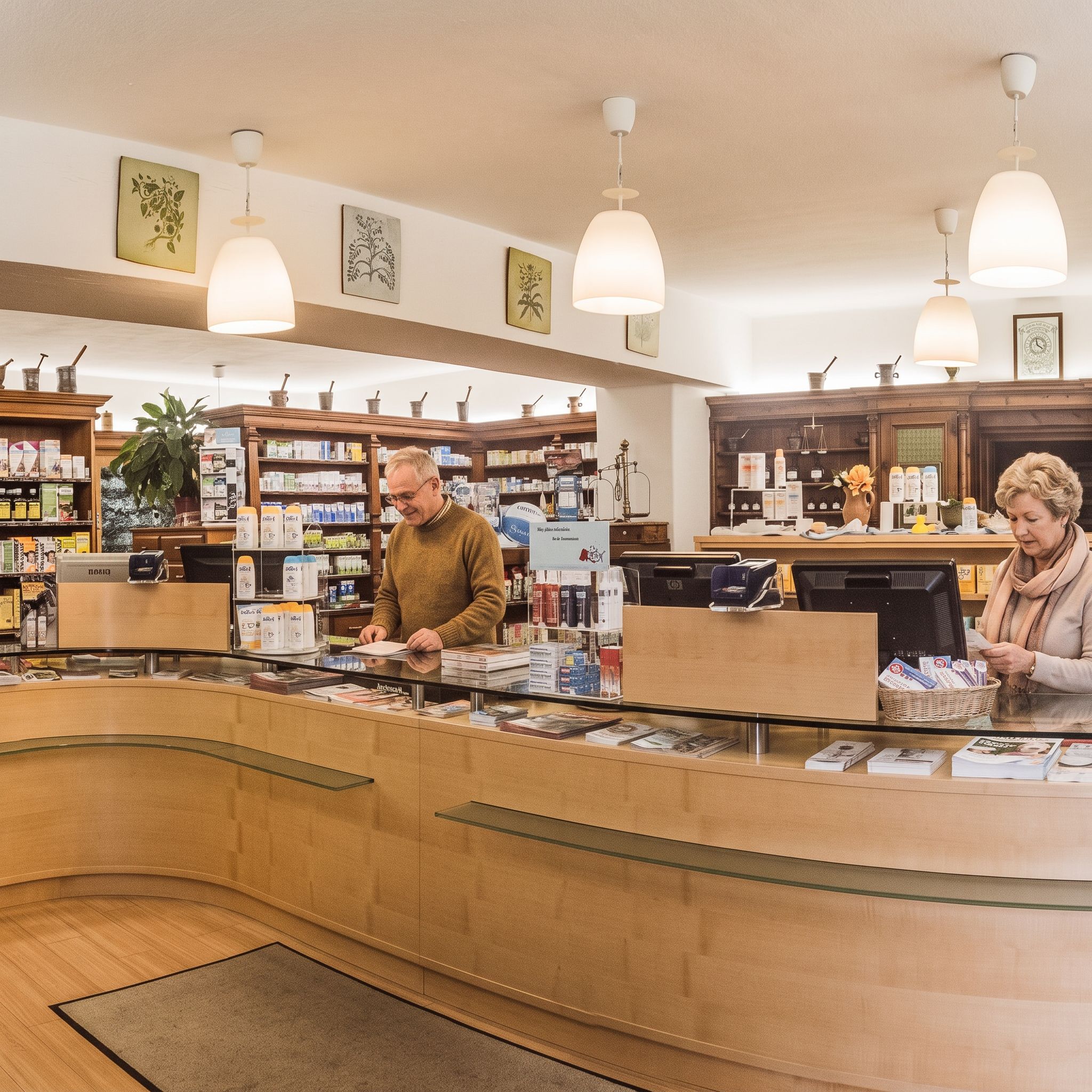
Eight public pharmacies serve the valley and share one night and weekend duty rota, but they are not spread evenly: Gerlos has only doctors' own dispensaries, and those are tied to a consultation at that practice. The most reliable options are in Mayrhofen, Zell am Ziller, Fügen, and Ramsau.
The Steinbockapotheke in Mayrhofen (Hauptstraße 444, phone +43 5285 62313) opens Monday to Friday 08:30–12:30 and 14:00–18:00 and Saturday 08:00–12:00, and rates 4.7/5 on Google from 57 reviews as of August 2026, with guests reporting friendly, English-speaking staff and thorough consultations. The Gerlossteinapotheke in Zell am Ziller (Dorfplatz 3a, phone +43 5282 2641) opens Monday to Friday 08:00–12:30 and 14:30–18:30 and Saturday 08:00–12:00 and rates 4.9/5 on Google from 86 reviews as of August 2026. Both publish the valley’s night and weekend duty roster on their own websites.
The other public pharmacies are the Europa Apotheke in Ramsau (Talstraße 74), the St. Pankraz Apotheke (Karl-Mauracher-Weg 36) and Dorf Apotheke in Fügen, the Rupertusapotheke in Stumm (Koflerweg 11), the Apotheke Kaltenbach (Kaltenbacher Landstraße 9) and the Easy-Apotheke zum Hl. Paulus in Aschau (Bräufeld 2). Eight public pharmacies share the valley’s 2026 duty calendar, and several publish it on their own websites, which is essential for Sunday or late-evening arrivals. The dispensaries of Dr. Kashlan and Dr. Stöckl in Gerlos are doctors’ own Hausapotheken, tied to a consultation at that practice, and they do not take part in the rota.
What about the nearest hospital and emergency numbers?
The nearest district hospital is in Schwaz, about 43 kilometres and a 45-minute drive from Mayrhofen, with more serious cases transferred to Innsbruck. For non-life-threatening issues, the valley’s GP practices and pharmacies handle most needs.
Emergency contacts confirmed for the Zillertal include 144 for ambulance and emergency medical transport, 1450 for the Austrian health advice line (staffed by trained medical professionals who can direct you to the right service), and 112 as the general EU emergency number. For ski-area emergencies in Hochfügen, the piste rescue team can be reached at +43 664 811 82 40. The ski area’s own emergency page notes that the piste rescue is on duty only while the lifts are running, and that for a cold, flu or overstrained muscles there is no need to dial the emergency number at all: your accommodation or the lift staff can point you to a doctor nearby. It adds that even simple fractures can usually be treated by local doctors and that a doctor can be called out to the hotel for an extra charge, which is worth checking against your policy first.
The Bezirkskrankenhaus Schwaz at Swarovskistraße 1/3 keeps a medical emergency clinic open 24 hours a day, every day. It states plainly that it cannot issue sick notes or repeat prescriptions for regular medication, and that chronic complaints belong with a general practice or a specialist outpatient clinic — worth knowing before you drive 45 minutes for a refill. Outside surgery hours, 141 reaches the Ärztefunkdienst, Tyrol’s medical on-call service; it is staffed mainly at night from 19:00 to 07:00, at weekends from Friday 19:00 to Monday 07:00 and all day on public holidays, so during normal weekday hours you call the practice itself.
“Very nice and helpful staff. They speak English which is great. I got some medicine for a stomach pain and they also ordered some meds they did not have in stock.” — a review of the Steinbock Apotheke in Mayrhofen left on Google in December 2023
How do I handle altitude and mountain rescue?
Altitude in the Zillertal ranges from valley-floor towns at around 500 metres to the Hintertux Glacier at 3,250 metres. Austria’s health portal puts the onset of altitude sickness at about 2,000 metres and reckons that roughly one unacclimatised visitor in four develops symptoms above 2,500 metres — a real risk on a fast cable-car ascent, but not a certainty.
The valley’s major cable cars at Mayrhofen, Zell am Ziller, and Hintertux offer the most practical way to reach high elevations without strenuous walking. However, altitude sickness can affect anyone, regardless of fitness. The typical signs are headache together with nausea or vomiting and dizziness. Acute mountain sickness usually develops when someone climbs too fast into unfamiliar altitude and then stays there longer than six hours, so on a cable-car day the simplest protection is not to linger at the top. Above 2,500 metres the daily fluid requirement rises to roughly three to four litres.
Mountain rescue in the Zillertal is coordinated through the Bergrettung Tirol (Tyrolean Mountain Rescue), reachable via 140 (the alpine emergency number). This service covers hikers, skiers, and anyone in distress on the mountain. Rescue costs can be substantial, which is why insurance is essential. The Alpenverein (Austrian Alpine Club) does not sell a separate rescue card. Its Weltweit Service insurance comes with membership and, as of 2026, covers recovery from difficult terrain up to €25,000 with helicopter costs included, repatriation from abroad without a ceiling, and medical treatment abroad up to €10,000 during the first eight weeks of any trip. As of 2026 the minimum membership fee is €75, or €58 from the age of 65. Check your own policy carefully as well: some standard travel insurance excludes mountain rescue or limits cover to a specific altitude.
What do I need to know about travelling with medication?
Carry all prescription medications in their original packaging, with a copy of your prescription and a letter from your doctor explaining the medical need. The EHIC/GHIC card covers medically necessary treatment but does not cover repatriation or private ambulance transport.
The European Health Insurance Card (EHIC) or GHIC (for UK residents) entitles you to state-provided healthcare in Austria at the same cost as a resident. This includes doctor visits, hospital treatment, and prescribed medications. However, it does not cover mountain rescue, private ambulance transport, or repatriation to your home country. For skiing or winter walking, you need separate travel insurance that covers these risks.
Age limits are real and worth reading before you buy: the Alpine Club’s optional accident add-on, for example, can be taken out only up to the age of 74. What the policy has to name is mountain rescue, transport off the piste, outpatient treatment and repatriation. Arrange it before you travel rather than on arrival: the European Commission’s guidance on unplanned healthcare abroad states that the EHIC “will not help you with rescue and repatriation”, and no Zillertal lift company sells that cover at the ticket window.
For medication storage, ask your hotel in advance whether the room has a fridge; it is not a given, and no Zillertal hotel publishes an on-site medical service. If you carry insulin or another temperature-sensitive medicine, raise it when you book rather than at check-in. The valley’s clinical fallback is the medalp Sportclinic in Mayrhofen, open every day of the week, and for the lower valley the medical centre at Dorfplatz 3 in Kaltenbach.
How do I cope with alpine weather changes?
Mountain weather in the Zillertal can change rapidly, even in summer, and height alone costs you warmth: GeoSphere Austria station records for 2020 to 2025 put the July mean at 13.2°C at Hintertux (1,505 m) against 18.6°C on the valley floor at Mayrhofen (640 m), with July nights at Hintertux averaging 4.5°C.
The valley’s glacier-fed rivers and high peaks create localised weather patterns. The Zillertal Arena and Hintertux Glacier are particularly prone to sudden weather shifts. The practical rule is to check the mountain weather forecast each morning from the Zillertal tourism board website or your hotel’s information board. Many cable car stations display real-time weather updates and warnings.
For walking on the valley floor, the Zillerpromenade runs eight kilometres from the Ziller bridge in Zell am Ziller to Mayrhofen; the operator calls it a comfortable, easy walk that also suits families with a pram, and publishes no wheelchair rating and no note on surface or width. Mayrhofen works well as a base if your accommodation has lift access and a step-free entrance, but the village is not uniformly flat. Accessible public toilets are documented at the Rosenalmbahn valley station in Zell am Ziller and at the Ahornbahn valley station in Mayrhofen.
For winter visits, the Zillertal Arena’s ski buses are free — but only with a valid ski pass, only while the lifts are running, and, in the operator’s own words, only for passengers carrying winter sports equipment. For a run to a pharmacy or a surgery you are on the ordinary valley buses. The Zillertalbahn runs along the valley floor, and the Verkehrsverbund Tirol shows for each individual service whether it is a low-floor train and whether a wheelchair space and accessible WC are available; the wheelchair space has to be booked by telephone on +43 5 17 17 5, so step-free boarding is not a given at every station. Cable cars at the major ski areas are often the most practical way to avoid steep walking, though some require a short uphill walk from the car park.
For more on the valley’s seasonal rhythms, see our guide to The Zillertal Through the Year: Festivals and Quiet Seasons, which covers the best times for calm travel. If you are a light sleeper, our article on The Quietest Hotels in the Zillertal offers practical advice on choosing accommodation with good acoustics and restful rooms.
What insurance do I need for peace of mind?
For a Zillertal trip, you need three layers of cover: the EHIC/GHIC for state healthcare, a comprehensive travel insurance policy that includes mountain rescue and repatriation, and, if you ski, a separate ski insurance policy that covers piste rescue and liability.
The EHIC/GHIC covers medically necessary treatment in Austrian public hospitals and doctor visits. It does not cover private ambulance transport, mountain rescue, or repatriation. For these, you need travel insurance. The Zillertal Arena’s own travel-insurance page recommends only a cancellation policy from Europäische Reiseversicherung AG, and neither it nor the Hintertux Glacier sells a rescue or accident add-on with the lift ticket. Recovery from the mountain is therefore your own arrangement, whether through the Alpine Club or a travel policy that names it explicitly.
Read the age limit and any medical declaration clause before you pay; where an insurer publishes a limit it is explicit, and the Alpine Club caps its optional accident add-on at the age of 74. Mountain rescue itself comes with ordinary Alpenverein membership rather than a separate card, on the terms set out earlier in this guide.
A practical checklist before departure:
- Print your EHIC/GHIC card and keep it with your passport.
- Buy travel insurance that explicitly covers mountain rescue and repatriation.
- If skiing, buy ski-specific insurance that covers piste rescue and liability.
- Carry a photo of your medication list and prescription.
- Save emergency numbers (144, 1450, 112, 140 and 141) in your phone.
- Check the nearest pharmacy’s Sunday and night duty schedule.
What does peace of mind look like on the ground?
Peace of mind in the Zillertal means knowing that help is never far away, that guests at the Steinbockapotheke and the Gerlossteinapotheke report being served in English, and that your insurance covers the unexpected. It means choosing accommodation with good acoustics and restful rooms, and planning your routes with rest stops in mind.
The practical details are the ones worth writing down before you go. A room with lift access and a walk-in shower makes rest easier after a day on the slopes or trails, so ask about both when you book rather than on arrival. Outside the Gerlossteinapotheke in Zell am Ziller you may use the marked municipal bays directly in front of the door free of charge for the length of your visit — a small thing that matters when you are driving between villages for a prescription.
For those who prefer a calm base, our guide to A Spa Day at the Zillertal Thermal Baths offers a restorative option after a long travel day. And for planning your visit around quieter periods, see When to Visit the Zillertal: Ski Season, Summer and the Quiet Between.
What visitors consistently report about Zillertal pharmacies is unglamorous and useful: staff who switch to English without being asked, and a willingness to order in what is not on the shelf. None of that replaces bringing an adequate supply of your own prescription medication, which is covered earlier in this guide.
The Zillertal is a valley that rewards preparation. With the right contacts, the right insurance, and a calm approach to the mountains, you can focus on what matters: the views, the fresh air, and the quiet satisfaction of a well-planned trip.


