
The Amalfi Coast presents a particular challenge for travellers seeking rest and wellness: its beauty sits on cliffs, and its pleasures often involve stairs. Yet a handful of spa hotels have turned that verticality into an advantage, perching pools, treatment rooms and terraces above the Tyrrhenian Sea. For travellers aged 50 to 70, the question is not simply which spa is finest, but which one lets you reach the spa, the pool and your room without an expedition. This guide assesses the coast's leading spa hotels for comfort, accessibility, quiet and treatment range, drawing on operator information and verified guest feedback.
The coast itself is not one town but a string of municipalities along the Province of Salerno, from Vietri sul Mare in the east to Positano in the west, a stretch recognised as a UNESCO World Heritage site. That matters for planning: each town has its own character, its own gradients and its own access realities. Amalfi town sits close to sea level with a flat seafront, while Ravello perches high above and Positano descends steeply to the water. For a fuller picture of how these towns compare for slower-paced travel, see The Amalfi Coast for Travellers Over 50: The Complete Guide.
See also: Tuscany With Grandchildren: A Family Guide for Travellers Over 50.
What makes a spa hotel work for travellers over 50?
A successful spa hotel for this age group keeps the spa, pool, restaurant and bedroom in a tight cluster, minimises stairs between them, and publishes its access details clearly. Where those details are absent, the property should be willing to answer questions directly before you book.
Guest feedback across the coast's leading spa properties clusters around a few themes. Attentive service is praised repeatedly, with staff bringing cool towels, drinks and snacks, and helping with excursions. Breakfast quality is often strong in the better-rated properties. But reviews also flag recurring frustrations: road noise, thin walls, hard beds and awkward access where steps or limited lift convenience intervene. For travellers prioritising rest, the practical lesson is to choose a property where the spa, pool and rooms sit close together, and to ask specific questions about access before committing.
The coast's spa hotels are generally luxury leisure properties rather than medical spas. None of the properties profiled here publishes clinical or therapeutic claims for its treatments, and none documents senior tariffs or reduced rates for older guests. The wellness offering is about relaxation, sea views and attentive service rather than medical intervention.
Which spa hotels are the strongest matches for rest and wellness?
Five properties stand out for travellers seeking genuine rest: Anantara Convento di Amalfi, Belmond Hotel Caruso in Ravello, Borgo Santandrea between Amalfi and Positano, Hotel Raito's Thalea Spa in Vietri sul Mare, and Monastero Santa Rosa in Conca dei Marini. Each offers something distinct in setting and treatment approach.
The clearest documented matches from operator and official sources are these:
- Anantara Convento di Amalfi Grand Hotel: a converted 13th-century monastery built into the cliffside, 600 metres from Amalfi's town centre, with 52 rooms and suites and an award-winning spa.
- Caruso, A Belmond Hotel, Ravello: a historic palazzo with a spa retreat offering sunrise yoga and historic hikes alongside treatments.
- Borgo Santandrea Wellness Retreat: described by Relais & Châteaux as a well-being escape with sea views, where treatments can be enjoyed outdoors or indoors.
- Hotel Raito's Thalea Spa, Vietri sul Mare: open year-round to guests and non-residents, with clear booking arrangements.
- Monastero Santa Rosa Hotel & Spa, Conca dei Marini: a meticulously restored property with a spa, closed from November to mid-April.
Two further day-spa options, Otium Spa in Minori and Aquaboutique Wellness & Spa in Vietri sul Mare, offer treatment-focused experiences without requiring an overnight stay. These are covered in the dedicated spa-day guide; this article focuses on the hotel experiences.
 AI-edited
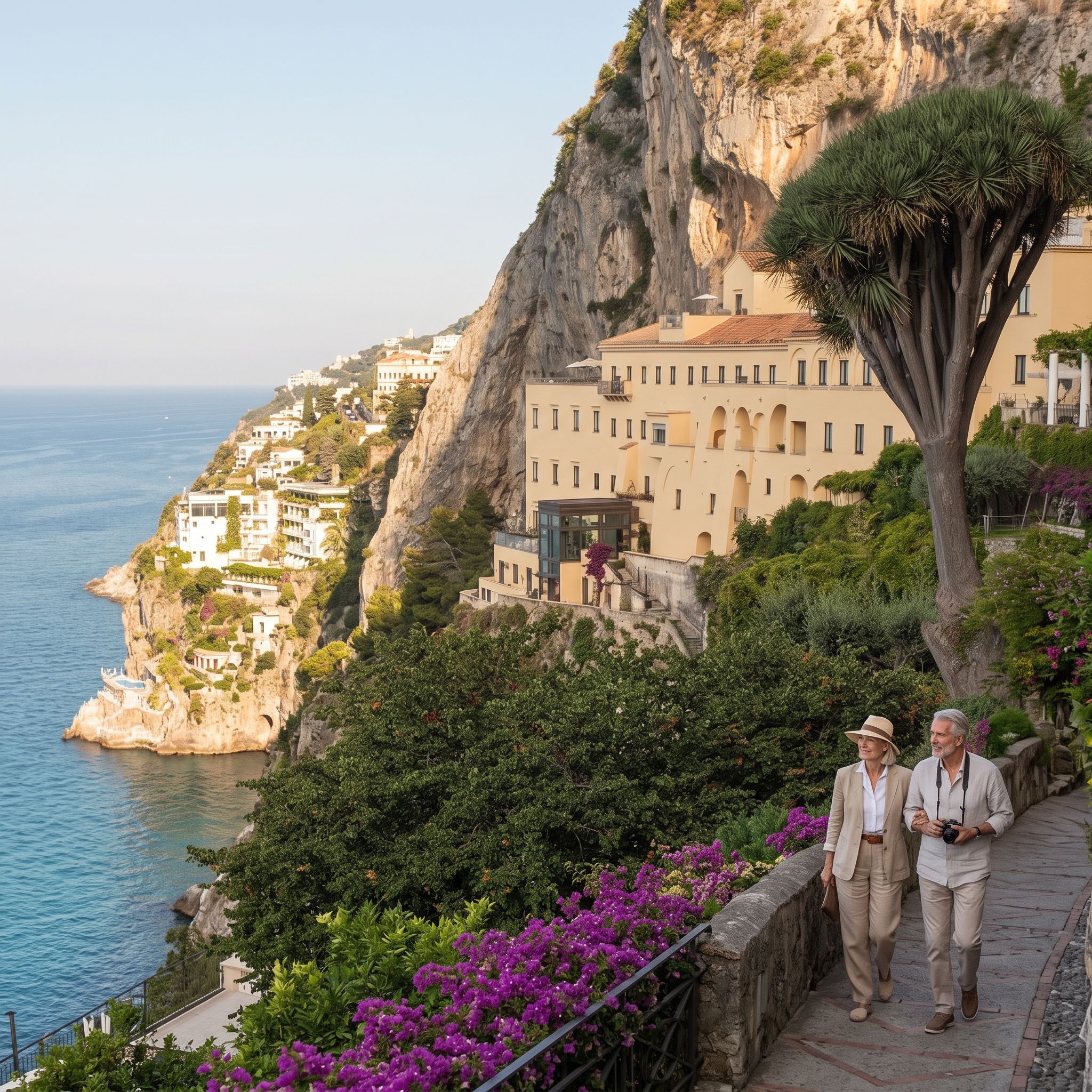
Anantara Convento di Amalfi: the cliffside monastery
Anantara Convento di Amalfi offers the most complete documented spa package on the coast: a heated infinity pool open all season, a panoramic gym, wheelchair-accessible rooms and an award-winning spa, all within a converted 13th-century monastery that was completely renovated in 2023.
The property's own materials state that it is built into the cliffside overlooking the harbour, just 600 metres from Amalfi's town centre, and that almost all of its 52 rooms and suites look directly out to sea. The Anantara Spa operates daily from 11:00 to 19:00, according to the operator's page. The hotel confirms it has wheelchair-accessible rooms, a heated infinity pool available all season, and a panoramic gym with Technogym equipment.
Guest feedback on Google, where the property holds a 4.7 out of 5 rating across 930 reviews as of September 2026, is consistently warm about the staff. Reviewers describe being greeted by name and treated with exceptional attentiveness. The complimentary shuttle to Amalfi town centre runs hourly, and staff will drive guests to the port or pharmacy.
"This was our third summer stay at Anantara Convento Di Amalfi hotel and we couldn't recommend it more! The location, property and food is fantastic and the staff are exceptional." — a guest wrote on Google in August 2026
The property does not publish step counts for its cliffside setting. A private walkway with 210 illuminated steps connects the hotel to town, described in guest feedback as safe at night but steep, with some guests choosing the shuttle instead. The hotel's own page notes it is a one-and-a-half-hour drive from Naples International Airport and offers valet parking with a daily charge. Access to the Lido degli Artisti beach club is five minutes away by boat.
Belmond Hotel Caruso, Ravello: wellness above the clouds
Belmond Hotel Caruso in Ravello offers the coast's most explicit wellness programming, with the Caruso Spa Retreat open daily from 10:00 to 20:00 and activities including sunrise yoga and historic hikes. Its hilltop position provides quiet and views, but requires a winding drive from the coast below.
The Belmond property sits in a historic palazzo in Ravello, a five-minute walk from the town's main square according to guest feedback, yet remains quiet and removed from the crowds of Amalfi below. The infinity pool overlooking the coast is repeatedly highlighted in reviews as a standout feature, with poolside service including complimentary water, towels and suncream. Breakfast is praised for quality and variety, served on a terrace overlooking the coast.
The operator's materials frame wellness around the sunrise yoga sessions and historic hikes, alongside the spa treatments. The property does not document wheelchair access, step counts or lift details for its spa. The road from Amalfi to Ravello involves 20 to 25 minutes of winding cliffside driving, which guests note as a consideration when planning day trips.
For travellers weighing Ravello against the coastal towns, the trade-off is clear: greater quiet and elevation in exchange for the winding access road. The complimentary daily boat tour along the coast, organised by the hotel, offers an alternative way to see the shoreline without road travel.
Borgo Santandrea: outdoor treatments with sea views
Borgo Santandrea, positioned between Amalfi and Positano, is documented by Relais & Châteaux as a well-being escape where treatments, massages and rituals can be enjoyed outdoors or indoors, including on a panoramic terrace. The property names a sauna, sensory shower and Cupido Suite among its facilities.
The Relais & Châteaux description emphasises the sea-view setting and the flexibility of indoor or outdoor treatments. Guest feedback from 2025 describes a well-equipped indoor gym, an outdoor workout patio with a view, and a sauna beside the pool. The property has added three cliffside suites, a spa and wellness offering, a boutique and a private boat fleet for transfers and excursions, which reduces road-traffic friction for guests.
The property does not document mobility details, health provisions, booking rules or cancellation terms in the materials reviewed. Its position between Amalfi and Positano means access is by the winding SS163 road, and the cliffside setting implies steps, though the property publishes no step counts. Ask directly when booking about the route from reception to the spa and pool.
Hotel Raito's Thalea Spa, Vietri sul Mare: open to non-residents
Hotel Raito's Thalea Spa in Vietri sul Mare is the most clearly documented option for travellers who want spa access without an overnight stay, open year-round to guests and non-residents daily from 12:00 to 20:00, with booking by phone or email.
The operator's page states the spa is open to non-residents and can be booked by phone at 089 7634608 or by email at expurespa@hotelraito.it. The property does not document wheelchair access, steps, lifts, handrails or cancellation terms in the materials reviewed. No specific medical or healing benefit claims are documented beyond spa access and age rules.
Vietri sul Mare sits at the eastern end of the coast, closer to Salerno, which makes it a practical base for travellers arriving by train or wanting easier road access. The town is less touristed than Amalfi or Positano, which may appeal to travellers seeking quiet. The property does not publish senior tariffs or reduced rates for older guests.
Monastero Santa Rosa, Conca dei Marini: seasonal cliffside retreat
Monastero Santa Rosa Hotel & Spa in Conca dei Marini is described by Fodor's as a meticulously restored property with a spa. Its seasonal closure from November to mid-April is a key planning consideration for travellers.
The property occupies a clifftop position in Conca dei Marini, between Amalfi and Positano. Fodor's describes it as meticulously restored, and the spa is part of that restoration. The property's seasonal closure from November to mid-April means it operates only in the warmer months, which aligns with the coast's best weather window of April to October.
The property does not document mobility details, step counts or lift access in the materials reviewed. Its cliffside setting implies vertical movement between levels, though the property publishes no specifics. Ask when booking about the route from the car park or entrance to the spa and pool areas.
How does access compare across the coast's spa towns?
Access varies sharply by town. Amalfi town is the most level, with a flat seafront and main piazza reached directly from the road. Ravello sits high with some step-free hotel access but steep town gradients. Positano is documented as effectively inaccessible for independent wheelchair exploration and very difficult for those with limited mobility.
For Amalfi specifically, a 2026 accessibility guide records that the main piazza is flat and reached directly from the seafront road, the seafront lungomare is flat, several seafront restaurants have step-free entrances, and the small pebble beach is directly accessible from the main road. The same guide notes that the cathedral steps are unavoidable and the upper town rises steeply.
For Positano, the recorded accessibility guidance is negative: it is described as effectively inaccessible for independent wheelchair exploration and very difficult for those with limited mobility. Travellers who want to visit Positano's spa hotels, such as Il San Pietro di Positano or Le Sirenuse, should plan for significant steps and slopes. Guest feedback on Il San Pietro describes the spa as "very small", and the property's cliffside position implies considerable vertical movement.
Where a property does not publish these details, the reliable approach is to ask directly when booking. The Anantara Convento di Amalfi is the exception, confirming wheelchair-accessible rooms on its official page.
When is the quietest time to visit for rest and wellness?
The documented quietest window for the coast is shifting. A 2025 tourism report says July and August have become "quiet months" with arrivals down 8 to 10 percent against the previous year, while September and October are the new peak months. For spa tranquillity specifically, Belmond Caruso's sunrise yoga implies dawn is the calmest time of day.
The climate data supports spring and autumn as the most comfortable seasons for wellness travel. Average highs in Amalfi town reach about 30°C in July and August, easing to about 21°C in October. Rainfall peaks in November at about 160 mm, with July the driest month at about 15 mm. The best "sun holiday" window runs April to October, and the coast is less busy from November to March.
For travellers aged 50 to 70 seeking rest, the practical window is May, September or early October: warm enough for outdoor treatments and pool use, quieter than the July-August peak, and with milder temperatures for any walking. Note that Monastero Santa Rosa closes from November to mid-April, so autumn visits should be scheduled before that closure.
What should you ask before booking a spa hotel here?
Before booking any Amalfi Coast spa hotel, ask four questions: How many steps between the entrance, room, spa and pool? Is there lift access to all levels? What are the cancellation terms? And is the spa open to non-residents if you want day access? The properties reviewed here do not uniformly publish these details.
The Anantara property confirms wheelchair-accessible rooms. Hotel Raito's Thalea Spa states its booking method clearly. No property in the reviewed materials documents senior fares, reduced tariffs or passes.
There are no hospitals in Amalfi town; the closest documented local health facility is ASL Salerno in the Ravello area, less than 2 km from Amalfi. A practical travel guide lists emergency contact numbers for Amalfi, including the municipality, police station, port authority, roadside assistance, sea rescue and the European emergency number.
How do prices and half-board options compare?
Rates vary significantly by season, room category and booking channel, so the reliable approach is to request current quotes directly from each property.
No coast-wide reduced-fare scheme was documented. Where dining is concerned, guest feedback consistently praises breakfast quality at the leading properties, with reviews calling it "delicious", "wonderful", "rich" or "high quality", and some properties offering early takeaway breakfasts for early departures.
For travellers weighing half-board, the documented strength of breakfast at Anantara Convento di Amalfi, Belmond Caruso and Borgo Santandrea suggests that including breakfast is worthwhile at these properties. The dinner offerings at the cliffside restaurants are also praised in guest feedback, but the value of half-board depends on whether guests plan to be at the hotel for evening meals or exploring the coastal towns. Rates are indicative and vary by season and booking channel; request current quotes directly.
What do guest reviews reveal about rest and quiet?
Guest feedback across the coast's spa hotels reveals a consistent pattern: service and breakfast are the strengths, while noise and bed comfort are the recurring challenges. For travellers prioritising rest, requesting a quiet room away from the road and confirming bed firmness before arrival are the two most useful precautions.
Night-time noise is a major recurring issue in reviews across the coast, especially from roads, scooters, horns, dogs, other guests and thin walls. Several reviews advise earplugs and warn that front-facing rooms can be noisy. One review describes beds as "extremely hard" with "thin and scratchy" covers. These are planning considerations rather than verdicts on any single property: ask for a room away from the road side of the hotel and confirm bedding preferences when booking.
Positive feedback clusters around attentive service, with staff bringing cool towels, drinks and snacks, helping with excursions and making guests feel well looked after. The Anantara property's staff are described as greeting guests by name, and the complimentary shuttle service to town is frequently mentioned. One guest wrote on Google in April 2026: "I think there's no perfect Amalfi stay without staying at this hotel. Great history and location, and breathtaking scenery, lovely breakfast, and warm welcoming staff."
For travellers who want to use a spa casually without scheduling a treatment, the Furore Grand Hotel, which opened in 2024 after a four-year renovation, reports that its Petramare Spa is free to use even without booking a treatment. The hotel describes Petramare, at 2,000 square metres indoors and out, as the largest spa on the Amalfi Coast, with a heated indoor pool, a sauna, a hammam and an outdoor infinity pool.
How to choose your base on the Amalfi Coast
Choose Amalfi town for the most level access and useful services, Ravello for quiet and elevation with a winding drive, Vietri sul Mare for easier road and rail connections, and avoid Positano as a base if mobility is a concern. Each town's spa hotels reflect these access realities.
Amalfi town offers the most practical base for travellers aged 50 to 70: it sits directly above sea level, has a flat seafront and main piazza, and hosts the Anantara Convento di Amalfi with its documented accessibility features. The town has two pharmacies and useful services, and the hourly shuttle from the Anantara property covers the cliffside distance.
Ravello offers the quietest, most elevated setting with Belmond Caruso's wellness programming, but requires the winding road drive from the coast. Vietri sul Mare at the eastern end provides easier access from Salerno and hosts both Hotel Raito's Thalea Spa and the day-spa Aquaboutique. For travellers wanting to explore multiple towns, the colour-coded bus network launched in April 2026 connects Amalfi, Positano, Ravello, Maiori, Agerola and intermediate towns, designed to simplify travel between them.
Whichever base you choose, the coast's beauty comes with verticality. The properties that work best for rest are those where the spa, pool and bedroom sit close together, where staff anticipate needs, and where the property is honest about its steps and slopes. Ask the questions, confirm the details, and the Amalfi Coast's cliffside spas deliver some of the most restorative settings in Europe.


