
Tuscany rewards the slow traveller, and that is precisely what makes it work so well when grandparents travel with grandchildren. The region's official tourism site maintains a dedicated "Tuscany with the family" section, confirming that multigenerational travel is a recognised theme here, not an afterthought. The pace that suits grandparents, unhurried mornings, long lunches, and early evenings, also suits young children who need rest and routine. The key is choosing documented, manageable outings and building in generous pauses between them.
This guide focuses on the gentle side of Tuscany: pizza and gelato in Florence, a farm-stay with animals, an easy outing to the Leaning Tower of Pisa, and gardens where children can run while grandparents sit in the shade. Adult-only wine touring and strenuous hill walks have their own dedicated guides elsewhere on this site, including cycling Tuscany's wine country by e-bike and half-day walks in the Tuscan hills for active over-50s. Here, the focus stays firmly on what both generations can enjoy together.
What pace works best for grandparents and grandchildren?
The pace that works is one built around one main outing each morning, a proper lunch, and a rest or quiet activity in the afternoon, with Florence's historic centre relatively flat but uneven underfoot, so comfortable shoes matter for both generations.
Families planning a Tuscany trip with young children and grandparents in their 70s with mobility limitations have documented their approach on travel forums, and the pattern is consistent. One family planning a February 2026 trip with children aged 8 and 2, plus grandparents in their 70s, asked specifically for activity recommendations that would suit all ages. The advice that emerged centred on choosing one destination per day rather than trying to see everything, and on verifying mobility details for each site before setting out.
The regional tourism authority does not publish a single walkability rating for Tuscany as a whole. What it does publish is a dedicated accessibility section pointing to the "Accessible Tuscany" project, which coordinates tailored routes and services for visitors with motor and sensory disabilities, seniors, and families with children. For grandparents planning a multigenerational trip, the practical approach is to confirm mobility details for each specific site you intend to visit, since conditions vary considerably from one museum or garden to the next.
How do you enjoy Florence with grandchildren of different ages?
Florence works well when you split the day into short, focused segments: a morning museum visit, a pizza lunch, a gelato break, and an afternoon garden or quiet square, since the historic centre is relatively flat but paving is uneven and crowds can be intense in peak season.
The senior-travel guide to Florence describes the historic centre as relatively flat, which is good news for grandparents, but notes that paving is uneven and crowds can be intense. For a family group, this means choosing destinations carefully and avoiding the busiest hours where possible. The city's museums offer documented options that suit mixed-age groups, and the regional "Welcome" project coordinates free guided visits, workshops, and tailored routes for families with children, all bookable directly with the museums.
For a first museum outing with grandchildren, La Specola, the Natural History Museum of the University of Florence, offers a compelling mix. It is open Tuesday to Sunday from 9:00 to 17:00 with last entry at 16:00, and closed on Mondays, 1 January, Easter, 1 May, 15 August, and 25 December. Admission is reduced to €5 for ages 6 to 19 and for visitors over 65, which makes it an economical choice for a grandparent-led outing. Guided visits run at 11:00, 12:00, and 15:00 Tuesday to Sunday, with a maximum of 15 people per time slot, and cost an additional €3 per person. The museum offers guided visits in Italian and English, which helps when explaining exhibits to curious grandchildren.
 AI-edited
One important planning note: La Specola is not wheelchair accessible. The museum states that partially accessible visits are available only through a private guided tour booked by reservation. For grandparents who use a wheelchair or have significant mobility limitations, this is a decisive factor. The museum does not publish details of step counts or lift access beyond this statement, so it is worth calling ahead to discuss your specific needs before committing to a visit.
Tickets for La Specola can be purchased online through Vivaticket or at the ticket office, though ticket-office availability is limited. Booking online in advance is the more reliable option, particularly during school holidays when family groups are common.
What should you look for in a farm-stay with animals?
A farm-stay with animals works best when it offers direct, supervised contact with farm life, simple accommodation with family rooms, and a setting quiet enough for early nights, since children tire quickly and grandparents value rest.
Guest feedback across Tuscany properties points to a few consistent themes for multigenerational farm-stays. A Tripadvisor review of Bagni di Pisa in nearby San Giuliano Terme described it as "the right place for everyone" for "grandparents, children and grandchildren," which captures what many families seek: a base where every generation feels welcome. The property sits about 85 kilometres from Florence's Santa Maria Novella station, roughly 55 minutes by car with clear roads.
When choosing a farm-stay, look for properties that document their family credentials. Al Giardino degli Etruschi in Chiusi, about 126 kilometres from Florence's station or roughly 75 minutes with clear roads, earned praise for breakfasts described as "something to wake up early for," with fresh cakes baked early each morning. The same property was described as quiet enough for light sleepers, and one return-stay review was titled "It's great to be back," suggesting repeat visits are common. Chiusi itself sits in southern Tuscany, a useful base for exploring the Val d'Orcia without the crowds of the northern hill towns.
For grandparents concerned about noise, guest feedback across properties offers useful guidance. At Il Borro in San Giustino Valdarno, guests reported hearing footsteps in corridors and voices from neighbouring rooms, with one review saying the property could be noisy "all day long." At Villa Cora in Florence, a review warned light sleepers to avoid rooms near balconies because guests stayed out until around 3:00 a.m., making sleep difficult. These are not verdicts on the properties, which both have high sleep-quality ratings overall, but practical pointers: ask for a quiet room away from common areas when booking.
How do you plan a gentle outing to the Leaning Tower of Pisa?
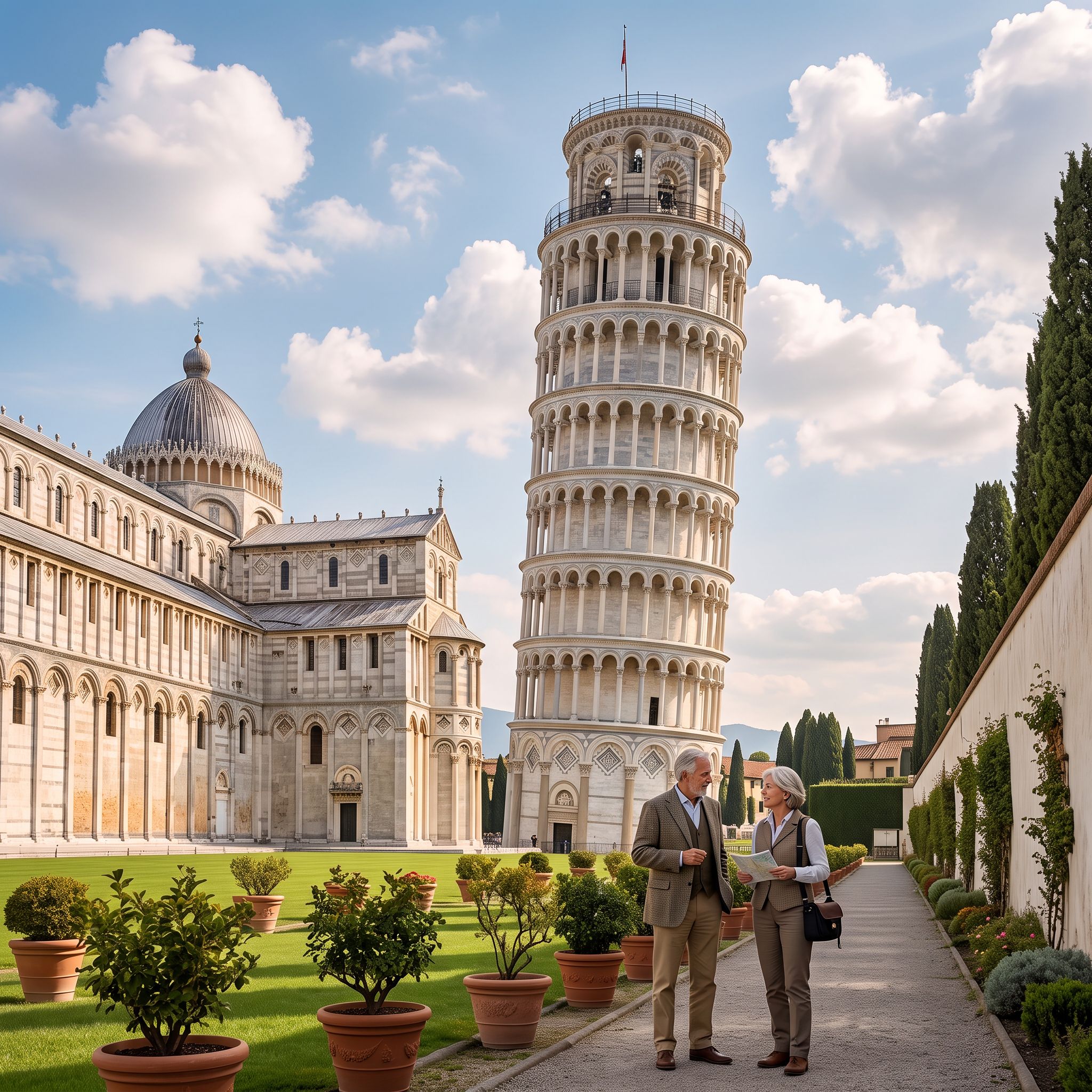
A Pisa outing works best as a half-day trip with the tower and square as the single focus, since the drive from Florence is about 99 kilometres or 65 minutes with clear roads, and the site itself rewards a slow, unhurried approach.
The Leaning Tower of Pisa is the kind of landmark that delights grandchildren precisely because it looks like it should not be standing. For grandparents, the appeal is the chance to watch that delight. The practical question is how to structure the outing so it does not exhaust either generation.
The drive from Florence's Santa Maria Novella station to Pisa's central station is 99 kilometres, about 65 minutes with clear roads and no stops. That makes a morning departure, a few hours at the square, and an early afternoon return entirely feasible. The train is an alternative worth considering, though the senior-travel guide notes that public transport in Tuscany often involves stairs at stations and not all trains are step-free, so grandparents with mobility limitations should check the specific service before booking.
The square itself, the Campo dei Miracoli, is flat and pedestrian-friendly, which suits both generations. The tower climb, with its 294 steps, is not suitable for everyone, and the official ticketing system requires booking a specific time slot in advance. For grandchildren too young to climb, or grandparents who prefer to stay at ground level, the surrounding buildings and the square itself offer plenty to see while other family members take the ascent. The key is to agree beforehand who will climb and who will stay below, so no one feels rushed or left out.
Which gardens in Tuscany are easiest for mixed-age groups?
The Medici Villa of Poggio a Caiano offers a documented garden visit with €2 admission, open Tuesday to Sunday from 8:15 to 17:00, though the garden path is described as difficult and the villa itself is accessible only by guided tour.
Gardens are often the easiest outing for grandparents with grandchildren because they allow children to move freely while adults sit and watch. The Medici Villa of Poggio a Caiano, about 20 kilometres northwest of Florence, offers a documented garden visit that suits this purpose. The garden is open Tuesday to Sunday from 8:15 a.m. to 5:00 p.m., with last admission half an hour before closing, and costs €2.00 for a full-price garden entrance ticket.
The villa itself is accessible for disabled guests, according to the official ticketing information, but the garden path is described as difficult. This is a crucial distinction: the building has access provisions, while the outdoor terrain does not. For grandparents who use a wheelchair or walking aid, the garden may present challenges that the villa does not. The property does not publish detailed step counts or surface descriptions for the garden path, so it is worth calling ahead to discuss specific needs.
Guided tours of the villa run Tuesday to Sunday at set times, 8:30, 9:30, 10:30, 11:30, 12:30, 2:30, and 3:30 p.m., with tours lasting approximately one hour and a maximum of 25 people per group. The 1:30 p.m. tour is not available. On free admission days, the first Sunday of each month and national holidays, reservations are not available, so arrive early if you plan to visit then. A combined ticket for the Medici Villa of Poggio a Caiano and the Medici Villa of Cerreto Guidi costs €10.00, while a four-villa ticket covering Petraia, the Garden of Villa di Castello, Poggio a Caiano, and Cerreto Guidi costs €16.00 and is valid for 12 months with one entry to each site.
One caution from the official ticketing information: with a yellow, orange, or red weather alert, the gardens and outdoor areas of the Regional Museum Directorate of Tuscany may be closed to the public for safety. In summer, when thunderstorms are common in the late afternoon, this is worth checking before setting out.
Which is nicer for a family trip, Siena or Florence?
Florence suits families who want museums, pizza, and gelato within a relatively flat historic centre, while Siena offers a more compact medieval experience but with steeper terrain, so the choice depends on your group's mobility and energy levels.
This is a question families ask often, and the honest answer is that the two cities offer different experiences. Florence has the larger concentration of child-friendly activities, including the museums of the University of Florence system and the accessible-museum network coordinated by Regione Toscana. Its historic centre is relatively flat, which helps when young legs tire and grandparents need to rest.
Siena, about 69 kilometres from Florence's station or roughly 65 minutes with clear roads, is more compact but hillier. The regional emergency information lists Ospedale Riuniti Senese in Siena among the area hospitals, which is reassuring for grandparents who like to know where medical help is available. The city's famous shell-shaped Piazza del Campo is a natural gathering point where children can sit on the sloping brick while adults enjoy a coffee nearby.
For a first multigenerational trip, Florence is the more forgiving base. For a second visit, or for families with older grandchildren who manage hills well, Siena rewards the extra effort. The two cities are close enough that a day trip from Florence is feasible, though the round trip with young children makes an overnight stay in Siena the more relaxed option.
When is the best time to visit Tuscany with grandchildren?
The shoulder months of April, May, June, September, and October are the most comfortable for family travel, with milder temperatures and generally less intense crowds than July and August, when Tuscany's high season peaks.
Visit Tuscany's official tourism site presents the region as having distinct experiences across spring, summer, autumn, and winter, rather than promoting a single best season. Independent climate summaries agree that the driest and warmest period is usually June to September, while November is typically the wettest month, with rainfall rising to about 114 mm compared with about 35 mm in July.
For grandparents travelling with young children, the shoulder months are the sweet spot. May offers warm days around 21°C maximum with about 67 mm of rain, while September stays warm at about 25°C maximum with 73 mm. June is drier at about 51 mm of rain and warmer at 25°C, but crowds build as the month progresses. July and August are the hottest and busiest months, with maximum temperatures around 28°C and 29°C respectively, and the high tourism season runs from mid-April to the end of September, with July and August as the peak months.
One consideration for grandparents is the summer heat. August temperatures around 29°C maximum can feel intense for older travellers and young children alike, particularly in hill towns where walking involves climbs. The cooler months of May and October, with temperatures around 21°C and 20°C respectively, are more forgiving for both generations.
How do you get around Tuscany with grandchildren?
Driving is manageable if you understand the ZTL restricted-traffic zones that protect historic centres, and regional trains offer reduced fares for children, with free travel for under-4s and reduced fares for under-12s.
Getting around Tuscany with a multigenerational group requires a transport strategy. The senior-travel guide notes that driving in the region is manageable if travellers understand the ZTL restricted-traffic zones that protect historic centres. Visit Tuscany states that visitors with limited mobility, when they have the required documentation, can access the ZTLs without restrictions, which is useful for grandparents who need to drive close to their accommodation.
Regional trains in Tuscany give children up to 4 years free travel without a seat and children up to 12 a reduced fare. This makes train travel economical for families, though the senior-travel guide cautions that public transport often involves stairs at stations and not all trains are step-free. For grandparents with mobility limitations, checking the specific service for step-free access is essential before booking.
Florence's transport network has been improving. The T2 tram extension to Piazza San Marco and Piazza della Libertà opened on 25 January 2025, improving access between the airport, the historic centre, and the north of the city. Work on the new T3 tram line to Bagno a Ripoli began in January 2025, with completion expected by the end of 2026, and the construction site affects viale Giovine Italia and viale Giannotti. Further tram and utility works were reported in early 2026 in piazza Beccaria, viale Europa, and viale Matteotti, with lane reductions and traffic detours expected through at least late February in some sections. Florence bus and tram tickets are due to rise to €2 from 1 August 2026, while the regional government said free travel would be extended to all children under 11.
For longer distances, a new trial service called Tootbus Tuscany began in March 2026, linking Florence with Siena, San Gimignano, Pisa, and Lucca. It was announced as a pilot running until 31 October 2026, which could simplify day trips for families who prefer not to drive.
What health and safety information should grandparents know?
The single emergency number for Tuscany is 112, covering police, fire, and medical emergencies, and hospitals with 24-hour emergency rooms are available across the region, though the nearest pharmacy to any specific site is not documented.
For grandparents travelling with grandchildren, knowing where to turn in a medical situation is essential. The single emergency number for Tuscany is 112, which covers police, fire, and emergency medical services. Visit Tuscany states that 112 should be used for serious medical emergencies, and its health pages note that hospitals are available in the northwest, centre, and southeast of Tuscany, with 24-hour emergency rooms. The regional emergency information lists Ospedale Riuniti Senese in Siena among the area hospitals.
For minor ailments, Visit Tuscany states that there is an extensive network of pharmacies throughout the region, some open 24 hours, with Sunday and holiday service organised by a shift system. The exact nearest pharmacy to any specific museum or garden is not documented, so it is worth noting the location of a pharmacy near your accommodation when you arrive.
Visit Tuscany's official health pages are a useful reference for planning. The regional transport information also notes that airport assistance is available at major Italian airports through the airline, which helps grandparents who need help with luggage or mobility support when flying with grandchildren.
How do you structure a realistic itinerary?
A realistic itinerary for grandparents with grandchildren builds in rest time after lunch each day, limits outings to one main destination per day, and alternates active mornings with quieter afternoons.
The families who document their Tuscany trips on travel forums consistently recommend the same structure: one main outing each morning, a proper lunch, and a rest or quiet activity in the afternoon. A week-long base in Florence or the surrounding countryside allows for day trips to Pisa, Siena, or Lucca without constant packing and unpacking.
A sample week might look like this: two days in Florence exploring the historic centre, the museums, and the gardens; a day trip to Pisa for the Leaning Tower; a day trip to Siena if the group manages hills; and a rest day at a farm-stay with animals where children can simply be children. The distances between these destinations are manageable: Florence to Pisa is 99 kilometres or about 65 minutes with clear roads, Florence to Siena is 69 kilometres or about 65 minutes with clear roads, and Florence to Lucca is 75 kilometres or about 45 minutes with clear roads.
For grandparents who prefer not to drive, the Tootbus Tuscany trial service linking Florence with Siena, San Gimignano, Pisa, and Lucca offers an alternative, though it was announced as a pilot running only until 31 October 2026. Regional trains remain the most flexible option for families, with the reduced fares for children under 12 making them economical.
For grandparents who want to explore the countryside at a gentle pace, the region offers documented options for gentle countryside walks and the best views in Tuscany, while those curious about the hill towns can consult which Tuscan hill towns are easiest underfoot. These guides complement the family-focused approach here, offering alternatives for grandparents travelling without grandchildren or for days when the group splits by interest and energy.
Visit Tuscany's official health pages and transport pages provide the most current information on medical services and getting around, and both are worth consulting as your travel dates approach. The region's commitment to family travel is documented across its official channels, from the dedicated "Tuscany with the family" section to the accessible-museum network that coordinates tailored visits for families with children. With careful planning and a realistic pace, Tuscany offers grandparents the chance to create memories that both generations will carry for years.


