
The Amalfi Coast rewards the traveller who plans around its terrain rather than against it. For visitors aged 50 to 70, the difference between a glorious week and an exhausting one comes down to choosing the right base, understanding the steps before you book, and letting boats do what buses cannot. This guide lays out how the coast is arranged, where the walking is level, and how to move between towns with your energy intact.
The coast is one of Italy's most celebrated stretches of shoreline, a vertical world of cliffside villages, lemon groves and shimmering sea. Its beauty is genuine, but so is its physical challenge. Travellers over 60 who have written about their experiences describe "lots of steps everywhere" and "poor or non-existent sidewalks," noting that people move slowly even when they are not climbing. The secret is not to fight this reality but to work with it: choose a flat base, use ferries in season, and treat Positano as a view to enjoy rather than a place to conquer on foot.
How is the coast laid out?
The Amalfi Coast runs along the southern side of the Sorrentine Peninsula in Campania, with Sorrento at its western gateway and Salerno at its eastern end. The main towns, from west to east, are Positano, Praiano, Amalfi and Ravello, with Amalfi sitting roughly at the midpoint of the coastal road.
The coast is not one continuous town but a chain of distinct villages connected by the winding SS163 Amalfitana road and, in season, by passenger ferries. Each settlement has its own character and, crucially, its own relationship with the sea and the hillside behind it. Amalfi town spreads across a valley mouth with a flat seafront and level main square. Positano climbs a near-sheer cliff. Ravello sits high above the sea, reached by a road that switchbacks up from Amalfi, about 6.9 km away, roughly 10 minutes by car with clear roads.
Sorrento, though technically on the northern side of the peninsula, functions as the practical gateway for many visitors because of its rail connection to Naples and its flat, walkable centre. From Sorrento, ferries run along the coast in season, and the road distance to Amalfi is about 31 km along the coast road, roughly 60 minutes with clear roads.
 AI-edited
Which base is best for travellers over 50?
Amalfi town and Sorrento are the two bases that travellers over 50 consistently recommend for comfort, while Positano is best treated as a day visit by boat. Ravello suits those who want quiet and views and do not mind the hilltop setting.
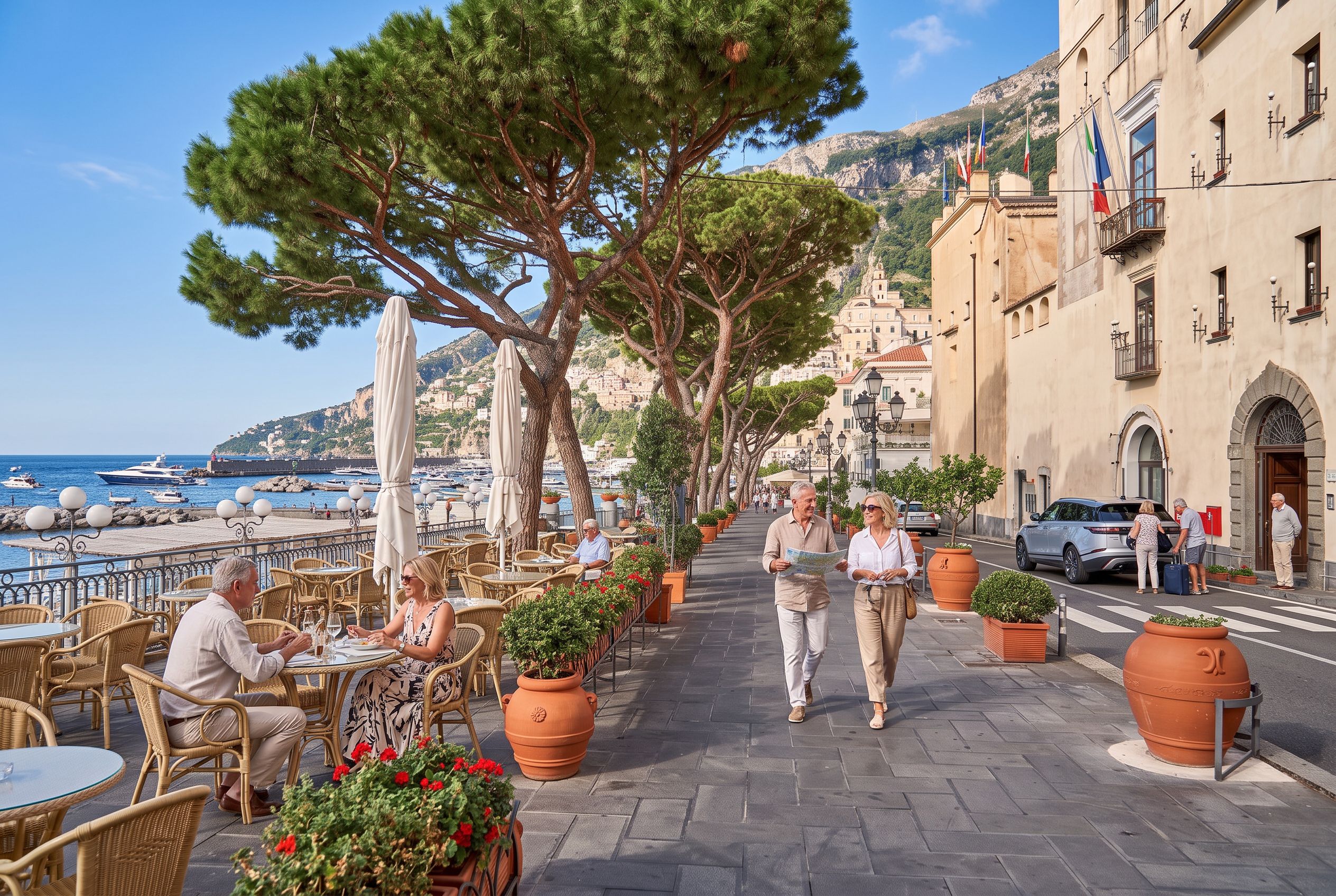
Forum discussions among older travellers return to the same conclusion again and again: the jump in comfort from Positano to Amalfi to Sorrento is significant, even though all sit on or near the same coast. Amalfi's waterfront and piazza area are manageable, which surprises people expecting the entire town to be steep. The town centre is mostly flat, with the main challenge being the cathedral stairs and the uphill street toward the paper museum.
Sorrento is described by multiple travellers as "largely flat," "relatively flat and walkable," and easier for day trips than staying in hill towns. Its centre has large flat areas, and hotels and restaurants are concentrated in walkable zones. One source notes an elevator down to the seafront from the town above, which helps those wanting to reach the marina without a long descent.
For those who prefer to stay within the coast proper, Amalfi offers the most level walking environment. Positano, by contrast, is described as built into a near-sheer cliff with staircase routes dominating movement. One source says the main beach is reached by descending over 1,000 stairs from the main road.
What is the reality of steps and steep terrain?
The coast is vertical. Steep roads, staircases and narrow cliffside streets dominate the experience in most towns, and the degree of difficulty varies sharply from one place to the next. Amalfi's seafront is flat, Sorrento's centre is mostly level, and Positano is almost entirely stairs.
Travellers who have explored the coast on foot describe a landscape where what looks like a 15-minute walk can be "15 minutes purely up and down stairs." One traveller counted 1,700 stairs on a walk from Ravello down to Minori and said they never wanted to walk back up after a few days of coastal walking.
Ravello has "a decent amount of level walking" and is "very flat" in its centre, according to travellers, but getting there usually means taxis or a bus, and the downhill stair walk to Amalfi or Atrani is steep. The Amalfi-to-Ravello route takes about an hour via stairs, and travellers advise that walking down is the better direction.
For those with limited mobility, the practical approach is to identify the flat pockets: Amalfi's seafront and Piazza Duomo, Sorrento's centre, and specific attractions like Villa Cimbrone's Terrace of Infinity, which one source describes as involving about a 700-metre walk on a flat but slightly uneven gravel path.
How do you get around by boat and bus?
Ferries are the easiest way to move between towns in season, while public buses are repeatedly described as a poor choice for mobility-limited visitors. The sea route is part of the coast's travel culture and the most comfortable way to see the shoreline.
Passenger ferries link Sorrento, Positano, Amalfi and Salerno in season, according to multiple sources. The Travelmar ferry service operates year-round, according to its timetable page. Ferries are ramp-accessed with seating near the entrance, making them easier than buses for some travellers with mobility issues, as one Rick Steves forum post notes.
Public buses, by contrast, draw consistent criticism. One report says buses are unreliable and "a nightmare in summer," while ferries run regularly and on time. A Reddit post says "Don't rely on SITA buses if you can help it" because of crowding. Another Reddit post specifically warns against buses in summer because they are unreliable and crowded, and suggests ferry use helps avoid bus "drama."
The SITA Sud / Unico Costiera system covers 20 municipalities with integrated fares, and the CMS Amalfi Coast consortium offers direct local connections with reserved seats and GPS tracking. However, one source explicitly says SITA buses have no wheelchair spaces and require stepping up. If ease of movement matters, ferry access from Amalfi, Maiori, Cetara, Positano and Salerno is a useful fallback when road traffic is heavy.
How accessible is Amalfi town itself?
Amalfi is the coast's most accessible major town, with a flat seafront, a level Piazza Duomo and a central waterfront bus stop. The town centre is mostly flat, though the areas behind the main square climb steeply by stairways, and the cathedral itself has stairs to enter.
The main piazza is flat and directly reached from the seafront road. One source counts 63 steps to the cathedral's main entrance, so visitors who cannot manage stairs should plan to admire the exterior and the square. The town rises steeply behind the centre, and the uphill street toward the paper museum is one of the main challenges, according to travellers.
Amalfi's Marina Grande beach area has taken steps toward inclusivity. Beginning in summer 2025, according to Visit Amalfi, the town introduced an equipped beach area for people with disabilities, with walkways, showers, toilets, floating chairs and a Job chair. From June to October, visitors in need can enjoy this space, and assistance is completely free of charge, entrusted to the L'Alveare Social Cooperative, which also provides orientation and organizes access.
The Comune di Amalfi also offers a transport service for elderly people and people with disabilities, delivered by Pubblica Assistenza Millenium Amalfi O.N.L.U.S., a non-profit association of social utility. This municipality service is documented on the official portal and is worth contacting before your visit if you need help moving around town.
What makes Sorrento a practical gateway?
Sorrento's centre is flat or mostly flat, with hotels and restaurants concentrated in walkable areas, and it offers the easiest access to the coast by ferry in season. Its rail connection to Naples makes it a convenient base for a longer Italian holiday.
Travellers over 50 repeatedly recommend staying in Sorrento and visiting the coast by ferry, bus or driver, which reduces repeated stair exposure and hotel moves. The town itself is described as having large flat areas and minimal elevation near the station, making it practical for short walks.
One source names accessible hotels in Sorrento with lifts and accessible rooms, though exact booking terms and cancellation policies are not documented. An elevator down to the seafront from the town above helps those wanting to reach the marina without a long descent, according to one source.
Sorrento's position as a gateway means you can base yourself there and take day trips along the coast by ferry, returning to level ground each evening. The road distance from Sorrento to Amalfi is about 31 km along the coast road, roughly 60 minutes with clear roads, but the ferry is the more comfortable option in season.
Should you stay in Positano or just visit?
Positano is best treated as a visual stop rather than a walking destination. The town is built into a near-sheer cliff, most routes are staircases, and one source describes it as effectively inaccessible for independent wheelchair users.
Positano's beauty is undeniable, and its cliff-built setting is part of its charm. But the practical reality is that almost every route within the town is stairs. One source says the main beach is reached by descending over 1,000 stairs from the main road. Even getting to buses or ferries often requires 5 to 10 minutes of stair climbing or more, according to travellers.
For travellers over 50, the sensible approach is to see Positano from the water. Ferries arrive at the harbour, and the view of the pastel houses climbing the cliff is one of the coast's most memorable sights. If you want to explore the town itself, be prepared for stairs, and consider hiring a driver for the uphill transfer if you arrive by road.
One source warns about narrow aisles on the small orange bus descending to the beach and says buses are not accessible for wheelchair users. The town's value is primarily visual rather than mobility-friendly, and planning your visit accordingly will protect your energy for the rest of the coast.
Is Ravello worth the hilltop climb?
Ravello offers quieter streets, celebrated gardens and panoramic views, but its elevated location makes access harder than Amalfi or Sorrento. The town centre itself has level walking, but getting there requires a winding road or bus ride up from the coast.
Ravello sits about 6.9 km by road from Amalfi, roughly 10 minutes with clear roads, but the drive climbs steadily. The town is high and hilltop-based, and accessibility should be checked in advance if stairs are a concern, according to one source. Travellers say Ravello has "a decent amount of level walking" and is "very flat" in its centre, which makes it manageable once you arrive.
The main attraction for many visitors is Villa Cimbrone's Terrace of Infinity, which one source says involves about a 700-metre walk on a flat but slightly uneven gravel path. The path is flat but uneven, so assistance may help for some visitors. The gardens and views are the reward for the journey up.
Travellers recommend reaching Ravello by taxi or bus rather than on foot. The downhill stair walk from Ravello to Amalfi or Atrani is steep, and the walk back up is punishing. One traveller who walked from Ravello to Minori counted 1,700 stairs and said they never wanted to walk back up after a few days of coastal walking.
What about beaches and easier seaside stops?
Marina di Praia, near Praiano, offers one of the coast's more accessible beach experiences, with a lift from the main road to the beach area and a short stair-free path. Amalfi's Marina Grande is described as the town's most accessible beach, though it is crowded in peak season.
For travellers who want to reach the water without a long staircase descent, Marina di Praia stands out. One source says the beach is reached by a lift from the main road, with a short stair-free path, and the seafront is flat. This makes it a practical choice for a seaside stop without the physical demands of Positano's main beach.
Amalfi's Marina Grande is described by Italia.it as the town's most accessible beach and easy to reach for older visitors, according to a secondary source, though it is crowded in peak season. The equipped beach area for people with disabilities, introduced in summer 2025, adds walkways, showers, toilets, floating chairs and a Job chair, with free assistance from June to October.
These accessible pockets matter because they let travellers over 50 enjoy the coast's seaside pleasures without exhausting themselves. Plan beach visits for the accessible spots, and treat the more dramatic coves as views to admire from above or from a boat.
What should you know about roads and traffic?
The coastal road, SS163 Amalfitana, is winding, narrow and congested in summer. Regional authorities have introduced traffic measures in recent years, including alternate-plate restrictions and coach bans on certain routes, and local reporting documents ongoing efforts to manage peak-season congestion.
Driving the coast yourself is not recommended for most travellers over 50. The road clings to cliffs, and parking is scarce and expensive in the towns. Regional reporting from July 2026 says the Province of Salerno banned tourist coaches, scheduled buses and heavy vehicles on SR 373 and SR 366, including the route connecting Agerola to Amalfi via Furore and Conca dei Marini, beginning 13 July 2026.
Alternate-plate restrictions applied on the SS163 Amalfitana from 30 March to 6 April 2026 and again from 24 April to 2 May 2026, between 10:00 and 18:00, with exemptions for residents of the coast's 14 municipalities, including Amalfi. In Amalfi itself, starting 1 April 2026, the municipality launched Viabilità Amica, with five posts and eight traffic assistants operating from 09:00 to 19:00 to manage vehicle flow.
Cetara and other small coastal towns can be especially affected by short-notice roadwork and bridge maintenance. Local reporting from November 2024 documented final safety works on the arch bridge in Piazza Roma, Cetara, requiring temporary closures and public-transport adjustments. If you are travelling by road, build flexibility into your schedule.
What health services and emergency numbers should you know?
The nearest hospital reference for Amalfi is the Presidio Ospedaliero Costa d'Amalfi at Via Civita 70 in Ravello, described as a first-response facility. Each main town on the coast has at least one pharmacy, and Amalfi's city centre has two. The coast is generally safe with standard tourist precautions.
Ferryhopper notes that Amalfi itself has no hospital in the city and points to the closest local health centre in the Ravello area. For medical emergencies, the recorded numbers are 112 for police and 118 for medical emergencies. Marina Amalfi lists additional local numbers: 113 for ambulance and emergency, 115 for fire, 116 for road assistance, 117 for Guardia di Finanza, and 1530 for sea rescue.
One guide notes that summer sea or helicopter response can be faster than road ambulance on the Amalfi Coast, given the winding roads and traffic. The coast is presented as broadly safe with common-sense caution against crowd theft and with faster summer rescue options by sea or helicopter.
For travellers with ongoing health conditions, it is wise to note the location of the nearest pharmacy on arrival and to carry any necessary medications with you, as pharmacy opening hours can vary, particularly outside the main season.
When is the best time to go?
The practical season runs from April to October, with the warmest month in August and the wettest in November. September and October have become the new peak months for the area, according to tourism-district data, while July and August 2025 were down 8 to 10 percent in attendance versus the previous year.
The Costa d'Amalfi tourism district reported that July and August 2025 were down 8 to 10 percent in attendance versus the previous year, while September and October were described as the new peak months, according to Il Vescovado. This shift reflects travellers seeking milder temperatures and fewer crowds.
For Amalfi municipality, monthly climate averages show January at about 12°C high and 6°C low with about 100 mm of rain, rising to July and August highs around 30°C with very low rainfall, then turning wetter in November at about 16°C high and 11°C low and about 160 mm of rain. Another climate table shows the driest month as July at about 15 mm and the wettest as November at about 191 mm.
One source says Amalfi feels less crowded in summer than smaller cliff towns because it is one of the larger towns. Another warns that Marina Grande is crowded in peak season. For travellers over 50 who want comfortable walking temperatures and manageable crowds, late September and October offer the best balance, though ferry schedules begin to reduce as the season winds down.
Are there senior fares or passes?
The SITA Sud / Unico Costiera page lists standard integrated fares and tourist-line discounts but does not document a senior tariff, and the CMS Amalfi Coast and Travelmar pages are similarly silent.
Tourist transport discounts are documented on the Unico Costiera page, including reductions on City Sightseeing and discounted or included rides on some Amalfi Coast lines for pass holders. However, these are tourist passes rather than age-based concessions.
The Amalfi Paper Museum states its own opening hours by season and day, including Monday closures in some periods, and the exact current schedule must be checked against the museum's published information because it changes through the year. The museum's own information page states seasonal opening patterns, including January and February Friday to Sunday hours and other schedules depending on the period. The page does not document senior fares.
Where reduced fares are not stated, treat them as not documented and ask at the ticket office or booking point when you arrive. The absence of a published senior fare does not mean one does not exist at the point of sale, only that it is not documented in the official materials reviewed.
How should you plan your days?
Plan around ferry schedules and level ground. Base yourself in Amalfi or Sorrento, use ferries to move between towns in season, and save your walking energy for the flat pockets: Amalfi's seafront, Sorrento's centre and Ravello's gardens once you arrive by taxi or bus.
One source recommends planning around ferry schedules and using seasonal ferries to avoid the winding bus and stairs. Ferries connect the major towns in season, making the sea route part of the travel culture and the easiest way to see the coastline.
A recurring suggestion from travellers is to pack light and use porters if needed, because stairs, transfers and uneven surfaces make bags harder than expected. Another recommendation is to pay for cars or drivers if walking is difficult, especially for Ravello or when skipping multiple transfers.
For a day on the coast, consider this pattern: morning ferry from your base to a town you want to see, a few hours of level walking in that town's accessible centre, lunch, and a ferry back in the afternoon. This approach lets you see multiple towns without exhausting yourself on stairs or waiting for crowded buses.
What else should you know before you go?
No coast-wide entry ticket or universal permit applies to the Amalfi Coast itself. Private transport is repeatedly recommended for limited mobility, especially for uphill transfers and hotel access, but exact booking conditions vary by operator and are not documented coast-wide.
The coast is a year-round region, and no official "opening season" applies to it as a whole. However, several climate guides and tourism sources indicate the most visitor-friendly period is roughly April to October, and ferry services are seasonal, so visits should be planned around the timetable.
For those who want to explore beyond the coast itself, the nearby archaeological sites of Pompeii and Herculaneum offer accessible tour options. One accessible tour operator says its private Amalfi Coast tours can be adjusted for wheelchair users, scooter users, slow walkers and able-bodied travellers, with accessible van transport between Naples, Pompeii, Sorrento, Positano and the Amalfi Coast, and step-free routes throughout that tour.
For travellers considering a broader Italian holiday, the gentle hills of Tuscany offer a different rhythm, with options like half-day walks in the Tuscan hills for active over-50s or a family guide to Tuscany with grandchildren. Those who enjoy being on the water might also appreciate sailing and watching the windsurfers at the North Lake.
For a different kind of coastal holiday, cycling Tuscany's wine country by e-bike offers level terrain and vineyard views without the stairs.
The Amalfi Coast asks visitors to slow down, choose their moments and let the sea do the work. For travellers over 50 who plan around its terrain, the reward is one of Italy's most beautiful shorelines, experienced at a pace that suits them.


