
A spa day in the Dolomites is a structured, etiquette-conscious experience rather than a loose afternoon of lounging. The region's wellness venues are concentrated in South Tyrol, where German-speaking alpine sauna culture meets Italian bathing traditions, and the two do not always agree. For travellers aged 50 to 70 planning rest and recovery rather than hiking mileage, the practical questions are straightforward: what a day pass actually covers, what you wear (or do not), how to pace yourself at altitude, and how far ahead to book. This guide sets out what the operators themselves publish, and flags plainly where they publish nothing at all.
Is there a spa in the Dolomites, Italy?
Yes. The Dolomites have both public thermal baths and hotel-based sauna and wellness areas. The best-documented public options are the Merano Thermal Baths in Merano and the Naturno Adventure Thermal Baths in Naturno, both in South Tyrol. Hotel sauna areas, such as the one at Hotel Santer in Dobbiaco, are also documented, though with fewer published details.
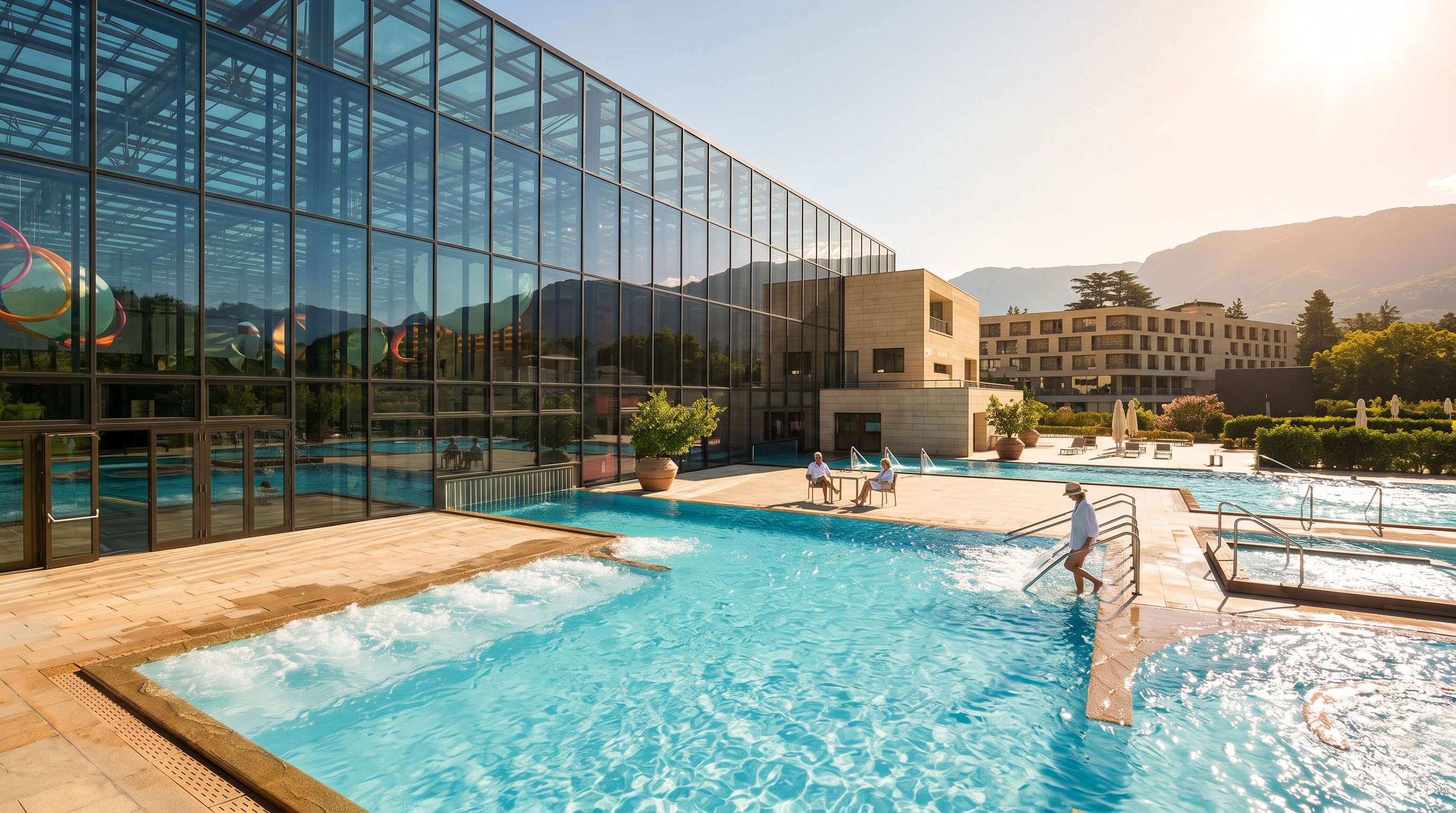
Merano Thermal Baths publishes day tickets, sauna access, a MySpa area and a thermal park with outdoor pools. Naturno Adventure Thermal Baths publishes indoor and outdoor pool options, sauna access and seasonal opening details. Hotel Santer in Dobbiaco documents a seven-sauna wellness area with posted opening hours, and Aparthotel Panorama Living Dolomites in Maranza documents private in-apartment sauna access.
Merano's operator describes thermal baths, sauna, thermal park and MySpa, but makes no therapeutic claim in the material reviewed. The same is true at Naturno. Treat the waters as restorative and pleasant, not as treatment.
What does a spa day pass actually cover?
Coverage varies by venue. At Merano Thermal Baths, a weekday day ticket costs €27 for adults and young people aged 14 to 18, and €19 for children aged 4 to 13. Weekend and public holiday rates are €29 and €21. Sauna combined with the thermal baths costs €41 on weekdays and €43 at weekends.
Those figures come from the operator's published tariff. Children under four enter free. Sauna entry is from age 14, and under-18s may enter only when accompanied by an adult.
At Naturno Adventure Thermal Baths, seniors aged 65 and over pay less than the adult rate in every listed ticket category. Weekday outdoor-pool-only entry is €8.30 for seniors, rising to €10.30 at weekends. A weekday pool combination is €14.60, and a weekend pool combination €16.60. Sauna with swimming pool is €22.00 on weekdays and €24.00 at weekends.
Those Naturno figures are the clearest senior pricing in the material reviewed. Merano's operator publishes no senior fare and no pass; it does publish a 30% discount for disabled guests on presentation of a disability card and ID.
 AI-edited
What is the sauna etiquette in South Tyrol?
South Tyrol's public saunas are textile-free. Swimsuits are not worn in the sauna itself, a towel is used on the bench, and silence is expected in both the sauna and the relaxation rooms. This is Nordic sauna practice, and it is standard rather than optional in German-speaking alpine wellness areas.
Hotel Santer's own guidance asks guests to use the sauna in its traditional way for hygiene reasons and to enter wrapped only in a towel. A South Tyrol sauna guide notes that sauna naked is standard in the region, and that anyone uncomfortable may cover themselves with a towel.
- Shower thoroughly before entering, and enter dry.
- Sit or lie on your own towel, never directly on the wood.
- Keep quiet, and close the sauna door quickly behind you.
- Avoid entering or leaving during an infusion except in an emergency.
- Leave phones and devices outside the sauna area.
- Cool down after each session and rest between rounds.
Swimwear is required in pool areas but not in the sauna and nude zones. If modesty matters to you, ask before booking whether the venue offers private spa sessions or a textile sauna option. Not every venue publishes this; where it is not documented, ask directly.
How long should each sauna session be at altitude?
Keep sessions short and rest properly between them. Guidance published for Panorama Living Dolomites advises limiting sauna sessions to 8 to 12 minutes, with no more than 15 minutes. A South Tyrol sauna guide recommends 8 to 10 minutes on a first visit, followed by a 30 to 45 minute rest before the next round.
Altitude is the reason for the caution. The Dolomites sit high enough that most visitors notice the difference on stairs and slopes, and heat stress compounds it. The published safety guidance is consistent: hydrate, rest, avoid alcohol in the sauna area, and do not sauna if you are feverish or unwell.
For a rest-and-wellness trip rather than an activity trip, a sensible shape to the day is two or three sauna rounds in the morning, a long lunch, pool time in the early afternoon, and a final rest period before dinner. That is a rhythm the venues support; it is not a schedule any of them publishes.
When is it quietest, and when should I book?
Merano Thermal Baths recommends a reservation, which the operator states guarantees access. For treatment bookings in the wider South Tyrol spa area, one source recommends the quieter window between 4 pm and 6 pm. Neither Merano nor Naturno publishes a calmest-time schedule.
The 4 pm to 6 pm guidance comes from Dolce Vita Hotels and applies to treatment bookings in the broader South Tyrol and Dolomites area, not specifically to Merano or Naturno. Treat it as a general steer rather than a venue rule.
Season matters more than hour. The area's visitor pattern runs in two peaks: summer for hiking and panoramic travel, and winter for skiing and snow activities, according to the Dolomites tourism board. Spa days booked inside those peaks will be busier. For travellers seeking calm rather than hiking intensity, June, September and winter spa stays are the most supportive periods, per the Dolomites destination guide.
May, October and November are the weakest months for full mountain-service availability, with limited lift operations and some accommodation closures. If your spa day depends on a lift or a seasonal venue, avoid those months.
What accessibility information is available?
Merano Thermal Baths is documented as welcoming wheelchair users, and offers a 30% discount for disabled guests on presentation of a disability card and ID. The same discount extends to an accompanying person where the disability level is 100% and documented. Accessibility details for Naturno, Hotel Santer and Panorama Living are not documented.
Merano's operator does not publish step counts, lift locations, handrail details or accessible route descriptions. Naturno's operator publishes prices and seasonal openings but no accessibility information. The same silence applies to the hotel-based saunas at Hotel Santer and Panorama Living.
Silence is not evidence either way. It means the detail is not published, and the only reliable course is to contact the venue directly before booking and describe your specific requirements. Ask about entrance thresholds, pool access, changing facilities and the route between the changing rooms and the water.
For wider trip planning around mobility and comfort, our guide to Dolomites hotels where comfort comes first covers the accommodation side in more detail.
What about changing rooms and what to bring?
Bring a bathrobe, slippers and your own sauna towel. Spa etiquette guidance for the region says to wear a bathrobe and slippers in public spa areas, and to use towels or sauna towels in saunas and steam rooms. Towels and bathrobes are provided at some venues and not at others.
At Forestis Dolomites, guests have reported that bathrobes and towels were provided for the saunas. That is guest feedback rather than an operator statement, and it applies to that property only.
The safe assumption for a day visit is to bring your own. A large towel serves double duty as a sauna seat cover and a drying towel, and a second smaller towel is useful for the pool.
Changing-room accessibility is not documented for any of the four venues. If you need a private changing space or a larger cubicle, ask when you book.
How do I get to a Dolomites spa day?
Merano and Naturno sit in South Tyrol, reachable by road and by regional transport. The Seiser Alm cable car, which serves the Alpe di Siusi area, runs from Seis am Schlern and takes about 15 minutes.
The Seiser Alm cable car is a useful reference point for how lift-assisted access works in the region. In summer 2026 it operates from May 22 to November 2, from 8:00 am to 6:00 pm, extended to 7:00 pm from June 7 to September 6, 2026, according to the official Seiser Alm cable car page. A senior fare (born 1960 or earlier) is €18 one way and €26 return, and the eligible person must be present with valid ID.
Note that during the operating season the road up to the Seiser Alm is closed to cars from 9:00 am to 5:00 pm. Parking at the valley station is free in the large outdoor car park or paid in the garages.
For the wider picture on arriving in the region, see our guide to airports, trains and transfers in the Dolomites.
What should I know before booking?
Book ahead where the operator recommends it, confirm what is included, and check seasonal closures. Merano Thermal Baths recommends a reservation that guarantees access. Naturno Adventure Thermal Baths schedules maintenance works in May and September, and its outdoor pool is accessible from 30 May 2026.
Merano's thermal baths are open every day all year round, and the outdoor thermal park is accessible from mid-May to mid-September. No closing day is documented.
Cancellation terms are not documented for Merano, Naturno, Hotel Santer or Panorama Living. Assistance services beyond Merano's disability discount policy are not documented either. Neither are senior fares at Merano, passes at any venue, or emergency numbers for the specific spa sites.
For general emergencies in the Dolomites, one safety guide states that the single European emergency number is 112. A Val Gardena guide lists a medical service in Selva di Val Gardena on 0471 794266, available daily in the main tourist season and closed on Wednesday.
If you are building a wider trip around the spa day, our selection of the finest Dolomites experiences for the over-50s covers what else is worth your time. And if you want to understand the valleys you are passing through, the guide to mountain villages and Ladin culture explains the German, Italian and Ladin layers that shape how each spa operates.
How should I pace a spa day at altitude?
Treat the day as rest, not as a schedule to complete. Two or three short sauna rounds, a proper lunch, pool time and a long rest is a shape the venues support. Hydrate throughout, avoid alcohol in the sauna area, and do not sauna if you are unwell or feverish.
The published safety guidance is consistent across sources: rest, quiet, hydration, showering before sauna use, and no smartphones or alcohol in the sauna area. A South Tyrol sauna guide adds that you should cool down properly and rest between sessions, and not sauna if feverish or unwell.
What they do document is that the region's wellness venues are built around rest, and that the etiquette exists to protect it. Silence in the sauna and relaxation rooms is not a suggestion; it is the operating norm.
For a spa day specifically, the calmest approach is to arrive outside peak hours, take the sauna in short rounds, eat properly rather than lightly, and leave before you are tired. The venues are set up for exactly that.


