
The Dolomites reward a certain kind of traveller: the one who wants the high scenery without the high price in effort. Across the range, the best-documented options for visitors aged 50 to 70 are lift-assisted viewpoints, gentle meadow paths and short walks to a mountain hut, rather than long ascents. The UNESCO Dolomites foundation counts 36 trails accessible to people with limited mobility, including older visitors, and 13 panoramic viewpoints reached by fully accessible lift systems. That is the framework for everything below.
This guide covers five standout experiences across the range: the Alpe di Siusi meadows, the Sella massif, a cable-car summit, an Alpine lake and a mountain-hut lunch. Each entry sets out the effort involved, where to sit, and how to dodge the busiest hours. Hotels and full-day hikes are covered in their own dedicated guides.
Why do the Dolomites suit travellers over 50?
The Dolomites work for older travellers because the lift network does the climbing. A cable car or gondola can put you at 2,000 metres or more, with marked paths, benches and huts at the top. The UNESCO foundation's accessible trail network spans nine mountain systems, so the choice is wide rather than concentrated in one valley.
The region is not uniformly easy. The UNESCO accessibility project publishes detailed technical information sheets in English, German and Italian so that walkers can analyse a route and judge for themselves whether they can complete it. That self-assessment tool is the single most useful planning document for this age group, and it is free to consult.
Terrain varies sharply between valleys. The Kronplatz authority advises checking the route description, elevation profile and current trail conditions before setting out, which is sensible practice anywhere in the range. Forum reports from walkers in their sixties describe averaging nine to eleven miles a day on itineraries they had assumed would be moderate. Choosing lift-assisted loops rather than point-to-point routes is the recurring advice from that group.
Is the Alpe di Siusi good for a gentle day out?
Yes. The Seiser Alm, as it is known in German, is the largest high alpine meadow in Europe, and its cable car is fully accessible, with cabins taking up to 16 passengers. Barrier-free paths cross the meadow, and accessible toilets sit at key stations and villages. It is the strongest single option for a leisurely day at altitude.
The meadow sits above Siusi and Castelrotto in South Tyrol. The cable car removes the climb entirely, and once up, the terrain is open grassland rather than rocky ground. The Seiser Alm tourism authority states that blind visitors, visitors with 100% disability and wheelchair users ride the cable car free of charge; blind and visually impaired visitors can also use public transport free with appropriate ID.
For the last kilometres from a railway or coach hub, the Südtirol Transfer shuttle can be booked as a barrier-free service on request. That removes the car from the equation entirely, which matters if you would rather not drive mountain roads.
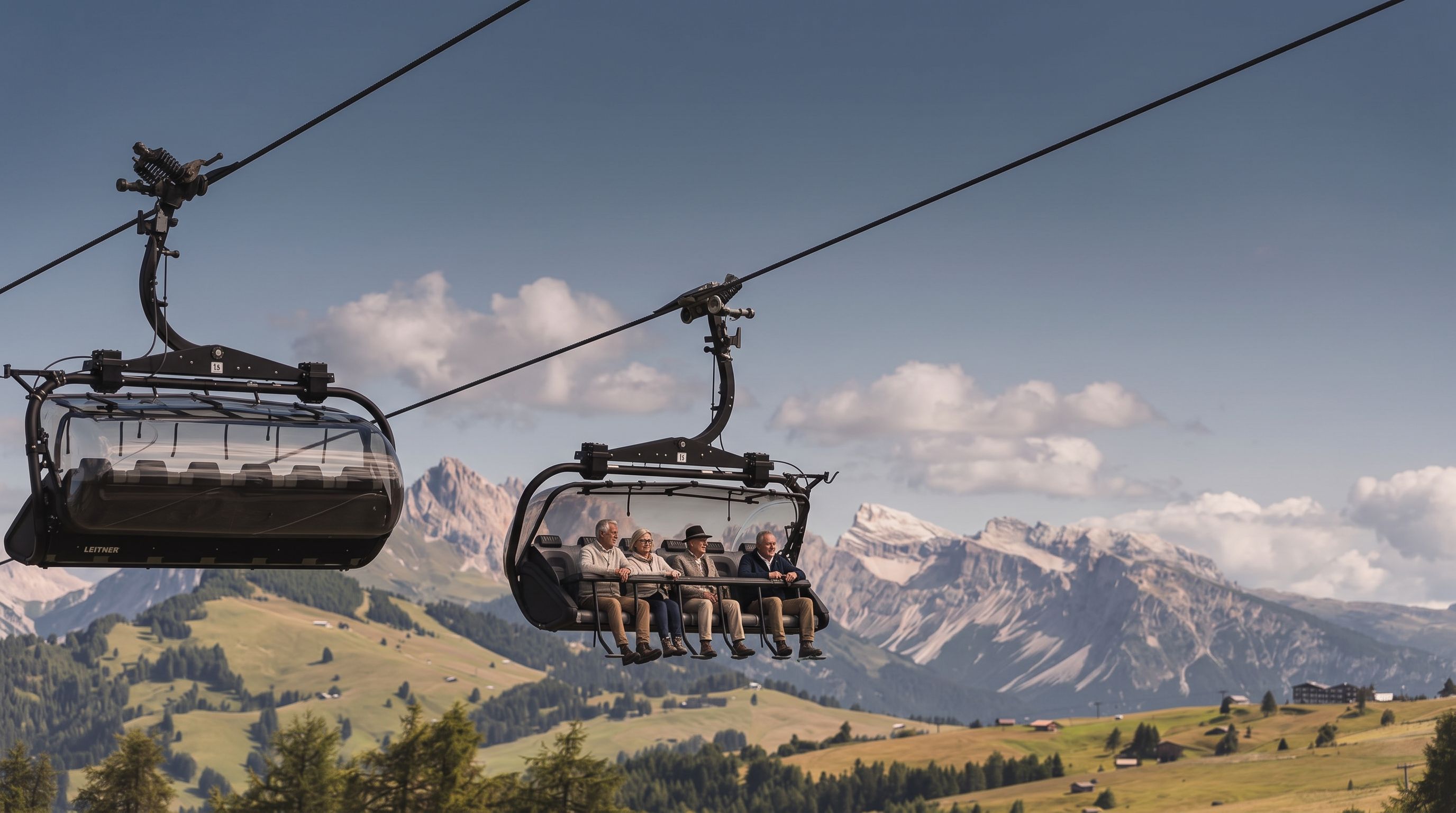 AI-edited
Seating is the easy part here. Benches line the paths, and the meadow huts have terraces facing the Schlern massif. Arrive on the first or second cable-car departure of the morning. Coach groups tend to reach the meadow mid-morning, and the paths around the top station are at their most crowded between roughly 10am and 2pm. An early start also means calmer light for photographs and a free choice of terrace table at lunch.
Can you see the Sella massif without climbing it?
Yes. The Sella is a plateau rather than a peak, and the passes around it are reached by road. The Ladin Jëuf de Sela, known in German as the Sellajoch, sits at 2,218 metres and is a viewpoint in its own right. You look at the massif rather than stand on it, which suits most visitors perfectly well.
The four passes around the Sella (Sella, Gardena, Pordoi and Campolongo) form a loop that drivers and bus passengers can complete in a morning. Each pass has parking, a viewpoint and at least one hut or hotel with a terrace. The Sella itself rises as a wall of rock above them, and the geology is the point: the UNESCO listing recognises the property for the history of the Earth recorded in its rock.
Effort here is measured in steps from a car park, not in elevation gain. The passes sit above 2,000 metres, so the air is thinner than at valley level, and a short walk can feel longer than the distance suggests. Take the first ten minutes slowly.
Busiest hours on the pass roads run from late morning through mid-afternoon in July and August. Early morning and after 4pm are quieter, and the light on the Sella's south wall is better in the late afternoon in any case. If you are using public transport rather than a car, the valley bus networks connect the passes, and the practical guide to airports, trains and transfers sets out how the valleys link up.
Which cable-car summit should you choose?
Two are well documented for easy access. The Seiser Alm gondola, covered above, and the Plose gondola above Brixen, which sits seven kilometres by car from the town and takes strollers. The Plose lift closes at 5:00 pm. For a wider choice of lifts, Val Gardena's Gardena Card covers all 17 lift facilities in the valley for three or six consecutive days.
The Gardena Card is valid from the moment you first scan it, and covers three or six consecutive days; bike transport is not included in the price. Val Gardena's own accessibility page notes that many lifts reach high viewpoints, and that benches line the promenades and higher trails for rest breaks.
On the Plose, the gondola is stroller-friendly, and the operator recommends a rough-terrain stroller for the WoodyWalk and other unpaved trails. Mountaincarts run only on Tuesdays, Thursdays and Sundays. The Plose hut has 68 beds in private rooms with en-suite bathrooms and shared dormitories of six to eight beds, if you want to stay up rather than ride down.
| Lift or pass | Documented detail | Condition |
|---|---|---|
| Seiser Alm gondola | Cabins for up to 16 passengers; fully accessible | Free for blind, 100% disabled and wheelchair-using visitors |
| Gardena Card | All 17 lift facilities in Val Gardena | Three or six consecutive days from first scan; bike transport excluded |
| Plose gondola | 7 km by car from Brixen; strollers permitted | Closes at 5:00 pm |
For a broader pass, the Dolomiti Supersummer Card covers more than 100 lift facilities across the range, according to Val Gardena tourism. Reduced fares and reduced-mobility assistance for the Val Gardena lift network are not documented on the retrieved pages; ask at the valley's lift ticket offices before you buy.
Which Alpine lake is worth the stop?
Carezza, known in German as Karersee, is the lake most often reached on a short walk from a road, with a circular path around the water.
The lake sits below the Rosengarten and takes its colour from the dolomite rock beneath. It is a short stop rather than a day out, which makes it a good pairing with a pass drive or a cable-car morning.
Parking fills early in high summer. The lake is at its quietest before 9am and after 5pm. Coach traffic peaks in the middle of the day, and the path around the water is narrow enough that a group of forty changes the experience entirely.
If you want a lake with documented accessible facilities, the Odles Slow Dolomites area lists the Natural pond Lüsen with wheelchair and stroller access, along with the Zannes nature trail and the Puez-Geisler Visitor Centre. That area's mobility and accessibility page sets out which trails, museums and accommodation have accessible facilities.
What is a mountain-hut lunch actually like?
A hut lunch is the simplest pleasure in the Dolomites. You walk a short, marked path to a rifugio, sit on a terrace, and eat dumplings, barley soup or apple strudel while the massif does the entertaining. The effort is the walk in, which can be as little as twenty minutes from a lift station.
Huts in the Dolomites are working mountain businesses, not restaurants with a view. Service is brisk at peak lunch, roughly 12.30pm to 2pm, and tables on the terrace go first. Arriving at 11.30am or after 2pm gets you a seat and a calmer kitchen.
Carry cash in euros as a default. Altitude affects appetite and hydration; drink more water than you would at valley level, and take the walk back slowly.
Huts open with the season. The dolomites.com travel guide states the main summer season runs June to September and winter runs December to March, and warns that May, October and November can bring limited lift operations and accommodation closures. A separate hiking-season source puts the easiest walking window at 20 June to 20 September, when snow is least likely and huts and lifts are running.
When should you avoid the busiest hours?
Plan around two daily peaks: roughly 10am to 2pm for coach groups at headline viewpoints, and 12.30pm to 2pm for hut lunches. Early morning and late afternoon are consistently quieter. In July and August, the difference between 8am and 11am at any major viewpoint is substantial.
The clearest hard figure on crowding comes from the Tre Cime access road to Rifugio Auronzo, which recorded about 110,000 entries over 160 opening days in 2025, with peaks above 800 cars a day, according to a 2026 report on overtourism in the Dolomites. The municipality of Auronzo has set a daily cap of around 700 vehicles. That figure applies to the Tre Cime corridor specifically, not the whole range, but it shows how concentrated demand can be at a single access point.
Season matters as much as hour. The dolomites.com guide warns that May, October and November bring limited lift operations and accommodation closures, so a shoulder-season trip needs checking against the specific lift you plan to use. Exact opening seasons and maintenance-closure calendars for the Val Gardena lift network, Seiser Alm/Gröden and Plose are not documented on the retrieved pages; confirm with the operator before booking travel.
What about pharmacies, hospitals and emergencies?
Emergency numbers are well documented. The official Dolomiti health and safety guide gives 118 as the emergency number, with emergency rooms and first-aid points open 24 hours a day, seven days a week in the ULSS1 Dolomiti network. The Sciliar area and Val Gardena both publish 112 for urgent medical emergencies.
Pharmacies are documented at municipality level in the Sciliar area: Schlern Pharmacy in Castelrotto, Vitalis Pharmacy in Siusi, Marien Pharmacy in Fiè and Alpenfarma Pharmacy in Alpe di Siusi. The same source lists Hospital Bressanone at 30 to 35 kilometres and Hospital Bolzano at 35 to 40 kilometres as the nearest hospitals for that area.
For Ortisei in Val Gardena, Pharmacy Sella at Reziaplatz 73B is named as the nearest pharmacy, with Bressanone and Bolzano again the nearest hospitals. The operations centre can activate helicopter rescue when needed, according to the official health and safety guide.
Nearest pharmacies and medical help for the other named places in this guide are not documented. Check locally on arrival, and note that the SOS EU Alp app is named by the Seiser Alm tourist office as an emergency reporting option alongside 112.
Are there senior or disability discounts?
Some, and they are specific. In the Seiser Alm/Gröden ski area, seniors born in 1960 or earlier receive a 10% discount on day or multi-day ski passes and must present ID. Guests with a certified disability of at least 51% receive a 20% discount on day, multi-day and season passes. Both apply to winter ski passes.
Val Gardena's accessibility page states that blind or visually impaired people may use public transport free of charge with appropriate ID, and that disabled visitors with 51% or more certified disability receive discounts on certain ski passes, though the discount varies by company and facility. Contact the sales outlet first.
For the Seiser Alm/Gröden area, the 2026/2027 winter season runs from 4 December 2026 to 4 April 2027, with sales points open from 2 December 2026 to 4 April 2027. Self-service machines at the bottom station of the Seiser Alm gondola accept card payment only. Free ski passes for children under eight are available only at sales counters, since they must be linked to an accompanying adult's pass.
Senior fares for the Plose cable cars are not documented on the operator's page. Reduced-mobility assistance beyond the Seiser Alm disability discount is not documented either. Ask at the ticket office.
How should you plan the days?
Build each day around one lift, one short walk and one long lunch. That rhythm suits both the active and the leisurely: the active can add a second loop from the same top station, and the leisurely can sit it out on a terrace. Base in one valley rather than moving hotels.
Ortisei comes up repeatedly in forum reports from travellers in their sixties and seventies as an easy base, with lifts on the doorstep. Val Gardena's accessibility page notes barrier-free accommodation and restaurants, many lifts reaching high viewpoints, and benches along promenades and higher trails. The guide to Dolomites hotels where comfort comes first covers the accommodation side in detail.
Pack for cold evenings even in high summer. A trip report from walkers aged 63 to 66 in late August and early September recorded daytime temperatures of 55 to 70°F and evening temperatures of 30 to 50°F depending on elevation. Afternoon thunderstorms are common in summer, so plan walks for the morning.
If you want to add a cultural half-day, the guide to the mountain villages and Ladin culture covers the valleys' three-language heritage, and the roundup of Alpine spa hotels covers recovery days. For the broader accessible trail network, the official accessible Dolomites route map lists 36 routes of varying difficulty and 13 accessible viewpoints across the nine mountain systems.


