
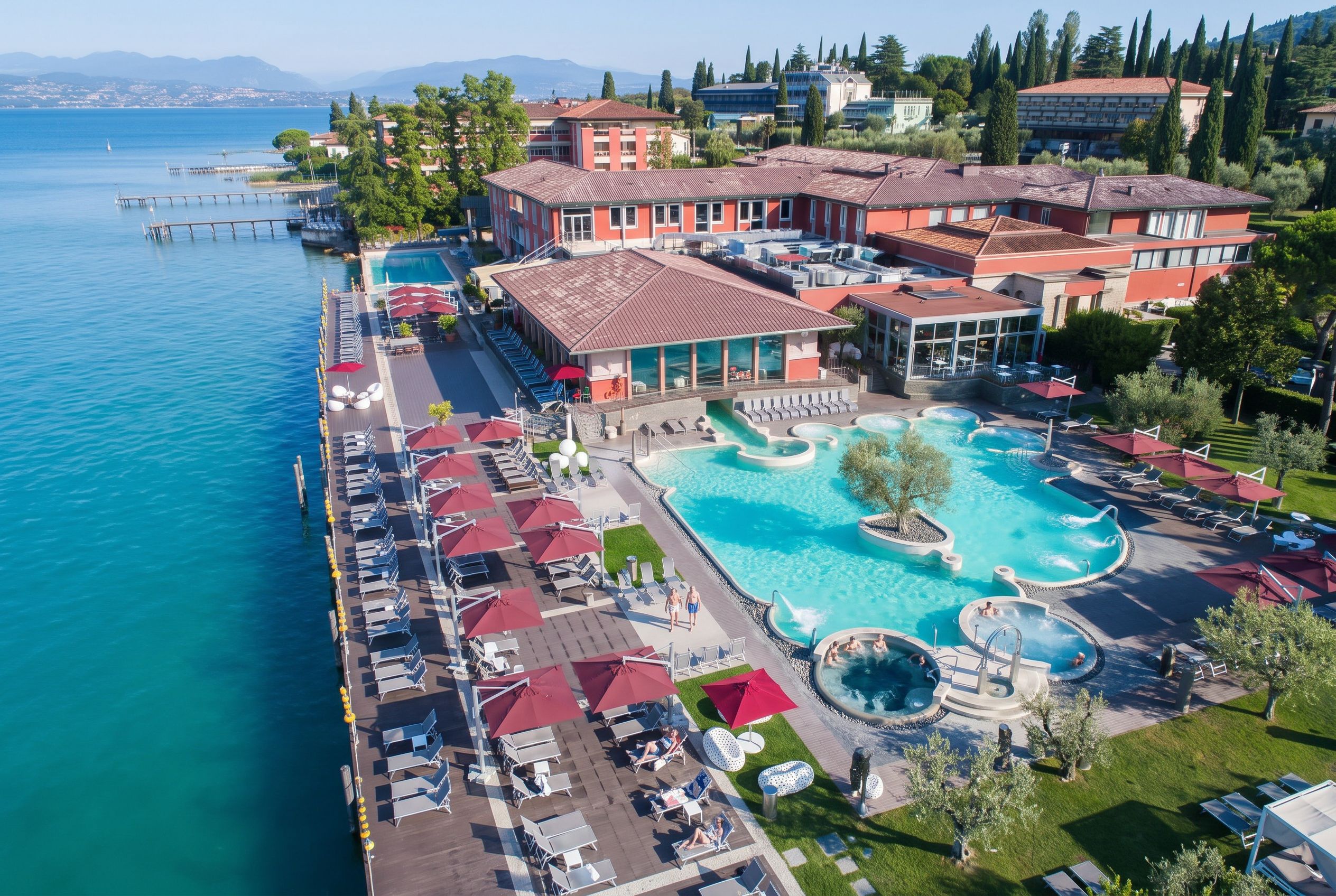
The idea is simple: a morning of warm, mineral-rich water, an unhurried lunch, and an afternoon of quiet rest. Sirmione, on the southern shore of Lake Garda, has drawn visitors to its sulphur springs since Roman times, and a day at Terme di Sirmione – SPA & Thermal Garden, the spa that many visitors still know by its former name Aquaria, remains one of the most restorative ways to spend time here. For travellers aged 50 to 70, the appeal is not just the water itself, but the pace of the day—slow, deliberate, and entirely yours.
This guide walks you through the practical details: how to book, what is included, how to manage the changing rooms and pools, and how to choose the calmest hours. You will leave knowing exactly what to expect, so the only thing left to do is exhale.
 AI-edited
Why choose Sirmione for a thermal spa day?
Sirmione’s sulphur springs have been prized since Roman times for their therapeutic qualities, and today the town’s SPA & Thermal Garden offers one of the most well-organised spa experiences on Lake Garda. The water is warm, mineral-rich, and associated with comfort, relaxation, and circulation support.
The thermal waters here emerge at around 69°C at the Boiola spring beneath the lake and are cooled for bathing: 34°C in the pools in summer, 36°C in winter, with the freshwater infinity pool at 30°C. Children from two and a half to sixteen are admitted with an adult, so this is not an adults-only spa. The operator classifies the water as sulphurous and salso-bromo-iodine — sulphur, salt, bromide and iodine — which is why it has historically been used for respiratory, rheumatic and skin conditions. The Comune di Sirmione’s accessibility page states that "all pedestrian routes are suitable for wheelchairs" in the town, which matters more here than at most spa towns because the walk in is part of the visit.
What makes Sirmione special is the setting. The spa sits at the far end of the historic centre, a few minutes’ walk beyond the Scaliger Castle, and the old town itself is flat, paved, and largely car-free. Two practical details for slower walkers: the Comune has accessible public toilets at Piazzale Monte Baldo, in Viale Marconi and at the Lido Galeazzi beach, and a winch at Piazzale Porto helps passengers with reduced mobility board the excursion boats. Guest reviews often describe the short walk from the castle to the spa as part of the experience rather than a chore.
How do I book and what does it cost?
Booking is required every day, not only at weekends. As of August 2026 Terme di Sirmione states that online booking is always necessary and that entry without it is not guaranteed; the phone lines are down because of an IT problem, so the website is the only reliable channel. The standard admission is five hours and costs €44 from Monday to Thursday and €58 from Friday to Sunday.
The official booking page is straightforward, and you can choose between morning, afternoon, or evening entry. Evening admissions run until closing time and cost less than the daytime tickets: €34 from Sunday to Thursday and €40 on Friday and Saturday, with a €19 "Last Time" ticket for the final stretch. A bathing cap and towel come with every admission, whatever the time of day; a bathrobe is only included if the specific ticket says so, and otherwise can be rented on site.
| Entry Type | Price Range | Included |
|---|---|---|
| Spa&Saunas Short (2 hours) | €25 | Every day; pools, saunas, relaxation areas |
| Spa&Saunas 5 hours | €44 Mon–Thu / €58 Fri–Sun | The standard admission; all pools, saunas, Water Journey rooms |
| Spa&Saunas All Day | €86 | Mon–Fri only; includes a wellness salad with soft drink |
| Evening admission | €34 Sun–Thu / €40 Fri–Sat | Entry until closing time |
Treatments such as massages or thermal-mud rituals are priced separately, from around €45 to €90 for a 25- to 50-minute session as of August 2026. Check whether your treatment includes spa access, as this is often a separate charge. The on-site bistro serves light meals and drinks, charged to an electronic wristband and settled on exit.
If you are comparing options, the comfort-first hotel guide on this site covers nearby stays that include thermal access, but for a day visit, the SPA & Thermal Garden itself is the most convenient choice.
What is included in a standard spa pass?
A standard admission includes the indoor and outdoor thermal pools, the whirlpools and vascular path, three Finnish saunas plus a Roman bath, steam bath and hammam, the freshwater infinity pool over the lake, and the relaxation rooms including the four Water Journey rooms. A bathing cap and towel come with every ticket; a swimsuit and flip-flops do not and are compulsory.
Recent guests consistently report that the facilities are well-maintained and the staff friendly. As of 17 August 2026, the SPA & Thermal Garden holds a 4.5/5 rating on Google from over 11,800 reviews, with particular praise for the massage therapists and the outdoor thermal pool. One Google reviewer wrote in August 2021, “The view on the Garda lake is great, especially during the sunset. There are many kinds of pools and the ones on the outside are beautiful.”
What is not included: a swimsuit and flip-flops. Both are compulsory and are not provided with the ticket, so bring them. Flip-flops must be worn everywhere except in the pools and saunas, which you enter barefoot. Your first towel is included; an extra towel or bathrobe can be rented at reception. The lockers are spacious enough for a day bag, and the changing rooms are clean, though some guests note they can feel busy at peak times.
How accessible are the changing rooms and pools?
Terme di Sirmione publishes no accessibility statement of its own, so treat any promise with care. What is documented is narrower: the operator’s Google business listing records a wheelchair-accessible entrance and a wheelchair-accessible restroom, and the Comune di Sirmione states that all pedestrian routes in the town are suitable for wheelchairs. Nothing published covers lifts, pool hoists or the width of the changing cubicles, so ask when you book if that matters to you.
Vehicle access to the historic centre around the castle is restricted, which is why the walk in matters. The spa lies at the far end of the village: about 750 metres from the ferry landing at Piazza Carducci, which the operator describes as a ten-minute walk through the historic centre. There is no parking at the spa. Drivers use the Piazzale Monte Baldo car park, 700 to 800 metres from the village, and the operator allows a further fifteen minutes on foot from there. Accessible parking bays are in Piazzale Porto, with more reserved spaces in Piazza Porto Valentino.
The layout is worth knowing in advance: the facility has a ground floor and one upper floor, with the men’s changing rooms on the ground floor and the women’s upstairs. The showers and hairdryers are in the changing rooms. Pool depths are published — 90 to 120 centimetres indoors, 140 centimetres in the outdoor pool, 90 centimetres in the vascular path — and the operator publishes a recommended time in each. None of the published material describes how you get in and out of the water, which is the one detail a walking-aid user most needs before setting out.
How should I pace my spa day?
The standard admission is five hours, and that is the length the spa is built around. There is a two-hour Short admission for €25 and an All Day ticket for €86 on weekdays if you want longer; the combination of warm pools, heat rooms, rest areas, and a light lunch fills five hours without any rushing. Start with the outdoor pool, move to the saunas, rest, then repeat.
The operator’s own guidance points the same way: about twenty minutes in each pool, fifteen to twenty in a sauna plus a cooling phase, and the day treated as rest rather than sightseeing. A review left on Google in November 2025 put it this way: “Loved the thermal pools, selection of saunas and relaxation areas … Could easily spend a day there.” The rhythm that works well:
- 9:30–10:00: Arrive, change, and settle into the outdoor thermal pool.
- 10:00–11:30: Alternate between the outdoor pool and the indoor whirlpools.
- 11:30–12:30: Sauna and steam room session, with a cool shower between.
- 12:30–13:30: Light lunch at the bistro.
- 13:30–14:30: Relaxation area, Water Journey rooms, and a final soak — the five-hour admission runs out at 14:30 if you arrived at 9:30.
Three-hour admissions exist only inside the treatment packages; on its own the choice is two hours or five. The five-hour ticket is the one that allows proper rest between heat sessions, and the operator itself recommends about twenty minutes in each pool. If you book a massage, schedule it mid-afternoon so you can float afterwards.
What is the etiquette inside the spa?
The house rules ask guests to be "silent and discreet" and require mobile phones to be set to silent mode; deliberately photographing other guests is forbidden. Swimwear is required in all pools, flip-flops everywhere except in the pools and saunas, and going topless is not allowed.
Guest reviews frequently mention how much the quiet matters, and the rules back that up. You move between areas in swimwear, with flip-flops on and a bathrobe if your ticket includes one. Smoking is banned throughout, including the outdoor relaxation areas, and only moderate alcohol consumption is allowed.
In the saunas, it is customary to sit on a towel and to shower before entering. The steam room is quieter still, and the relaxation rooms—the Salt Room, the Music Room, the Starry Sky Room and the four Water Journey rooms—are designed for near-silent rest. If you are unsure of any rule, the staff are friendly and happy to guide you.
“Beautiful and relaxing spot in Sirmione, we were a group of 4 and we loved it! Towels, bathrobe, and cuff provided (no slippers and swimsuit, so make sure you bring your own). Staff is super friendly and attentive.” — a guest wrote on Google in August 2024
When is the calmest time to visit?
Monday to Thursday mornings are the quietest, and the operator prices them that way: €44 against €58 from Friday to Sunday. The spa opens at 9:00 every day, and the first two hours are noticeably calmer than the afternoon. Every day needs a booking, weekends simply fill up first.
The operator’s rules put it plainly: "In order to ensure the respect of actual national health regulations the number of clients present in the facility simultaneously is reduced: thus online booking is always required." If your schedule is flexible, aim for a Tuesday or Wednesday morning. Spring and late autumn are calmer than high summer. The turn of the year is the exception: Terme di Sirmione charges holiday rates and stays open until midnight from 25 December to 6 January.
Evening admission is another option for a quieter experience, and it costs less than a daytime ticket: €34 from Sunday to Thursday, €40 on Friday and Saturday, with entry allowed right up to closing time. The building closes at 22:00 from Sunday to Thursday and at midnight on Friday and Saturday, but the pools, saunas and relaxation areas shut half an hour earlier.
For a broader view of the region’s highlights, including the best times to visit the lake’s other attractions, see our guide to Lake Garda’s highlights for the over-50s.
What should I bring and what should I leave behind?
Bring flip-flops, a swimsuit and a book. Leave makeup at home—you will be in and out of water all day—and plan for wet hair until the end. Leave food and drink at home too: the house rules do not allow anything bought outside to be consumed inside, and there is a bistro on site instead.
The basics matter more than anything decorative. The spa provides a bathing cap, a towel, lockers, showers and hairdryers; flip-flops and a swimsuit are your job. An extra towel or a bathrobe can be rented at reception, and one recent Google review sums up what to expect: "Towels, bathrobe, and cuff provided (no slippers and swimsuit, so make sure you bring your own)."
Staying hydrated matters when you move between hot pools and saunas, and the only way to do it here is the bistro: the house rules forbid food and drink brought in from outside. Everything is charged to the electronic wristband you get at reception and settled when you leave, so you carry no cash. The bistro is open Sunday to Thursday 9:00–21:30 and Friday to Saturday 9:00–23:00.
For getting to Sirmione itself, including transport options from the airports and train stations, our guide to getting to Lake Garda covers the practical details.
What should I do after the spa?
Take a slow walk through Sirmione’s old town, look in at the Grotte di Catullo just beyond the spa, or sit by the lakefront with a coffee. The ferry landing is about 750 metres away through the pedestrian centre, so a boat trip or a lakeside stroll pairs easily with the visit.
The old town is flat and largely car-free, with the lakefront paths within easy reach. The Grotte di Catullo are closer than most people expect: the spa entrance sits at the end of the village, just before the rise up to the Roman ruins. The Comune notes that the Grotte and their museum are accessible, while the Scaligero Castle is not accessible inside. The town’s gardens and villas are covered in our gardens, villas, and castles guide.
If you are staying overnight, choose a hotel close to the spa so you do not add transport stress after a long thermal session. One option is Hotel Sirmione Terme, known until recently as the Sirmione e Promessi Sposi. It stands at Piazza Castello 19 inside the historic village, a few steps from the Scaligero Castle, and has its own thermal spa. Guests who book through the hotel’s own website get 30 per cent off a five-hour admission to the SPA & Thermal Garden from Monday to Thursday. It holds 4.3/5 on Google from 1,714 reviews, checked in August 2026.
What if I want a different thermal experience?
For a quieter, more park-like setting, Parco Termale del Garda (Villa dei Cedri) at Piazza di Sopra 4 in Colà di Lazise, on the Veneto shore, spreads thermal lakes and pools across a thirteen-acre park. For a smaller wellness centre, Garda Thermae in Arco, in Trentino, is another option.
These alternatives are covered in their own dedicated guides on this site, but a brief note: at Villa dei Cedri the main thermal lake and the swimming pool are held at about 33°C, and only the smaller pools set inside the lake reach 37–39°C. The operator describes its water as alkaline with anti-inflammatory effects. Garda Thermae, at Via Linfano 52 in Arco on the Trentino side, sells day-spa packages. Both are worth considering if you want to explore beyond Sirmione.
Any final practicalities I should know?
As of August 2026, the phone lines at Terme di Sirmione are unavailable because of an IT problem, so book online. Standard hours are Sunday–Thursday 9:00–22:00 and Friday–Saturday 9:00–midnight, but they change on public holidays, and the pools, relaxation areas and sauna circuit close 30 minutes before the building does.
Neither the pharmacy nor a hospital is within walking distance. Sirmione’s only pharmacy, the Farmacia Comunale at Via Verona 47, is around five kilometres away on the mainland part of the municipality, and there is no hospital in Sirmione at all: the Comune points to ASST del Garda in Desenzano, the Ospedale Pederzoli in Peschiera del Garda and the Spedali Civili in Brescia. Dial 112 for an emergency and 116117 for non-urgent medical advice. The operator asks guests to consult their doctor first if they have cancer, heart disease or a history of cardiac surgery, high blood pressure, epilepsy or seizures, a condition affecting balance, or chronic respiratory disease such as asthma or emphysema.
The spa’s address is Piazza Don A. Piatti 1, in the historic centre of Sirmione, and the contact-centre number is +39 030 916044, though online booking is the reliable route while the phone lines are down. The ferry landing is about 750 metres away on foot; the Piazzale Monte Baldo car park is 700 to 800 metres from the village, with a further fifteen-minute walk in.


