
Lake Garda rewards the traveller who plans the approach as carefully as the stay. The lake stretches 51.5 kilometres from the flat southern shore to the dramatic northern fjords, and your arrival strategy depends entirely on which shore you call home. For travellers aged 50 to 70, the difference between a smooth arrival and a stressful one often comes down to choosing the right airport, the right train station, and the right final transfer. This guide cuts through the confusion with practical, door-to-lake routes that respect your energy, your luggage, and your patience.
Which airport should I fly into?
Verona Villafranca (VRN) is your first choice for the southern and eastern shores, roughly 35 minutes by road to Peschiera and about 50 minutes to Garda town. Bergamo (BGY) works well for the western shore via Desenzano, while Milan Malpensa (MXP) and Venice Marco Polo (VCE) are viable but require longer, multi-leg journeys that many seniors find tiring.
Verona Airport is the closest gateway to Lake Garda, and the 2026 season brings a significant improvement: ATV bus line 482 runs hourly from the airport from 29 March 2026, direct to Villafranca, Valeggio, Peschiera and San Benedetto. For Lazise, Bardolino, Garda town, Torri del Benaco, Brenzone and Malcesine you change at Peschiera or San Benedetto onto line 483, and line 484 carries on from Malcesine through Torbole to Riva del Garda. Even with that change, it removes the detour into Verona city centre with luggage.
For those flying into Bergamo, the journey involves the Airport Bus to Bergamo station, then a train to Desenzano del Garda-Sirmione with a change on the way. The total trip runs about two hours. Malpensa requires the Malpensa Express to Milano Centrale, then a regional train to Desenzano or Peschiera — allow three hours minimum. Venice Marco Polo involves a bus or train to Venezia Mestre, then a train across the Veneto plain, roughly two and a half hours in total.
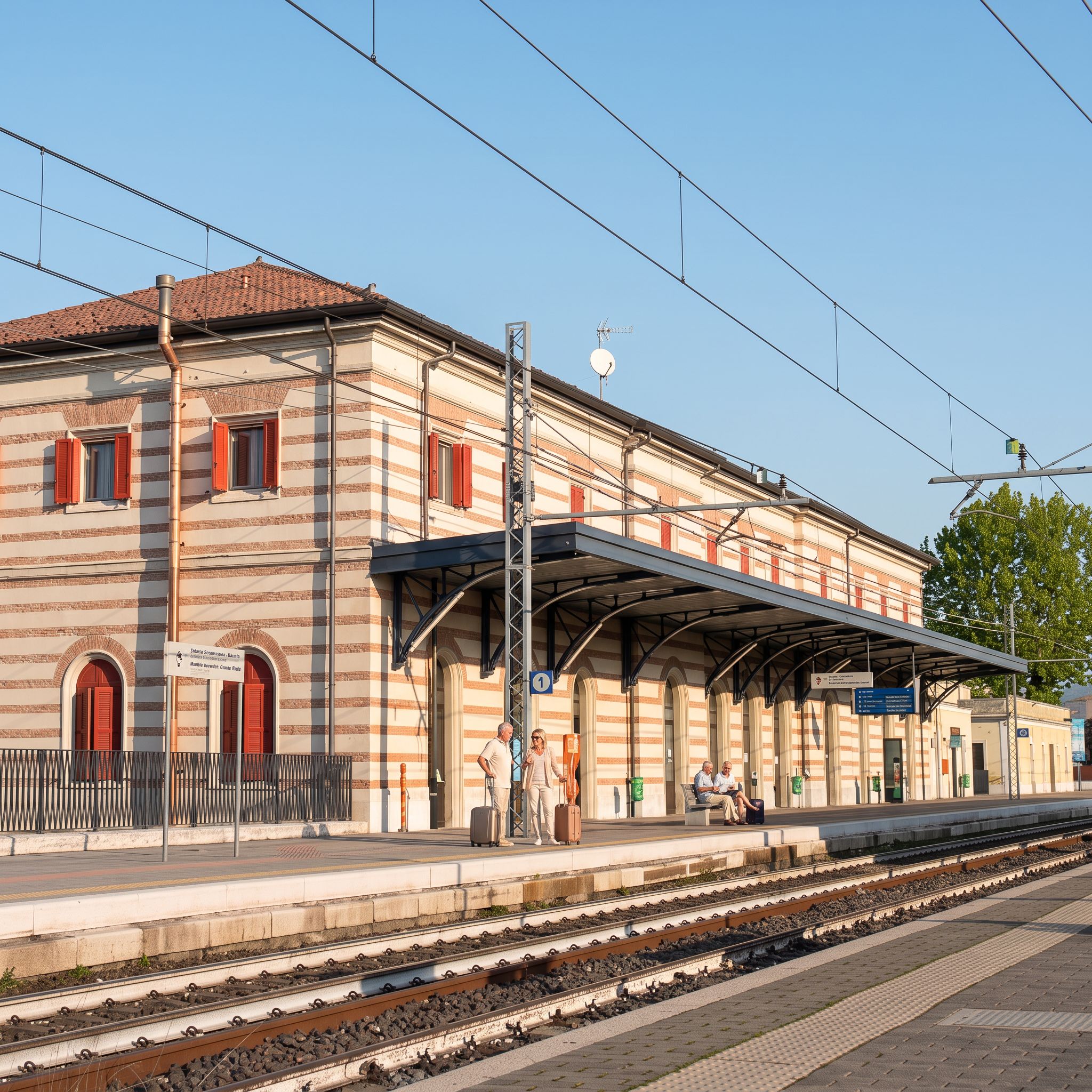 AI-edited
How do I get from Verona Airport to the lake?
You have two solid options: ATV bus line 482 to Peschiera and San Benedetto, changing there onto line 483 for Lazise, Bardolino and Garda town, or the Airlink 199 shuttle to Verona Porta Nuova station followed by a regional train to the southern shore. The bus needs fewer decisions; the train is faster once you factor in waiting times.
ATV publishes line 482 as running hourly from 29 March 2026, and Verona Airport describes it as a local public transport line active during the summer season, so it is not a year-round connection. Between them, lines 482, 483 and 484 drop you in the centre of each eastern-shore town, typically within walking distance of hotels and the lakefront promenade.
The train alternative requires the Airlink 199 shuttle from the airport to Verona Porta Nuova, then a regional train to Peschiera del Garda or Desenzano. ATV puts the shuttle at 15 minutes and runs it every 20 minutes daily, at €7.00 for a ticket valid 75 minutes from validation; the train onwards takes 13 to 16 minutes to Peschiera and 19 to 25 to Desenzano. Neither station, though, publishes a plain statement that every platform is reachable without steps, so treat step-free access as something to verify rather than assume.
Which of the two suits you better depends on where you are staying rather than on which is objectively faster. The bus chain puts you down in the centre of the eastern-shore towns, close to the hotels and the promenade, and asks one change of you. The train wins on speed but ends at one of the two southern stations with a transfer still ahead. If your hotel is in Bardolino or Garda town, the bus usually wins; if it is in Sirmione or Peschiera itself, the train does.
Which train station should I use: Peschiera or Desenzano?
Peschiera del Garda suits the eastern shore and the ferry network; Desenzano del Garda-Sirmione serves the western shore and offers more frequent intercity connections from Milan and Venice. Both are on the main Milan–Venice rail corridor, so you cannot go wrong with either for southern-lake access.
The railway line hugs the southern shore of Lake Garda, which means the train serves only the southern towns. If you are staying in Limone, Riva del Garda, or Malcesine in the north, you will need to continue by bus, ferry, or taxi after alighting. Forum travellers repeatedly advise that the rail network is a southern-lake tool, not a whole-lake solution.
| Factor | Peschiera del Garda | Desenzano del Garda-Sirmione |
|---|---|---|
| Walk to ferry dock | About 0.9 km, roughly 15 minutes | About 1.5 km, roughly 20 minutes |
| Train frequency from Verona | Hourly regional | Hourly regional + intercity |
| Direct buses to lake towns | Lines 164, 483 | RegioLink 204, every 30 min 07:00–23:00 |
| Step-free platform access | Not published as guaranteed | Not published as guaranteed |
| Taxi availability at station | Usually present | Usually present |
Peschiera is often recommended because of its excellent ferry connections. The walk from the station to the ferry dock takes about 15 minutes along flat, paved streets — manageable with light luggage, but worth factoring in if you have mobility concerns. Desenzano, meanwhile, has been strengthened as a rail gateway by Lombardy regional authorities, with bus connections timed to trains on the RE6 Milan Centrale–Verona Porta Nuova corridor.
For those heading to the western shore towns like Salò or Gardone Riviera, Desenzano is the better choice. Half-hourly buses connect Desenzano station to Salò, making it a seamless transfer. For eastern shore destinations like Bardolino or Garda town, Peschiera is your station.
Is the bus network reliable for reaching the lake?
Yes, for the southern and eastern shores. ATV lines 163, 164, 166, 184 and 185 connect Verona with lakeside towns, with line 164 being the main Verona–Peschiera–Lazise–Bardolino–Garda service. Line 482 from the airport adds a direct seasonal option that many seniors find invaluable.
The bus network is strongest on the eastern and southern shores, where the terrain is flat and the roads follow the lake. Buses run regularly through the day, though frequencies drop in the shoulder seasons. From Verona Porta Nuova bus station, line 164 departs roughly every 30–60 minutes depending on the time of year.
One caveat: the far north of the lake is less directly served, though it is not cut off. ATV's line 483 runs the eastern shore from Peschiera up to Malcesine, and line 484 continues from Malcesine through Torbole to Riva del Garda, so the north is reachable on buses alone. The alternative is a train to Rovereto and a connecting bus across to Riva. Either way it is a multi-leg journey, which is why a pre-booked private transfer earns its cost more easily in the north than in the south.
What about Milan's airports — Bergamo or Malpensa?
Bergamo (BGY) is the better Milan-area option for Lake Garda, but the train to Desenzano is never direct: you change at Treviglio, Rovato or Brescia, and the quickest connections take about 90 minutes. Malpensa (MXP) requires a change in Milano Centrale and adds at least an hour to the journey, making it a last-resort choice for most senior travellers.
From Bergamo Airport, take the Airport Bus to Bergamo station — ATB runs it daily every 20 minutes — then catch a regional train towards Brescia and change for the Verona-bound service. Desenzano del Garda-Sirmione is the main stop for the western lake. Allow about two hours door-to-station, and rather more in the middle of the day, when the connections are looser.
Malpensa is more complicated. The Malpensa Express runs to Milano Centrale in about 50 minutes, then you need to find the regional train platforms for the Verona-bound service. This involves navigating one of Italy's busiest stations, which can be overwhelming with luggage. Forum travellers on Fodor's consistently advise against driving from Malpensa to the lake, recommending the fast train from Desenzano to Milano Centrale plus the Malpensa Express instead.
If you have an early morning flight, consider staying at an airport hotel the night before; it removes the stress of a same-day transfer and gives you a relaxed final evening. At Bergamo the obvious candidate is the NH Orio al Serio Airport, which sits opposite the terminal — but the property itself describes the connection as a 15-minute walk through an underground passageway, or a shuttle ride, which is a different proposition at six in the morning with two suitcases.
Is Venice Marco Polo a practical option?
Venice Marco Polo (VCE) works for the eastern shore, but it is not the easiest gateway. The journey involves an ACTV or ATVO bus to Venezia Mestre station — the airport's boats serve Venice itself, not Mestre — then a train to Peschiera or Desenzano, totalling roughly two and a half hours. Use it only if you are combining Lake Garda with a Venice visit.
The train from Venezia Mestre to Peschiera del Garda runs along the main Milan–Venice corridor, so frequencies are good, and the fastest services do it in about an hour and forty minutes without a change. The challenge is the airport-to-station leg: ATVO's published summer timetable puts the airport to Mestre railway station at 20 to 25 minutes, and you need to factor in waiting time and luggage handling on top.
For travellers combining Venice and Lake Garda, the train is straightforward. But as a sole arrival airport, Marco Polo adds complexity, and the awkward stretch is the first leg rather than the rail journey: you clear the terminal, find the bus lanes outside Arrivals, ride to Mestre, and only then reach a platform. Three handovers of the luggage before the holiday has started.
If you do arrive at Marco Polo, consider spending your first night in Venice itself, then taking a morning train to the lake. This breaks the journey into manageable segments and lets you enjoy two destinations without a marathon transfer day.
What is the easiest last-mile transfer from station to hotel?
For most southern and eastern lake towns, a short taxi ride from the station to your hotel costs in the region of €10–€20 outside peak season and is worth every euro if you have luggage or mobility concerns. Pre-book a private transfer for the northern lake, where taxis are scarce and distances are longer.
Taxis are generally available at Peschiera and Desenzano stations, but availability drops in the evenings and on Sundays. Uber's own list of Italian cities does cover several Garda towns — Peschiera del Garda, Desenzano, Sirmione, Lazise and Bardolino among them — so the app is worth having installed; cover thins out quickly beyond them, and in the smaller villages a car at short notice is not something to count on. Pre-booking is always the safer option.
Private transfer companies offer door-to-door service from any airport or station to your hotel. Costs vary by operator and time of day and climb in peak season, but as a rough guide expect €60–€90 for a Verona Airport to Garda town transfer, and €120–€180 for a Bergamo Airport transfer. For groups of three or four, this often works out cheaper than multiple train and bus tickets.
How should I handle luggage on transfer days?
Pack light and book hotels with lifts. A wheeled suitcase of 20–23 kg is manageable on trains and buses, but cobblestones, station stairs, and ferry gangways will test your patience. Consider a backpack-style carry-on for the final leg if you are changing transport modes.
Platform access at Peschiera and Desenzano depends on lifts and ramps whose availability RFI publishes station by station rather than guaranteeing, and the walk from platform to street can involve slopes and uneven surfaces. Buses have luggage racks but require you to lift your bag up a step. On the ferries, Navigazione Laghi puts the boarding gangway at a minimum of 80 centimetres wide with a non-slip surface, and states that its gradient varies with the level of the lake — which is exactly why boarding feels steep on a low-water day.
Lifts matter more than star ratings on a transfer day, and the useful question is narrower than it looks. Wording such as "lift to all floors" can still leave a top floor served only by stairs, or a few steps between the entrance and the lift itself. Ask the property where the steps are rather than whether there is a lift, and ask about ground-floor rooms if you have significant mobility concerns.
For the northern lake, where you will likely need a bus or taxi after the train, packing light becomes essential. Several forum users recommend a small daypack for medication, water, and a phone power bank during transfer days, keeping your main luggage wheeled and manageable.
Are there senior discounts on transport?
Lake ferries carry a reduced senior fare on their ordinary sailings, and Trenord gives travellers 65 and over 20 per cent off single tickets on Lombardy's regional tariff. Verona's ATV buses do not advertise an age-based discount. Check the operator's current tariff before booking, as policies change.
Navigazione Laghi lists a reduced senior fare in the tariff in force since 1 April 2026 — on the whole-lake day pass it is about a fifth off the adult price. It applies to the ordinary scheduled sailings; the supplement for the fast services is charged separately at the full rate. One catch worth knowing before you queue: the contactless NAVITAP readers cannot apply reductions at all, so a discounted ticket has to be bought at a ticket office. The lake ferry system is covered in depth in our separate guide, but the southern lake towns are well connected by boat, which makes it a genuine transport option rather than only an excursion.
For trains there are two separate schemes. Trenitalia's Carta Argento covers travellers over 60 on the Frecce and Intercity services. On the regional side, Trenord states that people aged 65 and over can buy single tickets at 20 per cent off the Lombardy Regional Unified Tariff — which applies to journeys within Lombardy, so Milan or Brescia to Desenzano qualifies, but the continuation to Peschiera, over the border in the Veneto, does not. ATV buses do not advertise senior discounts, so budget for standard fares there.
One practical tip: buy train tickets in advance through the Trenitalia app or website. Regional tickets are valid for any train on the route that day, so you do not need to commit to a specific departure time. This flexibility is valuable when you are coordinating airport arrivals and hotel check-in times.
How accessible are the stations and paths?
Step-free platform access at Peschiera and Desenzano rests on lifts and ramps that RFI reports on day by day rather than guarantees, so check its station status before you travel; the southern lake's flat promenades are the easiest walking for seniors. The eastern shore is mixed with rolling terrain, while the northern lake is the most demanding with steeper, rockier sections.
Lake Garda is not a single continuous easy promenade. The southern lake, around Sirmione and Peschiera, offers flat lakeside walking with periodic benches. The eastern shore around Bardolino and Garda town has gentle hills and some cobblestones. The northern lake near Riva del Garda features steeper trails that can be challenging for those with limited mobility.
On accessibility, the ferry operator is the source worth reading. Navigazione Laghi states that all its vessels and the principal landing stages have been fitted with stepless ramps that remove the step between pontoon and gangway, and that more than 55,000 passengers with disabilities travelled on its boats in 2025. The same page is candid that not every landing stage is easy to use, and that boarding can be restricted by the master on the day if the lake is rough. Visit Brescia makes no accessibility claim of its own for Garda; it points readers to that operator page instead.
For health needs, two hospital emergency departments cover the eastern shore around Garda town: the Pronto Soccorso at the Ospedale P. Pederzoli in Peschiera del Garda, at Via Monte Baldo 24, and the Pronto Soccorso at the Ospedale Orlandi in Bussolengo, inland towards Verona. Both are open around the clock. Pederzoli is a private hospital, but it is accredited with Italy's national health service and runs as a presidio ospedaliero of ULSS 9 Scaligera, and it states that admission through its emergency department is free for patients covered by that service. The hospital further up the shore at Malcesine is a rehabilitation facility with no Pronto Soccorso of its own; what it does have is a punto di primo intervento, a first-aid point run under the emergency department at Villafranca — worth knowing before you assume the nearest sign for "ospedale" is the right one. Larger towns such as Desenzano and Bardolino have several pharmacies. For urgent emergencies, call 112, the European emergency number.
"The hotel is located within a short, easy walk to the harbour which is the focal point of the village" — a guest wrote on Google in August 2026 about a hotel in Garda town.
What should I pack for transfer days?
Supportive walking shoes with good grip, light layers, sun protection, a compact rain layer, and a small daypack are the essentials. If you are mobility-sensitive, bring a trekking pole or folding cane, and consider a lightweight seat pad for promenades with limited rest spots.
- Supportive walking shoes — cobblestones, lakeside paths, and uneven trails demand good grip
- Light layers — warm lake days, cooler evenings, and breezy ferry crossings
- Sun protection — hat, sunglasses, sunscreen, and a refillable water bottle
- Compact rain layer — wet stone and trail sections become slippery
- Small daypack — for medication, water, and a phone power bank
- Mobility aids — trekking pole or folding cane if needed
Summer at Lake Garda can be hotter than expected. One family report from May warned that peak summer would be too hot for anything except lounging indoors, and the area gets very crowded as the week progresses. If you are travelling in July or August, plan your outdoor activities for the morning and early evening, and use the midday hours for lunch, rest, or a visit to one of the lake's thermal baths and spa hotels.
For those planning to explore the lake's cultural attractions, our guide to the gardens, villas and castles of Lake Garda offers accessible options that pair well with your transfer-day planning.
When is the best time for an easy arrival?
May, June, and September offer the best balance of pleasant weather, manageable crowds, and full transport schedules. July and August are hot and crowded, while October through April sees reduced ferry and bus services.
The direct airport bus line 482 starts on 29 March 2026, and Verona Airport describes it as a service running through the summer season. Neither the airport nor ATV publishes an end date, so check before you count on it late in the year. Ferry services also run on reduced winter schedules, so if you are travelling outside the main season, verify that your planned connections are operating.
Spring and autumn shoulder seasons are ideal for seniors: temperatures are comfortable for walking, crowds are thinner, and accommodation prices are lower. The lake's Mediterranean-influenced climate means even October can offer warm afternoons, though evenings require a light jacket.
For those combining Lake Garda with other Italian destinations, our complete guide to Lake Garda for travellers over 50 covers multi-destination itineraries and broader planning considerations.
Which lakeside base is easiest for arrivals?
Peschiera del Garda and Desenzano offer the easiest arrivals thanks to their train stations and ferry connections. Garda town and Bardolino are well served by buses and are quieter bases for a relaxed stay. For the western shore, Salò is a charming option with good bus links from Desenzano.
Peschiera is the most practical base for first-time visitors, with its station, ferry dock, and bus connections all within a 15-minute walk. The town itself is compact and walkable, with a historic centre surrounded by Venetian walls and a lakeside promenade that is flat and well-maintained.
Desenzano offers a similar convenience for the western shore, with the added benefit of intercity train connections that make day trips to Milan or Venice straightforward — Milan Centrale is under an hour on the fastest regional services. The town has a lively atmosphere, particularly around the harbour, but the station sits about 1.5 kilometres back from the water, a good twenty minutes on foot. With luggage, that is a leg to take by taxi or on the RegioLink 204 bus.
For those prioritising comfort and quiet, our guide to the best comfort hotels on Lake Garda highlights properties with lifts, accessible rooms, and strong breakfast service — all factors that matter when you are arriving after a long journey.
Recent guest reviews consistently praise hotels that are quiet yet convenient. Reviewers consistently describe the quietest hotels in Garda town as those close to the lake but away from the main tourist route, and they single out properties near the bus station for their easy onward connections. When booking, ask about room location relative to the road and any nearby bars or restaurants, as noise can affect sleep quality.
As of August 2026, the public transport stop at Peschiera del Garda holds a 4.3/5 rating on Google from 398 reviews. What makes Peschiera unusual is the geography of the interchange itself: station, ferry dock and bus stops all sit within about a kilometre of each other, so changing between them stays a walk rather than a cross-town journey.
For the timetables themselves rather than estimates, ATV publishes its Lake Garda lines and fares as downloadable schedules, the 482, 483 and 484 among them, listed service by service.
If you are planning to explore beyond the southern shore, the lake ferry system — covered in its own dedicated guide — connects the major towns and offers a scenic alternative to road transport. From Peschiera the boats run the length of the lake to Riva del Garda at the northern end — a long crossing rather than a quick hop, and one of the best views of the lake's dramatic scenery. Navigazione Lago di Garda splits the year into several timetables; the summer one for the Desenzano–Peschiera–Riva boats and fast services runs from 16 May to 4 October 2026, and the sailing times are only in that timetable.
"Garda town is a beautiful base with a plethora of restaurants, shops, easy transportation around the lake (bus, car, bike or boat) and amazing vistas" — one Google reviewer put it that way in August 2026.
For those arriving from Milan or Venice, the train journey itself is part of the experience. The Milan–Verona corridor runs through the Po Valley, with glimpses of the Alps on clear days. The final approach to the lake, as the train curves south of the water, builds anticipation for the stay ahead.
One final note on taxis: they are available but not abundant. Pre-book your return transfer to the airport at least 24 hours in advance, especially for early morning flights. Several forum users recommend staying near the airport on your final night if you have a very early departure, particularly from Malpensa or Venice Marco Polo.
With the right planning, getting to Lake Garda is straightforward. Choose Verona for the easiest access, use the rail corridor for the southern shore and the 482/483 bus chain for the eastern one, and pre-book your last-mile transfer. The lake itself will do the rest — rewarding you with some of Italy's most beautiful scenery and most relaxed pace of life.


