
A restorative spa day in Venice is not a matter of finding a thermal spring in the historic centre, because the city has none. What Venice offers is a small number of hotel spas and day spas on its islands, reached by boat rather than on foot, plus the option of travelling to the thermal town of Abano Terme on the mainland. For travellers aged 50 to 70 who want rest and wellness between sightseeing, the practical question is not which spa is best, since no official ranking exists, but which one fits the amount of walking and boat travel you are prepared to do.
Venice's historic centre is documented by the Comune di Venezia as only partly accessible, with designated accessible routes and some areas not served by public transport at all, so a low-walking spa day is best built around vaporetto-linked routes and assistance booked in advance. The city's own accessible Venice map classifies parts of the city as fully accessible by vaporetto, some as reachable by motoscafo or a facilitated bridge, and some as not accessible by public transport. That map is the single most useful document to read before you book anything.
Is there a thermal spa in Venice itself?
No thermal spring operates in Venice's historic centre. The classic thermal-water experience near Venice is in the Veneto plain around Abano Terme, a town near Padova known for its thermal mud and pools. Within Venice, spa access is generally tied to a hotel or a day spa on an island, reached by boat.
The distinction matters for planning. Thermal water, mud therapy and medical spa programmes are documented at Abano Terme properties such as Hotel Terme Venezia, Hotel Terme Paradiso, Hotel President Terme and Hotel Mioni Pezzato. In Venice proper, the documented options are hotel and day spas, and the city's official health pages record no spa accreditation for Venice itself. The major recorded designation for Venice is heritage and protection status, not a thermal cure.
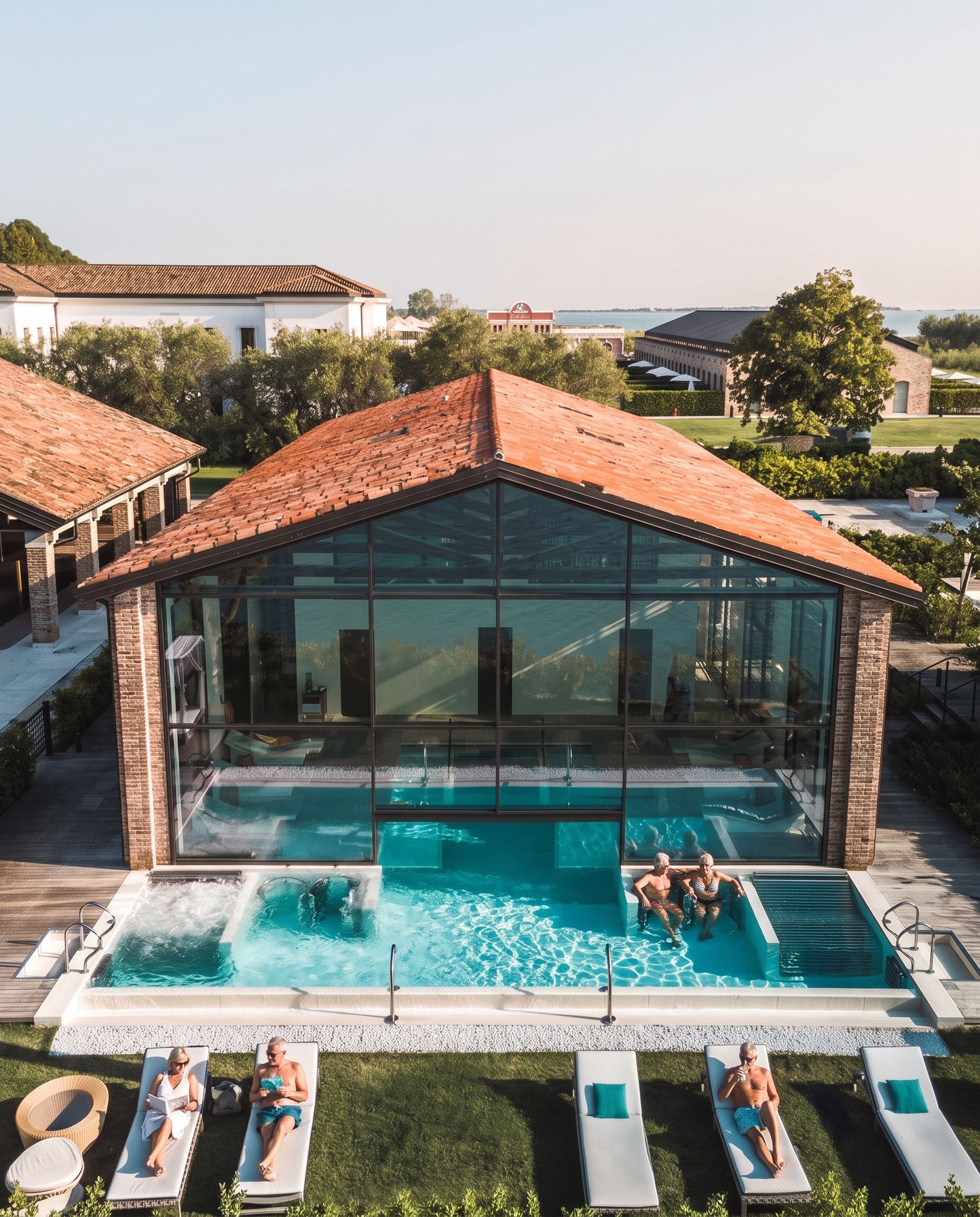
For a spa day inside the lagoon, the JW Venice Spa at the JW Marriott Venice Resort & Spa on Isola delle Rose is the option with the clearest published detail. It offers day spa access, treatment-only services, a vitality pool, a fitness room, relaxation zones and dedicated indoor relaxation areas for bad weather. The spa menu PDF states that robes, slippers and towels are provided.
How do I get to a Venice spa without a long walk?
By boat, not on foot. The JW Venice Spa runs a complimentary shuttle boat from its private dock at St Mark's Square, which removes most walking from the journey.
The shuttle is the single most useful transport fact for anyone managing distance. Rather than crossing the city to a vaporetto stop and then walking to a jetty, you board at St Mark's Square and arrive at the resort's own dock.
For the wider journey into the city, the airport and station connections are well documented, and our guide to getting to Venice by airport, train and water covers the arrival legs in detail. Once in the city, waterbus services have special boarding arrangements for wheelchair users at selected stops, including booked assistance for some late-evening Rialto services, according to the Comune di Venezia. Assistance for disabled passengers should be requested no later than 48 hours before departure. Trams, the people mover and waterborne craft are equipped for wheelchair users.
If you are staying overnight and comfort is the priority, our guide to where to stay in Venice when comfort comes first sets out what to look for in a hotel base.
 AI-edited
What does a spa day in Venice actually include?
Expect a wellness circuit rather than a thermal cure: pools, sauna or steam, relaxation areas, and treatments booked separately. The Garden Space in Venice lists a hydromassage pool, Finnish sauna, steam bath, Scottish shower, ice waterfall, emotional tunnel, reading area with Wi-Fi and a herbal tea corner, plus massages and treatments.
That list is typical of the Venetian day-spa model. You move through warm water, heat, cold and rest, then take a treatment if you have booked one. The JW Venice Spa follows the same shape with its vitality pool, fitness room and relaxation zones.
At Abano Terme, the emphasis shifts. Hotel Terme Venezia describes thermal pools, a Spa Venezia, a gold relaxation room, a thermal-vapour cave, a fitness room and free water aerobics classes every afternoon. Hotel President Terme lists thermal pools, whirlpool, sauna, solarium, salt cave and thermal grotto. Hotel Mioni Pezzato states that thermal water and 100% natural mud are prepared and applied for wellbeing. These are the treatments that give Abano its reputation.
Should I choose Venice or Abano Terme for a spa day?
Choose Venice if you want the spa folded into a sightseeing day and are happy to travel by boat. Choose Abano Terme if thermal water, mud and a slower wellness rhythm are the point. Abano is better documented for thermal-spring wellness; Venice is better documented for island spas with clear booking and transport detail.
Traveller accounts suggest Abano Terme suits a slow wellness day rather than a sightseeing day. A Rick Steves forum post described an all-day Abano Terme package with sauna, pool, massage, facial and lunch for about 120 euro, calling it "a lot of fun". That figure comes from a forum post, and the properties themselves publish no equivalent day rate in the material reviewed here, so treat it as an indication only.
Within Venice, guest reports of satisfying hotel-spa experiences do exist. A Reddit post about a Venice hotel spa described a spa day massage at Ai Re as an "incredible experience". That is one traveller's account, not a ranking, and no official "best spa" designation for Venice was documented.
How much does a spa day in Venice cost?
Published prices for Venice spa days are thin. Hotel Terme Venezia lists day-pass tariffs under the names Easy Day, Easy Break and Thermal Night, but the amounts are not given in the material reviewed. No Venice-wide senior or over-65 spa fare was documented, and no reduced spa tariff for Venice proper appears.
What is documented is a set of related charges. Hotel Terme Venezia states that guests may use the spa after checkout for an additional €15 per person. Ermitage Bel Air, in Monteortone near Abano Terme, advertises "Easy-going stays for Seniors' Area" with a listed from-price of €1760 for 7 days. That is a package price, not a day rate, and it is the only senior-specific figure.
On transport, the ACTV fare FAQ states there is no senior discount for tourists; reduced fares for over-65s apply only to Veneto residents holding an ACTV Venezia Unica resident card. Wheelchair users and EU Disability Card holders pay a reduced fare of €1.50 instead of €9.50 on ACTV waterbuses, and one accompanying person rides free in the stated cases. Route exceptions apply.
Rates for spa access and treatments are indicative and vary by season and booking channel. Ask the spa directly for its current day-pass price before you commit.
What about accessibility at Venice spas?
Mostly undocumented. The JW Venice Spa source does not record wheelchair access, lifts, handrails or step-free routing. The Garden Space, Hotel Terme Venezia, Hotel Terme Paradiso, Garden Terme and Ermitage Bel Air likewise do not document these details. Hotel President Terme states "Facilities for disabled" without specifying what they are.
This is the single most important planning gap for a spa day in the Venice area, and it should be handled by asking, not assuming. Where a property does not publish lift details, step-free routes or handrails, ask when booking and ask again on arrival.
Some wider context is documented. Venice itself is only partly accessible, and reviews of Venice properties frequently mention no lift, steep stairs and the burden of carrying luggage. One Tripadvisor review of an Abano Terme spa hotel reported that the main entrance was not accessible and that guests had to enter via the parking area. That is one property and one report, so confirm the entrance arrangement with whichever Abano property you choose.
For medical context, the reference hospital for the historic centre is the Ospedale Civile di Venezia, also known as Ospedale SS. Giovanni e Paolo, in the Castello sestiere and reachable from the "Ospedale" vaporetto stop. A Venice accessibility guide places the hospital in Castello and notes that emergency response in the historic centre is by boat. The medical emergency number is 118, active 24 hours a day. Pharmacies are spread throughout the historic centre and operate standard hours; no single nearest pharmacy is documented for the city as a whole.
When is the calmest time for a spa day?
Spring and early autumn. Tourism guidance consistently points to April, May, September and October as the most comfortable months, while June to August are peak season with very high crowds and prices. A Fodor's post notes that March is very low season in Abano and Montegrotto Terme, which suits visitors who prefer quieter facilities.
Venice's climate is warmest in July and August and coldest in January, February and December, with higher rain in autumn. One month-by-month chart gives average daytime highs of about 6°C in January, 17°C in April, 25°C in July, 27°C in August and 7°C in December, with rainfall peaking around November. A second chart gives January at 4.2°C, April at 13.6°C, July at 25.2°C, August at 24.8°C, October at 15.6°C and December at 5.0°C.
Venice runs a summer tourist medical service only from 13 June to 15 September, which is a strong indicator of when the city is busiest. That service is for holidaymakers only and operates daily in season, with surgery and home visits from 8:30 to 13:30 and 14:30 to 19:30.
The Garden Space is closed on Tuesdays and has shorter hours from Wednesday to Friday. Hotel Terme Paradiso offers thermal pools open until 11pm, which may help avoid daytime crowds, though the source does not state that this is the calmest time. Garden Terme states spa day access from 9am to 7pm without identifying a quietest period. No Venice spa names a calmest time to visit.
| Period | What the evidence records |
|---|---|
| April, May, September, October | Named as the most comfortable months; June to August are peak season with very high crowds and prices |
| March | Described as very low season in Abano and Montegrotto Terme |
| 13 June to 15 September | Venice's summer tourist medical service operates daily in this window |
| November | Rainfall peaks around this month |
How do I book, and what are the rules?
Book ahead, by phone, email or the operator's own form. The JW Venice Spa accepts phone, email and online booking. The Garden Space accepts phone, WhatsApp, social networks, its website form or email, and requires reservations for spa entry and treatments. Hotel Terme Venezia books by website, phone or email and requires a credit card for every booking.
Availability tightens at predictable moments. Hotel Terme Venezia states that availability is limited on long weekends and national public holidays, and that treatments can be reserved seven days a week from 7:00 to 16:30. Garden Terme recommends booking a few days in advance by phone. Hotel Terme Paradiso offers day use booked through its official website.
Cancellation terms are not documented for any of the Venice-area spas reviewed here. Ask for them in writing when you book.
Some house rules are published and worth knowing before you arrive. At The Garden Space, children under 18 are not admitted except 16 to 18-year-olds accompanied by an adult with a signed release form; pregnant guests may use the wellness centre except the sauna and steam bath; slippers are mandatory; animals are prohibited. Parking there is free in both outdoor and underground car parks, which matters if you are driving from the mainland.
What is the etiquette at a Venetian spa?
Bring or expect slippers, arrive early, and keep the circuit quiet. The Garden Space makes slippers mandatory. The JW Venice Spa provides robes, slippers and towels with its day spa offering. Silence in sauna, steam and relaxation areas is the norm at this type of venue, and phones belong in lockers.
Practical pacing suits the over-50 traveller better than endurance. A thermal circuit works by alternating heat, cold and rest, and the Venetian day spas are built around exactly that sequence: hydromassage pool, sauna, steam bath, Scottish shower, ice waterfall, then a reading area and herbal tea corner at The Garden Space; vitality pool, fitness room and relaxation zones at the JW Venice Spa.
Two or three rounds is a sensible day. Eat lightly beforehand, drink water between rounds, and leave the fitness room for a separate visit if you have walked the city that morning.
If you want the spa to sit inside a wider, unhurried visit, our guide to Venice's palaces, basilicas and museums at an unrushed pace shows how to pair a rest day with lighter sightseeing. Several major sites do offer reduced or free admission for over-65s or for disabled visitors with a helper, including the Doge's Palace and the Pinault Collection venues.
What else is within reach of a Venice spa day?
Abano Terme is the main alternative and has its own dedicated guide in this magazine. Within Venice, the Lido and the lagoon islands hold resort-style spas, and the Hotel Cipriani's Dior Spa opened on 15 July 2026 with five treatment cabins, including a double suite, plus a relaxation lounge and a boutique, and is open to the public as well as hotel guests.
The Cipriani opening is recent and sits inside a broader multi-phase renovation of the property led by Peter Marino Architect, so the wellness offering is tied to an ongoing transformation rather than a stand-alone launch. The JW Marriott Venice Resort & Spa announced a reopening for 26 February 2025 and said its Venice spa would be refreshed with new treatments and a partnership with Maria Galland.
On the Lido, the Hotel Des Bains began renovation with reopening targeted for 2030, which affects the wider Venice leisure market rather than any current spa day.
Abano Terme itself is covered in depth in our dedicated Abano Terme wellness guide, so this article stays with the Venice day.
What should I confirm before booking?
Confirm four things in writing: step-free access from the boat or entrance to the changing rooms and pool, whether a lift serves every level you will use, the cancellation terms, and the current day-pass price. None of these is documented for the Venice-area spas reviewed here.
Then match the venue to your energy. A hotel spa on a lagoon island with a shuttle boat from St Mark's Square keeps walking to a minimum. A city day spa such as The Garden Space keeps you in Venice but requires you to reach it across the city. A mainland thermal resort gives you the water and mud but adds a transfer.
Finally, build the day around rest rather than achievement. The documented Venetian model, a warm pool, heat, cold, a quiet room and a treatment, is designed to be repeated gently, not completed. That is the whole point of putting a spa day between sightseeing days rather than after them.


