
The Dolomites are not one place with one set of rules. They are a UNESCO World Heritage system spread across South Tyrol, Trentino and the Veneto, and the practical health information that matters to a traveller aged 50 to 70 is published valley by valley, not region by region. That is the single most useful thing to understand before you book. Val Gardena, Alpe di Siusi, Alta Badia and the Veneto Dolomites each publish their own emergency numbers, pharmacy lists and doctor-on-call arrangements. The reassuring news is that the infrastructure is there, well documented and, in the main, easy to reach.
What follows is a practical briefing on altitude, sun and storm safety, medication, mountain rescue and insurance. It draws on the published pages of the valleys themselves, the regional health authority for the Veneto Dolomites, and the UNESCO Dolomites accessibility programme. Two topics sit outside this guide: what a comfortable trip costs, which has its own dedicated guide, and what to pack, which is covered separately.
Do I need to worry about altitude in the Dolomites?
For most travellers aged 50 to 70, the answer is no, provided you sleep low and take the first day gently. The main villages sit far lower than the summits. Ortisei, Santa Cristina and Selva in Val Gardena sit at roughly 4,000 to 4,500 feet, while Cortina d'Ampezzo's valley floor is 1,224 metres.
The adjustment problem is not the towns. It is the passes and the summits, where shortness of breath can appear quickly in anyone not used to altitude. That distinction shapes everything else in this section.
Travel-health guidance states that altitude sickness can affect the Alps and the Dolomites, and that older adults should discuss planned high-altitude activity with a clinician before travel. The Senior Traveler's guide to the Dolomites for travellers over 50 notes that the accessible lower and lift-served areas stay below roughly 3,000 metres, and advises that people with heart conditions or respiratory issues consult a doctor before attempting high-altitude activities.
The consistent advice from visitors who have been there is simple. Take the first full day gently. Drink more water than usual. Limit alcohol and excess caffeine. Do not plan a strenuous hike for arrival day. Several travellers on the Rick Steves forum compare the valley towns to Denver, and say that anyone comfortable at that elevation should be comfortable in Ortisei, Santa Cristina or Selva.
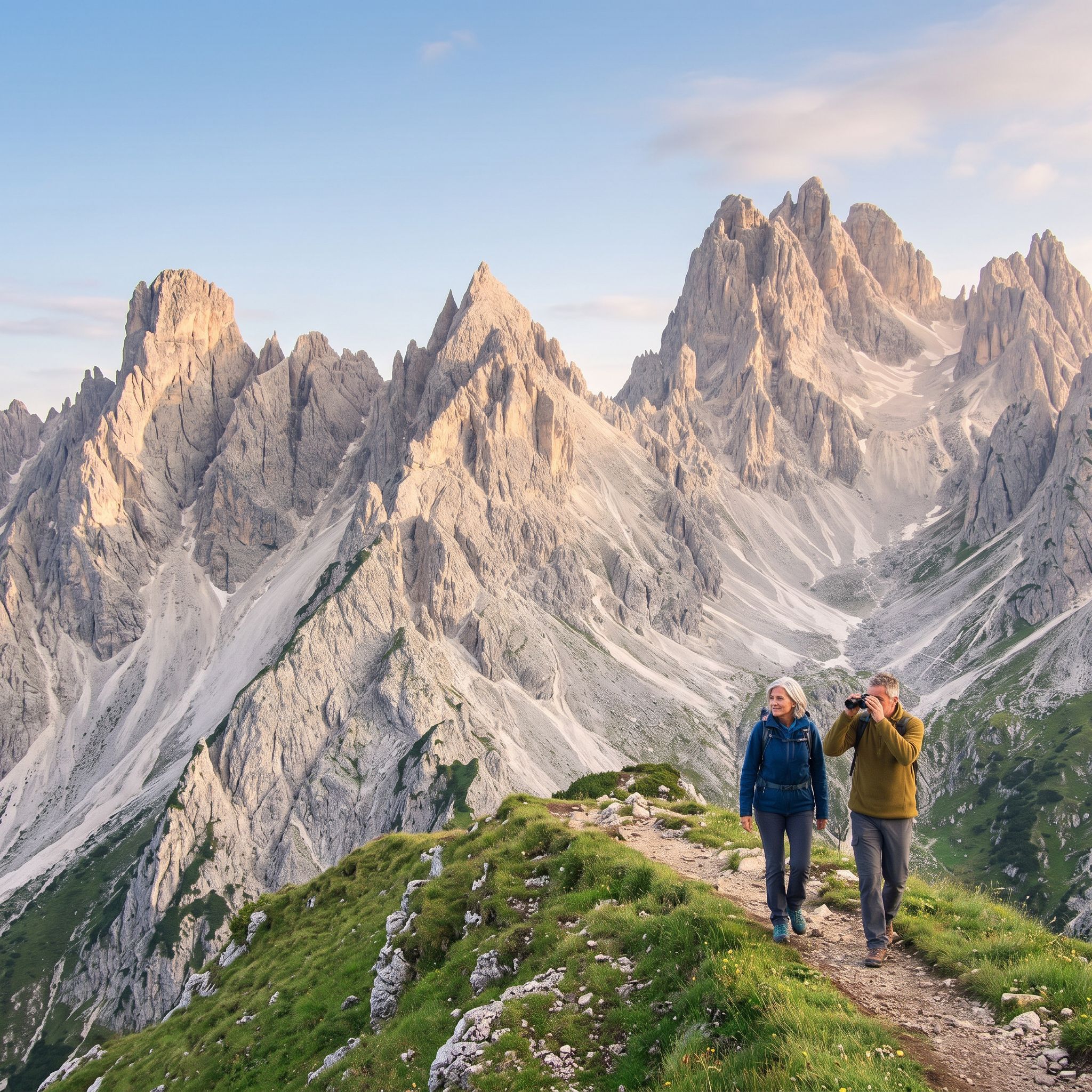 AI-edited
How should I pace my first days at altitude?
Treat the first full day as an acclimatisation day, not a hiking day. Hydrate, eat regularly, rest more than usual and keep the walking short. Save the higher outings and the long ascents for day two or three, once your body has had a night or two at valley height.
That advice recurs across traveller forums and published guidance alike. On a Fodor's discussion about the Alps, travellers repeatedly advise drinking more water than usual, limiting alcohol and resting more than normal at altitude. Several say this is what helped them most. The same thread mentions avoiding excess caffeine and using naps, saline and frequent snacks to manage dryness and fatigue at higher elevations.
Official safety guides for the Dolomites advise planning hikes carefully, telling someone your route, drinking plenty of water and reducing physical exertion in heat. The Alta Badia safety page puts the principle plainly: find out, get informed.
For travellers who want the mountain views without the climb, the lift network does much of the work. The UNESCO Dolomites accessibility programme documents 36 trails accessible to everybody, including people with limited mobility, older visitors and families with small children, plus 13 panoramic viewpoints reached by fully accessible lift systems. Those trails are spread across all nine of the Dolomite systems that make up the World Heritage Site, and each has a detailed technical information sheet in English, German and Italian so you can judge for yourself whether you can complete it. More on that infrastructure sits in our guide to how accessible the Dolomites are for older travellers.
How do I handle sun and afternoon thunderstorms?
Expect strong sun at altitude and a real chance of afternoon storms in the hiking season. Start early, carry a light rain shell and sun protection, and be off exposed ridges and summits by early afternoon. The published climate figures for Cortina d'Ampezzo show rainfall days peaking in May and staying elevated through summer.
The Cortina d'Ampezzo climate table gives a clear picture of the temperature swing you are dressing for. January averages 6°C by day and -5°C at night. July averages 29°C by day and 15°C at night. December averages 7°C by day and -4°C at night. Those figures apply to the valley floor, not the mountain system as a whole, and the swing is substantial even before you add height.
| Month | Average high | Average low |
|---|---|---|
| January | 6°C | -5°C |
| April | 19°C | 5°C |
| July | 29°C | 15°C |
| October | 19°C | 6°C |
| December | 7°C | -4°C |
Weather bulletins for the Dolomites are published by A.R.P.A.V., the regional environmental agency for the Veneto, whose avalanche centre covers snow, avalanches, alpine meteorology, alpine climatology, glaciers, water and hydrology. In the Arabba area, the local information office publishes weather information online and runs a telephone line for the bulletin. The practical takeaway is the same across the range: check the forecast the evening before, and again in the morning.
Layers, waterproof gear and proper boots are the standard advice for shoulder-season trips, and the first week of October is specifically named in hiking discussions as a period when the weather can turn. Many huts and hiking services are seasonal, with openings often running into early October depending on location.
Where do I find a pharmacy or a doctor?
Pharmacies are found in almost every Dolomite town and are marked by a green cross. Val Gardena lists pharmacies in Ortisei, Santa Cristina and Selva di Val Gardena, plus a doctor-on-call service in Selva from July to September and December to April. Alta Badia lists pharmacies and a trauma centre in Corvara.
In Val Gardena, the official valley page lists doctors, paediatricians, dentists and pharmacies in Ortisei, Santa Cristina and Selva di Val Gardena, along with the Dolomiti Sportclinic for orthopaedics and traumatology. Pharmacy Dolomiti in Selva di Val Gardena is listed at Str. Meisules 246. In Ortisei, the nearest named pharmacy is Pharmacy Sella at Reziaplatz 73B, and the nearest named hospitals are in Bressanone and Bolzano. That applies to Ortisei in Val Gardena, not to Alpe di Siusi itself.
In Alta Badia, the valley's useful numbers page lists pharmacies and a trauma centre in Corvara, plus pharmacies or parapharmacies in La Villa and San Cassiano. Opening periods are documented for some of them, including summer dates for Apoteca Alta Badia and Parapharmacy Colfosco.
Two practical points. A travel guide for the Dolomites notes that many pharmacies close for the midday break and are usually closed on Sundays, so plan around that. And the nearest pharmacy and hospital are not documented for the Alpe di Siusi area specifically, so if you are basing yourself there, ask your accommodation which pharmacy and which hospital they would use.
Which emergency number do I call?
Dial 112 across Val Gardena, Alpe di Siusi and Alta Badia. In the Veneto Dolomites, medical emergencies use 118. The 118 operations centre is active 24 hours a day, seven days a week, with helicopter rescue available if needed.
The single European emergency number, 112, reaches mountain rescue across the Dolomites. Val Gardena's local numbers page lists 112 and the mountain rescue service Aiut Alpin Dolomites, with hospitals in Bressanone and Bolzano also named. Alta Badia's useful numbers page lists 112 and Aiüt Alpin Dolomites under the same number.
In the Veneto Dolomites, the regional health guide states that emergency rooms and first-aid points are open around the clock, with hospitals in Belluno, Feltre, Agordo and Pieve di Cadore serving the area. The guide is published by ULSS1 Dolomiti and is available as a downloadable health and safety guide.
One regional warning is worth carrying. A Dolomiti Bellunesi article reports that overtourism has become a serious safety problem in some Dolomite areas, with increased rescue call-outs tied to unprepared visitors on difficult trails. That is a regional observation, not a comment on any one valley, and the response is straightforward: match the route to your fitness, carry the right gear, and turn back when the weather or your legs say so.
What does mountain rescue cover, and what insurance do I need?
Helicopter rescue in the Dolomites can be expensive, and the UK government's travel advice states plainly that a GHIC or EHIC is not a substitute for travel insurance. It recommends cover for medical treatment and emergency evacuation. Buy a policy that explicitly includes mountain rescue and hiking or skiing at altitude.
On the rescue side, a Reddit hiking thread notes that CAI membership, the Italian Alpine Club, includes helicopter rescue in Europe, and mentions a separate Dolomiti Emergency service used by some hikers. The same thread notes that hut discounts may come with CAI membership, though not always, depending on the hut owner. Anyone considering membership should confirm current terms directly with the club rather than relying on a forum.
For the Veneto Dolomites, the regional health service documents a CUP booking service as the channel for booking visits and diagnostic tests, with a dedicated phone line and an accessible email contact for deaf or blind users.
Can I travel with my medication?
carry medication in original packaging, keep it in hand luggage, and bring enough for the whole trip plus a margin.
Altitude and dryness can affect how some medications work and how you feel taking them, which is one more reason the pre-trip conversation with a clinician matters. Travel-health guidance specifically recommends that older adults discuss planned high-altitude activity with a clinician before travel, and that conversation is the natural place to raise medication questions.
Pharmacies in the Dolomites are well distributed and marked by a green cross, but they stock Italian brands. A prescription written at home may not translate directly. If you take something regularly, bring your own supply rather than planning to buy it locally. The Val Gardena page lists doctors, paediatricians and dentists across Ortisei, Santa Cristina and Selva, so routine medical contact is available if you need to see someone during your stay.
When is the quietest time to visit?
What they do document is the season pattern: summer from June to September and winter from December to March, with May, October and November as shoulder months when lift operations are limited and some lodging closes.
A second seasons guide gives a similar shape: summer from mid-June to September, autumn from late September to October, winter from December to April, and spring from May to early June, with many huts shut in spring. The summer hiking season is framed elsewhere as mid-July through September, when trails and via ferratas are most open, and winter snow usually accumulates from December through March, sometimes into April.
For health reassurance specifically, the shoulder months carry a trade-off. Fewer people, but also fewer lifts running and fewer services open. Val Gardena's official destination site states that the cable cars are open and that the last lifts close at the beginning of November 2026. The Seiser Alm cable car page documents summer operating dates. Neither source gives a general low-crowd recommendation for the whole region, so if quiet matters more than guaranteed lift access, ask your accommodation which lifts and huts will be running for your exact dates.
How do I reach the mountains without a car?
South Tyrol's public transport is described as accessible for people with limited mobility, with raised train platforms, lifts and modern low-floor buses and trains carrying designated wheelchair spaces. The Südtirol Transfer shuttle connects the train stations at Bozen and Brixen, and long-distance bus stops at Bozen, Klausen and Vahrn, to accommodation, and is barrier-free on request.
For the Alpe di Siusi area specifically, the documented transfer options are rail and long-distance bus connections via Bozen and Brixen. Airport transfer is not documented for that area. The road distances are short: Bozen railway station to Seiser Alm is 20 km by road, about 20 minutes with clear roads, and Brixen railway station to Seiser Alm is 30 km, about 30 minutes with clear roads. Both figures assume free-flowing traffic and no stops.
In Val Gardena, blind or visually impaired people may use public transport free of charge with appropriate ID. The Seiser Alm cable car is documented as fully accessible, with wheelchair priority boarding and free travel for wheelchair users, blind passengers and people with 100% disability. For summer 2026, the published senior rate for people born in 1960 or earlier is €18 one way and €26 return. Dolomiti Superski states that senior discounts exist but vary by product and area, with a 10% reduction listed for seniors born in 1960 or earlier on some daily and multi-day ski passes.
Journeys and tickets on the regional bus network can be planned through the Dolomiti Bus tourism portal. Rates quoted here are indicative and vary by season and booking channel.
For a quieter base, our guide to the quietest hotels in the Dolomites covers properties where reviews consistently mention soundproofing and distance from lifts and roads. And if you want to know where to eat after a day on the trails, the Dolomites' mountain rifugi and restaurants are covered in their own guide.
What should I arrange before I go?
Four things. A travel insurance policy that explicitly covers mountain rescue and your activity. A conversation with your doctor about altitude and your medication. A note of the emergency number for the valley you are staying in. And a check on which pharmacies and doctors are open for your dates, since several services are seasonal.
The valley-by-valley pattern is the key. Val Gardena publishes 112, Aiut Alpin Dolomites, pharmacies in three towns, a doctor-on-call in Selva from July to September and December to April, and hospitals in Bressanone and Bolzano. Alta Badia publishes 112, mountain rescue under the same number, pharmacies and a trauma centre in Corvara, and summer opening dates for some pharmacies. The Veneto Dolomites publish 118, round-the-clock emergency rooms, hospitals in Belluno, Feltre, Agordo and Pieve di Cadore, a Tourist Medical Guard for non-residents, and a CUP booking line with accessible email contact for deaf or blind users.
Where a detail is not documented, the answer is to ask. The Alpe di Siusi area does not publish a nearest pharmacy or hospital. The transport and health services listed here do not publish cancellation terms. Neither gap is a problem, but both are worth a question at the time of booking rather than on the day you need them.
The mountains themselves are generous to travellers who pace themselves. Sleep low, walk early, drink water, watch the sky after lunch, and keep the emergency number in your phone. That is most of it.


