
In the Dolomites, dinner is not a footnote to the day. It is the second act. The hotels that food-minded travellers aged 50 to 70 talk about most are the ones where the kitchen carries the stay: a half-board arrangement so good that leaving the building feels like a mistake, a breakfast buffet that becomes the meal you remember, a terrace where the view over the Sassolungo does half the work. It does not rank them. It explains who each one suits, and whether the half-board supplement earns its keep.
Two things shape the list. First, the strongest documented food reputations in the region cluster in South Tyrol's Val Gardena and the Seiser Alm area, where hotels publish their board arrangements and guests write about them at length. Second, half-board is a different proposition depending on where you sleep. In a small village with two restaurants, it is close to essential. In a larger town such as Ortisei or Cortina d'Ampezzo, where restaurant choice is wide, it is optional. Guests posting on the Rick Steves Travel Forum have described half-board dinner as often more practical and cheaper than hunting for a table every night, while a widely read Reddit thread on the same subject noted that in bigger towns the calculation changes.
Which Dolomites hotels are actually booked for their food?
The clearest food-first reputations belong to Hotel Touring Dolomites and Monte Pana Dolomites Hotel in Santa Cristina Val Gardena, Hotel Grones in Ortisei, Hotel La Fradora in San Cassiano, Romantik Hotel Santer in Dobbiaco and My Arbor in the Bressanone area. Each is discussed by guests primarily for its kitchen and its half-board, not its spa or its ski room.
Hotel Touring Dolomites draws repeated praise for dinners described as superb and of an exceptionally high standard, with several guests specifically recommending the half-board option. Breakfast is widely described as varied and high quality, with eggs and waffles cooked to order and gluten-free items available. Service is called friendly, efficient and attentive, including accommodation of gluten-free needs. The hotel holds a Google rating of 4.7 out of 5 from 389 reviews, as of September 2026.
"The hotel has very convenient rooms, great SPA, convenient ski room. The staff are extremely helpful and kind. The restaurant is an experience of its own - no need to get out of the hotel." (Google, March 2026)
That last line is the whole argument for half-board in one sentence. It also flags a planning point: the hotel is not ski-in, ski-out. The lifts sit roughly a 10-minute walk away, and a six-seat shuttle runs to the gondolas, with occasional waits at busy times.
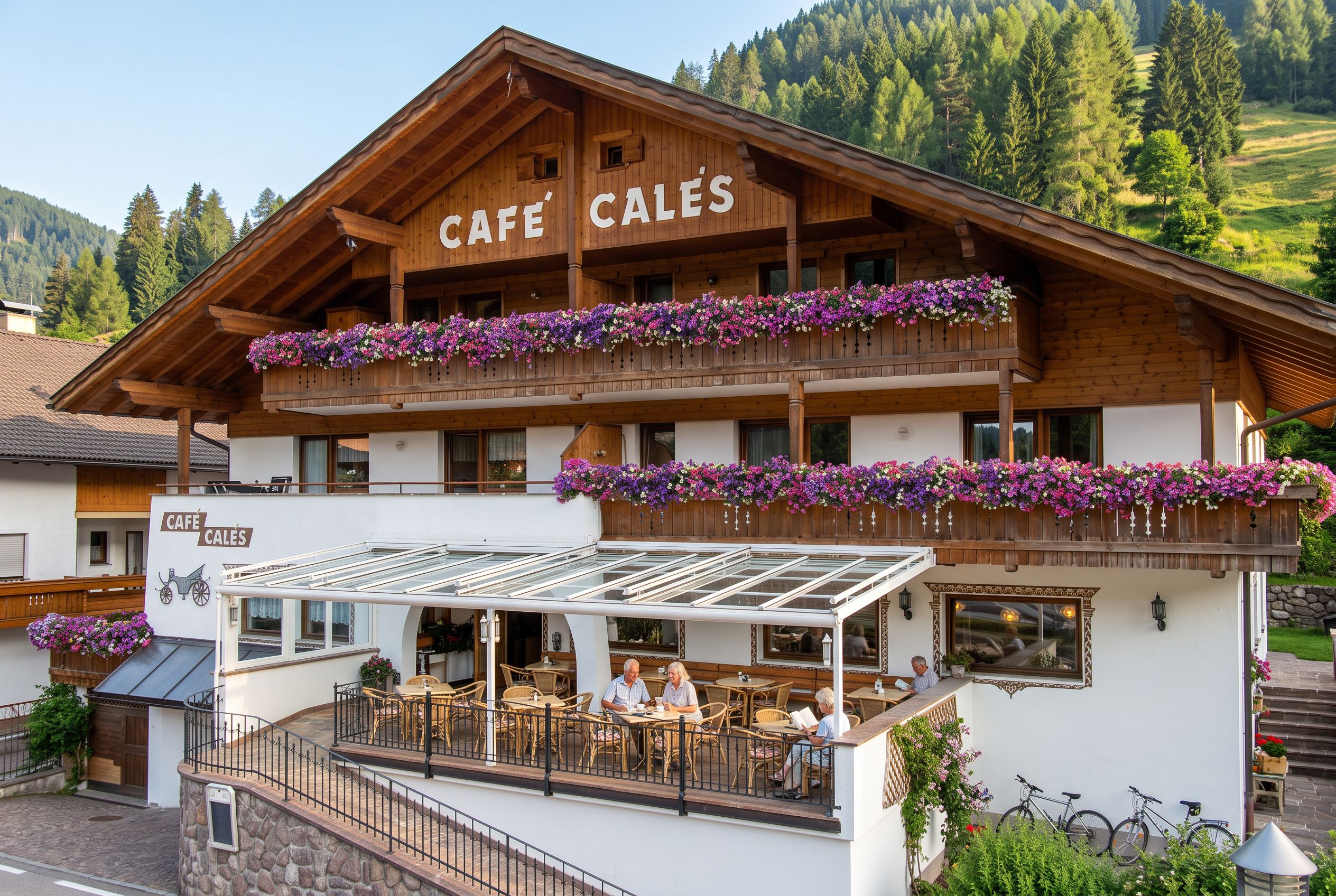 AI-edited
Where is half-board genuinely good value?
Half-board pays off most in smaller villages where restaurant choice is thin. Guests repeatedly single out Romantik Hotel Santer in Dobbiaco, Hotel Grones in Ortisei, Kristiania Small Dolomites Hotel in Selva and Hotel Cappella in Colfosco as places where the dinner alone justified the board upgrade.
Romantik Hotel Santer markets a wellness half-board and gourmet cuisine on its own site, and traveller comments on Tripadvisor repeatedly recommend the arrangement. Guests there describe choosing from three different five-course menus. The hotel presents itself as a year-round property, with winter, Advent, Christmas, New Year and white-weeks packages documented on its own pages.
Hotel Grones in Ortisei has been recommended on the Rick Steves Travel Forum specifically for its half-board package, with posters describing the food as exceptional and the staff as warm and friendly. The same forum commentary pairs the food praise with practical comfort: indoor and outdoor sitting areas, a pool and saunas.
Kristiania Small Dolomites Hotel in Selva di Val Gardena is described in Tripadvisor reviews as well worth paying for half board, with a four- or five-course dinner that reviewers said would not have been out of place in a top-end restaurant. Hotel Cappella in Colfosco draws Tripadvisor comments calling the half-board food worth the upgrade and excellent.
What does a mountain gourmet stay look like at the top end?
Rosa Alpina in San Cassiano reopened on 24 July 2025 as Aman Rosa Alpina after a complete redesign, with all guestrooms and suites remodelled and new dining concepts added. It is the clearest example in the region of a property rebuilt around gastronomy rather than rooms alone.
Press coverage of the reopening described a widened culinary offer: an Italian grill, an all-day lounge, a dedicated breakfast room, private dining spaces, informal alfresco fondues, fine-dining multi-course meals and live cooking at breakfast. A Japanese restaurant was planned for winter 2025/26. For travellers who plan a Dolomites trip around one splurge dinner, this is the address the recent coverage points to.
Forestis Dolomites, in the Bressanone area, is a different proposition. A Reddit post recommended staying half board there and described the hotel as doing a fantastic breakfast and dinner, with a wine tasting described as pretty good. Later Reddit reviews said the half-board dinner runs to two multi-course menus, one meat-based and one vegetarian, usually around seven courses, and that guests can mix dishes across both. The menu is described as seasonal and focused on local ingredients, alpine herbs, vegetables and regional specialties. The property sits somewhat isolated with winding roads, so dinner there is part of the stay rather than a convenience you can skip.
Which hotels have the most memorable breakfast?
Breakfast is the meal guests write about most warmly across the region. My Arbor in the Bressanone area, Monte Pana Dolomites Hotel in Santa Cristina and Hotel Touring Dolomites all draw repeated praise for their morning buffets.
That verdict, from a Tripadvisor review of My Arbor, is the kind of detail that matters if you treat breakfast as the day's foundation before a long walk. Guests at My Arbor also repeatedly call dinner delicious, perfect or fantastic, and several say they would return.
Monte Pana Dolomites Hotel draws multiple reviews describing breakfast as amazing and dinners as delicious, with several guests saying the half-board meals felt fine-dining level. The location directly below Sassolungo is repeatedly described as exceptional, with ski lifts between 50 and 200 metres away and hiking trails starting from the property. The wellness area, indoor pool and outdoor heated hot tubs are consistently described as pleasant and well maintained.
The picture is not unanimous. One Tripadvisor review of Monte Pana reports a hard mattress, disappointing half-board variety and flies around the buffet. That is worth knowing before booking, and it is the reason this hotel suits travellers who want to weigh praise against a clear dissenting view rather than those who want a single verdict.
Is terrace dining with a view worth planning around?
Yes, where the property publishes it. Panoramahotel Huberhof in the Valle Isarco documents a first-floor suite with balcony views over the Dolomites, and Monte Pana's setting below the Sassolungo makes outdoor dining a genuine part of the stay. Not every hotel publishes terrace details, so confirm when booking.
The Huberhof's documented suite has a bathroom with toilet, shower and bidet, plus handrails for wheelchair users. The stay is sold with three-quarter gourmet board rather than standard half board, which is a meaningful distinction: three-quarter board typically adds a mid-afternoon snack to breakfast and dinner. Guests posting on Reddit noted that some Ortisei hotels offer this same three-quarter arrangement, with cold cuts, cake and drinks in the afternoon.
For the wider picture on where to eat beyond the hotel table, the magazine's guide to the Dolomites' finest restaurants and mountain rifugi covers standalone kitchens and mountain huts, which sit outside this article's scope.
What should older travellers check before booking?
Lift access, shower type and room location vary sharply between these properties, and several do not publish the details at all. Tirler in Alpe di Siusi has the most detailed accessibility documentation, including a ground-floor room with a level-access shower and stepless access to the pool, fitness and beauty areas.
Room 200 at Tirler is documented on the ground floor with a terrace, a level-access shower and direct garden access. The underground car park connects to the main building by two lifts, and the dining room, restaurant and public bar are reached by an internal route with a long ramp and a lift. For travellers who need to know exactly what the route looks like before arriving, this is the most thoroughly documented property in the set.
Elsewhere the picture is thinner, and the honest answer is that you must ask. Hotel Monte Paraccia in San Vigilio di Marebbe documents lift access to the first two floors only, with accessible rooms available on request and no access ramp. Hotel La Perla in Canazei documents classic rooms with a walk-in shower and a lift that serves all floors but is explicitly not accessible. Schloss Hotel Dolomiti in Canazei documents lift access to all floors and a bathroom described only as bath or shower, so walk-in status is not documented. Hotel Mignon in Selva documents lift access to all floors, with shower type and step-free entry not documented. Hotel Restaurant Jägerhof in Colfosco is listed as handicapped accessible, with lift count and circulation not documented.
| Hotel | Location | Documented access detail |
|---|---|---|
| Tirler – Dolomites Living Hotel | Alpe di Siusi | Ground-floor room 200 with terrace and level-access shower; two lifts from car park; stepless pool, fitness and beauty areas |
| Hotel Monte Paraccia | San Vigilio di Marebbe | Lift serves first two floors only; accessible rooms on request; no access ramp |
| Hotel La Perla | Canazei | Classic rooms with walk-in shower; lift serves all floors but is not accessible |
| Schloss Hotel Dolomiti | Canazei | Lift to all floors; bathroom documented as bath or shower only |
| Hotel Mignon | Selva di Val Gardena | Lift serves all floors; shower type not documented |
For the wider question of altitude, pace and health planning in the region, see altitude, health and peace of mind in the Dolomites. On the ground, the nearest hospitals to Val Gardena are Bressanone, roughly 30 to 35 kilometres away, and Bolzano, roughly 35 to 40 kilometres away. The emergency number in Val Gardena is 112. In the wider Veneto Dolomites, medical emergencies use 118, with emergency rooms and first-aid points open 24 hours a day, seven days a week, according to the regional health and safety guide. A destination safety guide notes that 112 is the single European emergency number throughout Italy, while specific medical services in Veneto still use 118.
What does a food-focused stay cost?
Published rate floors are scarce. Hotel Ritterhof in Steinegg publishes half-board from €86, one of the clearest documented half-board rates in the area. Beyond that, rates are indicative and vary by season and booking channel, so treat any figure as a starting point rather than a quote.
That scarcity is itself useful information. Most Dolomites hotels do not publish a standing half-board rate on an open page, because the price moves with season, room category and length of stay. The practical approach is to ask the property directly for the half-board supplement as a per-person, per-night figure, and to compare it against what you would realistically spend on dinner nearby.
Where the calculation is close, remember what half-board includes. A four- or five-course dinner with local wines, as described by guests at Hotel Villa Monica in Dobbiaco, plus an afternoon cake, is a different proposition from a single à la carte plate. Guests at that property repeatedly praised the rhythm of breakfast, hiking, afternoon cake and a multi-course dinner.
When should food-minded travellers go?
The Dolomites run two main seasons: summer from June to September and winter from December to March. September often brings clearer skies, fewer crowds and good hiking conditions. Shoulder months bring limited lift operations and some accommodation closures, so check opening dates before booking.
That seasonal pattern comes from the regional destination guide, which also notes that July and August are the warmest and busiest months, while December and January are the coldest. February to early March brings longer days and strong ski conditions. For travellers whose priority is a table rather than a piste, September is the month most often singled out for the combination of weather and quieter restaurants.
One caveat belongs here rather than in the introduction. The 2026 Winter Olympics are reshaping hotel timelines across the region, with renovations and staggered reopenings reported in Cortina d'Ampezzo and beyond. Expect some construction noise and shifting restaurant availability in key resort towns through the Olympic build-up. For a fuller picture of timing, see when to visit the Dolomites for fine weather and fewer crowds.
Which hotel suits which traveller?
Match the property to how you eat. Guests who want dinner to be the event should book a village half-board hotel. Guests who want restaurant choice should base themselves in Ortisei or Cortina and book board selectively. Guests who need documented step-free routes should start with Tirler.
- For a half-board rhythm with a strong kitchen: Hotel Touring Dolomites or Monte Pana in Santa Cristina, Romantik Hotel Santer in Dobbiaco, Kristiania in Selva.
- For a splurge dining stay: Aman Rosa Alpina in San Cassiano, or Forestis in the Bressanone area with its seven-course half-board menus.
- For breakfast as the main event: My Arbor, where a Tripadvisor reviewer described the widest range of healthy food seen in a hotel.
- For documented access detail: Tirler in Alpe di Siusi, with room 200 and stepless leisure areas.
- For a quiet base: the magazine's guide to the quietest hotels in the Dolomites covers that ground separately.
One pattern is worth carrying into your booking. Guest feedback across the region consistently describes hotel food as leaning more Austrian than standard Italian in style, with dumplings, roasts and hearty soups alongside pasta. That is not a shortcoming, but it is a surprise if you arrive expecting a Tuscan menu. Ask to see a sample dinner menu before you commit to a week of half-board.
How should you book a food-focused stay?
Book direct where possible, ask for the half-board supplement as a per-person nightly figure, and confirm the specific dining details in writing. Several properties sell three-quarter board rather than half board, and the terminology is not standardised across the region.
Three questions are worth putting in an email before you pay a deposit. First, what exactly does the board include: breakfast and dinner only, or an afternoon snack as well? Second, is the dining room reachable without stairs from your room, and does the property publish that route?
That last point deserves emphasis. The properties discussed here do not publish cancellation terms on the pages reviewed, and neither do they document nearest pharmacy or medical help at property level. Ask when booking rather than assuming. For Val Gardena, the named pharmacies are Pharmacy Sella in Ortisei, Pharmacy Dolomiti in Selva and Pharmacy St. Elisabeth in Santa Cristina.
Finally, if you sleep lightly, ask for a room away from the bar and the lift. Guest feedback at one Canazei property noted no noise issue even above the bar, but that is a single property's experience, not a regional rule. The magazine's guide to hotels for light sleepers covers this in more depth.


