
Charleston's table is built on rice, shellfish, stone-ground grits and recipes carried across the Atlantic from West Africa and the Caribbean. The city's food identity is Lowcountry cooking, and South Carolina's official tourism office describes it as a blend of nearby seafood, inherited recipes and contemporary interpretations. For a food-minded visitor in their fifties or sixties, the pleasure lies less in chasing a single address than in understanding the grammar of the cooking: what belongs on the plate, which dishes are worth your appetite, and where the versions have stood the test of decades rather than a season of reviews.
This guide stays with the traditional cooking and the everyday places that serve it. The city's fine-dining rooms and the restaurants inside hotels are covered in their own dedicated guides, and are mentioned here only where a classic dish happens to be served there. What follows is a map of the cooking itself, with the practical detail an older traveller needs: which rooms are busy, which are reached down an alley, where the parking sits, and what the published sources do and do not confirm.
What exactly is Lowcountry cooking?
Lowcountry cooking is the coastal South Carolina tradition built on rice, grits, shrimp, crab, oysters and vegetables, shaped by African, Caribbean and West African kitchens. Charleston is its best-known address. The signature dish is shrimp and grits, and the supporting cast includes she-crab soup, red rice, crab rice, oyster stew and fried seafood.
South Carolina's tourism board lists the classic plates plainly: shrimp and grits, she-crab soup, Charleston red rice, crab rice, oyster stew, Frogmore stew, Hoppin' John, fried green tomatoes, pimento-cheese fritters, oyster sliders, collards, salmon cakes with stone-ground grits and hummingbird cake. Fish or shellfish served over Carolina Gold rice appears too, a reminder that rice, not wheat, is the starch at the centre of this cuisine.
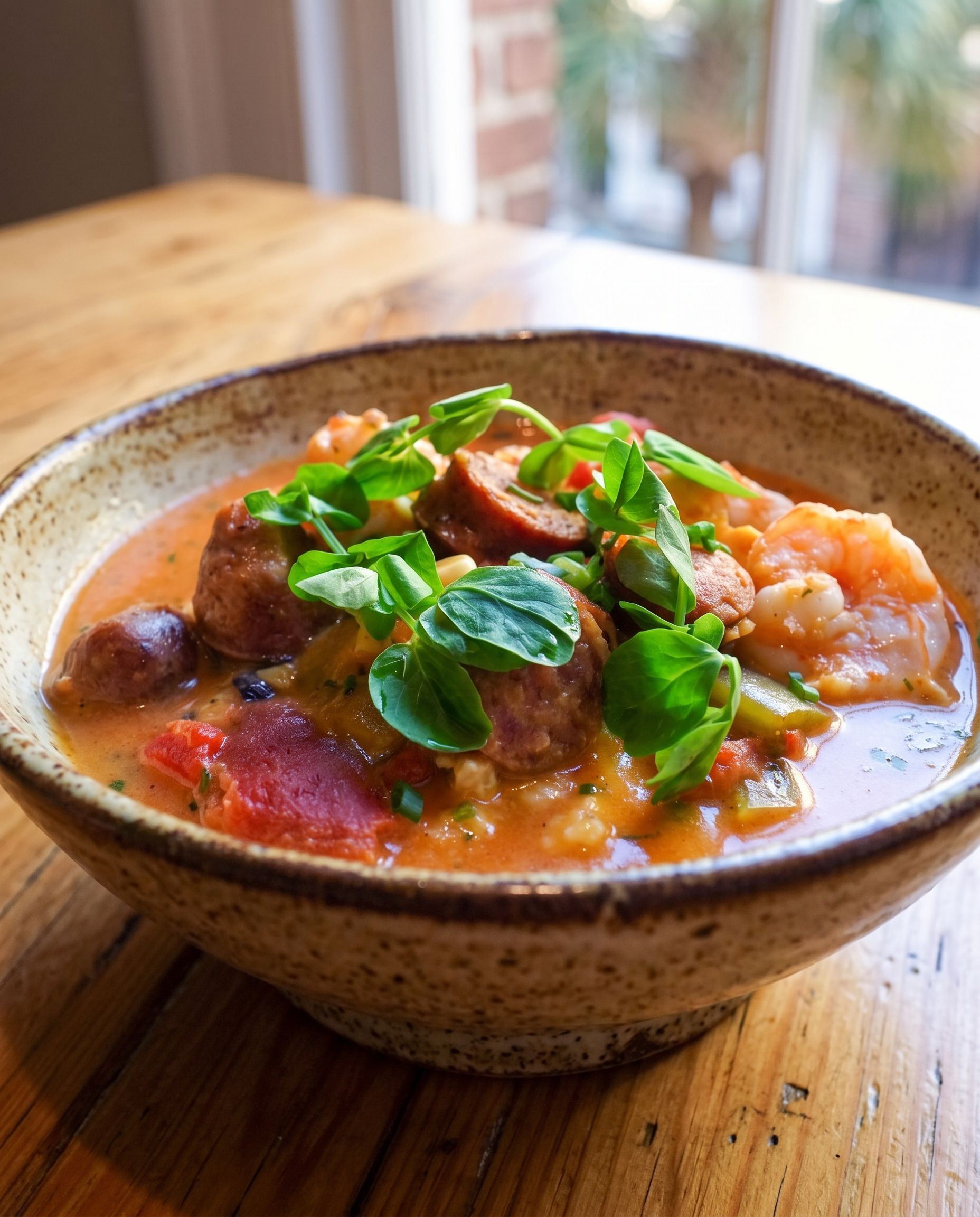
Eater reported in August 2024 that shrimp and grits remained one of Charleston's most-requested orders. The dish is a template rather than a recipe: creamy or stone-ground grits, local shrimp and a savoury sauce that may lean on bacon, gravy or regional seasoning. Versions vary enormously from kitchen to kitchen, which is precisely why the city can argue about them for decades.
Where should you try shrimp and grits?
Start with the long-established rooms the state tourism board names for traditional cooking: 82 Queen, Magnolias and Poogan's Porch, all described as longtime restaurants using time-honoured recipes and local ingredients. The tourism board also lists shrimp-and-grits versions at Slightly North of Broad and Edison, and describes the city's renditions as ranging from classic to creative.
82 Queen is the one with the most published detail. It told reporters it uses about 8,000 pounds of grits a year and calls shrimp and grits one of its top contenders. Guest feedback gathered on Google, where the restaurant held 4.5 out of 5 across 3,603 reviews as of November 2026, repeatedly names the she-crab soup, fried green tomatoes, fish and grits, jambalaya and pecan pie as the dishes that linger in the memory.
Further out, in the West Ashley area of the city, the Glass Onion's version was reported to use Carolina-caught shrimp, andouille sausage, Creole tomatoes and grits from Marsh Hen Mill on Edisto Island. Fleet Landing, at 186 Concord Street, is described by Cruise Critic as waterfront dining in a converted Navy pier serving seafood and Southern food at moderate prices. The airport road distance to Fleet Landing is 18 km, about 20 minutes with clear roads.
 AI-edited
Online forums add names rather than verdicts. In a Reddit discussion updated 19 January 2026, commenters repeatedly mentioned Fleet Landing, 82 Queen, Lowcountry Bistro, Hank's Seafood, S.N.O.B., Glass Onion and Page's Okra Grill for shrimp and grits; Fleet Landing was called good value, while Hank's was thought expensive but worthwhile. A separate thread from 2 November 2024, updated 3 November 2025, added Early Bird Diner, Sunrise Bistro, The Grit Counter and Grace & Grit. Forum opinion is not an independent assessment, and the same threads show diners disagreeing about individual kitchens.
What about she-crab soup and the other classic bowls?
She-crab soup is a rich crab soup traditionally associated with Charleston, made with crab, dairy and seasonings. South Carolina's tourism office identifies it as a famous Lowcountry dish tied to the city's culinary history. Recipes vary from kitchen to kitchen, and the presence of crab roe is not universal, so ask before you order if roe matters to you.
The same official listing points to Hank's Seafood for oyster stew, a creamy preparation bound up with the city's coastal foodways, and to Hannibal's Soul Kitchen for crab rice, a seasoned rice dish built around local crab. Those attributions come from the state tourism board, not from the restaurants' own menus, and the board does not publish dish-by-dish prices, portion sizes or reservation policies.
Oysters deserve a word of their own. They are a natural part of Lowcountry dining given the coastal setting, and cooler months are traditionally associated with oyster eating, though modern aquaculture and restaurant supply extend availability beyond the old seasonal rule.
How does Gullah cooking fit into the picture?
Rice-centred dishes such as Hoppin' John and red rice reflect Charleston's African, Caribbean and West African culinary heritage, and the state tourism board highlights Hannibal's Soul Kitchen as a destination for crab rice. Eater Carolinas reported a Gullah Geechee brunch spot among 2025 openings, but the material does not identify it clearly enough to name an address or confirm that it is trading.
This is the deepest layer of the city's cooking and the one most easily skipped by visitors who stay on the well-trodden restaurant streets. The rice itself tells the story: Carolina Gold was the crop that made colonial Charleston wealthy, and the knowledge of how to grow and cook it came with enslaved West Africans. Red rice, Hoppin' John and the rice-based plates on modern menus are direct descendants.
For context on the wider history that produced this food, our guide to Charleston's plantations and the Lowcountry's history sets the rice economy in its proper frame. It is worth reading before you sit down to eat, because the dishes taste different once you know what they cost to produce.
Where do oysters, boiled peanuts and biscuits fit?
Oysters belong to the coastal setting and are traditionally eaten in cooler months, though farmed supply now stretches availability. Boiled peanuts and biscuits are everyday Southern staples rather than restaurant set pieces.
That closure is a useful caution. Charleston's restaurant scene turns over quickly. The Charleston City Paper reported the recent closures of Cru Café, Rutledge Cab Co., Barsa and YoBo Cantina Fresca, and a year-end roundup listed 60 Bull Cafe, Bumpa's, Fuel Cantina, Herd Provisions, La Bonne Franquette, The Rarebit, Raw Lab and The Select among the casualties of 2025. The Post and Courier separately reported that The Rarebit closed permanently on 21 December 2025, having opened on King Street in 2012. None of this means the classic dishes have vanished; it means you should confirm a specific address is trading before you build an evening around it.
Hominy Grill, formerly at 207 Rutledge Avenue and known particularly for breakfast, is a case in point. Cruise Critic described it as a short ride from downtown, but restaurant details change, so verify current operating status before adding it to an itinerary.
Is Charleston City Market worth visiting for food?
City Market is an open-air market associated with sweetgrass baskets, local art and Lowcountry food, and it is described as open daily. Weekend afternoons are the busiest period, and local planning material recommends visiting early.
Think of it as a place to graze and to look rather than a destination restaurant. The food association is documented; specific stalls, menus and prices are not. If you want to browse the sweetgrass baskets without the crush, the documented quieter choice is early in the day, and the same guidance applies to the market's food stalls.
Getting there is straightforward. The city's fare-free DASH shuttle runs three routes covering most downtown historic and tourist attractions, and CARTA states that all its buses are accessible, with wheelchair lifts, accommodation for mobility devices, kneeling functions and priority seating.
Which places feel welcoming, and which are tourist traps?
There is no independent ranking of welcoming versus tourist-trap restaurants. The only explicit warning comes from a forum: a Charleston Reddit restaurant guide updated 3 November 2025 labelled Hyman's Seafood a "mega tourist trap" and advised avoiding seafood restaurants on Market Street generally. That is one forum's opinion, not a quality assessment, and it should be weighed as such.
Reviews of 82 Queen, gathered on Google, describe service that reads the table well and does not over-check, a historic building with courtyard seating inside, upstairs and in the garden, and a relaxed atmosphere. The same review set notes that portions and pricing on certain dishes, such as the Oyster Rockefeller, felt small for the price. That is planning information: if value matters more than ceremony, order the dishes the reviews single out rather than the showpieces.
"If you have already walked 20,000 steps and need a break -- you'll be happy to hear that there's a public parking garage literally right across the street from the restaurant as well. Would we go back? 10/10 yes." (Google, October 2026)
That review points to a practical detail worth knowing before you book: 82 Queen sits at the end of a narrow alleyway that opens into a courtyard, and a public parking garage stands directly across the street. The city's own visitor page notes that parking with a disability placard or plate is free at city-owned garages, lots and meters, and that restrooms in city facilities may be locked and available on request.
What should older diners know before booking?
Charleston's official sources do not publish a step-free walking map for historic streets or restaurant entrances, so plan around the specific venue rather than assuming continuous level access. Confirm entrance steps, accessible toilets, table spacing and reservation procedure directly with the restaurant before you go. The city publishes an accessibility programme, but it does not document individual dining rooms.
Distances are manageable if you plan them. Charleston International Airport to 82 Queen is 18 km by road, about 20 minutes with clear roads; to Page's Okra Grill it is 22 km, about 25 minutes with clear roads. Those times assume free-flowing traffic with no stops, so add your own margin for the reality of a busy afternoon.
For health planning, a local travel guide identifies CVS Pharmacy at 59 George Street and Roper Hospital at 316 Calhoun Street, the latter described as providing 24-hour emergency treatment. The Medical University of South Carolina at 171 Ashley Avenue is also identified as an emergency-services provider. The CVS information is inconsistent: one part gives pharmacy-counter hours of Monday to Friday 8 a.m. to 10 p.m., Saturday 9 a.m. to 6 p.m. and Sunday 10 a.m. to 6 p.m., while another describes the store as open 24 hours, so confirm overnight counter availability before relying on it. For police, fire or medical emergencies, call 911.
Our guide to how accessible Charleston is for older travellers covers the wider picture of pavements, shuttles and museum access, and our breakdown of what a comfortable Charleston trip costs helps you budget for meals without guesswork. If you are choosing where to sleep between dinners, the roundup of the quietest hotels in Charleston for light sleepers is the place to start.
How much should you budget for a food-led visit?
No official source in the material publishes dish-by-dish prices, portion sizes or reservation policies for Charleston's traditional restaurants. What exists are qualitative notes: Cruise Critic describes Fleet Landing as moderate in price, and a Reddit discussion calls Fleet Landing good value and Hank's Seafood expensive but worthwhile. Those are forum and guide impressions, not published rates.
Treat any figure you see quoted for a specific dish as indicative and subject to change by season, menu revision and booking channel. The state tourism board does not publish a restaurant-by-restaurant price list, and the restaurants themselves do not publish standard tariffs available here. The honest guidance is to check the current menu at the door or online, and to ask about portion size if you are ordering several small plates to share.
One documented saving is worth noting. The South Carolina Historical Society Museum charges $1 admission, with tickets bought on site, and is open Tuesday to Saturday, 10 a.m. to 4 p.m., closed Sundays and Mondays. The Charleston Museum publishes admission of $15 for the museum, $22 for two sites and $30 for three sites, with youth and child reductions but no senior or over-65 reduction. Neither figure is a meal, but both leave more in the budget for dinner.
How do you build a food day in Charleston?
Eat early, walk between courses, and keep one anchor reservation. City Market is calmest in the morning, the DASH shuttle is fare-free and covers most downtown attractions, and the classic dishes reward a leisurely lunch more than a rushed dinner. Book the one room you care about most and leave the rest to appetite.
A workable shape: start with biscuits or a light breakfast, browse City Market before the weekend crowds arrive, take a late morning at a museum while the day is still cool, then sit down to shrimp and grits or she-crab soup for a long lunch. Charleston's summer heat is real, and the historic record lists a July 1998 monthly average of 86.0°F downtown, so a midday table indoors is not a compromise but good sense.
Evenings are for oysters in the cooler months and for the dishes you have not yet tried. Confirm the address is trading, ask about steps at the entrance, and keep the number of a taxi or rideshare handy for the return. The cooking here rewards curiosity more than checklists, and the best meal is often the one you did not plan.


