
Rome keeps a cultural calendar that runs the whole year, and the shape of it is unusually clear. Holy Week fills St Peter's Square and the Colosseum in late March or early April. Summer brings open-air opera and free cinema in the piazzas. Autumn turns to festivals and citywide programming. Christmas settles into Piazza Navona with a market that stays open daily into January. For travellers aged 50 to 70, the useful question is not whether something is on, but how crowded it will be and how easily you can move through it.
What follows is a season-by-season guide to the city's fixed cultural dates, with the practical notes that matter: what needs a ticket, what is free, when the transport network is reinforced, and which weeks are calmest for anyone who would rather see the city than queue through it. Weather and temperatures have their own dedicated guide and are not covered here.
What should you know about Holy Week in Rome?
Holy Week is Rome's busiest religious period, running from Palm Sunday to Easter Sunday, with the 2026 calendar set from 29 March to 5 April. The Good Friday Via Crucis at the Colosseum and the Easter Sunday Urbi et Orbi blessing in St Peter's Square are free and need no ticket. Seated papal celebrations require free tickets requested in advance from the Prefecture of the Papal Household.
Through Eternity's guide to Holy Week in Rome sets out the 2026 programme in detail. Palm Sunday Mass is at 10:00, the Holy Thursday Chrism Mass at 9:30, the Good Friday Passion at 17:00, the Way of the Cross at 21:15, the Easter Vigil at 21:00, and Easter Sunday Mass at 10:15, followed by the Urbi et Orbi blessing at 12:00. The Vatican publishes the locations and times, and the guide notes that the official programme confirms them.
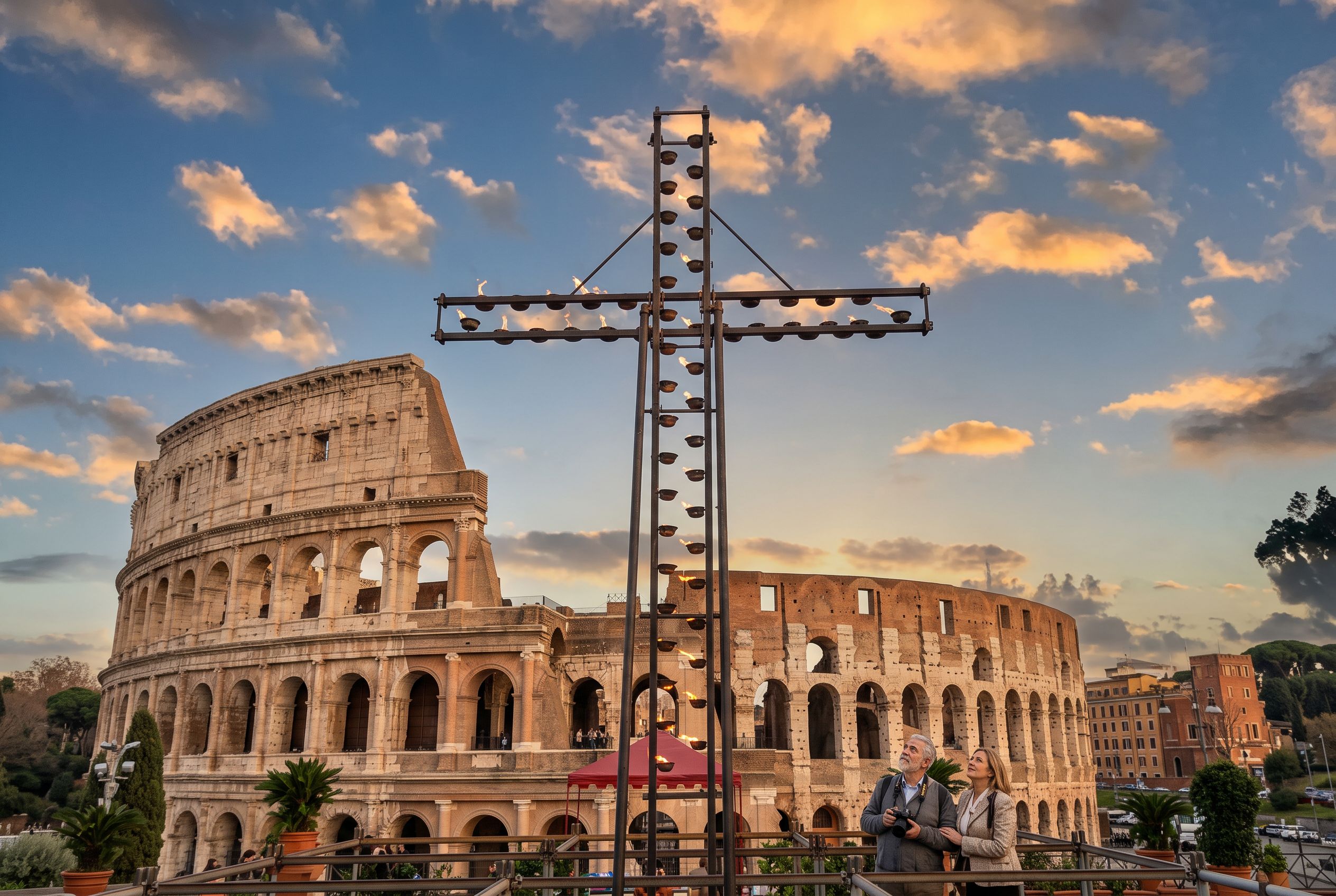
The public-access pattern is straightforward. The Good Friday Via Crucis is free and open to all. So is the Urbi et Orbi blessing in St Peter's Square. The seated ceremonies (Easter Sunday Mass, the Easter Vigil) use free tickets, and those must be requested in advance from the Prefecture of the Papal Household. A Rome jubilee programme source identifies the Good Friday Way of the Cross at the Colosseum as a major public observance, which is why the area around it becomes the city's key bottleneck that evening.
 AI-edited
How crowded is Holy Week, and what closes?
Holy Week is the city's peak period, and crowds build from Holy Thursday. The Vatican Museums and Sistine Chapel close on Easter Sunday and Easter Monday, while most other major monuments stay open. St Peter's Basilica has restricted access until roughly 1pm on Easter Sunday after the morning ceremonies.
For anyone planning a museum-heavy visit, that closure pattern matters. The Vatican Museums are shut on Easter Sunday and Easter Monday, so the days around the Triduum are better suited to pilgrims and to the city's other churches than to gallery time. The major Roman churches, including Santa Maria Maggiore, San Giovanni in Laterano, Sant'Ignazio, Santa Maria in Trastevere and the Gesù, remain accessible and often hold their own Holy Week liturgies.
Rolling road closures affect St Peter's Square on Palm Sunday and Easter Sunday, and the Colosseum area on Good Friday evening. The practical advice from the Holy Week guide is to sightsee before the great ceremonies begin, when St Peter's and the Vatican Museums are open. Forum reports describe crowds concentrating around the Vatican from Holy Thursday onward, with the Colosseum area the pinch point on Good Friday. Anyone wanting a view of the 21:15 procession should expect to claim standing space hours beforehand.
When is Rome's birthday, and what happens?
Rome marks its birthday, Natale di Roma, on 21 April, with free reenactments at the Circus Maximus. It is a single-day civic celebration rather than a week-long event, and it sits outside the Holy Week crush, which makes it a comfortable date for travellers who want atmosphere without the Easter crowds.
The 2026 Rome events calendar lists 21 April as the city's birthday and records the Circus Maximus reenactments as free to attend. Because it falls after Easter in most years, the surrounding days tend to be calmer than Holy Week, and the site itself is an open, level expanse where spectators stand or find space along the edges.
It is worth pairing with the city's other late-spring programming rather than treating it as a standalone trip. The calendar shows a lighter build-up before summer, then a fresh surge in September, so late April sits in one of the more comfortable windows for moving around the centre on foot.
What happens in Rome in summer?
Summer is the Estate Romana season, running from mid-June to mid-October under a programme published by Roma Capitale. It brings open-air cinema, concerts and neighbourhood events across the city's districts. The 2025 edition ran from 15 June to 15 October, and the open-air cinema programme runs from 26 May to 31 October 2026.
Turismo Roma describes the summer cinemas as taking place in squares, parks and courtyards, with a programme ranging from classics to new releases, arthouse films and themed retrospectives. Screenings begin at 9.15pm. Admission is free and no booking is required, except for special events at Cinema Troisi. Venues include Piazza San Cosimato in Trastevere, running 28 May to 12 July, the Casale della Cervelletta park in Tor Sapienza, and Monte Ciocci park in Valle Aurelia, which has a view toward St Peter's.
Turismo Roma's Estate Romana page notes around 50 open-air cinemas across the city, most free to enter, from the historic centre to outlying districts such as Tor Bella Monaca and Ostia. The 2026 calendar records closures on Tuesday 11 August and Tuesday 18 August. For older travellers this is the least physically demanding part of Rome's cultural year when chosen well: you arrive, you sit, and you leave when you like.
Where does summer opera and music happen?
The Rome Opera House moves outdoors for the summer. In 2026 it performs at the Caracalla Festival from 29 June to 30 July and at the Circus Maximus. The Casa del Jazz runs its Summertime festival from 13 June to 7 August, and Rock in Roma takes over the Ippodromo delle Capannelle from 9 June to 18 July.
The shift of the opera season to the Circus Maximus is a change from the usual Baths of Caracalla venue for that year, so anyone planning around the opera should confirm the site when booking rather than assuming the Caracalla setting. The Circus Maximus is a large open site, and summer evenings there are warm rather than cool, so a light layer and a cushion for stone seating are sensible.
For the jazz festival at the Casa del Jazz, the published programme runs from mid-June to early August. Rock in Roma at the Capannelle racecourse runs from early June to mid-July. Both are ticketed events with their own booking channels, and neither publishes a Rome-wide over-65 rate in the material available. The summer sales also begin on 4 July and run to 1 September, which adds shopping crowds to the centre on top of the cultural programming.
What happens in Rome in autumn?
Autumn is Rome's festival season. The Romaeuropa Festival runs from 8 September to 15 November 2026, and the city's official calendar shows September already dense with overlapping events. The third weekend of September sees national monuments, museums and lesser-known sites open to the public, often with free or reduced admission.
Rome's official events calendar continues into late autumn, and a year-round events guide places major food-and-festival activity in the autumn period. That said, the material gathered here does not document a single official Rome-wide autumn food calendar in the way the Vatican publishes Holy Week or Turismo Roma publishes Christmas transport measures. A specific citywide autumn food-event series with published admissions, senior tariffs or accessibility standards is not documented found.
What is documented is that the autumn cultural season is substantial and that September is the densest month. The cooler months are the most useful for cultural sightseeing with fewer heat-related constraints, and the shoulder weeks before the September surge are the easiest for moving around the centre. Anyone building a trip around a specific autumn food event should check the organiser's own page directly, because the citywide calendar does not consolidate them.
What happens in Rome at Christmas?
Piazza Navona hosts the clearest documented Christmas event in Rome. The 2025/2026 Piazza Navona Festival ran from 1 December 2025 to 6 January 2026, with the square and market open daily from 9:00 to 1:00, extending to 2:00 on weekends and holidays. Admission is free for the square, market and shows.
The market sits in the historic centre, which makes it one of the most accessible festive events in the city by location alone: it is a short walk from the Pantheon and Campo de' Fiori, and it needs no ticket. It is also one of the busiest. Guest feedback on Piazza Navona consistently notes the crowds, and reviewers advise keeping bags closed because of pickpocket risk in the press of people, and mention vendors and bracelet sellers approaching visitors.
St Peter's Square hosts a nativity scene and tree over the Christmas period, with large public gatherings around it, though the exact 2026 dates for the Vatican display were not documented in the official material retrieved. The published year-round guide marks 6 January as the end of the Christmas market season.
How do you get around Rome at Christmas?
Turismo Roma publishes a formal mobility plan for the Christmas holidays, covering 6 December 2025 to 6 January 2026. It includes extra public-transport service, a special 15-day Christmas Mobility Pass, and free parking at park-and-ride facilities. This is the best-documented period for practical visitor rules.
Under that plan, certain car parks had reduced rates. Park FS in via Marsala and the Saba car park at Villa Borghese offered the first hour free, while the Atac car park in piazzale dei Partigiani charged €0.80 per hour or €5 for the whole day. The plan documents a special seasonal pass for all users; it does not document a Rome-wide over-65 Christmas fare in the city centre.
The mobility plan is the strongest practical source in the set for the festive period because it documents extra transit capacity and park-and-ride incentives. It does not specify lift or seating arrangements at individual piazzas, so anyone with mobility concerns should treat the transport side as solved and the venue side as something to check individually.
When is Rome quietest for a slower visit?
The quietest windows are after Easter week and before the summer rush, and again in the second half of January through February. The Rome events calendar identifies Holy Week, mid-June to mid-October, and late December as peak periods. August is emptiest but harshest, with many locals away and businesses closed.
Travellers reporting on Rome's least crowded periods favour the second half of January through February, when museums can feel nearly empty, though daylight is short. Mid to late November is described as pleasant, and the first two weeks of December as quiet, cool and decorated, before the Christmas market crowds arrive. August is described as a ghost town, with half the businesses closed, but also as extremely hot and hard on walkers.
For a visit built around fixed events, the choice is a trade-off. Holy Week suits visitors comfortable with very large crowds and standing for outdoor liturgies. Summer opera suits those wanting open-air evenings. Christmas in the piazzas suits people who want festive atmosphere rather than quiet streets. For the calmest major-sightseeing trip, the Monday to Wednesday before Holy Thursday, or the week after Easter when the Vatican Museums reopen, are the most comfortable windows.
How accessible are Rome's main cultural sites?
The best-documented senior-friendly sites are the Colosseum, Forum and Palatine complex, the Vatican Museums, and Rome's civic and state museums, because their sources explicitly mention lifts, ramps, wheelchairs or barrier-free routes. The Colosseum park has a tactile trail with 11 panels, a lift at Salara Vecchia, a platform lift at the Arch of Titus, and a lift inside the Colosseum between the first and second tiers.
The Museo Nazionale Romano sites (Palazzo Massimo, the Baths of Diocletian and Palazzo Altemps) are described as accessible to people with limited mobility, with lifts, accessible restrooms and wheelchairs provided at each site. Entrances use intercoms for assistance at Palazzo Massimo and the Baths of Diocletian. The Musei Capitolini provide lifts, stairlifts and platforms, and wheelchairs can be requested. The Museo di Roma in Piazza Navona states it is fully accessible for mobility reasons, with a stairlift over a few steps leading to an elevator serving three visitor floors, accessible toilets on all three floors, and seating along the route.
Centrale Montemartini has a barrier-free footpath from Via Ostiense 106 through the inner courtyard to the entrance. For the Vatican Museums, a Rome seniors guide describes elevator access at major staircase points, free priority access for disabled visitors and a companion, and wheelchairs available to borrow, but that source is a secondary guide rather than an official museum page, so it should be confirmed directly.
What do tickets and passes cost?
The clearest reduced-fare item is the Christmas Mobility Pass, not a senior-specific Rome-wide cultural pass. Vatican Museums standard entry is around €20, with no automatic senior discount, and the last Sunday of each month is free for everyone. The Roma Pass costs €34 for 72 hours.
One senior-travel guide states that Rome's metro, buses and trams offer discounted fares for seniors aged 65 and over, but that this primarily applies to EU residents. The same guide says EU citizens aged 65 and over get free entry to state museums on the first Sunday of each month, and that many state-run sites have discontinued broad senior discounts for most international visitors. That first-Sunday arrangement is also the day the guide warns is crowded.
No exact Rome citywide over-65 tariff is documented in the material for Holy Week, the open-air cinema circuit or the Christmas events. Rates are indicative and vary by season and booking channel. Anyone relying on a senior reduction should check the operator's own page, because the citywide calendar does not consolidate fare rules.
| Event | Dates | Admission |
|---|---|---|
| Holy Week and Easter | 29 March to 5 April 2026 | Free; seated papal ceremonies need advance tickets |
| Natale di Roma | 21 April | Free reenactments at the Circus Maximus |
| Open-air cinema | 26 May to 31 October 2026 | Free, no booking except Cinema Troisi special events |
| Summer opera | 29 June to 30 July 2026 | Ticketed |
| Romaeuropa Festival | 8 September to 15 November 2026 | Ticketed |
| Piazza Navona Christmas market | 1 December 2025 to 6 January 2026 | Free |
How should you plan the week around an event?
Plan around closures and crowds rather than the calendar alone. The Monday to Wednesday before Holy Thursday and the week after Easter are the calmest windows for major sightseeing. For Holy Week, base in Monti or Celio. For Christmas, use the published mobility plan and park-and-ride facilities.
For Holy Week, sightsee before the great ceremonies begin. For the Christmas period, the city publishes extra transit capacity and parking incentives, so the transport side is well supported. For the summer cinema, arrive early because admission is free and subject to venue capacity, and the recommendation is to queue at least an hour before the start.
Guest feedback across Rome stays repeatedly links sleep quality to room position rather than to the hotel itself. Rooms facing bars, streets, rooftop venues or corridors are the ones most often associated with disrupted sleep, while interior-courtyard rooms and properties with strong soundproofing and blackout are the ones guests describe as quiet. During Holy Week and the Christmas market period, asking for a room away from the street is the single most useful request.
For the rest of the trip, our four-day Rome itinerary for the over-50s sets out a pace that fits around these seasonal peaks, and packing advice for Rome's cobbles and summer heat covers the footwear question that matters most on the city's uneven streets. If you are weighing up where to stay, our look at the Hotel Eden covers one central option in detail, and Rome's restaurants and historic cafes covers the eating side of the calendar.
Two external references are worth keeping open while planning. The Holy Week guide carries the full 2026 programme and times, and the Estate Romana listing tracks the summer programme as Roma Capitale publishes it.


