
Rome rewards a slower pace. The city's historic core is compact enough that four days can cover the Colosseum and Roman Forum, the Vatican Museums and St. Peter's Basilica, the centro storico, and Trastevere without ever changing hotels. The catch is the ground itself: cobblestones, uneven archaeological terrain, and long stretches between sights that look short on a map. For travellers aged 50 to 70, the workable formula is one central base, one district per day, timed tickets booked in advance, a rest afternoon built into the middle, and taxis for the legs that would otherwise cost a kilometre of walking.
This itinerary groups each day around a single area so that once you arrive, you stay put. It assumes a base near Termini or Via Nazionale, where buses and taxis are plentiful and the Leonardo Express from Fiumicino Airport terminates. Roma Termini to the Roman Forum is 3.8 km by road, about five minutes with clear roads and no stops. That short hop is the reason a central base works: every major sight is a brief taxi ride, not a forced march.
Why does a single central base work best in Rome?
A single central base eliminates repacking and shortens every transfer. From Termini or Via Nazionale, the Colosseum, Vatican, centro storico and Trastevere are each a short taxi or bus ride away. Guests who split their stay between neighbourhoods consistently report that the packing and check-in time costs more than the walking it saves.
Rome's geography helps here. The historic centre is one of the world's best-known protected urban areas, and the major sights cluster within a few kilometres of each other. Roma Termini to the Trevi Fountain is 2.9 km by road, about five minutes with clear roads and no stops. Staying put means you learn one set of streets, one taxi rank, one nearby café for breakfast, and you never haul a suitcase up a cobbled lane twice.
Forum contributors who have done this trip repeatedly give the same advice: stay central and use the city's transport rather than over-walking. A Rick Steves forum post recommended exactly this for older travellers, and another contributor advised using buses or the metro so you do not "walk yourself in" around the city. The pattern that recurs across trip reports is a morning outing, lunch, a hotel rest, then a second, shorter outing later in the day. Visitors who tried it said it "worked out for the 4 days" they were there.
 AI-edited
Day One: ancient Rome without the marathon
Give the Colosseum, Roman Forum and Palatine Hill a full morning and early afternoon, then stop. This trio "will take up close to a day, in energy if not time," as one traveller put it. Book a timed Colosseum slot for opening time, taxi there, and leave by mid-afternoon.
The Colosseum is documented as accessible for visitors with specific needs, with a support person permitted. Booking requires visitor identity and eligibility details, and reduced or free-category visitors must show supporting documents at the gate. A booking-assistance phone number is documented at +39 06 21115843. The exact extent of lifts, step-free routes and walking distances inside the Colosseum is not fully documented here; ask when booking if you need specifics.
The Roman Forum and Palatine Hill are included in Colosseum-style ticketing and Roma Pass-related concessions, but the terrain is uneven and accessibility is only partial. Treat this as the higher-strain walking site of the trip. If the ground proves difficult, the Colosseum alone plus a taxi to the Victor Emmanuel II monument is a sound substitute. That monument has an elevator to the top for 360-degree views, which makes it a low-effort viewpoint near the Forum.
After the ruins, take a taxi back to the hotel and rest. The evening can be a gentle stroll to the Trevi Fountain or the Spanish Steps, both free, both easy to add between bigger sights. Neither requires a ticket, so there is no penalty for arriving, looking, and leaving when your legs say so.
Day Two: the Vatican, booked and paced
Reserve the Vatican Museums online in advance and treat the day as a full one. The Vatican is "an all day activity," and timed entry spares you the queue. Disabled visitors with certified invalidity of at least 67% and one companion receive free entry and priority skip-the-line access.
Vatican Museums pricing is published on the official site: full entry is €20 without online booking, reduced entry is €10, and booking through the official website adds a €5 supplement. The entry ticket covers the Museums and Sistine Chapel solely on the day it is issued, and tickets cannot be refunded. The only official site for purchasing tickets online is tickets.museivaticani.va. Several sources warn against buying from street vendors; "skip the line" offers on the street are not official.
Free tickets for disabled visitors and their companions cannot be booked online. They are issued at the Special Permits or Welcome Desk in the entrance hall, on presentation of certification of invalidity. The official Vatican page does not advertise a universal over-65 discount, so do not expect one at the door. Free admission on the last Sunday of the month is documented, subject to the calendar of museum openings and closures, though one source describes that day as crowded.
St. Peter's Basilica has free entry, wheelchair access, and a dome elevator. Advance booking for the dome elevator is mentioned in the source set. The exact age-related pricing at the basilica is not documented in the official source cited here. If you have energy left, Castel Sant'Angelo is a short walk from the basilica exit; if not, taxi back and call it a day.
Day Three: the centro storico on foot, in short bursts
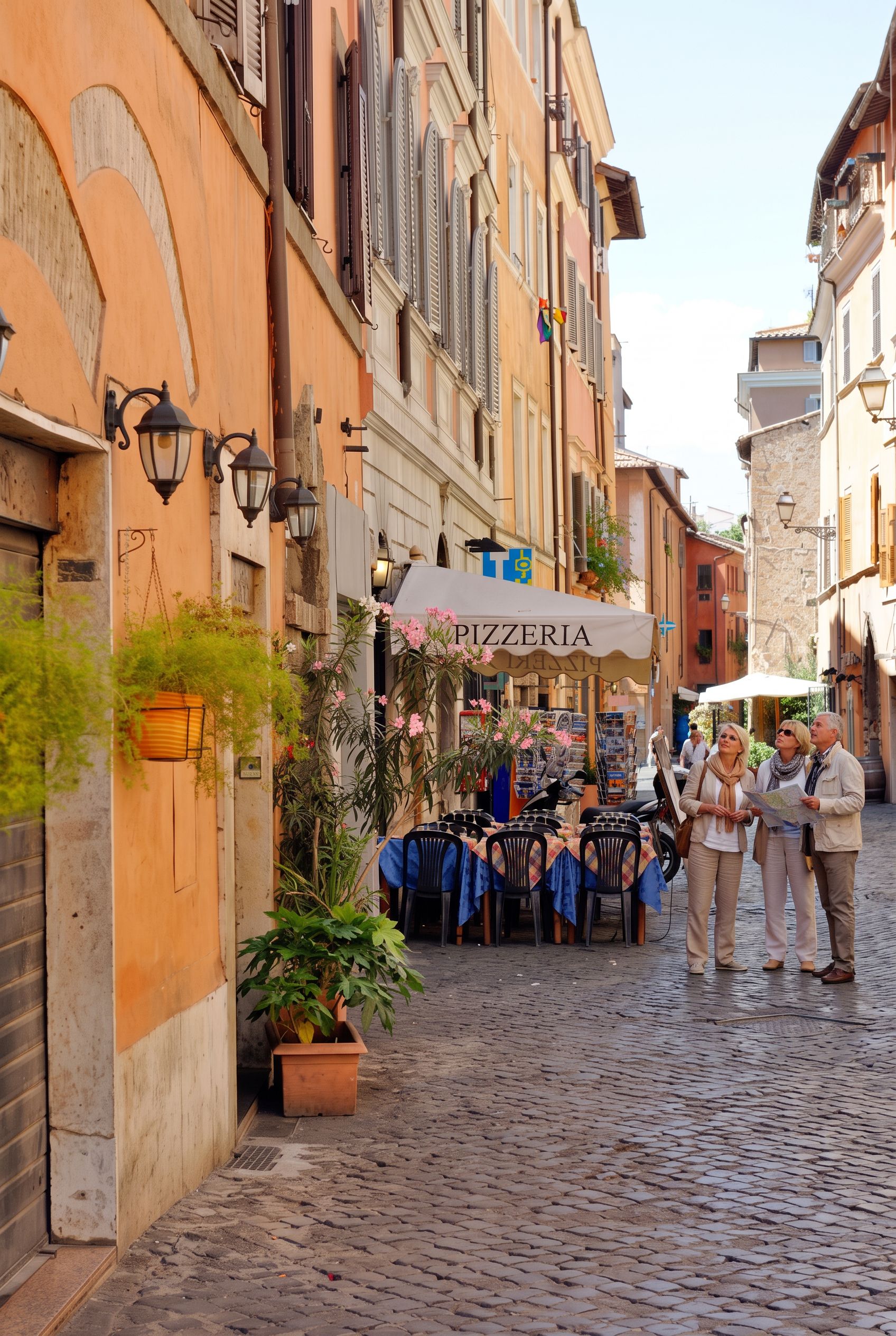
The centro storico suits a morning of short walks between free sights, then a rest. The Pantheon, Piazza Navona, the Spanish Steps and the Trevi Fountain sit within a compact area, but the cobblestones and some hill-like streets make the walking harder than the distances suggest.
Central Rome can tempt visitors into walking "because everything is about a 20 min walk," as one guide notes, but for older parents "it may be hard because of the cobblestone and some hill-like area on the streets." The practical answer is to break the morning into two or three short legs with a café stop between each. Cards are widely accepted, but carry some cash: one Rome thread advised always having enough for a taxi, because some cab drivers may refuse cards.
The Capitoline Museums make a good indoor anchor for this day. Concessionary fares and free-admission categories are documented, including reduced fares for some pass holders and a 50% reduction for non-residents on Wednesdays in the last two opening hours. The municipal museum system grants reduced admission to EU citizens aged 65 and over, and from February 2026 it grants free admission to residents of Rome and the Metropolitan City. Entitled visitors can obtain a free ticket by calling 060608 or at the ticket office.
For a slower afternoon, the city's official tourism portal promotes the Roma Pass, sold in 48-hour and 72-hour versions, covering more than 100 attractions. Reduced rates begin from the second or third site depending on the pass type. The pass is a tourist-cultural card for museums, monuments and archaeological areas; it is not presented as a mobility-assistance product.
Day Four: Trastevere and a rest afternoon
Trastevere is best reached by taxi and explored slowly. Its lanes are narrow and cobbled, and the neighbourhood rewards lingering over a long lunch rather than ticking off sights. Pair it with a rest afternoon back at the hotel before a final evening out.
This is the day to build in the rest that the rest of the itinerary has been earning. Visitors who planned a morning outing, lunch, a hotel rest and a second outing later reported that the pattern sustained them across four days. Trastevere fits that shape: a late morning taxi across the river, lunch, a slow wander, then a taxi back for an afternoon off your feet.
If you want one more indoor stop, the municipal museum portal documents tickets, audioguides and pass-related concessions across the city's civic museums. Audioguides on permanent exhibitions are €4, and video guides are €6, in Italian, English, French, German and Spanish. The exact on-site programme for each museum is not fully documented here, so check the individual museum page before you go.
How should over-50s get around Rome?
Use buses and taxis as your default, and treat the metro as a fallback. ATAC says 100% of the bus fleet has boarding platforms and a wheelchair area, while 70% of the tram fleet is low-floor. Four Line A stations lack lifts or stair lifts to the platforms.
ATAC, Rome's transport authority, states that all metro stations are accessible except Spagna, Barberini, Repubblica and Vittorio Emanuele on Line A, which do not have lifts or stair lifts to the platforms. A booking service exists for stair lifts or wheelchairs on Line A. Stations have tactile paths and maps for visually impaired passengers and displays for hearing-impaired passengers. The Termini-Centocelle line is not accessible for passengers with reduced mobility, but bus 105 provides accessible travel along the same route.
ATAC's fare pages confirm that Rome's public transport covers buses, trams, trolleybuses, metro and certain urban rail services, with concessions defined by resident category rather than a general over-65 tourist fare. No sourced Rome-specific senior fare or reduced-tariff pass for visitors was documented. Roma Capitale's mobility department says its work includes improving accessibility and safety for pedestrian and cycle movement through intermodal transport integration.
| Route | Distance | Driving time |
|---|---|---|
| Fiumicino Airport to Roma Termini | 37 km | About 40 minutes with clear roads, no stops |
| Roma Termini to Roman Forum | 3.8 km | About 5 minutes with clear roads, no stops |
| Roma Termini to Trevi Fountain | 2.9 km | About 5 minutes with clear roads, no stops |
These times assume free-flowing traffic at the speed limit with no stops and no rush-hour crossings. In practice, allow more. The Leonardo Express runs from Fiumicino Airport to Roma Termini and is described as the easiest airport rail link to the terminus; the airport rail station is steps from the Terminal 3 arrivals hall. Fiumicino lists priority security and passport checks for reduced-mobility passengers and a 24-hour first-aid point, with pharmacies in Terminals 1 and 3.
When should over-50s visit Rome?
April to June and September to October are the most comfortable windows for a four-day break. July and August are the hottest and driest months, and November is among the wettest. The EU's tourism seasonality release notes that October was the top month for Rome among several big-city regions.
Official World Weather Information Service data for Rome shows January averages of 3.1°C minimum and 11.9°C maximum, July 18.0°C to 30.3°C, and August 18.3°C to 30.6°C. Rainfall is lowest in summer and highest in late autumn: July 19.2 mm, August 36.8 mm, October 113.3 mm and November 115.4 mm. July and August are the months most likely to feel hardest for older travellers, with long bright days and strong heat.
November to March is lower-crowd but cooler and more closure-prone. For a closer look at timing, see our guide to when to visit Rome for warm days and small crowds.
What should you book ahead, and what works are under way?
Book the Colosseum and Vatican Museums before you fly, and check transport works before you travel. For a four-day trip, the most practical disruptions are the Metro A Lepanto works and Metro C service changes around Colosseo/Fori Imperiali.
ATAC said Lepanto would be closed from 18 July to 30 August 2026 for resurfacing, with trains passing through without stopping and nearby Ottaviano and Flaminio as alternatives. The work schedule said the renovated stop was due to be fully completed by 5 October 2026. This matters for access to Prati, Via Cola di Rienzo and the Vatican side of the city. Wanted in Rome reported that the closure was part of a broader €81.74 million Line A station-renovation programme funded from Jubilee 2025 resources and project financing, which suggests more intermittent disruption on Line A.
ATAC also listed "Modernisation of the Tramway Network" with service changes affecting lines 2, 3, 5, 8 and 14 in September 2026. That can affect east-west movement and short hops to central neighbourhoods. Roma Capitale said extraordinary maintenance resumed on 23 February 2026 on Ponte Risorgimento, affecting movement near the north side of central Rome and potentially taxi and bus routing.
On tickets, the recurring lesson from trip reports is to reserve timed entry early for the Vatican and Colosseum rather than improvising on arrival. One contributor said they would not schedule anything with very long lines when time is limited. Several sources warned against buying from street vendors; use official websites or queue at the ticket office.
What else should over-50s know before booking?
Carry cash for taxis, pack for cobblestones, and confirm accessibility details directly with each site.
Health provisions at individual sites are not documented here. The nearest pharmacy or medical post to each attraction is not stated, so ask at your hotel on arrival. No citywide official source gives a simple tourist-safety rating for Rome, so general safety is not documented here as a single official fact. Operationally, the accessible transit facts are the strongest safety-adjacent planning points: use ATAC buses, avoid the four inaccessible Line A stations unless pre-booked assistance is confirmed, and check station equipment status before travel.
For what to pack, our guide to packing for Rome, shoes, cobbles and summer heat covers the footwear question in detail. For dining between sights, Rome's finest restaurants and historic cafés is a separate guide. Hotel choice is its own topic, covered in our closer look at the Hotel de la Ville above the Spanish Steps.
The clearest pattern in guest feedback across Rome is that quiet rooms, good blackout and attentive service matter most to older travellers, and that street noise and weak sound insulation are the most common complaints. When booking any hotel, ask for a room away from the street and confirm whether the lift reaches your floor. That single question prevents most of the friction reported by guests.
What does the four-day shape look like in practice?
Day one is ancient Rome, day two the Vatican, day three the centro storico, day four Trastevere with a rest afternoon. Each day stays in one district, each major sight is pre-booked, and taxis cover the legs that would otherwise cost a kilometre on cobblestones.
The itinerary works because it respects the two things that most often derail a Rome trip for this age group: over-scheduling and over-walking. The most consistent regret in trip reports was trying to do too much walking, with several visitors saying they would use taxis, buses or hop-on-hop-off transport more often next time. Another recurring adjustment was splitting the day into a morning outing, a midday rest and an evening outing instead of one continuous marathon.
Major sites such as the Vatican Museums and the Colosseum have documented accessibility measures, while the historic centre and the Roman Forum remain uneven, crowded and in places physically demanding. Plan around the documented sites, book the tickets, keep the days short, and let taxis do the rest.


