
Rome rewards the traveller who plans a single grand meal and a handful of long coffees rather than chasing a list. The city's special-occasion dining is concentrated in rooftop rooms with views across domes and rooftops, while its historic cafes trade on marble, gilt and a sense of occasion that has survived wars, renovations and ownership disputes. For food-minded visitors aged 50 to 70, the practical questions are the same in both cases: how hard is the room to reach, what does the bill look like, and when should you go to avoid the crush.
This guide covers the high-end restaurants and the grand historic cafes of central Rome. The everyday trattoria circuit, where Romans eat on a Tuesday, is a separate subject and has its own dedicated guide to what to eat in Rome. What follows is about the rooms you book weeks ahead, and the counters you visit for a standing espresso.
Which Rome restaurants have the best views?
Rome's view dining is concentrated in rooftop rooms and terrace restaurants, and the Michelin Guide identifies seven Rome restaurants with views. Named venues include AROMA, Imàgo, Terrazza Borromini, Oro Bistrot and La Pergola. Michelin's recognition covers individual restaurants, not a citywide accreditation.
The Michelin Guide's list of Rome restaurants with a view is the most useful starting point, because it names venues rather than describing a category. The material repeatedly highlights AROMA, Imàgo, Terrazza Borromini and Oro Bistrot as premium panoramic options, with La Pergola at the Rome Cavalieri on Monte Mario as the headline name for a special-occasion dinner.
Terrazza Borromini, in Piazza Navona, spreads across two rooftop levels, on the fourth and sixth floors. The Roof Garden Restaurant at the Hotel Forum sits on the top floor of the hotel, overlooks the Imperial Forums, and is reached through the hotel lobby. Guest reviews describe the Roof Garden as suggestive, romantic and suited to an occasion to remember, and the hotel's American Bar is noted for views over the tops of churches and bells.
Two practical points apply to all of them. Open-air terraces often close or reduce service when the weather turns, especially in the rainy months. And one rooftop guide notes a specific Rome venue closed for a summer break from 14 to 29 August, so an August booking needs checking rather than assuming.
 AI-edited
What does a special-occasion dinner cost, and how do you book?
The material documents no published prices for Rome's fine-dining or rooftop restaurants, so no figure is given here. Rates are indicative and vary by season and booking channel. Book directly with the venue, confirm the terrace is open, and ask about the dress expectation when you reserve.
This is the honest position: the operator pages gathered for this guide do not carry menus with prices, and no reliable price range for these specific rooms appears in the material. Rather than estimate, the sensible approach is to treat the bill as a known unknown and settle it before you commit.
What the material does document is timing. The Roof Garden Restaurant at the Hotel Forum serves lunch on Saturday and Sunday from 12:30 to 15:30, and dinner Monday to Saturday from 19:00 to 23:30, and operates all year. Those hours are the venue's own published schedule, and they are the kind of detail worth confirming when you book, since terrace service can shift with the season.
Dress is not documented for these venues. For a room of this type in Rome, the safe approach is to ask when you reserve rather than assume, and to treat the answer as binding.
How do you reach Rome's rooftop restaurants if stairs are a concern?
Step-free access to the individual rooftop venues is not documented. What is documented is the city around them: ATAC states all Rome metro stations are accessible except Spagna, Barberini, Repubblica and Vittorio Emanuele on Line A, which lack lifts or stair lifts to the platforms.
That single fact matters more than it first appears, because several classic cafe and restaurant zones sit near exactly those four Line A stations. For a rooftop or special-occasion dinner, the practical assumption is to arrive by accessible bus or by taxi to the door, rather than relying on every historic street or metro exit being step-free.
On the buses themselves, ATAC states that 100% of Rome's bus fleet has a wheelchair area and boarding platforms. On trams, ATAC states that 70% of the fleet has platform-level flooring, but the Termini-Centocelle line is not accessible to passengers with reduced mobility; accessible journeys on that corridor are guaranteed by bus line 105. ATAC also runs a booking service for stair lifts or wheelchairs on Metro Line A.
None of this tells you what happens inside a specific restaurant. The venues do not publish step counts or lift details. Ask when booking, and ask specifically whether the route from the entrance to the table involves stairs.
Which historic cafes in Rome are worth the trip?
Antico Caffè Greco is the key historic name in the recent press, a short walk from the Spanish Steps on Via dei Condotti. Caffè Sant'Eustachio, near the Pantheon, is identified as historic and praised for its coffee. Sciascia Caffè is described as one of Rome's historic coffee shops and roasters.
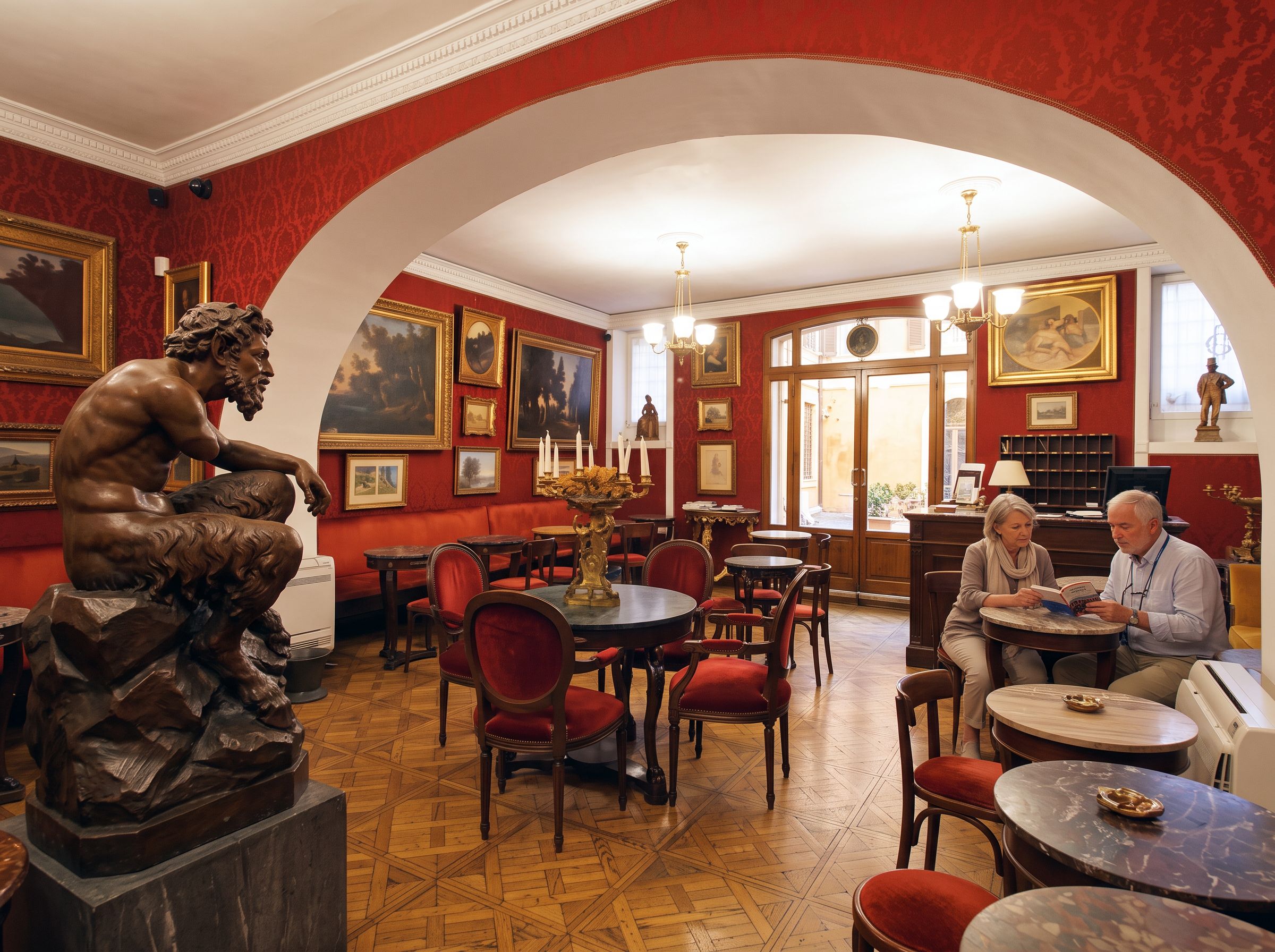
Caffè Greco's interior is what people come for. Guest reviews describe it as museum-like, with antique paintings, gilt frames, marble-topped tables, velvet banquettes and waiters in tuxedos. The historic decor is noted as unchanged. As of September 2026, Caffè Greco holds a Google rating of 3.9 out of 5 from 4,137 reviews.
One guest wrote on Google in May 2025:
"The staff are lovely and had remembered me from when I'd nipped in for an espresso at the counter when I was just passing through the day before. The day of my birthday I went inside and got a lovely marble table, with a wonderful view."
That review points to the single most useful thing to know about Caffè Greco: there are two ways to order, and they are priced differently. Standing at the bar costs less. Sitting at a table, inside or outside, costs substantially more, with espresso, cappuccino and cake prices repeatedly cited by guests as high. Reviews also note that the seating area is tight and crowded, and that waits for orders and the bill can run long.
Sant'Eustachio Il Caffè is praised in reviews for brilliantly good coffee with an extraordinary crema, and reviewers repeatedly recommend returning. Sciascia Caffè carries the historic roaster label.
When should you visit Rome's historic cafes?
Antico Caffè Greco takes walk-ins and needs no reservation for bar or table seating under normal conditions. The quietest times are before 10:00 a.m. or after 3:00 p.m. Those are the cafe's documented patterns, and they are the single most useful planning fact for a comfortable visit.
Arriving before ten or after three changes the experience from a crush to a seat. The same logic applies across the city's cafe culture, where the mid-morning and post-lunch windows are the busiest.
For the wider question of when Rome itself is comfortable, tourism guidance says the city's off-season runs from November to February, except Christmas and New Year, when crowds ease and prices fall, according to Rome tourism's seasonal guidance. April to June and September to October are described as offering the best balance of weather and manageable crowds. July and August are commonly 30 to 35°C or higher, and many Romans leave the city around Ferragosto, when some restaurants and cultural venues close.
For a fuller picture of the calendar, see our guide to when to visit Rome for warm days and small crowds.
What is the current state of Antico Caffè Greco?
The Telegraph reported the cafe was saved from closure after state intervention, while CNN later reported it had closed and the space was being prepared for a future reopening after renovations. Sources differ, and the position should be confirmed before you travel.
This is not a detail to gloss over. A cafe with a 2025 closure dispute and competing press accounts of its status is a cafe you check on before you build an afternoon around it. The two reports do not agree, and the material does not reconcile them.
What is not in dispute is the room itself, which reviews describe in consistent terms: the marble, the gilt, the tuxedoed staff. If it is open when you visit, the experience described by guests is the one to expect. If it is not, the historic cafe tradition it represents continues at Sant'Eustachio and Sciascia.
What about La Pergola and the city's headline restaurants?
Heinz Beck's La Pergola at the Rome Cavalieri closed for a major renovation on 18 November 2023 and was reported to reopen on 15 May 2024. The work was described as a broader reinvention of the venue at the Rome Cavalieri, on Monte Mario. Confirm the current position before booking.
La Pergola remains the major headline venue in Rome for a special-occasion dinner, and the renovation timing is the reason to check rather than assume. A reopening date reported in 2024 is not a guarantee of today's service, and the venue's own confirmation is the only reliable answer.
Beyond La Pergola, the material names AROMA, Imàgo, Terrazza Borromini and Oro Bistrot as premium panoramic options. Settimo is praised as ideal for romantic occasions with a view over Rome, and reviews repeatedly describe its service as friendly and attentive. Ambrosia Rooftop Restaurant & Bar draws repeated praise for its scenic rooftop location and sunset views, though reviews also warn of long waits on busy nights and occasional underseasoning.
Hotel Raphael's rooftop dining venue is described as a great find, with meals there organic vegetarian. The Hotel Albergo del Senato's rooftop bar overlooks Piazza della Rotonda and the Pantheon; a Rick Steves Travel Forum post calls it a great spot for an aperitivo, especially in the evening at sunset.
Where else can you eat well in central Rome?
Ristorante Terme di Diocleziano sits at Via del Viminale 3/A, not far from Termini. Serre Barberini opened as a cafe, bar and dining service inside Palazzo Barberini with views over the 19th-century garden. Augusto Caffè opened in the renovated Piazza Augusto Imperatore.
These are the newer and less panoramic entries in the material, and they suit a different kind of meal: a long lunch near a museum, or a coffee after a gallery visit rather than a rooftop occasion.
Turismo Roma describes Augusto Caffè as designed for locals, visitors and culture enthusiasts, with extended hours for special events. The Caffetteria-Bistrot at the Chiostro del Bramante is reported as a cafe-bistro concept with a panoramic terrace in a restored historic setting.
For anyone combining a meal with a museum, the National Roman Museum states that all its sites are accessible to people with limited mobility, with lifts, accessible restrooms, wheelchairs, tactile exploration at the Baths of Diocletian, and trained staff support. That is the kind of pairing, a morning collection and a long lunch, that suits a slower pace.
How should you handle safety and health logistics?
Official Rome-area guidance warns that pickpocketing risk is higher in crowded sightseeing areas and on public transport, naming St Peter's Square, the Trevi Fountain and the Colosseum as examples. Keep bags in front of you on buses, trams and the subway, especially at peak times.
For a fine-dining or cafe trip, the main safety issue in central Rome is opportunistic theft rather than site-specific danger, concentrated around major attractions and transit hubs. The historic centre's sampietrini cobblestones are separately described as uneven and tiring, and as a trip hazard for people with balance or mobility issues.
On medical logistics, the municipality-wide guidance does not document a single nearest pharmacy for the city. It directs visitors to the official pharmacy portal to find the closest pharmacy and its opening hours. Major Rome hospitals with emergency departments include Policlinico Umberto I, Ospedale San Camillo-Forlanini, Azienda Ospedaliera San Giovanni-Addolorata, Ospedale Pediatrico Bambino Gesù and Ospedale CTO Andrea Alesini, all within the municipality.
Emergency numbers are documented: Carabinieri 112, Police 113, Fire and rescue 115, Ambulance 118, Municipal Police of Rome 060606, and emergency medical service at night and on Sundays and holidays on 06 570600. For a fuller picture, see our guide to health, pharmacies and peace of mind in Rome.
What should you know about getting around?
Rome's transport network saw heavy disruption through 2024. Tram service was repeatedly replaced by buses during works at the Porta Maggiore depot, Metro A had repeated maintenance closures including a full closure of the Termini to Battistini section from 10 to 25 August 2024, and Metro C's Venezia station was still under construction.
Allow extra time if you are dining near Termini, the Spanish Steps, the Vatican or Piazza Venezia. Station closures for renovation tied to Jubilee preparations included Furio Camillo, Ottaviano and Spagna.
For a special-occasion booking, the buffer matters. A rooftop table at a fixed time and a delayed metro are a poor combination, and the taxi is the simpler answer when the schedule is tight.
Where a hotel is part of the plan, our closer look at the Rocco Forte hotel above the Spanish Steps covers a central base for this kind of trip.
What remains undocumented?
Several details a reader would reasonably want are simply not. Seat availability, elevator access and step-free access for each named venue are not documented. Walking times from major sights to these restaurants and cafes are not documented. Dress codes are not documented.
Senior or over-65 fares for Rome's restaurants and historic cafes are not documented either. No authoritative pass specific to senior dining or cafe access appears in the material. The clearest reduced-price policy found for an exact Rome site is the Pantheon's €2 reduced fare for EU citizens aged 18 to 25, and that page does not state a senior discount.
Where the material is silent, the answer is to ask the venue directly. For a restaurant, that means a short email covering access, dress and the terrace. For a cafe, it means arriving in the quiet window and ordering at the counter if the table prices are not what you had in mind.
The one thing the material supports without qualification is the shape of a good day: a long coffee before ten, a museum or a walk in the middle hours, and a booked table with a view once the light softens. Rome's finest rooms reward the traveller who plans the booking and leaves the rest to the afternoon.


