
Rome rewards walkers and punishes the badly shod. The city's historic centre is paved almost entirely in sampietrini, the small square cobblestones that give the streets their character and give visitors their blisters. Add long marble museum floors, summer temperatures that reach the low-to-mid 30s Celsius, and a strict dress code at churches, and packing becomes a practical exercise rather than an afterthought. This guide covers footwear, cover-ups, sun protection, water, bags and the walking conditions that shape all of it, for travellers aged 50 to 70 who want to spend their days on their feet rather than recovering from them.
What shoes should I pack for Rome's cobblestones?
Pack one pair of proven, broken-in walking shoes with grip and a stiff sole, plus a second equally sturdy pair if you want a change. Smooth leather soles, thin-soled flats, high heels and new shoes are all poor choices on Rome's sampietrini, which are uneven and sometimes wet.
Rome-focused packing guidance is consistent on this point: shoes with grip are practical for uneven and sometimes wet cobblestones, and smooth leather soles are not suitable on wet cobbles. The same guidance says high heels are impractical on the sampietrini used in many streets. The Colosseum's official visitor guidance goes further, recommending comfortable, closed-toe walking shoes and warning that flip-flops and high heels are a bad idea because the route includes uneven paving, steep steps and cobblestones.
Ankle support matters more than cushioning alone, according to a Rome seniors-and-mobility guide, because the cobblestones in the historic centre are genuinely uneven and tiring over extended distances. A stiff sole keeps feet from getting exhausted, according to a Reddit contributor.
 AI-edited
How demanding is the walking in central Rome?
Central Rome is genuinely hard on feet and calves. The roads are not flat, the paving is rocky and uneven, and the distances between major sights add up. Repeated first-hand accounts describe the city as tiring enough to justify more shoe support than most visitors would use at home.
Rome's cobblestones have been described as "beautiful and brutal," and the Vatican Museums themselves recommend comfortable walking shoes because the museums are vast. That combination, hard streets outside and long marble floors inside, is what makes footwear the single most important packing decision for this city.
Two practical consequences follow. First, plan on very good walking shoes because central Rome has ongoing construction, station closures and tram substitutions, and allow extra time and flexibility for moving between the historic centre, the Vatican area and the Termini corridor. If you need frequent sitting breaks, plan your route around the major churches and museums, which have seating, rather than assuming benches will appear when you need them.
What should I wear to churches and St Peter's Basilica?
Shoulders and knees must be covered at St Peter's Basilica, the Vatican Museums, the Sistine Chapel and most churches. Sleeveless tops, short skirts, ripped clothing and hats worn indoors are not permitted. Carry a light scarf or layer in summer so you can cover up quickly at the door.
St Peter's Basilica's own visitor page states that visitors must dress modestly, with shoulders and knees covered, and that sleeveless tops, short skirts, ripped clothing, and hats worn indoors are not permitted. The Vatican Museums, Sistine Chapel and St Peter's Basilica all enforce this, according to the Vatican dress code guide. Guards will turn people away for improper dress at Vatican entrances.
At least nine of the gathered Rome guides advise carrying a scarf, shawl, cardigan or similar layer for church entry. A lightweight skirt plus a shirt covering the shoulders became a reliable daily uniform for one traveller, because it handled both heat and church visits. A sarong or a pair of sweatpants in a backpack was another recommended quick cover-up. The rules do not change in cooler months, so your layers still need to include something that keeps shoulders covered for religious sites.
St Peter's also prohibits large backpacks, tripods and sharp objects, and there is no cloakroom inside the basilica, so travellers should pack light and bring only small backpacks or small personal bags. Re-entry is not permitted once you exit, so plan your visit carefully. Entry to the basilica itself is free for all visitors, but everyone must pass through mandatory security screening. As of September 2026, St Peter's Basilica holds a Google rating of 4.8 out of 5 from 183,579 reviews.
"I felt fried while waiting in the queue🥵You can get tickets to the dome via lift, even then you will have to climb a lot of stairs so be prepared for that as well. Be sure to cover up, they may not let you in if you aren't dressed properly." (Google, July 2026)
How do I handle Rome's summer heat?
Pack lightweight, breathable fabrics from May through September, a sun hat, sunscreen and a refillable water bottle. July and August are hot, often around the low-to-mid 30s Celsius, with strong sun and little shade. The Colosseum's official guidance explicitly recommends a sun hat.
At least seven of the gathered guides advise light clothing plus sun protection and a refillable water bottle for Rome in summer. Lightweight, breathable fabrics are described as essential from May through September. Temperatures can reach 30 to 38 Celsius with humidity, according to one traveller account, and shoes need to be comfortable for long walking days in that heat.
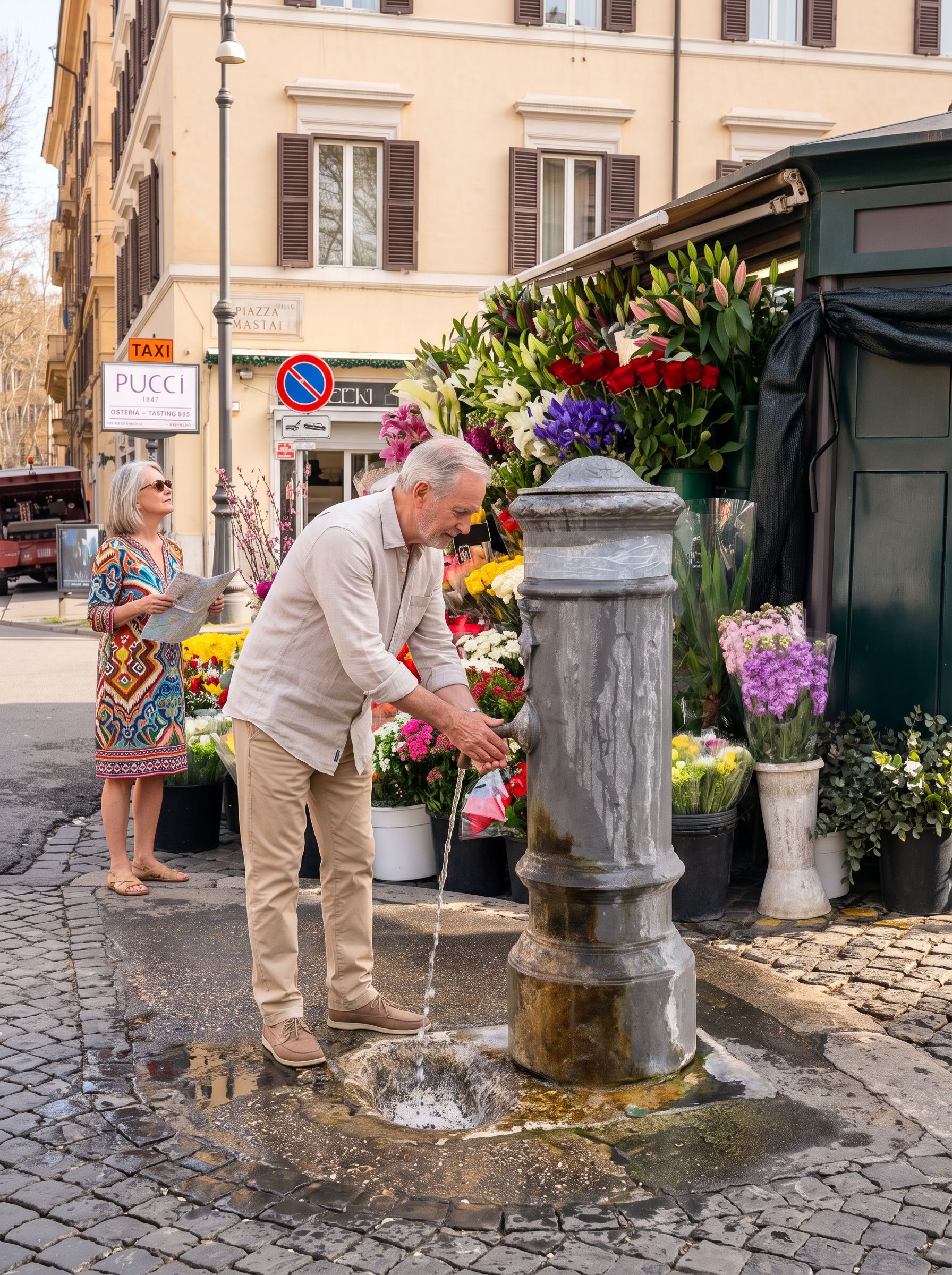
Rome's nasoni, the cast-iron drinking fountains found across the city, were created to provide free drinking water, according to Turismo Roma. A reusable bottle is practical because refillable water is available from fountains along the Colosseum route, per official Colosseum guidance. Small bottles of water are allowed at the Colosseum, which makes a small bag plus bottle the most practical combination for that site. Food, picnics and glass containers are not permitted there, but refillable water bottles specifically are.
What bag should I carry in Rome?
A crossbody bag with a secure closure, worn in front of you, is the practical choice. Large backpacks and rolling suitcases are prohibited at the Colosseum, which has no internal luggage storage. St Peter's Basilica also has no cloakroom, so pack light.
Rome travel guidance warns that major tourist sites and crowded public transport attract pickpockets, and advises a crossbody bag, a closed bag, and keeping valuables in front pockets or in front of you. Pickpockets are a concern at the Colosseum, the Vatican, the Trevi Fountain and metro Line A, according to that guidance.
The Colosseum's rules reinforce the same conclusion from a different direction. Large backpacks, bulky luggage and rolling suitcases are prohibited there, while small daypacks and crossbody bags are allowed. There is no internal luggage storage facility, which makes it sensible to travel with a small day bag rather than a suitcase or bulky tote. St Peter's Basilica's visit page says there is no cloakroom inside, so travellers should pack light and bring only small backpacks or small personal bags.
For evening meals and quieter hours, the city's dining culture has its own rhythms worth reading up on separately; our guide to Rome's finest restaurants and historic cafes covers where to eat rather than what to carry.
What should travellers with mobility needs know?
ATAC states that 100% of Rome's bus fleet has boarding platforms and a wheelchair area. All metro stations are accessible except Line A stations Spagna, Barberini, Repubblica and Vittorio Emanuele, which lack lifts or stair lifts to the platforms. The Termini-Centocelle line is not accessible, with bus 105 covering that route.
ATAC, the city's transport operator, publishes these details directly. The Termini-Centocelle line is not accessible to passengers with reduced mobility, and accessible journeys on the same route are guaranteed by bus line 105. ATAC customer service can be reached on 060606 for information on public and private mobility and the Metrebus tariff system.
At St Peter's Basilica, wheelchair users and visitors with reduced mobility should use the right-hand security entrance in St Peter's Square, which provides step-free access into the basilica. Inside, the main floor is accessible, and staff are available to assist when needed. The dome is not fully accessible due to stairs near the top. Visitors with certified disabilities may receive priority access and assistance at security. The basilica page states that disabled visitors with certified invalidity of over 74% receive free entry, with free entry extended to one accompanying visitor.
On fares, the gathered Rome transport sources do not document a Rome-wide over-65 fare or senior pass. A travel guide on Rome's public transport says accessible ticket options include single and multi-day city passes, but it does not document any senior or over-65 fare for Rome itself. EU citizens aged 65 and over get free entry to state museums on the first Sunday of the month, according to a Rome seniors guide, but this applies to state museums, not every attraction in the city. There is no universal senior discount across Rome for non-EU visitors.
What about health and pharmacies in Rome?
Emergency numbers are 112 for Carabinieri, police and fire brigade, and 118 for the doctor on duty and ambulance service. First aid and pharmacies are available 24/7 at Fiumicino Terminal 1 and Terminal 3.
For Rome emergency help, one source lists 112 for Carabinieri, Police and Fire Brigade, 118 for doctor on duty and ambulance service, and 0667109200 for Public Safety Rome. ATAC's number is 0645951 and Trenitalia's is 892021, though that source is a general useful-numbers page rather than a healthcare directory. Inside Vatican City, the St Peter's guidance lists the Vatican City Gendarmerie at +39 06 6988 3311 and the Vatican City Fire Brigade at +39 06 6988 3228 for urgent matters.
A general Rome numbers page lists a "pharmacies on duty" number, but it does not identify a specific pharmacy near a named site in Rome. If you take regular medication, bring enough for the trip and carry the prescription. Our dedicated guide to health, pharmacies and peace of mind in Rome covers this ground in full.
What should I pack for a four to seven day trip?
Rome-focused packing guidance for a four to seven day trip recommends layered tops, two pairs of trousers or equivalents, one smart evening layer, one season-appropriate jacket, one scarf that can cover shoulders, two pairs of shoes, and a compact umbrella for autumn and winter.
That list is framed as seasonal packing advice for Rome rather than a climate record, and it does not give exact temperature statistics for the city. The logic behind it is sound for travellers aged 50 to 70: layers rather than single outfits, because church dress rules do not change with the weather and because museum interiors and church naves stay cool even in high summer.
Two widely circulated packing formulas, the 5-4-3-2-1 rule (five tops, four bottoms, three pairs of shoes, two layers, one accessory set) and the 3-3-3 rule (three tops, three bottoms, three pairs of shoes), are not documented in any Rome-specific source gathered here. Treat them as generic frameworks rather than Rome advice. The Rome-specific version above is the one to follow.
What should I leave at home?
Leave the high heels, the smooth-soled leather shoes, the brand-new trainers, the large backpack and the rolling suitcase. Each of these is either impractical on cobblestones, prohibited at a major site, or both. The Colosseum bans large backpacks and rolling suitcases outright.
Rome's clearest packing don'ts are well documented. Sleeveless or very short clothing will be refused at St Peter's and other churches. Large bags are not permitted at the Colosseum. High heels are impractical on sampietrini. Smooth leather soles are unsuitable on wet cobbles. Ballet flats will not work, and most flats are not supportive enough for miles of walking and navigating the cobblestones, according to a Rick Steves shoe discussion. Lightweight shoes were too fragile for the cobblestone roads in Rome and other Italian cities, according to a forum post.
What to bring instead: closed-toe or exercise sandals with good support were recommended for one pair that handles both walking and warmer weather. A stiff sole keeps feet from getting exhausted. And if you are visiting in the cooler months, the church dress rules still apply, so your layers need to include something that covers the shoulders.
When should I go to avoid the worst of the heat?
July and August are the hottest months, often around the low-to-mid 30s Celsius with strong sun and little shade. May through September calls for lightweight, breathable fabrics.
Breathable fabrics are essential from May through September. A sun hat, sunscreen and water are repeatedly advised for the hottest months. For autumn and winter, the same Rome packing guidance recommends a compact umbrella alongside the layered tops and jacket.
Our separate guide to when to visit Rome for warm days and small crowds takes that question up in detail. For packing purposes, the practical takeaway is that your shoe and layer choices matter most in the hot months, when closed shoes feel too warm and churches still require covered shoulders.
One final note on the city itself: Rome has had a heavy wave of Jubilee-related works affecting visitors, especially around the centre, Termini, the Vatican area and the main metro and tram corridors, according to local and regional reporting. Metro A has been set to close early on weeknights, with full-station closures at Vittorio Emanuele, Spagna and Ottaviano, while Cipro stayed open under renovation. The entire tram network was being replaced by buses for long stretches during redevelopment of the Porta Maggiore tram depot. Plan on very good walking shoes and allow extra time and flexibility for moving between sights.
Rome rewards the traveller who packs for the ground underfoot. Get the shoes right, carry a scarf and a bottle, keep your bag small and close, and the city's cobbles stop being an obstacle and become part of the pleasure.


