
The first thing you notice about eating in Hallstatt is that it requires strategy. This tiny lakeside village, with its 7,000-year salt-mining history and UNESCO-protected charm, has just nineteen catering businesses on the official regional register, and several of them stop serving at five in the afternoon. For food-minded travellers aged 50 to 70 who value authentic flavours over tourist traps, knowing where—and when—to eat makes all the difference between a memorable meal and a frustrating evening spent hunting for a table.
 AI-edited
What makes Hallstatt's cuisine different from the rest of Austria?
Hallstatt's food story is written in its lake. The cold, clear waters of Hallstätter See produce two exceptional fish—Reinanke (whitefish) and Saibling (Arctic char)—that define the region's culinary identity. These are not menu afterthoughts; they are the main event, prepared simply to let their delicate flavour shine.
The Salzkammergut region's cuisine is Alpine comfort at its finest: hearty, honest, and rooted in what the land and lake provide. Unlike Vienna's refined schnitzel culture or Salzburg's festival-driven dining, Hallstatt's tables are filled with dishes that sustained salt miners for centuries—dense dumplings, slow-cooked meats, and fish pulled from the lake that morning. The salt itself, mined here for millennia, has shaped preservation techniques and flavour profiles you won't find elsewhere in Austria.
For a broader understanding of how Hallstatt fits into the region's travel landscape, our guide Hallstatt and the Salzkammergut for Travellers Over 50: A Realistic Guide covers the practicalities of visiting this remarkable area without the stress.
Where can I find the freshest lake fish?
Bräugasthof, first mentioned in a document in 1472 and standing on the lakeshore under a 150-year-old chestnut tree, is the best-known address in Hallstatt for lake fish. The regional register lists fish from the Hallstättersee among its specialities, and Saibling (Arctic char) is usually the more affordable of the two. Rick Steves calls it "just the place to try some of Lake Hallstatt's prized fish", and the family has run the house for 150 years.
The fish here is not complicated—and that is precisely the point. Reinanke is typically pan-fried with butter, lemon, and parsley in the style known as Forelle nach Müllerin Art. Saibling arrives either gebacken (breaded and fried, the skin crackling) or blau (poached, which turns the skin a striking blue-grey). The flavour sits somewhere between trout and salmon—delicate enough to taste the lake, substantial enough to satisfy.
Seewirt Zauner—the family-run house on the Marktplatz that older listings still call Gasthof Zauner—also specialises in fish, and the regional register describes it as one of the best-known fish restaurants in the inner Salzkammergut, with char and whitefish from the Hallstättersee, game from the surrounding forests and regional vegetables. Plan around its days: it is closed on Sundays and Mondays, and the warm kitchen serves from 12:00 to 14:30 and again from 17:30 to 20:30. It takes Bankomat debit cards, Mastercard, Visa, Diners Club and JCB. As of 25 August 2026 it holds a Google rating of 3.9/5 from 811 reviews.
What traditional Salzkammergut dishes should I try beyond fish?
Beyond the lake, Hallstatt's menu reads like a greatest hits of Alpine comfort food: Wiener Schnitzel, Tafelspitz, Kasnocken (cheese dumplings with caramelised onions), and the obligatory Kaiserschmarrn for dessert. These are not innovations—they are traditions perfected over generations, and they are exactly what you want after a morning exploring the village's steep streets.
Kasnocken deserves special attention. These small pasta dumplings are smothered in local cheese and topped with deeply caramelised onions—the ultimate comfort food on a cool Salzkammergut afternoon. You will find them on most menus, and Bräugasthof on Seestraße prepares them in the traditional way. One name worth untangling: Gasthof Simony, which turns up in listings as though it were a restaurant, is a guest house in the Wolfengasse with no kitchen of its own—it sends its own guests to the Bräugasthof, "less than a 2 minutes' walk" away, which it calls its main building. For a lakeside table at lunch, the Seeauer restaurant at the Heritage Hotel on the Landungsplatz has a raised terrace seating about 30, with a step-free entrance to the building.
For those who prefer meat, Tafelspitz—boiled beef served with apple-horseradish sauce and vegetables—appears on several menus, though it is more commonly associated with Vienna. At Bräugasthof it comes out of a kitchen the house itself describes as traditional Austrian home cooking, listed in the regional register as regional, Mediterranean and vegetarian. Schnitzel, whether veal or pork, is reliably excellent at Gasthof Zauner and Bräugasthof alike.
Where should I go for cakes, Kaiserschmarrn, and afternoon treats?
Café Derbl on the Marktplatz is the best-known address for Apfelstrudel and Kaiserschmarrn; in summer it serves warm food and house-made pastries straight through from 10:00 to 17:00, and it is closed on Sundays and Mondays. For bread and pastries, head to Bäckerei Maislinger at Seestraße 156, open Monday to Saturday from 06:30 to 17:00, which bakes with regionally milled grain, brine from the salt mine and its own natural sourdough.
Kaiserschmarrn—those fluffy, torn pancakes dusted with powdered sugar and served with berry compote—is the dessert you will remember, and it is worth eating somewhere you can sit for a while. Café Derbl on the Marktplatz keeps its warm kitchen going all afternoon in summer. For a table nearer the water, the Seecafé at Seelände 173 sits at the Lahn end of the village, roughly a kilometre south of the Marktplatz boat landing along the shore road.
For a quick, comfortable breakfast without the restaurant rush, Die Gemischtwarenhandlung am See on Gosaumühlstraße does exactly that job: a self-service café inside a small general store, open daily from 09:00 to 17:00, two minutes' walk from the Hallstatt Markt boat landing, with a level entrance and coffee, cake, strudel and filled rolls over the counter. It is not glamorous, but it is efficient and avoids the crowds that descend on the main cafés between 10:00 AM and noon.
If you are considering a day trip to nearby Bad Ischl for its famous spa culture and café scene, our article Taking the Waters at Bad Ischl: A Spa Day Near Hallstatt provides everything you need to plan a relaxing afternoon away from Hallstatt's crowds.
Gasthaus versus lakeside terrace: which dining style suits me better?
Choose a Gasthaus (traditional inn) for warmth, authenticity, and reliable quality. Choose a lakeside terrace for atmosphere, views, and a sense of occasion. The trade-off is simple: Gasthäuser are cosier and often serve better food; terraces are more exposed to weather and crowds but offer the postcard-perfect setting Hallstatt is famous for.
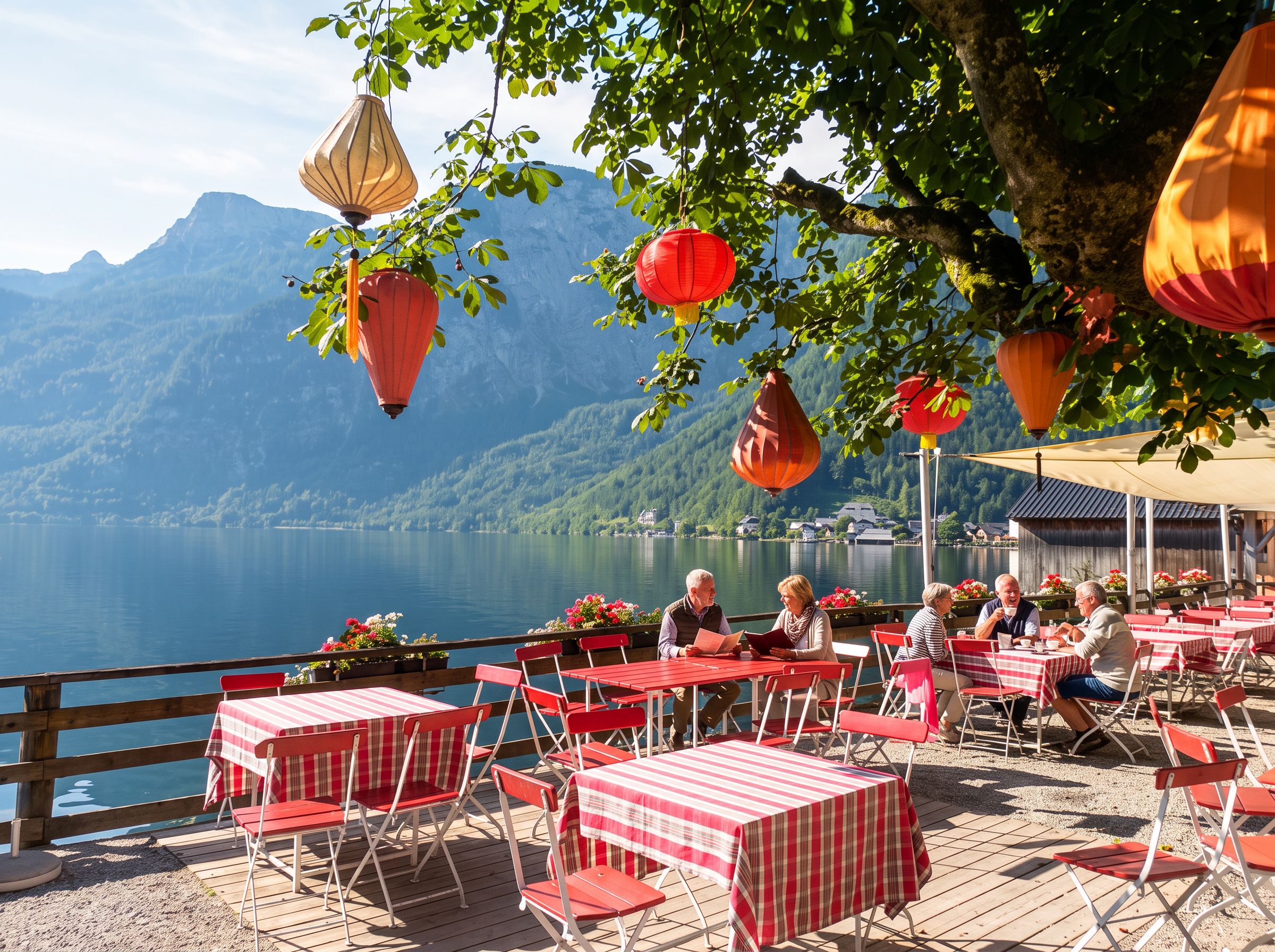
Bräugasthof manages to be both—its garden under the 150-year-old chestnut tree is one of the most pleasant outdoor dining spots in the village, while the house itself, first documented in 1472, still reads as an old inn. The raised terrace of the Seeauer restaurant at the Heritage Hotel on the Landungsplatz seats about 30 and looks straight down the lake. For a quieter alternative, consider Uferwirt Seeraunzn, a locals' place on the east shore at Obersee 41 in Bad Goisern. Reaching it takes about 40 minutes on foot from Hallstatt train station along the Ostuferwanderweg, and the reward is Salzkammergut cooking, a sun terrace at the water and the view back to Hallstatt—but the house opens only from early or mid-May to mid or late October, and in wet weather it closes or shortens its hours, so check before you set out.
Gasthäuser like Zum Bader in the Wolfengasse, a few steps off the Marktplatz, offer classic Austrian comfort food in a setting that feels like stepping into a private home. These are the places where you will hear German spoken at neighbouring tables and where the waitress might remember your order from last year. Two things to settle before you plan an evening around one: Zum Bader is closed on Wednesdays and Thursdays, and its warm kitchen runs from 11:30 only until 17:00, which makes it a lunch address rather than a dinner one.
How do I avoid the tour-group dining traps?
The single most effective strategy is to book dinner before you arrive, wherever booking is possible. Nineteen catering businesses are registered in Hallstatt itself, several of them closing at 17:00, and walk-in dining during the summer months is unreliable. Two houses need a workaround rather than a booking: Bräugasthof states that it cannot take table reservations in the summer months at all, and Uferwirt Seeraunzn can only confirm one when the weather is set fair.
Beyond reservations, time your meals with the day-trip rhythm rather than against it: the boat landing and the main square are at their busiest between 11:30 AM and 2:00 PM, when coach and boat arrivals overlap, and an hour either side makes a noticeable difference. The kebab cart on the Landungsplatz, right beside the boat landing, is a pragmatic option if you are caught without a reservation and do not want to queue for a table.
For dinner the practical shortlist is short, because most Hallstatt kitchens stop early: Bräugasthof for lake fish, Seewirt Zauner for fish, game and schnitzel, and the Seeauer at the Heritage Hotel, which serves an evening menu from 17:30 to 21:00 between April and October and stays open until 22:00 in winter. Café Derbl's warm kitchen and Zum Bader both stop at 17:00, and Uferwirt Seeraunzn's kitchen at 19:30—those three are lunch and afternoon addresses rather than dinner ones.
What price bands should I expect?
Hallstatt dining falls into three clear price bands. Budget (€8–€15): bakery breakfasts, kebab cart, grocery-store lunches. Mid-range (€15–€30): Gasthaus mains, lake fish, traditional Austrian dishes. Premium (€30–€50): lakeside terrace dining, multi-course meals, wine pairings. Most travellers aged 50–70 will find the mid-range band offers the best value and authenticity.
| Restaurant | Fish Mains | Meat Mains | Desserts |
|---|---|---|---|
| Bräugasthof | €18–€25 | €16–€22 | €6–€9 |
| Seewirt Zauner | €20–€28 | €18–€24 | €7–€10 |
| Uferwirt Seeraunzn | €15–€22 | €14–€20 | €5–€8 |
Cards go further than Hallstatt's reputation suggests. The regional business register lists Bräugasthof as taking cash and Bankomat debit cards, and Seewirt Zauner, Café Derbl, the Seeauer and Die Gemischtwarenhandlung as taking the major credit cards as well. Bäckerei Maislinger and Zum Bader are the two to carry notes for—neither is listed for Visa or Mastercard. Hallstatt has two cash machines, both on Seestraße, at numbers 99 and 114. Kitchens do stop earlier than most visitors expect: 17:00 at the cafés and Gasthäuser, 20:30 to 21:00 at the fish restaurants, which makes a 6:00 to 6:30 PM table the safe choice.
What seasonal factors affect dining in Hallstatt?
Summer brings the widest choice of outdoor dining and the heaviest crowds; winter menus shift toward hearty indoor fare—goulash, dumplings, mulled wine—and the seasonal places on the shore shut for months. Lake fish follows Upper Austria's closed seasons: whitefish (Reinanke) may not be taken from 16 October to 31 December and Arctic char (Seesaibling) from 16 September to 15 March, so late spring to early autumn is when both are genuinely local. Bräugasthof itself is registered for all four seasons and closes only on Wednesdays.
Spring and autumn are the sweet spots for food-minded travellers. The weather is mild enough for terrace dining at lunch, crowds are thinner, and Reinanke stays in season until 15 October. September suits the walk out to Uferwirt Seeraunzn particularly well—the house stays open into mid or late October, and after that it shuts for the winter.
For those visiting during the Christmas season, note that the Hallstatt Christmas Market is not an Advent-long affair: it runs for a single day, Tuesday 8 December 2026, from 10:00 to 18:00 on the historic Marktplatz, and entry is free. The Gemeindeamt Hallstatt, which organises it, lists musical entertainment, crafts, traditional delicacies, cookies, mulled wine and punch. One day is easy to miss, so put the date in the diary rather than planning a December trip around a market that will not be there.
"Nice food. I had the whole trout with parsley and potatoes. Usually not a huge fan of fish, however must say that I enjoyed this one. Would highly recommend, service was nice and view was great. Fairly priced for the view that was provided with the meal." — a diner wrote of Bräugasthof on Google in June 2026
What practical tips will make my dining experience smoother?
Book dinner reservations weeks in advance during summer. Carry cash. Eat lunch early (11:30 AM) or late (1:30 PM) to avoid the day-tripper rush. Ask every restaurant about their fish source—if it is not from Lake Hallstatt, consider ordering something else. And never skip the Kaiserschmarrn at a restaurant that makes it fresh to order.
For mobility considerations, the regional accessibility register is more use than any general reassurance. Seewirt Zauner on the Marktplatz is recorded with a level entrance, a lift reachable without steps or thresholds, and an accessible WC in the restaurant area. The Seeauer at the Landungsplatz is recorded with a step-free entrance to the building, a ramp at 2 per cent, a corridor of at least 150 cm and a lift cabin more than 110 cm wide. Die Gemischtwarenhandlung am See also has a level entrance. Bräugasthof, Café Derbl, Zum Bader and Uferwirt Seeraunzn publish no accessibility details and ask visitors to enquire, so telephone ahead if steps matter to you. The walk out to Uferwirt Seeraunzn takes about 40 minutes each way on the Ostuferwanderweg, which the regional tourist board grades as easy rather than level.
If you are arriving by train, our practical guide Getting to Hallstatt: Airports, Trains and Transfers – A Practical Guide for Travellers Over 50 covers everything from luggage logistics to the ferry connection from the train station to the village centre.
Finally, remember that Hallstatt's dining scene is small and finite. There are perhaps a dozen restaurants worth your time, and the best ones fill up quickly. Approach your meals with the same planning you would apply to a museum visit or a boat tour—and you will leave with the taste of the lake lingering long after you have returned home.


