
The Amalfi Coast is a vertical place. Towns cling to cliffs, staircases replace pavements, and the sea is often a long way below the road. Yet the coastline also holds a set of genuinely level, low-effort walks and viewpoints that suit travellers aged 50 to 70 who want the scenery without the exertion. Amalfi's seafront, the promenades at Maiori and Minori, Ravello's garden terraces and the flatter stretches of Sorrento are the documented options.
This guide covers only those gentle routes: where they are, what the surface is like, how much shade to expect and where the benches are. Hiking trails, including the Path of the Gods, sit outside its scope and have their own dedicated guide.
Which Amalfi Coast towns are actually flat enough to stroll?
Positano and Furore are steep and stair-dependent, and are best seen from the water rather than explored on foot.
The coast is repeatedly described in accessibility material as cliff-built, stair-heavy and hard going for independent walking. The flat walking that is documented concentrates in a handful of places. Amalfi's waterfront and Piazza Duomo area are described as flat or mostly flat, with few stairs in the central zone and a level promenade leading toward the church square. One source calls Amalfi the coast's most accessible major town.
Maiori and Minori, which sit side by side, are described as having long flat promenades and accessible beaches, with sea-access ramps in summer mentioned in at least one source. One guide calls Maiori the most accessible village on the coast.
Ravello is the surprise. Several travellers report that the town centre around Piazza Duomo is largely flat once you are up there, which is unusual for this coastline. The catch is the approach: getting to Ravello from Amalfi involves stairs or a bus, so the gentle part is within the town itself.
What is the walk along Amalfi's seafront like?
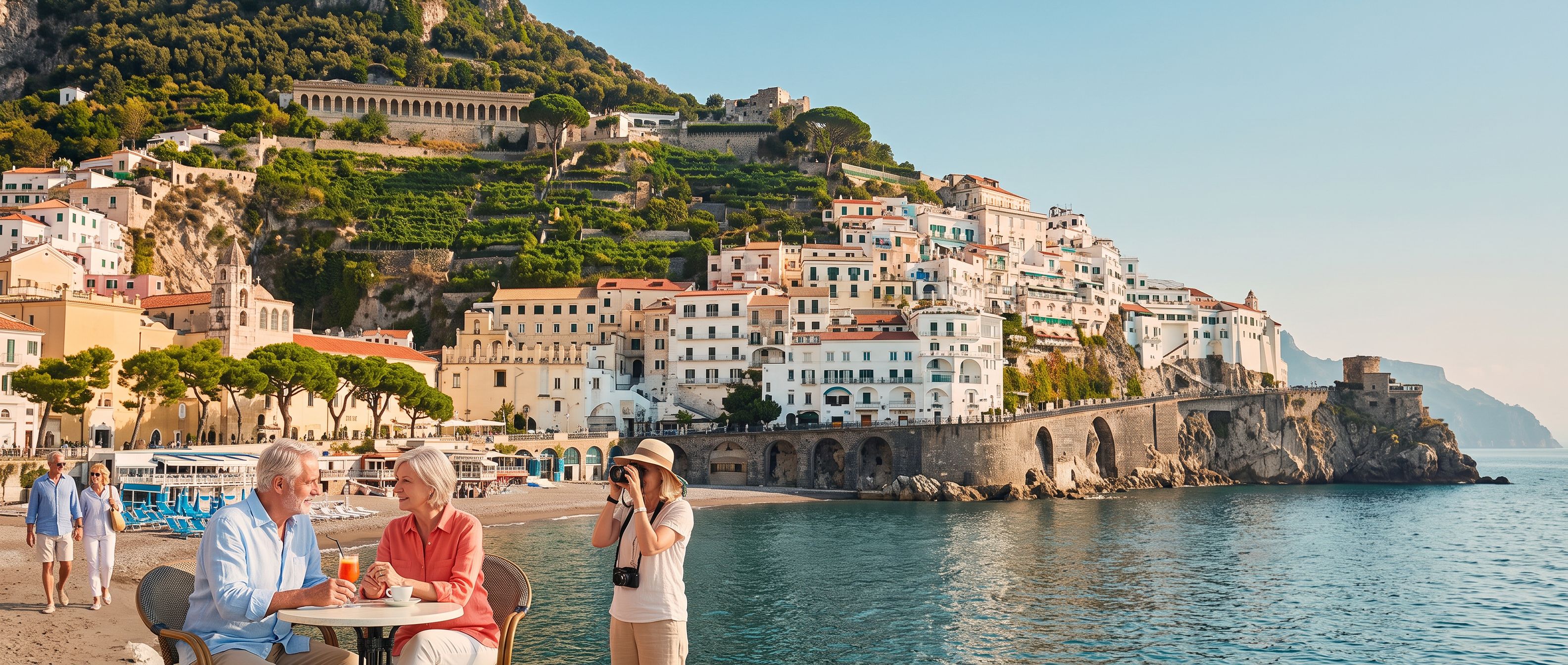
Amalfi's Lungomare dei Cavalieri is the town's main waterfront promenade, described as a public space with no entrance fee and access at all hours. The seafront-to-square walk takes roughly five to ten minutes along the same level waterfront edge, below Piazza Duomo.
The promenade sits below Piazza Duomo, where the ferry quay and boat-tour kiosks are. A town guide describes the walk from the seafront up to the square as about five to ten minutes along the same level waterfront edge. Amalfi's historic centre is arranged as a pedestrian island for the entire day, except for short time slots, according to the town's own visitor information at visitamalfi.info, which keeps the seafront approach free of general traffic for most of the day.
Amalfi became a major maritime power by 839 AD, according to UNESCO-related history material, and the town's shape still reflects that sea-facing past. The flat zone is the harbour edge; the streets behind it climb steeply into the valley.
 AI-edited
Two practical notes for anyone with limited stamina. First, the exact surface type, bench count and shade coverage along Amalfi's promenade are not documented in the material reviewed, so plan to rest at the cafes around the square rather than counting on benches. Second, the cathedral itself is not fully accessible, because steps are required to enter. The square in front of it is level.
Are Maiori and Minori good for an easy promenade?
Yes. Maiori and Minori have the longest documented flat seafronts on the coast. Maiori's Lungomare, identified in one source as Via Amendola, is described as shaded in stretches and lined with benches, with parking along the embankment payable by meter or app.
For travellers who want a level outing rather than a hill walk, Maiori is the strongest candidate. The promenade is described as a public space with no ticket required, generally accessible at all hours. Shade in stretches and benches along the route make it a realistic option even in the middle of a warm day.
Minori is confirmed by official tourism material as a village in Campania on the Amalfi Coast, but the same material does not document the seafront promenade details needed for planning. Promenade information for Minori specifically is not documented in the gathered official material. Travellers who need precise detail on surface, length or bench spacing should ask at the local tourist office on arrival.
Ferry ticketing in this area has changed recently. A 2026 coast report said Grassi Junior added direct Positano to Salerno and Salerno to Capri ferry lines, with a new ticket booth on the pier in Maiori, which makes arriving by boat and strolling the promenade a straightforward combination.
Can you enjoy Ravello's gardens without climbing?
Partly. Ravello's town centre is largely flat once reached, and Villa Rufolo sits directly off the main square next to the Duomo, an easy walk from the centre. Villa Cimbrone's Terrace of Infinity is reached by a longer uphill approach with gravel or uneven paths and steps.
The two famous gardens behave very differently. Villa Rufolo is described as partially accessible, with an accessible entrance area or main-terrace access but some steps in the grounds. A guidebook and map are provided at admission, which guests find helpful for following the paths and not missing areas. The grounds are small enough to cover in roughly an hour, with seating areas available to rest. Parts of the garden can be closed or obscured when a concert stage and bleachers are erected for the Ravello Festival, particularly in August.
Villa Cimbrone is the harder proposition. A 2026 accessibility guide says the famous viewpoint is reachable by a flat but slightly uneven gravel path of about 700 metres. The last approach from Ravello's main square takes about 10 to 15 minutes on foot, and the final stretch is pedestrian only. The gardens are reported as open daily, year-round, from 9:00 a.m. until sunset, with the last ticket sold about 30 minutes before closing. A summerinitaly.com page says the garden ticket is around €10 per person, with lower off-season rates sometimes listed and no advance booking required. Bench locations, shade density and accessibility detail for the terrace path itself are not documented.
"Very nice place with beautiful gardens, everything is well maintained, wonderful view from the terrace of the coast." (Google, July 2026)
Guest feedback gathered across reviews notes that the walk up from Ravello town centre to Villa Cimbrone is a steep uphill climb of roughly 15 to 20 minutes with many stairs, and that a one-seat pushed cart can be hired to transport those unable to manage the climb. Parking near the property is described as difficult. As of September 2026, Villa Cimbrone holds a Google rating of 4.7 out of 5 from 4,001 reviews, and Villa Rufolo 4.6 out of 5 from 20,848 reviews.
Where are the level stretches in Sorrento?
Sorrento is repeatedly described as relatively flat or mostly flat, with a walkable central area and easy access to buses and ferries. Staying near the centre keeps the bus and train station a short, low-elevation walk away.
Sorrento functions well as a gentle base rather than a destination for long coastal walks. Travellers 50 and over consistently report that the least strenuous Amalfi Coast bases are Sorrento, Amalfi and Ravello, while Positano is the least mobility-friendly because it is steep and stair-heavy.
One caveat worth knowing before booking. A report notes that the docks at Sorrento are down a steep cliff, though this can be bypassed by taking a bus from Sorrento to Positano rather than walking down to the water. For anyone planning to use boats as the main way of seeing the coast, that is a detail to check against the specific pier your ferry uses.
From Sorrento, the practical pattern suggested by experienced travellers is to stay in the flat town and day-trip to the coastal villages by bus or boat. Our guide to day trips worth making from the Amalfi Coast covers the options in more detail.
How do you reach these walks without a car?
Ferries and buses are the documented ways to move between the flat zones. Ferries are repeatedly recommended in accessibility-oriented sources for avoiding stairs and uphill transfers, while SITA bus accessibility is described as unreliable in multiple sources.
The Amalfi Coast is a road-and-sea destination. One source notes there are no trains on the coast itself because of the terrain. Access is by car, bus or boat, with ferries and private boats repeatedly recommended for anyone managing mobility or stamina concerns.
Ferry service is described as seasonal, with main operation from roughly late March or April through October and some year-round select routes. Travelmar operates coast ferries serving Amalfi, Positano, Salerno and Capri routes. No senior or over-65 fare is documented on its published pages, and no specific mobility-assistance policy is documented. SITA Sud runs the coast buses linking Sorrento, Amalfi, Positano and Salerno. No senior or over-65 fare is documented for the bus network either, and no specific reduced-mobility assistance is documented. Tickets must be bought before boarding.
| Option | Route coverage | Documented notes |
|---|---|---|
| Travelmar ferries | Amalfi, Positano, Salerno, Capri | Seasonal, roughly late March/April to October; some year-round select routes |
| SITA Sud buses | Sorrento, Amalfi, Positano, Salerno | Reduced Sunday service; not at night in summer; buy tickets before boarding |
| COSTIERASITA pass | Amalfi Coast bus network | €10 for 24 hours, or €12 including Positano's local buses; no published senior reduction |
Our guide to getting around the Amalfi Coast by ferry and bus covers timetables and ticketing in full. For readers who would rather minimise walking altogether, seeing the Amalfi Coast mostly by boat sets out the boat-first approach.
Is Marina di Praia worth adding for a short, level outing?
Marina di Praia in Praiano is documented as reachable by elevator from the main road, with a short stair-free path. The flat seafront area is documented, but detailed official visit rules are not provided in the source set.
This is one of the quieter easy-walk candidates, alongside Maiori's shaded promenade. Both are noted for low-effort access. Praiano has a flat seafront area, and the lift from the main road removes the climb that would otherwise define the visit.
Exact operating hours for the elevator, any seasonal closure, and any booking requirement are not documented in the material reviewed. Travellers planning around the lift should confirm its current operation locally before making the trip.
When is the best time to walk these routes?
April to May and September to October are the windows most often highlighted for comfortable walking weather on the coast, with milder temperatures and longer light. July and August are consistently described as hot and crowded.
Late spring and early autumn are preferred partly because summer brings the harshest heat and the biggest crowds. For the level promenades at Amalfi, Maiori and Minori, the practical implication is simple: shade is limited in stretches, and the middle of a July day is not the time to test it.
One source recommends using ferries in season and choosing a flat base, but gives no hour-by-hour guidance.
Boat-based sightseeing is repeatedly presented as the calmest practical way to experience the steep coastal villages without stairs. That applies to Positano in particular, where a 2026 accessibility guide says there is no flat route through the town and the beach requires more than 1,000 stairs.
What else should travellers 50 to 70 know before setting out?
Verify the full route from drop-off or pier to your destination before booking, since step counts and lift operation should be confirmed in advance. Exact pharmacy locations, clinic names and locality-specific emergency numbers are not documented for the places covered here.
Several practical details are simply not published. No exact senior or over-65 fares for Amalfi Coast strolls, viewpoints, lifts or gardens are documented for the places named here. No closing days or maintenance closures are documented for them either.
For accommodation, guest feedback across reviews points to the same priorities for this age group: strong soundproofing, terrace breakfasts and attentive staff, with night noise, many steps and hard beds as the recurring drawbacks. In Amalfi itself, the most review-consistent safer bets are properties with elevators, terrace breakfast and quieter rooms away from the main square. Guests have reported that windows at Hotel Residence Amalfi were surprisingly effective against the busy square below, and that Villa Annalara Hotel has an elevator up to reception. Both details are worth confirming directly when booking, since properties do not always publish step counts or lift specifications.
For anyone who prefers company and a fixed plan, small-group and guided tours of the Amalfi Coast can remove the logistics of ferries and buses entirely.
One final note on the Path of the Gods, which sits outside this guide's scope: it is a ridge walk that is free and open, but it is exposed, not paved, and not accessible to pushchairs or wheelchairs. It has its own dedicated guide elsewhere on this site.


