
Cape Town rewards the traveller who plans around terrain rather than against it. The city is not uniformly walkable, and Cape Town Tourism's own guidance treats accessibility as attraction-specific rather than citywide. That is not a warning so much as a map: a handful of the city's headline sights have documented provision for visitors who tire easily or use a stick, walker or wheelchair, and a handful of others do not publish enough detail to plan around. The difference between a good week and a tiring one is knowing which is which before you book.
The strongest provision sits with the Table Mountain Aerial Cableway, the V&A Waterfront and Kirstenbosch National Botanical Garden. The city's hills are real, its pavements are uneven in places, and its older buildings are not reliably step-free. But the cableway removes the mountain climb entirely, the Waterfront is the best-supported urban walking environment in the published material, and Kirstenbosch's lower garden is described as accessible. Robben Island runs adapted ferry access. Cape Point and Groot Constantia are named among the Cape Town Big Six but their mobility arrangements are not documented.
Is Cape Town a walkable city for someone with limited mobility?
No, not citywide. Cape Town Tourism describes accessibility as attraction-specific and advises visitors to check individual facilities rather than assume the whole city is step-free. The V&A Waterfront is the best-supported urban walking environment in the published material; the historic city bowl, with its hills, older buildings and obstructed pavements, is far less predictable.
The city's own tourism authority frames it plainly: Cape Town is a destination where most attractions are moving towards wheelchair accessibility, but the provision is per site. A 2026 discussion on r/capetown about wheelchair access named the Waterfront, the Table Mountain cable car and Kirstenbosch as the better options, while noting that some central business district routes work and others do not, and that older buildings, obstructed pavements and malfunctioning lifts are recurring difficulties. That is a local conversation, not a formal access audit, but it matches the official framing.
For planning purposes, treat the city in three bands. The Waterfront and the cableway are documented and manageable. Kirstenbosch is partly documented, with caveats. The historic streets, the Bo-Kaap slopes and the older civic buildings are not documented at all, which means you confirm before you go rather than after you arrive. The city's Universal Accessibility website lists attractions and services with accessibility features, and it is the sensible first stop.
Can you reach the top of Table Mountain without climbing it?
Yes. The Table Mountain Aerial Cableway runs from the lower station on Tafelberg Road to the upper station at about 1,067 metres, and the ride takes under five minutes. The operator documents ramps and lifts at the Lower Station, step-free boarding, priority assistance at the ticket office and wheelchairs on request.
The cabins have a rotating floor, so everyone gets a view on the way up regardless of where they stand. Guest feedback gathered on Google and Tripadvisor, read as of November 2026, describes the ride as smooth and the staff at both stations as helpful, guiding passengers through to the car; one recurring note is that staff found places for an elderly mother to sit while waiting. That last detail matters more than it sounds, because queues at busy times can run two to three hours and extend well down the road in peak season.
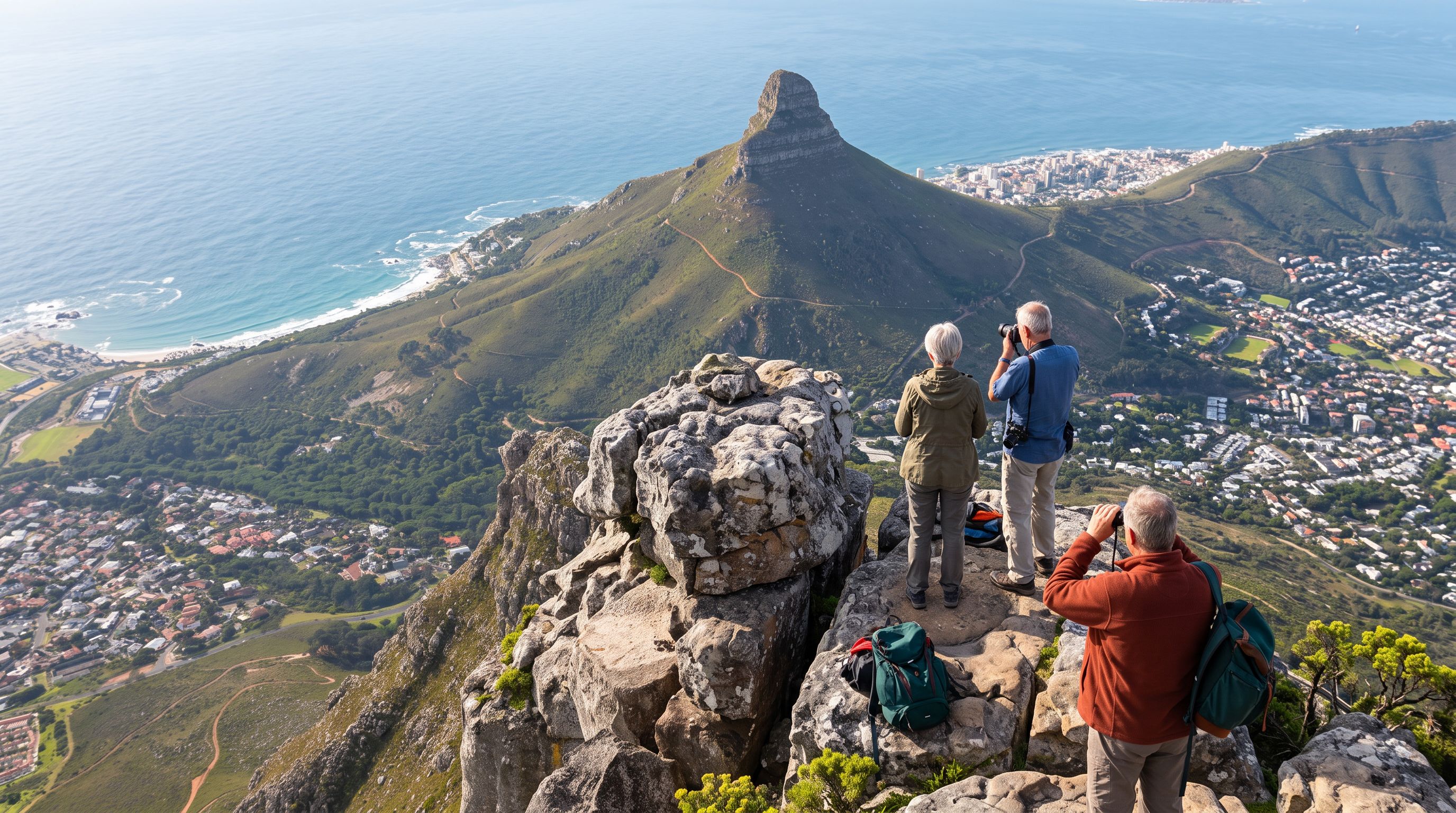
At the summit the operator documents paved accessible paths, accessible viewing areas and mobility scooters at the Top Station, subject to staff guidance and a safety assessment. A wheelchair-accessible summit walkway was introduced in 2025, but not every part of Table Mountain is accessible; some terrain remains steep or uneven. The operator publishes a wheelchair route map, which is the document to ask for at the lower station. A café, restaurant, toilets and gift shops sit at the top, and guest feedback describes the facilities as clean and the food and souvenir prices as reasonable rather than inflated.
 AI-edited
What does the cableway cost, and when does it close?
Under the operator's published tariff for 1 July 2026 to 30 June 2027, an adult return is R475 online or R530 at the ticket office, and a South African senior citizen pays R130 return or R80 one way with valid South African identification. An international over-65 fare is not documented.
That senior fare is available seven days a week with the required identification. The Senior Traveler's own Cape Town guide reports a different senior return figure of R230 in earlier Cape Town Tourism material, so verify the current tariff at the counter or online before you buy. Fast Track tickets are listed at R1,200 return and R750 one way for priority access, and a standard ticket is valid for seven days, which allows rescheduling if cloud obscures the view. A standard ticket does not remove the queue for the cabin.
| Ticket | Return | One way |
|---|---|---|
| Adult, online | R475 | R300 |
| Adult, ticket office | R530 | R330 |
| South African senior citizen (SA ID) | R130 | R80 |
| Fast Track | R1,200 | R750 |
The cableway operates only when weather is suitable, and daily closures are possible in strong wind, rain or poor visibility. From May to August the first ascent is at 08:30 and the last descent at 18:00. The 2026 annual maintenance closure was announced for 27 July to 9 August, with reopening planned for 10 August depending on the weather; the stations, toilets, restaurants and shops close during that period. If the cableway stops while you are on the summit, you wait until it reopens or you walk down, which is why wheelchair users should check conditions directly with the operator before travelling. Arriving early is the standard advice across published coverage.
Is the V&A Waterfront step-free?
The V&A Waterfront is the best-documented walking environment in Cape Town for visitors with limited mobility. A mobility-focused source reports wide walkways, ramps, elevators, accessible restrooms and navigation suitable for wheelchairs and mobility scooters. Walking around the district costs nothing, though the museum, the island ferry and the cableway each carry their own ticket.
The Waterfront is identified by Cape Town Tourism as one of the city's principal attractions and it functions as the departure point for Robben Island ferries. The Watershed market runs daily from 10:00 to 19:00 and is described as wheelchair accessible. The nearest listed car park is the Portswood Parking Garage. For ferry departures, arrive at least 30 minutes before departure.
exact walking distances across the district, gradients, the number of steps at individual venues, and specific emergency assistance points. There is no single admission fee, no attraction-wide pass and no central booking process. Individual museums, restaurants, cruises and activities set their own arrangements, so confirm with each venue rather than assuming the district's provision carries through every door. If you are deciding where to sleep relative to all this, our neighbourhood guide to choosing your base in Cape Town sets out the trade-offs.
How manageable is Kirstenbosch for a slow walker?
Kirstenbosch is described as a scenic garden rather than a demanding hike, with many lower-garden paths accessible and general suitability for leisurely scenic visits. The Boomslang canopy walkway is 130 metres long and rises to a maximum of 12 metres above the ground; it can be reached by wheelchair with help, but the approach paths are steep in places and some are mulch.
The easiest approach to the walkway is from Gate 3. That single sentence is the most useful piece of planning information in this section: choose your gate before you choose your route. Ask at the entrance.
On cost, South African residents over 60 with identification enter free on Tuesdays, except on public holidays. Cash is no longer accepted at the gate, and online tickets are sold through Webtickets. No confirmed over-65 fare for international visitors, reduced tariff, pass, closing day or maintenance closure is documented for the garden.
What does a Robben Island visit demand?
Robben Island combines a ferry from the V&A Waterfront with a guided island tour. Adapted ferry access, guided assistance and accessible tour arrangements for visitors with mobility impairments are documented. Exact walking distances between the jetty and tour points, terrain gradients and accessible toilet provision are not.
Advance booking is strongly recommended because ferry tours are popular. Cape Town Tourism says ferry operations depend on suitable weather and advises checking operator notices; morning departures are recommended in one source to reduce exposure to afternoon wind, but that is advice rather than a guaranteed calm-weather schedule. No confirmed senior fare, reduced tariff, pass, routine closing day or maintenance closure is documented. Robben Island has its own dedicated guide on this site, so this article does not cover it further.
Where will the hills and the walking catch up with you?
The historic city bowl, the slopes around Bo-Kaap and the older civic buildings are where stamina is tested. The published sources document no gradients, pavement widths or step counts for these streets, and a 2026 local discussion notes obstructed pavements and malfunctioning lifts as recurring difficulties.
Platteklip Gorge, the direct hiking route up Table Mountain, is described by Fodor's Travel as a demanding ascent involving steep, stair-like terrain and roughly one to three hours uphill depending on fitness. It is not an alternative for anyone with limited mobility, and during a cableway maintenance shutdown the hiking routes remain open but are not an equivalent option.
For getting around, the City of Cape Town says MyCiTi is currently the city's only universally accessible form of public transport. Buses use boarding bridges that give level access between stations or pavements and the bus, stations have glass and flap gates intended to accommodate wheelchairs, and guide dogs are permitted. The airport route normally links the airport terminal with the Civic Centre, where passengers transfer to other routes, but the current MyCiTi notice says the airport service is temporarily suspended. A 2026 GroundUp field report found that wheelchair users could not reliably board trains because of platform gaps and height differences, despite PRASA's accessibility commitments.
How do you get there, and who do you call if something goes wrong?
Cape Town International Airport sits 22 km by road from the V&A Waterfront, about 15 minutes with clear roads. Wheelchair and other special assistance should be requested through your airline in advance; the airport's accessibility information gives the ACSA assistance number as +27 21 935 3737.
Authorised taxis, shuttles and car hire are the documented alternatives to the suspended MyCiTi airport service, and the advice is to use authorised airport transport rather than unsolicited drivers. If you are arriving on a long flight, our guide to reaching Cape Town in good shape covers the journey itself.
On health, Cape Town is a large metropolitan municipality, so there is no single nearest pharmacy or hospital without specifying your neighbourhood. Documented options include Webb & Savoy Pharmacy on the corner of Main and Durban Roads in Mowbray, open Monday to Saturday 08:00 to 21:00 and Sunday 09:00 to 21:00, and Groote Schuur Hospital on Main Road in Observatory, with a published switchboard of 021 404 9111.
Emergency numbers listed by Cape Town Tourism's 2026 fact sheet include 112 from a mobile phone, 107 from a landline, 021 480 7700 for City of Cape Town emergency services, and 021 487 6552 for the Cape Town Tourism assistance line, listed as operating 24/7 with staff presence at Cape Town International Airport, Kirstenbosch and City Hall. The tourism authority's safety guidance is to avoid deserted or dark areas, stay on well-lit routes with others, and keep someone informed of your route and expected return.
When is the easiest time of year to visit?
March to May and September to November generally offer milder conditions and thinner crowds. December to February is warm and mostly dry but busy, with strong south-easterly winds that can affect exposed attractions. June to August is cooler, wetter and occasionally stormy, and outdoor plans need flexibility.
Cape Town Tourism's 2026 fact sheet sets out the pattern month by month. December to February brings the busiest holiday period and winds that can close the cableway. March to May is generally mild with cooler evenings and increasingly frequent rain, and is usually a more manageable period for sightseeing. June to August has clear intervals between fronts. September to November warms up but stays changeable with lingering showers and frequent wind.
Wind is the variable that matters most for this itinerary, because both the cableway and the ferries depend on it. Scheduling those two early in your stay leaves room to reschedule, and a cableway ticket bought in advance stays valid for seven days. If you want a slower day between the big sights, our piece on what to expect from a spa day in Cape Town covers the indoor option, and what to eat in Cape Town covers the Cape Malay and local flavours worth building a lunch around.
What should you confirm before you book?
Confirm step-free access, adapted transport and mobility arrangements directly with each operator before booking, as Cape Town Tourism advises. Check operator notices before departure, because cableway and ferry operations depend on weather. Book the cableway and Robben Island in advance and place both early in your itinerary.
Three things are worth knowing about the limits of the published record. Cape Point and Groot Constantia appear among the Cape Town Big Six, but their terrain, steps, lifts, walking distances, wheelchair equipment and senior fares are not documented; ask the operators directly. The cableway's refund and rebooking policy for weather disruption is not stated in the operator information supplied. And no citywide accessibility accreditation for Cape Town is documented, so a claim made for one venue says nothing about the next.
The UN World Tourism Organization's Cape Town case study records that 17% of graded accommodation rooms in the city had universal-access features, representing 2% of graded establishments. That is a useful figure to hold in mind when you are choosing where to sleep, and it is the reason hotel access deserves its own reading rather than a paragraph here. Our guide to choosing your base covers the neighbourhood question; room-by-room access is a separate subject with its own dedicated guide.


