
Cape Town runs on a Mediterranean rhythm: dry, bright summers from November to March, then a cool, wet winter that turns the mountains green. For travellers aged 50 to 70 who want warmth without the wind that defines high summer, the calendar matters more here than in most cities. The south-easterly known as the Cape Doctor can empty a beach and close a cable car in the same afternoon, while the festive weeks bring the year's heaviest demand. The months that balance warmth, calm and breathing room sit on either side of that peak.
The city's own tourism authority describes a Mediterranean climate and points visitors towards the outdoors, gardens, coast and wine estates that depend on it (Cape Town Tourism's Trade and Industry Holiday Fact Sheet 2026 sets out the pattern). What follows is a month-by-month reading of that pattern, with the wind, the rain, the whales and the crowds each given their proper weight.
When is the best time to visit Cape Town for warm, calm days?
Late March, April and September into October give the most reliable mix of warmth and calmer air. High summer (December to February) is hotter and drier but windier and far busier. Winter (June to August) is quiet and green but wet. May is the calmest month in one published analysis, though rain returns.
Two named sources disagree at the margin, and it is worth knowing that before booking. One Cape Town-focused climate analysis calls late February to March the best overall choice, with average daytime highs of about 25.9°C in February and 24.4°C in March, and describes March as "the insiders' summer": warm, dry and less windy than the height of summer. A separate guide names April as best overall, citing warmth, calmer conditions than high summer, lighter crowds and better value. Both readings point to the same window. Travellers who want the warmest air should lean towards March; those who want the quietest streets should lean towards April.
What is the weather like month by month?
Cape Town's year divides into a dry, warm summer from November to March and a cool, wet winter from June to August, with autumn and spring as transitions. Rainfall concentrates from May to August, and June is the wettest month in the published airport normals.
Cape Town Tourism's fact sheet publishes climate normals for Cape Town Airport, given as 24-hour mean temperature and rainfall. These are rounded normals rather than forecasts, and the authority notes that coastal, city and mountain conditions differ from the airport figures. One entry in the published table, a 5.3°C mean for May, appears anomalous and should be treated with caution.
| Month | Mean temperature | Rainfall |
|---|---|---|
| January | 21.6°C | 10 mm |
| February | 21.7°C | 11 mm |
| March | 20.2°C | 13 mm |
| April | 17.7°C | 41 mm |
| May | 5.3°C (published figure, appears anomalous) | 63 mm |
| June | 13.1°C | 89 mm |
| July | 12.5°C | 81 mm |
| August | 12.9°C | 73 mm |
| September | 14.4°C | 44 mm |
| October | 16.8°C | 29 mm |
| November | 18.5°C | 26 mm |
| December | 20.6°C | 12 mm |
Read the rainfall column and the shape of the year becomes plain. January, February, March and December each record barely more than a centimetre. June records 89 mm, with July and August close behind. A separate published climate guide gives June a range of roughly 8°C to 19°C and identifies it as the wettest month, which matches the airport normals.
Summer daytime temperatures commonly sit in the mid-20s to mid-30s Celsius. Winter highs drop to about 17.1°C in June and 16.4°C in July according to the same Cape Town-focused analysis. Forum reports from visitors who travelled in June describe daytime temperatures in the mid-20s, sunny skies and cool nights in the high single digits or low teens, which shows how variable a single winter week can be.
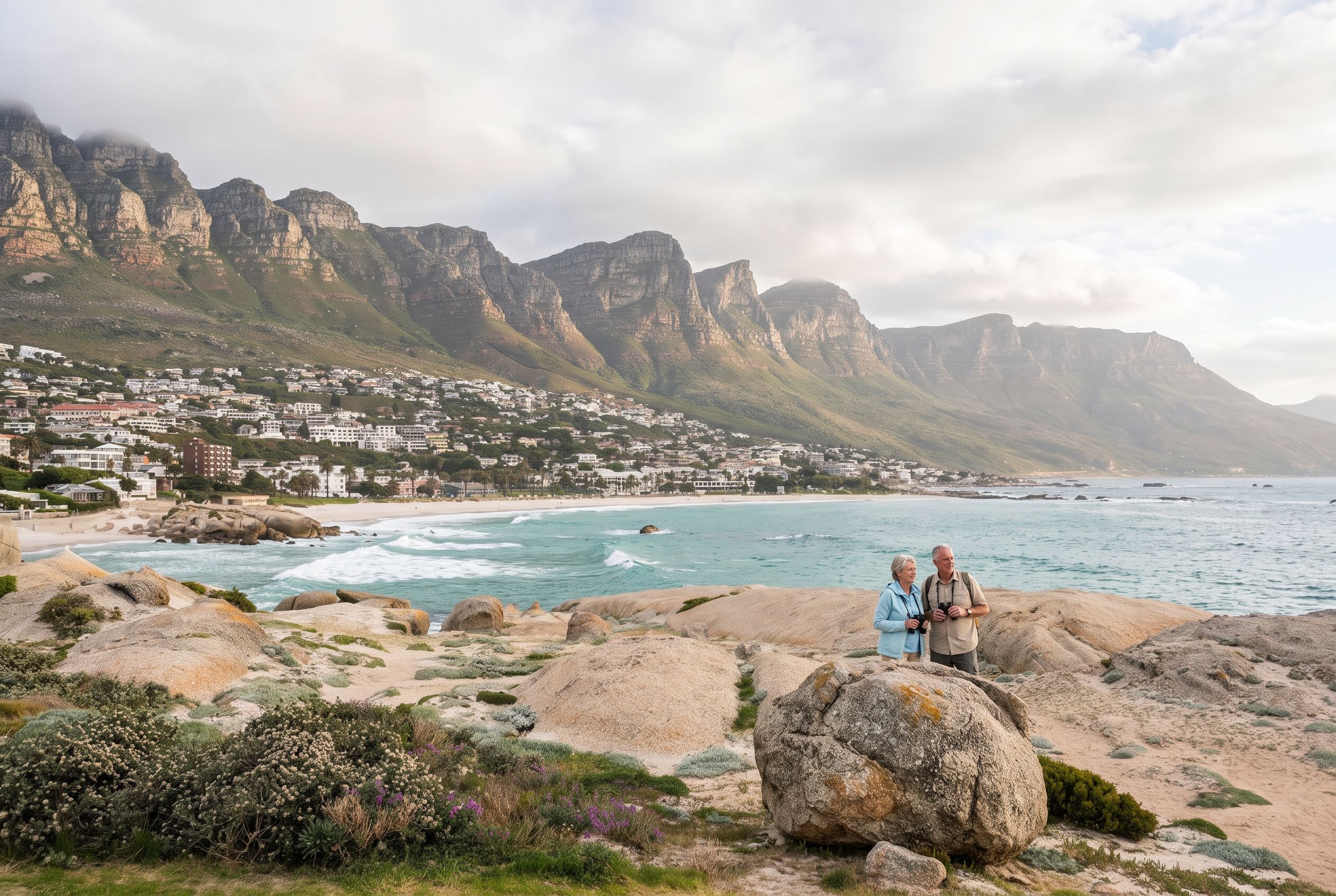 AI-edited
How bad is the Cape Doctor wind, and when does it blow?
The Cape Doctor is Cape Town's strong south-easterly, most associated with roughly September to March. In the cited long-term record it occurs on about 56 to 58% of days in January and February. It can make exposed northern and eastern parts of the peninsula uncomfortable while the Atlantic Seaboard is relatively more sheltered.
This is the single most useful thing to understand about Cape Town's summer. The dry season is reliable; the calm is not. A warm February day can arrive with a wind that rules out the cableway, cancels boat trips and sends sand across the coastal road. The Table Mountain Aerial Cableway publishes live operating status, visibility, wind conditions, temperature, first and last cars, and estimated waiting times through its website and app, and Cape Town Tourism advises checking weather-related operations for its headline attractions before setting out.
By March and April the summer wind has usually eased. A contributor to the Fodor's Travel Talk forum who identified as a South African guide and operator described March and April as generally quiet because the period falls outside school holidays, with the wind eased, temperatures not excessive and winter rain not yet begun. That is one operator's view rather than a guarantee, but it matches the wider pattern the climate sources describe.
What are the festive weeks like, and should I avoid them?
December and January form Cape Town's busiest and most expensive period, driven by domestic school holidays and international demand. Cape Town Tourism identifies December to February as a busy holiday period and advises booking popular accommodation and activities ahead. Early December can still be warm with better availability.
The festive peak is not a weather problem. December is dry and sunny, with 12 mm of rain in the airport normals and a mean temperature of 20.6°C. The problem is pressure on everything: beaches, restaurants, accommodation and the roads around the main visitor precincts. If peace, availability and value matter, the practical recommendation from the published guidance is to avoid roughly mid-December through early January.
Two practical notes for anyone travelling in this window. First, the city's events calendar produces substantial temporary road closures around large races and festivals, and the City of Cape Town publishes transport notices and service changes through its urban mobility department. Second, accommodation rates across the city are indicative only and vary by season and booking channel, so the same room can price very differently depending on how and when it is reserved. Our guide to what a comfortable Cape Town trip costs sets out the wider budget picture.
When is whale season, and can I see whales from Cape Town?
Southern right whales reach the Cape coast from June to November each year to mate and calve in shallow water. Hermanus Tourism gives the season as June to November, with boat trips operating in season, weather permitting. September and October combine improving spring weather with a reasonable chance of sightings.
The clearest operator statement comes from Hermanus Tourism, which describes southern right whales migrating from their feeding grounds off Antarctica to warmer water and reaching South Africa in June, staying until November. The same source notes Bryde's whales visiting all year round and humpback whales passing between June and November on their way to warmer Mozambican waters. Three permitted whale-watching boats leave Hermanus New Harbour for daily trips, weather and tides permitting, and times should be checked with the operators.
Hermanus sits roughly two hours from central Cape Town by road, and its cliff path along Walker Bay is the viewpoint the town's tourism body promotes for land-based watching. For a Cape Town-based itinerary, September and October offer the most appealing combination: spring weather improving, pressure below summer levels, and the season still open. Cape Town Tourism's own guidance on whale watching in Cape Town is the place to check what is running from the city itself.
What is winter in Cape Town really like?
June to August is the wettest, coolest and quietest stretch, with the lowest prices and fewest visitors. Rain arrives in pulses rather than as unbroken weeks, and the vegetation turns notably green. Cold Atlantic water and wet days make it a poor fit for beach plans but a good one for gardens and museums.
May to early August is identified as the city's quietest period, shaped by wetter weather, school terms and a quieter events calendar. Forum reports bear this out in both directions. One Reddit contributor who spent about ten days in Cape Town and the Western Cape in June reported daytime temperatures in the mid-20s, sunny conditions and cool nights, and found it ideal for avoiding intense heat with lower crowds, though the same visit required postponing a Table Mountain climb and delaying a Robben Island trip. A Fodor's contributor who visited in August found Cape Point and the Robben Island ferry particularly chilly, manageable with jackets on clear days.
Kirstenbosch is described by Fodor's contributors as worthwhile in winter, though it may be wet even when rain is not falling. A local warning recorded in the same forum discussion notes that mountain weather changes rapidly and that tourists have required rescue after starting hikes without a weather check. Winter suits flexible travellers who carry warm, waterproof clothing and accept that plans may move.
Which months are quietest and best value?
June and July carry the lowest prices and the fewest visitors, provided cool, wet weather is acceptable. September and October are the best-value warm months, with mild conditions, spring flowers and demand still below the summer peak. The official material publishes no month-by-month price index.
Cape Town Tourism does not publish a month-by-month occupancy or price index, so no source here can name a cheapest month with precision. What the published guidance does support is a direction of travel: June to August is consistently associated with fewer visitors and the lowest prices, alongside cooler temperatures, wet days and cold Atlantic water. September and October are repeatedly identified as a shoulder period, and reviews on hotel sites also favour May, June and October for a less crowded visit, a travel recommendation rather than a meteorological finding.
For accommodation specifically, the reviews that mention quiet rooms tend to praise blackout shutters and comfortable beds, and the practical advice is to ask for a room away from lifts, renovation areas, service corridors and mechanical equipment. Our round-up of the quietest hotels in Cape Town collects what guests have reported.
How should older travellers plan around the weather?
Build in one flexible day for Table Mountain and one for anything on the water, and check operating status each morning. Cape Town Tourism advises confirming step-free access and adapted transport before booking rather than assuming provision. Heat in January and February is manageable with early starts.
The Table Mountain Aerial Cableway publishes several access measures: dedicated disabled-parking bays, priority access at the ticket office, lifts, wheelchairs on request and mobility scooters at the Upper Station subject to safety assessment and staff guidance. The Universal Access Walkway at the summit, opened in April 2026 in partnership with SANParks, provides a route towards the summit-plateau edge for visitors using wheelchairs, prams and other mobility aids. The operator does not publish a general number of rest seats, and it does not establish that every route on the mountain is step-free; confirm those details directly before visiting.
On fares, the cableway's published 2026–27 tariff, valid from 1 July 2026 to 30 June 2027, lists an adult return at R475 online or R530 at the ticket office, and a South African senior citizen with valid South African identification pays R130 return or R80 one-way. A Cape Town Tourism listing separately gives an adult return of R340 and a senior fare of R230 without defining the age threshold, so the operator's own tariff is the figure to rely on. Our guide to how accessible Cape Town is for older travellers covers the wider picture.
For safety, Cape Town Tourism advises avoiding isolated streets after dark. Emergency numbers published in its fact sheet are 112 from a mobile, 107 from a landline, +27 21 480 7700 for City emergency services, and +27 21 487 6552 for visitor support after an incident, listed as available 24/7. The Western Cape government publishes further tourism safety tips for visitors.
What should I pack for each season?
Pack layers whatever the month. Summer needs sun protection and a windproof outer layer for the south-easter. Autumn and spring need a light waterproof. Winter needs warm, waterproof clothing and shoes that cope with wet pavements.
The wind is what catches people out. A February afternoon on the Atlantic Seaboard can feel mild while an exposed northern or eastern part of the peninsula is unpleasant, so a packable windproof layer earns its place in any summer bag. Winter visitors should treat rain as likely rather than possible between June and August, when the airport normals record 89 mm, 81 mm and 73 mm respectively.
Comfortable walking shoes matter in every season. Cape Town Tourism's advice is to confirm accessibility, step-free access and adapted transport before booking rather than assuming provision.
What should I know before booking?
Book the shoulder months early, keep the first full day free for weather, and check each attraction's opening hours and admission directly with the operator. Cape Town Tourism recommends confirming charges, hours, age limits and booking requirements with each operator rather than relying on a single source.
Several practical figures are worth having to hand. The Two Oceans Aquarium at the V&A Waterfront lists daily hours of 10:00 to 17:30 and an adult admission of R220. The Iziko South African Museum and the Iziko South African National Gallery each list daily hours of 10:00 to 17:00 with adult admission of R30, and the Iziko Slave Lodge opens Monday to Saturday from 10:00 to 17:00 at R30. The Castle of Good Hope opens daily from 09:00 to 16:00 at R50, and the District Six Museum opens Monday to Saturday from 09:00 to 16:00 at R50. Zeitz MOCAA in the Silo District opens daily from 10:00 to 18:00 at R250.
A travel publication states that the Cape Wheel, the Iziko South African Museum and the Two Oceans Aquarium list reduced prices for South African pensioners, though the exact amounts are not given available here. Ask at each ticket desk. For dining plans around these visits, our guide to Cape Town's finest restaurants and ocean-view tables is a useful companion.
One planning note on the city itself: the airport investment programme reported at over R10 billion, including a new 3,500-metre runway and terminal changes, was expected to begin construction in April 2027 subject to approvals and procurement. Visitors from that point should expect possible works and changing terminal arrangements rather than immediate disruption.
Finally, the festival and events calendar has its own dedicated guide and is not covered here. What matters for timing is simply that large events produce temporary road closures, so check the City of Cape Town's notices before driving on a big weekend.


