
Charleston's historic district sits on a peninsula, and its best-known sights are strung along a circuit of roughly two miles. For travellers who would rather not cover that on foot, the city offers a different way in: a one-hour carriage tour that covers 25 to 30 blocks from a seated carriage, a harbour cruise that shows the waterfront and Fort Sumter without a single step ashore, and a handful of compact stops where the view arrives within a few paces of the kerb.
The city's own visitor information points to parks, museums and seven miles of waterfront as the core of a visit, and the regional visitor bureau describes the historic district as highly walkable. That is good news for anyone who wants to stroll. It is also why a little planning pays: the same compactness that makes Charleston pleasant on foot makes it easy to overdo, particularly on the uneven brick and cobblestone surfaces the district is known for.
This guide is about the seated and short-stop version of Charleston: which sights work with minimal walking, where to sit down, and what to leave for another trip. The broader question of getting around without a car has its own dedicated guide.
What can you see from a carriage?
A public carriage tour is the clearest seated overview of Charleston. Tours last about an hour and cover roughly 25 to 30 blocks of the historic downtown, passing houses, gardens, mansions, churches and parks. Routes are assigned by the City of Charleston before departure, so the exact streets are not guaranteed.
That route lottery is worth understanding before booking. Charleston assigns carriage routes through a city-mandated system, with a City of Charleston tourism official selecting the streets before departure rather than the operator choosing them on the day. In practice this spreads carriages across the district and keeps any one street from being overwhelmed. For the passenger it means the tour is a genuine overview rather than a fixed checklist, and that a return visit may well show a different set of blocks.
Published itineraries indicate the routes can take in the Nathaniel Russell House, First Scots Presbyterian Church, Calhoun Mansion, White Point Gardens and the Edmondston-Alston House. Interpretation on board covers more than 300 years of history. The Old Exchange building, completed in 1771 and described as the last building constructed by the British before the Revolutionary War, features in some published route descriptions.
 AI-edited
Which carriage operator, and what does it cost?
Several operators run from around the City Market area, and published adult prices sit roughly between $40 and $50 for a standard one-hour historic tour. Private tours are priced far higher. No senior or over-65 fare is documented for carriage tours in the material reviewed.
Palmetto Carriage Works operates from the Big Red Barn at 8 Guignard Street; its listing notes that you walk up Market Street about 100 feet to the first right and the barn is in front of you. The South Carolina Department of Agriculture lists Palmetto Carriage as offering guided tours and wagon rides, with restrooms on site, a description as handicapped accessible, and senior discounts advertised. The department does not state the amount of the discount, whether every carriage is accessible, or the cancellation policy.
Palmetto's published hours are 9 a.m. to 4 p.m. from November through February and 9 a.m. to 5 p.m. from March through October. The listing also notes parking for 150 cars, which matters if you are driving in.
Old South Carriage Company publishes a one-hour Historic Charleston Carriage Tour operating approximately 9 a.m. to 5 p.m., usually daily, with departures every 15 to 30 minutes; hours vary seasonally. Its published pricing is from $50 for adults aged 12 and over, $40 for children aged 4 to 11, and free for infants. Boarding uses an elevated platform reached by an inclined ramp; disembarking involves three steps and a handrail. There is a restroom at 14 Anson Street, but no scheduled restroom break during the hour-long ride.
One group-tour operation runs departures approximately every 30 minutes and asks passengers to check in at 45 Pinckney Street, arriving at least 30 minutes before the final carriage or risking a lost place. Another lists public adult admission at $45 plus tax, children aged 4 to 11 at $35 plus tax, and children aged 3 and under free.
Can you take a carriage tour with a mobility device?
One major tour listing states its carriage tour is not wheelchair accessible. A separate operator advertises accessibility for people of all ages and physical abilities. Published guidance for one operator says a wheelchair user must transfer to a bench seat and leave the chair at the barn.
That last detail is the practical heart of it. Where a transfer is required, the question becomes how high the bench is, whether there is a step up, and whether staff can help. None of that is standardised in the published material.
Service animals are permitted on at least one listed tour. Strollers are accommodated on the same listing.
What do harbour cruises show, and where do they leave from?
Narrated harbour cruises run about 90 minutes and pass Fort Sumter without landing, which gives the view without the disembarkation and the walk around the ruins. Two operators are documented: SpiritLine from Aquarium Wharf and Patriots Point, and Charleston Harbor Tours' Carolina Belle from the Charleston Maritime Center at 10 Wharfside Street.
The SpiritLine Official Charleston Harbor Tour is a 90-minute narrated cruise with a guide described as certified by the City of Charleston. The cited booking listing gives $50 for adults, with up to two children aged 11 and under free per paying adult. SpiritLine's own booking information states that the harbour tour is not handicapped accessible.
The Carolina Belle is a 90-minute cruise with departures listed at 11:30 a.m., 1:30 p.m., 3:30 p.m. and 5:30 p.m., plus a sunset departure on the same listing; the cited fare is $54. Charleston Harbor Tours publishes no accessibility statement, so boarding arrangements should be confirmed directly before booking.
Operator information for the Carolina Belle adds useful specifics: boarding is via a ramp rather than stairs, and the upper deck holds the restrooms, with stairs required only for the enclosed lower level. The boarding ramp is about 30 feet long and can become steeper at high tide, so passengers using mobility aids should telephone about timing. The same operator says it cannot accommodate electric wheelchairs or mobility scooters and has only limited onboard storage for wheelchairs and strollers.
Is Fort Sumter worth it if you want to avoid walking?
Fort Sumter sits on a small island in the mouth of Charleston Harbor and can only be reached by boat, so there is no way to see it from the water's edge. The ferry fare is $46 for adults, with lower prices for seniors, active military and children aged 4 to 11; children under 4 travel free.
The National Park Service, which manages the site, describes the ferry as having a deck lift, a portable gangway and an accessible restroom with grab bars. Ramps can become steep at low tide, and the operator advises asking which departure has the easiest boarding conditions. Cell service is spotty within the fort and park buildings, but otherwise fine.
The park service also notes that the America the Beautiful Access Pass is available free for US citizens or residents with permanent disabilities, which is worth asking about at the ticket desk.
The trade-off is time ashore. Visitor information describes time on the island walking around the ruins, which makes the landing less suitable for anyone wanting to avoid walking altogether. The narrated cruises that pass the fort without stopping give the view without that element. Fort Moultrie, on Sullivan's Island, is a separate site and not part of the harbour crossing.
Which sights work with a short, step-light stroll?
Four stops reward a short walk from a drop-off point: Rainbow Row, the Battery and White Point Garden, Waterfront Park with the Pineapple Fountain, and the City Market. Each is compact enough that the sight arrives within a few paces, and each is free.
Rainbow Row is a concentrated row of historic houses on East Bay Street, so the principal view can be taken from the pavement without walking through a large site. It appears in published carriage itineraries as an exterior streetscape, which tells you what it is: something to look at rather than to tour inside.
The Battery gives a broad harbour viewpoint, while White Point Garden offers a compact park setting with shade from live oaks and places to pause. Both are recurring carriage-tour highlights and free outdoor attractions at the southern end of the peninsula.
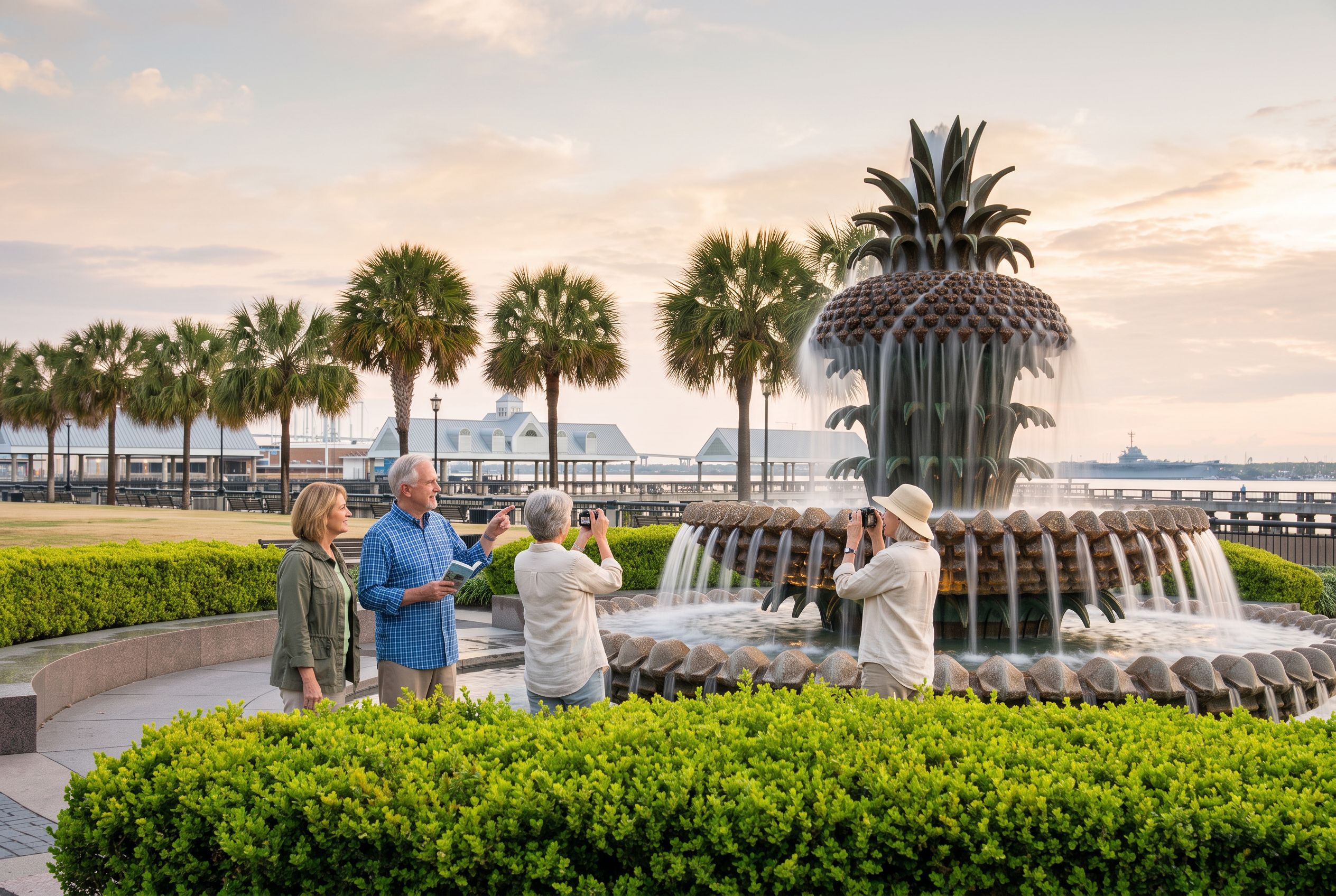
Waterfront Park is a single waterfront destination rather than a long sequence of streets, and the Pineapple Fountain is among the city's principal free sights. The City of Charleston's visitor information lists parks, museums and seven miles of waterfront as the city's outdoor assets.
The City Market is a single, central destination and the common starting point for carriage tours. It is also where the operators cluster, which makes it a natural anchor for a low-walking day: arrive, tour, sit, then take one short stroll.
Where can you sit down?
Seating is documented in general terms rather than as a map. White Point Garden offers places to pause and shade from live oaks. Waterfront Park has benches and waterfront seating where available. Public restrooms are listed in downtown parking garages, parks and city buildings, though they may be locked and available on request.
The City of Charleston's visitor information is the most useful single page for the practical side of a seated day. It confirms public restrooms in downtown parking garages, parks and city buildings, with the caveat that some are locked and opened on request. It also notes free parking with a disability placard or plate at city-owned garages, lots and meters.
What the official material does not publish is a complete seating map for Waterfront Park, a seating count at the Battery, or continuous step-free routes across the district. Those details should be confirmed locally on the day rather than assumed from a park setting.
On parking, two rules are worth carrying into the day. Street parking is prohibited on King Street between Spring and John streets from Thursday to Saturday, 6 p.m. to 3 a.m., so use Midtown or Marion Square instead. A lost parking ticket carries a $50 fee in garages.
How do you get between the stops?
The free DASH shuttle runs three routes serving most downtown historic and tourist attractions, and the regional visitor information describes it as a way to rest your feet while moving around the peninsula. For door-to-door trips, taxis, hired cars and hotel drop-offs are more predictable than a long walk between sights.
DASH is a fixed-route service, and CARTA, which runs it, does not publish a stop-by-stop accessibility specification, a boarding-height policy or guaranteed seating in the material reviewed. Anyone who needs level boarding or a guaranteed seat should verify the current vehicle and stop conditions with CARTA before travelling.
For visitors unable to use fixed-route buses, CARTA Tel-A-Ride is identified as origin-to-destination paratransit for eligible passengers. Visitors may use it with suitable disability certification from their home transit system. Eligibility, advance-booking deadlines and fares are not stated in the published material, so ask CARTA directly.
Construction and changing entrances make rideshares, taxis or private tours more reliable than a long walk between attractions. The plantations lie outside the peninsula along Ashley River Road and require a car, taxi or tour; step-free access and mobility-device policies for the individual plantations are not documented.
What should you skip?
Skip anything that requires covering the full Battery to Rainbow Row to City Market circuit on foot, which runs to roughly two miles. Skip the walking tours, which are better reserved for visitors able to walk on uneven historic streets. And think carefully before booking a harbour cruise that lands at Fort Sumter if you want to avoid walking altogether.
The district's surfaces are the reason. Charleston's historic district includes uneven sidewalks and cobblestone streets, which can be tiring or unstable for some visitors. That is not a reason to stay away; it is a reason to let a carriage, a boat or a car cover the distance and to save your steps for the four compact stops above.
Also worth knowing before you build a day around it: the Powder Magazine Museum closed for financial reasons and later reopened after an eight-month hiatus on a limited basis, according to The Post and Courier. A January 2026 tourism forecast reported by the same paper said the site remained a watchpoint and that the city was considering an agreement to manage it. Check before travelling if it is on your list.
If you want the seasonal picture, including which weeks are quietest, Charleston through the year covers the festival calendar and the calmer stretches.
What else is worth knowing before you go?
Two indoor and semi-indoor options extend a low-walking day. The Charleston Museum states that it is accessible to visitors with limited mobility, with manual and electric wheelchairs free on a first-come, first-served basis and permitted throughout the museum and historic houses. Charles Towne Landing, outside the peninsula, adds a replica ship and an animal park.
At the museum, service dogs are permitted when identified, therapy dogs and other animal companions are not, and videos are captioned. The museum does not publish over-65 pricing, opening-day closures or on-site medical help in the material reviewed, so ask at the desk.
Charles Towne Landing State Historic Site has a visitor centre, the replica ship Adventure, an Animal Forest and park grounds. Visitors can board and tour the ship, watch cannon firing and see animals including otters, bears and bison. The visitor centre and gift shop open 9 a.m. to 4 p.m. daily, the grounds 9 a.m. to 5 p.m. daily, the Animal Forest 10 a.m. to 4 p.m. daily, and the Adventure 10 a.m. to 4 p.m. daily but closed Tuesdays and Christmas Day. The whole site closes on Christmas Day.
Admission is $12 for adults, $7.50 for South Carolina seniors, $7 for ages 6 to 15, and free for children five and under. The ship leaves each winter for annual maintenance and returns in spring, with dates varying by year. At the time represented by the park's own information, part of the Animal Forest was temporarily closed Monday through Friday for construction while operating normally at weekends.
| Option | Duration | Published price | Condition noted |
|---|---|---|---|
| Public carriage tour | About 1 hour, 25–30 blocks | Roughly $40–$50 adult | Route assigned by the city; no senior fare documented |
| Old South Carriage historic tour | 1 hour | From $50 adult (12+), $40 child (4–11) | Departures every 15–30 minutes; hours vary seasonally |
| SpiritLine harbour tour | 90 minutes | $50 adult | Operator states the tour is not handicapped accessible |
| Carolina Belle harbour cruise | 90 minutes | $54 | Departures 11:30, 1:30, 3:30 and 5:30, plus sunset |
| Fort Sumter ferry | Crossing plus time ashore | $46 adult; lower for seniors | Deck lift and gangway; ramps steep at low tide |
| Charles Towne Landing | Half day | $12 adult; $7.50 SC seniors | Grounds 9–5 daily; closed Christmas Day |
Prices throughout are indicative and vary by season and booking channel. No source reviewed documents a Charleston-specific reduced-mobility pass covering the city's attractions, or a senior fare on the carriage tours.
If you would rather hand the logistics to someone else, small-group and guided tours of Charleston sets out how organised options work. And if you are weighing a stay in the historic core, a closer look at the Wentworth Mansion covers one of the mansion inns in detail.
The practical summary
Build the day around one seated experience and two short stops. A morning carriage tour from the City Market area, lunch, an afternoon harbour cruise from the Maritime Center, and a fifteen-minute look at Rainbow Row or the Pineapple Fountain covers a great deal of Charleston with very little ground on foot.
Book the carriage by telephone if you have any mobility question, and ask about the step, the bench and the transfer. Call the harbour operator about tide and boarding if you use a mobility aid. Use the DASH shuttle or a taxi between stops rather than linking them on foot. Park in a city garage with your placard displayed, and avoid King Street between Spring and John from Thursday to Saturday evenings.
Charleston rewards the visitor who slows down. Seen from a carriage bench or a harbour deck rail, with a bench under a live oak in between, the peninsula gives up its history without asking for two miles of cobblestones in return.


