
Charleston rewards travellers who treat the city as a base rather than a single stop. Within roughly two hours of the peninsula, the Lowcountry offers a Georgian city, three Ashley River plantations, two very different beaches and a live oak older than most European cathedrals. What separates a good day out from a tiring one, for travellers in their fifties and sixties, is not distance alone. It is the combination of driving time, time on foot and how much of the day is spent standing.
The outings below are grouped by effort rather than by geography, because a 45-minute drive to a beach with soft sand can demand more of a traveller than a two-hour drive to a city with a trolley. Travel times come from the guides and transport listings named in each section. Where a detail such as step-free access or a published fare is not documented, this guide says so and suggests what to confirm before setting out.
Which day trips from Charleston demand the least effort?
Angel Oak on Johns Island and Sullivan's Island are the two lightest outings. Angel Oak is free, open seven days a week, and the viewing area is described by a senior-travel guide as flat and shaded. Sullivan's Island is about 25 minutes east by car, but beach access involves walking from public rights-of-way, and conditions vary by path.
The City of Charleston's official page for Angel Oak Park places the tree at 3688 Angel Oak Road on Johns Island. The city describes it as the largest live oak east of the Mississippi, estimated at 300 to 400 years old, 65 feet high with a circumference of 25.5 feet, shading an area of 17,000 square feet. Explore Charleston gives a different age estimate of about 1,400 years; the two figures do not agree, so treat the age as approximate and the city's own measurements as the firmer numbers.
Driving time to Angel Oak is not stated on the city's page. A Charleston travel guide estimates about 30 minutes from downtown, and a senior-oriented guide gives approximately 40 minutes. The same senior guide reports that reaching the tree is easiest by car, ride-hail or an organised tour, and that the visit itself is short. The city publishes no transit route or fare.
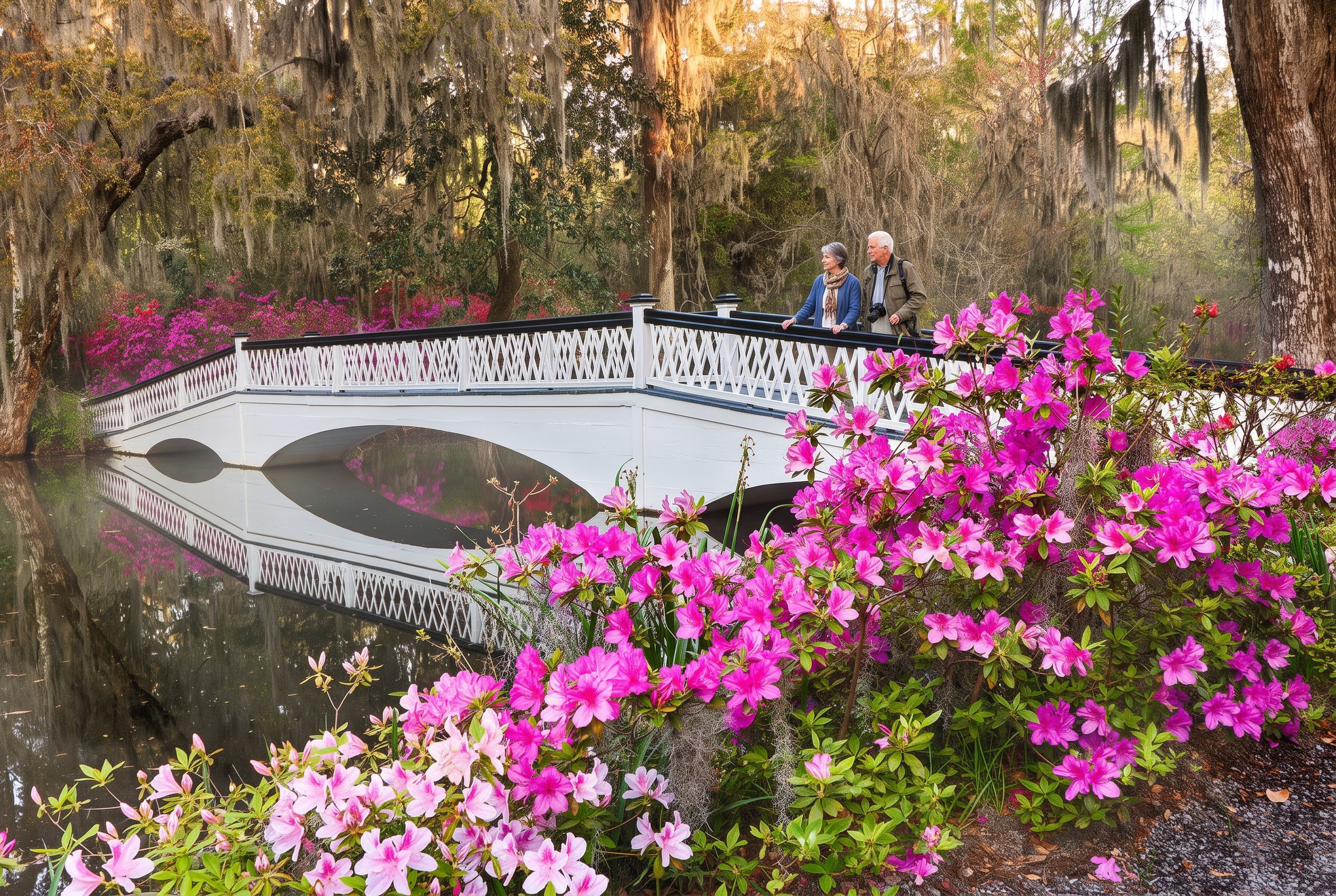 AI-edited
Admission is free, with donations accepted for the tree's preservation, and the park closes on holidays. Blankets, drinks, food, props and tripods are not allowed on or around the tree, and permits are required for weddings and engagement photographs. Leashed pets are allowed in designated areas including the picnic area. The city lists 843-559-3496 for the site and notes roughly 400,000 visitors a year, which is worth knowing if you prefer quiet.
The city does not document a formal paved route, benches beside the tree, wheelchairs, mobility scooters or staff assistance. Ask before you rely on any of these.
How far is Savannah, and is it a day trip or an overnight?
Savannah is about two hours from Charleston by road, according to a transport guide, or roughly 1 hour 45 minutes on Amtrak's Palmetto and Silver Meteor, which transport guides report running twice daily. A same-day visit leaves limited time in Savannah once the return journey is counted, so it suits travellers comfortable with a long day.
More recent discussion on Reddit puts the drive at approximately 1.5 hours, which suggests traffic and starting point materially affect the journey. Either way, the arithmetic of a day trip is unforgiving: four hours of driving leaves perhaps five or six hours in the city.
The train removes the driving but not the planning. Neither station sits in the centre of its city. The Charleston Amtrak station is in North Charleston, about a 15-minute ride-hail trip from the historic district, and Savannah's station is reported to be about a 10-minute taxi or ride-hail trip from its historic district. Transport listings report advance fares starting at $22, though fares and schedules change; confirm before booking.
Once there, the trolley earns consistent praise. A Fodor's Travel Talk contributor valued being able to get off at one stop and reboard at another, calling it a good way to see the city in limited time, and a later Reddit thread makes the same point about hop-on, hop-off convenience. That matters for anyone managing their walking.
Walking is the other variable. One Reddit participant reported covering about eight miles in Savannah, from Thomas Square to the river and back. A Fodor's Travel Talk trip report described River Street as "a bit difficult, but not impossible" for a husband using a wheelchair, and recommended the elevator in the Hyatt as an alternative route down. A 2026 Reddit discussion warns that seasonal heat and humidity can make walking challenging even for those who normally manage well.
Savannah has its own dedicated guide on this site; this section covers only the journey and the effort.
Are the Ashley River plantations a single outing or three separate days?
They are three separate properties, and a Charleston publication advises against visiting two in one day, estimating roughly three to four hours for each. Middleton Place, Magnolia Plantation and Gardens and Boone Hall sit on or near Ashley River Road, outside the peninsula, and a senior-travel guide places them roughly 20 to 45 minutes from Charleston.
The same Charleston publication characterises Middleton Place for formal gardens, Magnolia for less formal gardens and seasonal azalea colour, and Boone Hall for its Avenue of Oaks and its interpretation of Gullah and enslaved people's history. Choosing between them is a matter of taste rather than quality.
Guest feedback on Middleton Place is unusually consistent. As of November 2026, Google shows 4.7 out of 5 from 3,153 reviews. The landscaped grounds are repeatedly described as meticulously maintained, with formal terraces, reflecting ponds and live oaks draped in Spanish moss. Guided garden, history and "Beyond the Fields" tours draw praise for knowledgeable guides open to questions, and free-roaming sheep, goats and heritage livestock are a recurring highlight. Many visitors report spending four to six hours or more walking the grounds, and several note that comfortable shoes are needed given the size of the property.
"Best healing plantation. From swan to nice river view and restaurant and wonderful dishes. Perfect vacation." (Google, 5/5, September 2026)
Two planning points come up repeatedly in that feedback. The main house is not the original structure, and the house museum tour carries an extra fee beyond general admission. Visitors in summer report few blooms and heat, while spring is cited for azaleas and camellias; a Charleston publication notes that Magnolia's azalea display peaks in late March. Alligators are present near ponds and the river, and some paths can flood after heavy rain.
Accessibility varies by property and is not standardised. The senior-travel guide notes that plantation garden path surfaces range from paved to gravel and recommends checking before booking. No Charleston-wide plantation pass, over-65 fare or common accessibility standard is documented in the available official material, and no shared maintenance-closure calendar exists across the three estates. Ask each property directly about parking distance from the entrance, whether mobility devices are permitted on garden routes, which tours involve stairs, and whether seating or a shuttle is available on the grounds.
Is Sullivan's Island a gentle beach day?
Sullivan's Island is about 25 minutes east of Charleston by car, according to a Charleston guide, and combines a quiet beach with Fort Moultrie. The beach is free with no badge requirement, but access involves walking from public rights-of-way and conditions vary by path. Charleston tourism material states there are no lifeguards at any time.
Parking rules belong to the Sullivan's Island municipality rather than to Charleston citywide. Charleston-area material states that vehicles must park in the public right-of-way with all four tyres off the pavement, and that beach paths must not be blocked. Summer parking can be competitive, according to Charleston tourism material.
Published step-free access, beach wheelchairs, accessible mats or boardwalks, benches and reserved seating are not documented. The municipality does not publish a current beach-entry fee, parking schedule or seasonal access rules in the material reviewed. If sand and a short walk from the road suit you, this is a low-cost, low-fuss morning. If you need a mat or a beach wheelchair, confirm with the town before you drive out.
Fort Moultrie, identified by a Charleston destination guide as part of the same national park system as Fort Sumter, gives the outing a second dimension for anyone who wants history with their sea air.
What should I know about Kiawah Island and Beachwalker Park?
Explore Charleston identifies Kiawah Beachwalker Park as Kiawah Island's only public beach access, roughly 45 minutes southwest of Charleston by car according to a Charleston guide. Lifeguards operate seasonally in a designated swimming area, and the park operator should be asked about amenities, fees and opening hours.
They also do not document a specific public beach-access fee, parking rule, seasonal opening schedule or shuttle arrangement for Kiawah's beaches. The park operator is the party to ask.
Away from the sand, a separate Charleston tourism article describes Kiawah as having about 30 miles of flat, paved bicycle trails and characterises the terrain as accessible to riders of differing abilities. That statement concerns the island's cycling routes, not the public beach's sand access, and the two should not be conflated. Kiawah also includes private and resort-managed areas, so not every path or facility is open to day visitors.
When is the best time of year for these drives?
Charleston's official visitor material identifies March to May and October to November as the most comfortable periods, with warm conditions generally less hot and humid than high summer. July to September is identified as high summer, and January to mid-February as off-season. Hurricane season runs from June 1 to November 30, according to Charleston County.
For the plantations, spring has a specific draw: azaleas and camellias, with Magnolia's display peaking in late March according to a Charleston publication. Summer brings heat and fewer blooms, as guest feedback on Middleton Place confirms.
Winter is the least predictable season for day trips. Individual attractions may have reduced hours or maintenance closures, and no unified Charleston day-trip calendar is documented. The City's Angel Oak page gives a clear holiday closure but publishes no general seasonal closure. Kiawah Beachwalker's lifeguard service is seasonal, though the precise operating months are not stated. For a wider view of the year's rhythm, see our guide to Charleston through the year.
Should I drive or take the train?
Driving gives flexibility and is the only practical option for the plantations, the beaches and Angel Oak. The train is a genuine alternative for Savannah alone, but neither station is central and the timetable requires planning. No local senior or over-65 pass applying across these excursions is documented.
For travellers who would rather not drive at all, our guide to getting around Charleston without a car covers the city-side options. Within the peninsula, the free DASH shuttle has three routes serving many downtown attractions, and CARTA states that fixed-route buses are wheelchair accessible and ADA-compliant, with lifts, kneeling functions, priority seating and space for mobility devices. Neither reaches the day-trip destinations in this guide.
Two practical notes for drivers. Visitors with a disability placard or plate receive free parking at City of Charleston garages, lots and meters, according to the city. And restrooms are available in downtown parking garages, parks and city buildings, though some may be locked and available on request.
What should I plan for health and mobility on the road?
For police, fire or medical emergencies, call or text 911. Roper Hospital at 316 Calhoun Street is identified as providing 24-hour emergency treatment, and MUSC Health Adult Emergency Department at 96 Jonathan Lucas Street is stated to operate 24 hours daily on 843-792-2300. Charleston's tourism line, 843-709-1985, is not an emergency number.
Pharmacies and medical facilities at the day-trip destinations themselves are not documented. Plan on the peninsula as your supply base. CVS Pharmacy at 59 George Street is identified as a downtown resource, though the material gives conflicting information about whether the store itself is open 24 hours, so confirm overnight counter availability before relying on it.
On mobility, the honest position is that no shared accessibility standard covers these outings. The practical approach is a phone call ahead: ask how close parking is to the entrance, whether mobility devices are permitted on the route you plan, which tours involve stairs, and whether seating is available. For a broader picture of what the city itself manages well, see seeing Charleston with little walking.
How should I pace a week of day trips from Charleston?
Alternate a demanding day with a light one. A plantation morning, which guest feedback suggests can run four to six hours on foot, deserves a quiet afternoon. Angel Oak takes little time and pairs naturally with a Kiawah lunch, an itinerary a Fodor's Travel Talk contributor recommends.
The pairing logic is simple. Angel Oak and Johns Island sit on the road toward Kiawah, so a short tree visit and a beach stop can share one day without doubling the driving. Sullivan's Island, at about 25 minutes, works as a half-day. Savannah, at two hours each way, is best treated as the main event of a day or as an overnight.
For organised options that remove the driving entirely, our guide to small-group and guided tours of Charleston covers what operators run and how to book. One Charleston itinerary combined Drayton Hall, Middleton Place and Magnolia in a single day using a private shuttle, though the same report concedes that the three Ashley River Road plantations can themselves take a day.
One further caution from the forums: a Reddit participant described U.S. 17 as largely wooded with only occasional historic or scenic views, and recommended detours through Beaufort, Port Royal or Bluffton for more variety. Those detours can consume most of a day rather than adding a brief stop, so treat them as separate outings. Hunting Island State Park, mentioned in the same discussion as lying between Charleston and Savannah, suits travellers interested in outdoor scenery; walking-surface conditions, distances and accessibility there are not documented.
What should I confirm before each drive?
Confirm four things per destination: current opening days, whether any fare or discount applies to you, the distance from parking to the entrance, and whether seating is available. Where a source is silent, the operator is the party to ask, and a phone call is quicker than an email.
On fares, the picture is uneven. Angel Oak is free, so no senior discount applies or is needed. Sullivan's Island has no beach badge requirement, though parking rules apply. Kiawah Beachwalker's fees are not documented and should be confirmed with the park operator. The plantations set their own admission and do not publish a common over-65 rate in the material reviewed.
On closures, the city publishes a holiday closure for Angel Oak but no general seasonal closure. Charleston County Government issues closure notices, and the City of Charleston publishes news releases, both worth a glance in the week before you travel, particularly in hurricane season between June 1 and November 30.
Finally, book the fixed elements early. Fort Sumter Tours, for instance, publishes daytime adult admission of $43 and a senior or active-military fare of $39, with tickets available online, by telephone on 800-789-3678 or 843-722-2628, or in person at either departure point; in-person purchasers are advised to arrive at least 30 minutes early. Only the Liberty Square departure point is documented as able to board wheelchairs and scooters. The exact age threshold for the senior fare is not stated.


